Outperforming GPT-6, the dark horse in China's physical AI sector has taken the top spot.
Just now, a brand new dark horse has emerged in the AI circle.
In the authoritative public evaluation benchmark RoboDojo, a mysterious startup that was founded only a few months ago suddenly stood out from the competition and took the first place globally.

This company, named Simate, has just completed multiple consecutive rounds of financing totaling hundreds of millions of RMB, with VCs, leading internet giants, and industrial capital all rushing to invest in it.
As one of the core technical leaders of a leading autonomous driving company and the youngest technical expert at the level of Alibaba P10, Zhang Ying, the founder of Simate, participated in developing the domestic intelligent driving system that is most comparable to Tesla FSD.
Now, he has brought a dual-disciplinary team combining "industry expertise and academic excellence" to step into the Physical AI track.
In just 3 months, the results they delivered have shocked the entire industry: not only did they top the ranking list, but they also completed the full engineering closed loop of Physical RSI.
This directly touches on the ultimate proposition that excites everyone: "What if the research on physical AI itself can be automated by AI?"
The "hidden master" of intelligent driving makes a career shift
When industry veterans meet academic geniuses
Why was Simate able to secure hundreds of millions in financing within just two or three months and deliver results that shocked the industry?
The answer lies in its unique genes.
Those familiar with autonomous driving all know that in the past few years, the domestic intelligent driving track has gone through fierce competition: from map-based to map-less, then to pure vision one-stage end-to-end. Every transformation has seen countless companies fall behind.
Zhang Ying is exactly one of the most core "key contributors" in this battle.
Having fought his way out of the fierce competition in autonomous driving, Zhang Ying knows extremely well how terrifying the uncertainty of the physical world is, and how to combine cutting-edge AI algorithms with top-tier engineering capabilities. This time, he has set his sights on the broader field of general physical intelligence.
What kind of experience is it when a person who has reached the pinnacle of the "one-stage end-to-end" autonomous driving technology decides to work on physical AI?
The answer is: install the "brain" of a car into the "body" of a robot.
To this end, Zhang Ying founded Simate and serves as its founder and CEO.
Fighting alongside him is a "dream team" with dual backgrounds in both industry and academia.
Zhan Fangneng, Assistant Professor at the Hong Kong University of Science and Technology, Head of World Mind Lab. This top scholar who has previously worked at Harvard and MIT is an authority in the fields of world models and physical AI, and has published more than 50 highly cited papers at top academic conferences.
Ji Mazeyu: A post-2000 youth scientist who graduated from UCSD. He is one of the earliest representatives in the industry who realized the real-machine deployment and verification of the general humanoid controller, and was a founding member of ARI, a Silicon Valley physical AI star startup that was later acquired by Meta.
The combination of top-level mass production engineering capabilities, international cutting-edge research vision, and genius young talents has allowed them to not only rank first on RoboDojo, surpassing GPT-6-Astra and DeepMind, but also demonstrate amazing generalization capabilities in long-horizon task execution, memory, and high-precision operation of real robots.
However, for Zhang Ying and Simate, topping the RoboDojo ranking is by no means the end, it is just a "by-product".
They are playing a much bigger game.
Physical RSI
Do not create "gods", create the machine that can "create gods"
At present, the research on physical AI is facing a huge pain point: physical experiments are too slow, too expensive, and too prone to failure.
Research on Physical AI often does not lack a brilliant idea, but dies halfway through. Modifying models, cleaning data, configuring environments, running evaluations... Human energy is completely exhausted by massive engineering work.
The solution Simate provides is — RSI.
For a long time, RSI has only been discussed in the field of LLM. Simate is the first to systematically implement RSI in practice, and put forward the long-term development roadmap of Physical RSI.
What is Physical RSI? Simply put, it means that the entire system can continuously accumulate experience, propose hypotheses independently, conduct experiments on its own, and improve methods by itself during stable operation, so as to enhance the intelligence of robots.
Simate is the world's first company that systematically implements RSI into Physical AI.
What they are building is a continuous evolution system oriented to Physical AI. In this system, research is not a series of pre-written fixed tasks, but a living entity that keeps adjusting according to experimental feedback.
At present, Simate has pragmatically chosen "weak RSI with human-machine co-driving" as the phased starting point.
Human researchers are responsible for putting forward directions, setting goals and constraints, and controlling macro-level decisions.
The AI Agent, combined with the existing knowledge base, independently proposes hypotheses, plans experimental paths, modifies code configurations, performs verification and analyzes results.
It is under this "weak RSI" paradigm that Simate has launched its killer product — the AutoResearch autonomous research system.
It has successfully broken through the bottleneck of human physical strength, allowing the scale and speed of research to explode exponentially, and thus topped the global RoboDojo ranking!
Reveal AutoResearch
How does AI conduct scientific research on its own?
The reason why Simate can get the first place in the public RoboDojo evaluation is that it is supported by a set of autonomous research infrastructure that allows ideas to be continuously implemented, verified, and iterated.
Let's take an in-depth look at how AutoResearch actually works.
In this system diagram, we can clearly see a closed loop: "Propose Hypothesis — Plan Experiment — Execute Verification — Analyze and Iterate".
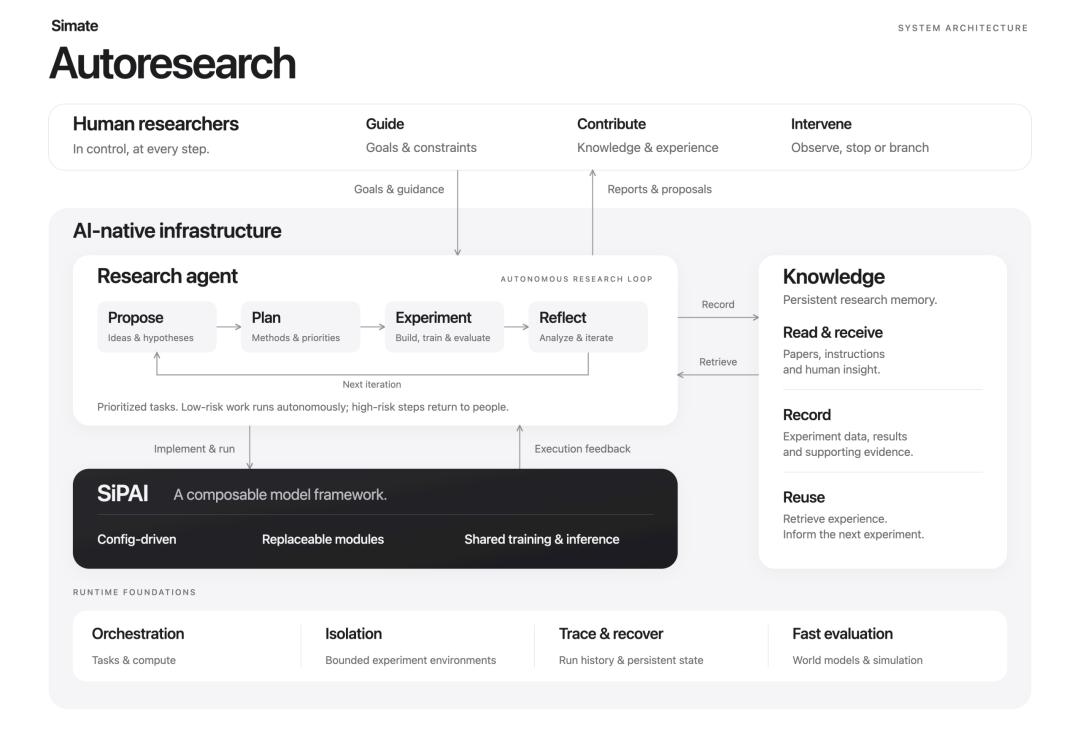
1. Translate research ideas into model changes with SiPAI
To allow Agents to truly participate in research, the model must be like "Lego blocks", which can be understood, disassembled and assembled.
Simate has built a pluggable model framework called SiPAI. It supports different architectures such as World Model (WM), World Action Model (WAM), and VLA (Vision-Language-Action Model).
When facing a specific problem, Agents can directly replace components and adjust configurations to conduct experiments, instead of rebuilding the entire engineering system every time. This gives research ideas a clear "landing point".
2. Rock-solid AI-native Infra foundation
Supporting the simultaneous execution of a large number of automatic experiments is an extremely powerful infrastructure.
It supports multi-Agent orchestration and multi-GPU scheduling, unifies the scheduling of training and inference computing power, and supports high-concurrency execution of dozens of research directions.
Even if an Agent writes a code with bugs that causes a crash, the environment isolation mechanism ensures that it will not affect the whole system, and the interrupted work can be restored instantly.
In addition, the world model and simulation environment provide Agents with second-level fast feedback, helping the system quickly judge which modifications are worth retaining.
3. Full visibility of the research process: make evolution traceable
When hundreds of experiments are running on the cloud at the same time, how can humans control the overall situation? AutoResearch provides an amazing visualization interface.
Through the "research lineage diagram", researchers can see the context of every attempt: how the solution is continued, adjusted, or stopped. Through the "operation timeline", they can accurately track the status of training and evaluation, which forms a dynamically expanding "tech tree" map.

What's even more impressive is that the research object of AutoResearch is not only the model itself, but also the research process itself.
At the data level: it will carry out data proportion experiments on its own, compare which action data combinations can improve the weak parts of the model, so as to answer "what data should be used for training next".
At the model level: when facing long-horizon tasks, it will conduct independent experiments to find the perfect balance between "memory capacity" and "operation overhead".
At the deployment level: it will even study and predict the execution length of actions, and explore the optimal strategy between model prediction and real-world deployment.
Every round of experiments improves the model, and at the same time paves the way for the next round of research.
The world's most powerful general physical fast system
With the support of this powerful autonomous research system, Simate is incubating a "monster-level" model: a general physical fast system oriented to zero-shot generalization.
If you have watched their latest real-machine demonstration, you will definitely be shocked.
In complex long-horizon tasks, the robotic arm demonstrates incredible memory, high-precision operation capability and generalization ability. It can be said that it is "understanding" the physical world.
Behind this are two core souls of Simate's model design.
First, 4D physical perception.
For robots to perform tasks, they must understand physics.
Simate deeply embeds spatial (3D) and temporal (1D) variables including depth, geometry, motion, occlusion and contact relationships into the model. Through efficient visual encoding and spatio-temporal modeling, they have greatly reduced the operation overhead.
This means that they are pushing the upper limit of the scale of models that can be deployed on the end side to the extreme. The model must not only be "large", but also "fast".
Second, hierarchical temporal memory mechanism.
Many robots will forget what they did earlier when performing tasks, or the system will lag due to processing too much historical information. Simate has developed a sophisticated filtering mechanism centered on "task progress memory", "continuous state tracking" and "instant change feedback".
The model can not only remember what happened just now, but also respond quickly to unexpected situations at the moment.
Based on only one contextual prompt, the model can reuse its capabilities in new tasks and for new objects; if it fails, it will adjust itself using historical information; it can complete dozens of steps of fine operations in one go.
This is the leap from "learning from demonstration" to "long-horizon execution". In the future roadmap, this world's most powerful "physical fast system" will also be interconnected and cooperate with the "slow system" that dominates reasoning, to fully advance the realization of zero-shot and few-shot general operations.
How large is this model exactly? How many parameters does it have? Simate reveals that the details will be announced in the upcoming in-depth report soon.
Thousands of computing units are waiting for you
Looking back at the past few months, the rise of Simate is dazzling.
A group of top experts gathered together, invested hundreds of millions of real funds, and did not focus on making fancy robotic arm water-pouring demonstration videos, but directly targeted the deepest pain points of the industry, and developed a set of RSI systems.
This reminds people of the Chinese meaning of the name Simate — Silicon Partner.
Their vision states: Silicon evolving with humanity.
Simate's roadmap has a clear three-step strategy.
Phase 1: Weak RSI (verified). Humans set goals, and Agents execute automatically. The first place in RoboDojo is the best engineering proof.
Phase 2: Strong RSI (in exploration). Further reduce human intervention. Agents will independently propose research hypotheses and plan experimental paths, and humans only need to be responsible for target management and supervision of key decisions.
Phase 3: Fully Autonomous RSI (long-term goal). Recursive self-improvement without human participation, the complete closed loop of research, data, model and real deployment is fully operated by the system autonomously, so that physical intelligence achieves real self-evolution.
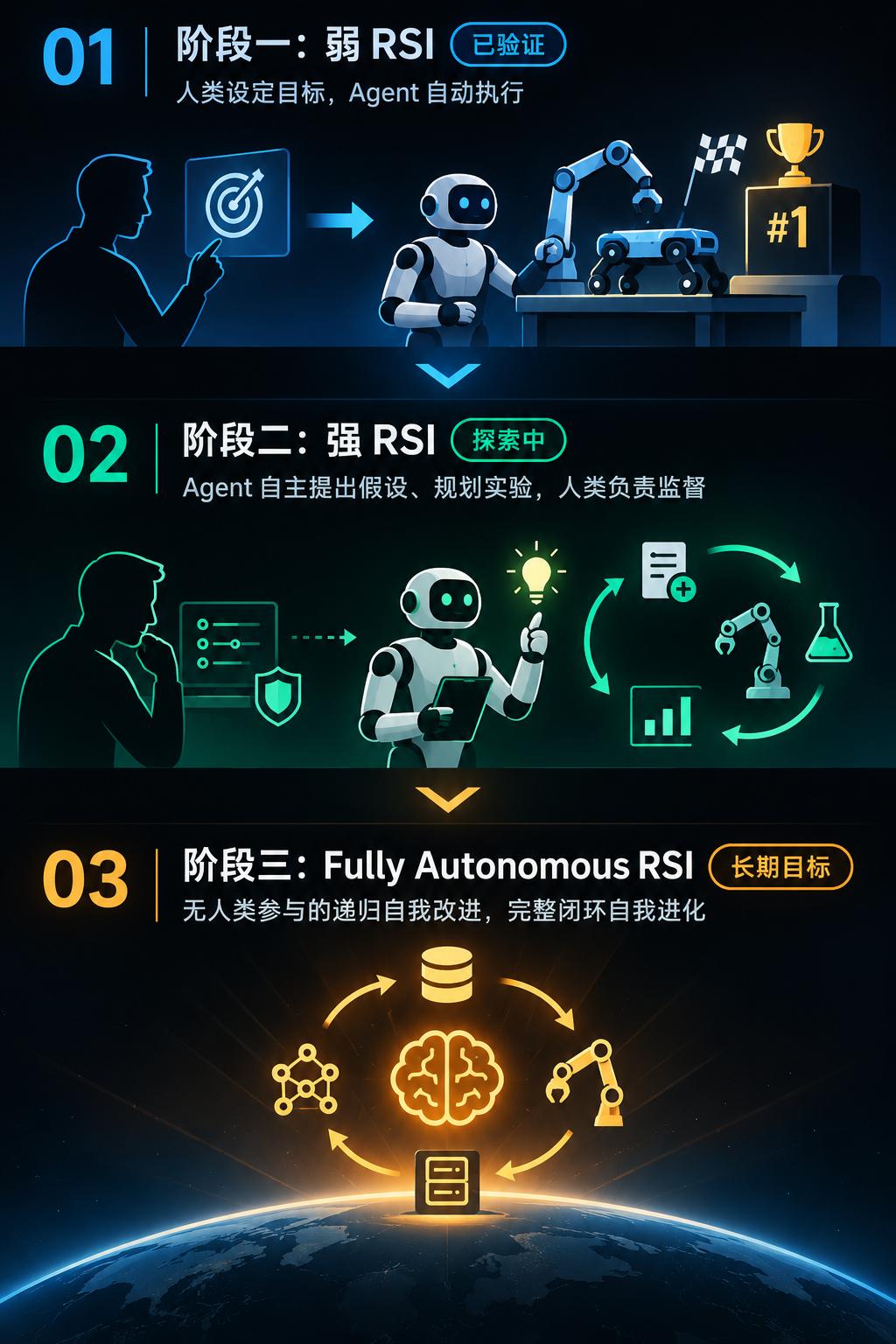
For them, the verification of weak RSI is just the beginning.
"Every data collection, every round of automatic experiments, and every real robot deployment is accumulating reusable experience for this roadmap. We will keep exploring until we realize RSI without human participation."
Good news! The AutoResearch scientific research platform that won the top ranking has officially launched its internal beta recruitment!
At present, teachers and students from more than a dozen top universities at home and abroad including Tsinghua University, Peking University, MIT, Caltech, Harvard, and Columbia University have been the first to use it.
If you are also fed up with endless parameter tuning, and if you also want to experience the great feeling of "letting AI help you do research"...
The internal beta of Simate AutoResearch scientific research platform is now open for recruitment.
Internal beta URL: https://mate-robot.cn/research/sinfra/
This article is from WeChat Official Account "AI Era", Author: ASI Revelation, Editor: Aeneas David, authorized for release by 36Kr.