The proportion of second-hand housing transactions has reached 52%
The real estate market has entered the stock era.
Data from the National Bureau of Statistics shows that the proportion of second-hand housing transactions has increased from 27% in 2020 to 46% in 2025. By the first 8 months of 2026, the proportion of second-hand housing transactions has reached 52%. This ratio is 1.6 percentage points higher than the 50.4% recorded in the first half of the year.
A proportion exceeding half means that the main transaction axis of the housing market has officially shifted from new homes to second-hand homes.
Focusing on core cities, according to the monitoring data of PTI Pruis Digital Intelligence, 15 typical cities have long been deeply immersed in the stock transaction era.
01
With the continuous adjustment of China's real estate market, profound changes are taking place in the transaction structure and total scale of real estate.
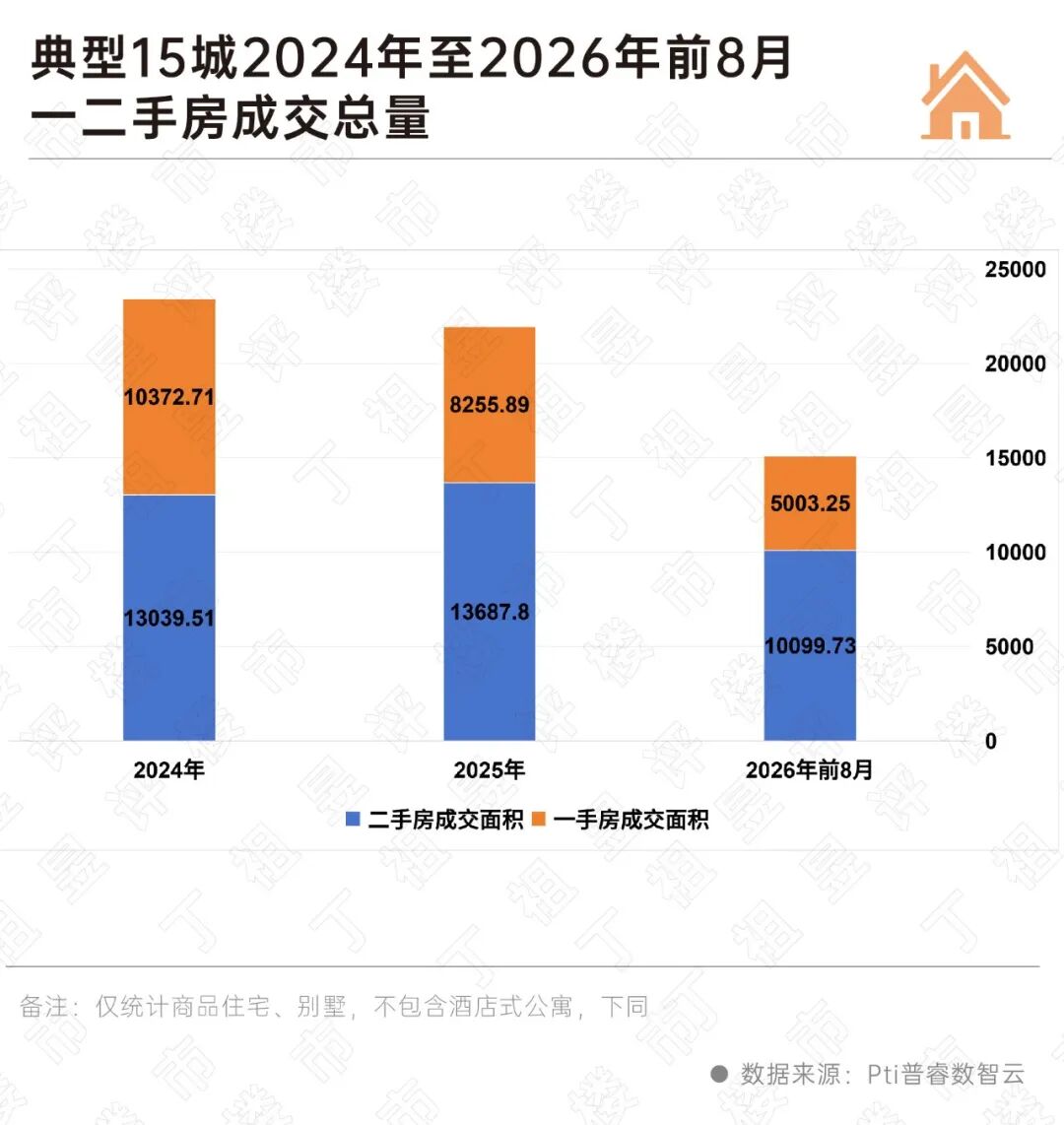
The traditional incremental transaction pattern dominated by new home sales is accelerating its transformation to a pattern where new homes and second-hand homes develop simultaneously. PTI Pruis Digital Intelligence cloud data shows that the transaction volume of second-hand homes in 15 typical cities in the first 8 months of 2026 reached 100.9973 million square meters, a year-on-year increase of 8%. Correspondingly, the transaction volume of new homes was 50.0325 million square meters, a year-on-year decrease of 11%.
Behind this one increase and one decrease, the total transaction volume of new and second-hand homes remains stable. In the first 8 months, the total transaction volume of new and second-hand homes in the 15 cities reached 150 million square meters, a 1% increase compared with the same period in 2025.
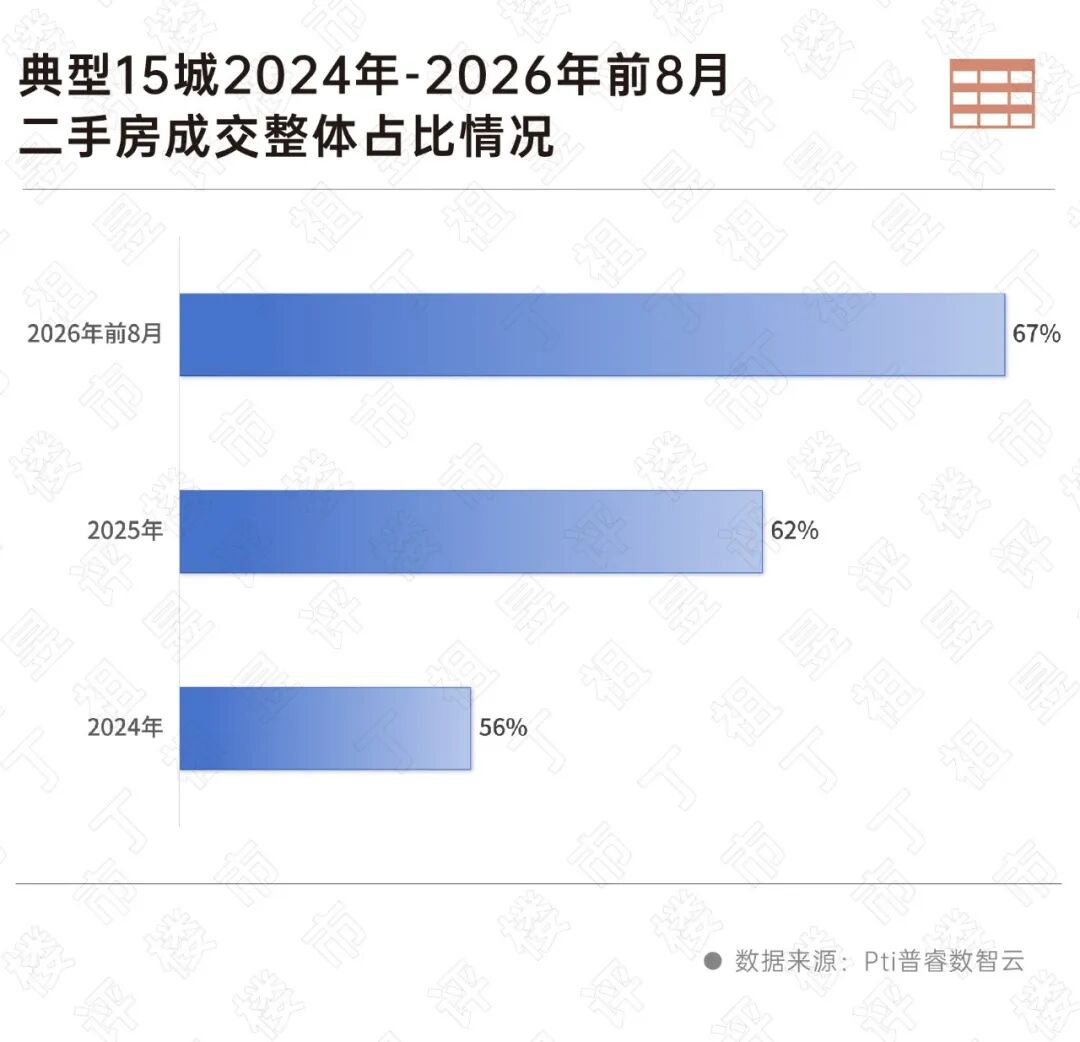
In terms of market share, the transaction proportion of second-hand residential properties in the 15 typical cities in the first 8 months of this year reached 67%, 5 percentage points higher than the full year of 2025, and 11 percentage points higher than that in 2024.
02
Cities with early and rapid real estate development have taken the lead in entering the era of stock transactions.
Shanghai has the deepest stock transaction penetration, from 2024 to the first 8 months of 2026, the proportion of second-hand housing transactions has risen from 72% to 81%, making it the only city among the 15 cities with a proportion exceeding 80%.
From the perspective of second-hand housing transaction performance, the Shanghai market shows outstanding resilience. Since November 2025, excluding the Spring Festival month, the monthly transaction volume of second-hand homes in Shanghai has exceeded 20,000 units for 9 consecutive months.
In addition, the transaction volume of second-hand homes in cities including Guangzhou, Shenzhen, Nanjing, Wuhan in the first 8 months all hit new highs in the same period of the past three years. For example, in Wuhan, the transaction area of second-hand homes reached 7.8 million square meters, a year-on-year increase of 78%.
The growth of second-hand housing transaction scale is mainly driven by a series of supporting policies implemented nationwide, such as the transfer of mortgaged properties, individual income tax rebates for home replacements, the reduction of value-added tax on second-hand homes, and provident fund support for housing swaps. These policies have greatly reduced the cost of second-hand housing transactions, unblocked the replacement cycle, continuously activated the circulation vitality of stock housing resources, and directly boosted the volume of second-hand housing transactions.
Correspondingly, Wuhan also saw the largest increase in the proportion of second-hand housing transactions among the 15 cities. The proportion of second-hand homes in Wuhan in the first 8 months of 2026 was 66%, 11 percentage points higher than the full year of 2025, and even 28 percentage points higher than that in 2024.
There are of course exceptions. Shenzhen is the only city where the proportion of second-hand housing transactions has declined, dropping from 68% in 2025 to 65% in the first 8 months of this year. Chongqing is the only city among the 15 cities where the second-hand housing proportion does not exceed 50%, which was 48% in the first 8 months, and the market is still dominated by new homes; even so, the second-hand housing proportion in Chongqing has increased by 10 percentage points in the past two years.
03
In the stock era, the relationship between market supply and demand is being reshaped.
Since the industry adjustment period in 2021, the supply of new homes has continued to shrink, and the shrinkage range is greater than the transaction range.
Monitoring data from Pruis Digital Intelligence shows that since 2024, the supply-demand ratio of new commercial residential properties (new supply area / transaction area) in the 15 key cities has continued to decline and is generally less than 1. The supply-demand ratio in the first 8 months of this year is only 0.76, and 13 of the 15 cities have a ratio lower than 1.
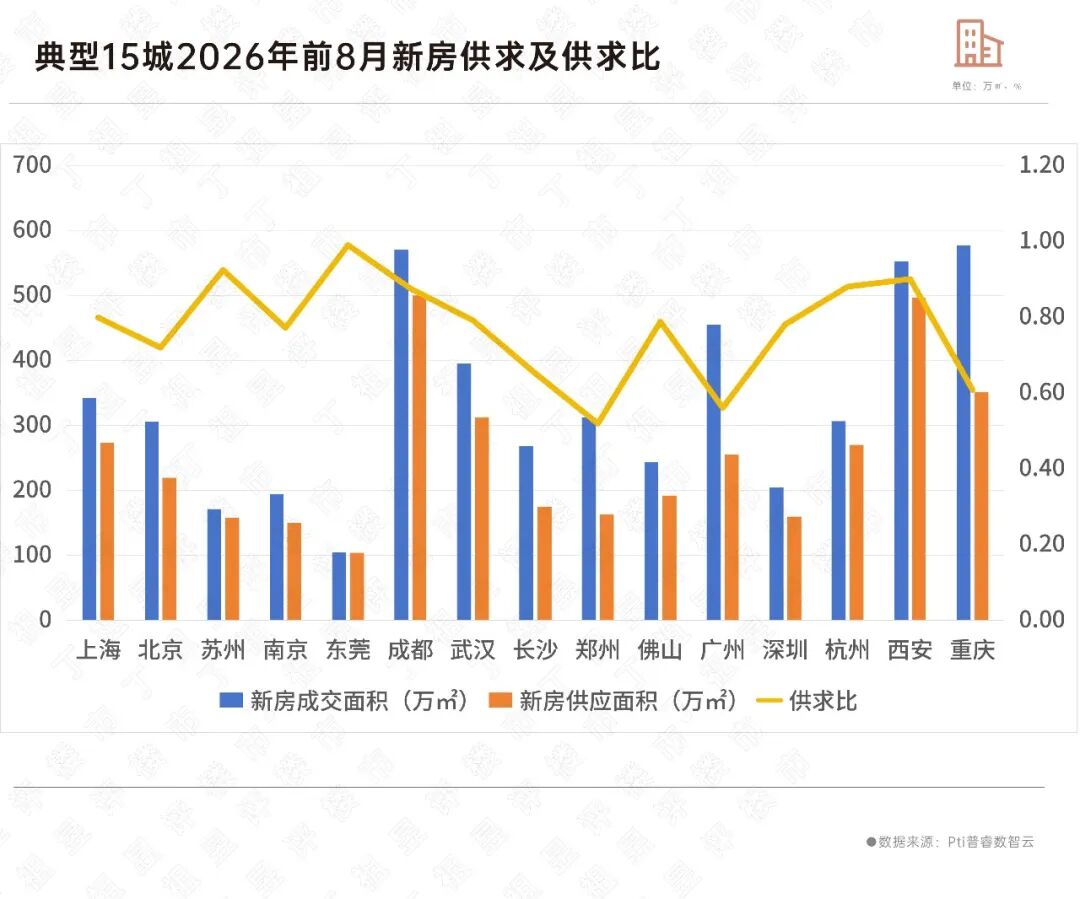
The new home market is mostly passively shrunk due to supply constraints. On the one hand, there is a diversion effect of supply substitution between new homes and second-hand homes, and more importantly, the new home market undertakes the demand for improved housing, and the two will form a positive cycle driven by housing replacement.
The activated circulation of second-hand homes releases the demand for improved new homes, forming a positive transmission chain of "second-hand home transaction growth - owner housing replacement - improved new home transaction". At present, the mainstream demand in the new home market is for improved housing. Home buyers must sell their original residences to obtain down payment and replacement funds. The higher the circulation efficiency of second-hand homes, the smoother the replacement chain, and the better the sales performance of improved new homes in core urban areas.
In addition, active second-hand housing transactions will, to a certain extent, promote the continuous iteration and upgrading of new homes to build "high-quality houses". Compared with new homes, second-hand homes usually have advantages such as mature locations, immediate occupancy after purchase, and sufficient negotiation space to divert demand, which slows down the de-stocking of new homes for rigid demand in outer suburbs. On the other hand, it will also stimulate real estate enterprises to continuously upgrade and iterate product innovation, and increase the supply of "high-quality houses" to attract the return of rigid demand.
The overall increase of the second-hand housing transaction proportion to over 50% and the continuous rise of the second-hand housing transaction proportion in typical cities are the inevitable results in the middle and late stage of urbanization and after the continuous expansion of the stock housing scale.
After two decades of large-scale commercial housing development in the real estate market, the era of housing shortage in Chinese cities has come to an end. The scale of new rigid demand continues to shrink, and improved housing replacement has become the main body of housing purchase demand. The market is undergoing structural reform, and has entered a new development cycle centered on stock housing circulation. From the perspective of supply and demand, second-hand homes and new homes have formed a two-way linkage pattern of positive replacement cycle and rigid demand substitution diversion, and the total housing transaction volume remains stable. "New homes as supplement, second-hand homes as the mainstay" will become the long-term normal state of the real estate market.
This article is from the WeChat official account "Ding Zuyu's Real Estate Review", written by the editorial department, and authorized for release by 36Kr.