Biweekly iterations, starting from $1,000, this company aims to make post-training "accessible to all".
In recent months, post-training has become the most focused topic in the AI industry.
Foundation model companies are scaling up reinforcement learning (RL); application companies are also exploring how to build their own post-training pipelines based on task trajectories and user feedback from real-world business operations.
They all point to the same shift: The experience generated by models in real environments is becoming the raw material for next-generation intelligence.
This has also led to a counterintuitive phenomenon.
A large batch of the world's most active open-source models come from China, but the third-party post-training platforms built around these models are developing faster overseas.
Tinker from Thinking Machines Lab, Fireworks, Together AI, Prime Intellect and Applied Compute have all entered this market from different positions, while there are very few independent platforms with similar positioning in China.
Now, Mind Lab is stepping in to carry out this business.
In July this year, it released Macaron V1 based on GLM-5.2; on September 23, it launched Macaron V1.1 based on GLM-5.3, and simultaneously rolled out Mint Recursive, the post-training platform behind V1.1.
According to official information from Mind Lab, as an enterprise-oriented post-training and inference platform, Mint Recursive supports open-source model series including GLM, Qwen, DeepSeek, Kimi and MiniMax, and currently offers three cooperation modes: joint training with FDE experts, automated platform training, and independent enterprise training.
For the Neo Lab inside a commercial company, this step is very pragmatic: After gaining some technical achievements through trials, it is moving from papers and the lab to market implementation.
Macaron V1 proved that Mind Lab can post-train "its own model", while Mint Recursive starts to answer whether it can deliver this capability to more enterprises.
1
Learning has only just begun after a model is released
Let's first look at the newly released model this time.
Following the ideas of V1, Macaron V1.1 is a 752B-parameter model, composed of the 744B base weights of GLM-5.3 and four sets of LoRAs of about 2B each, which are responsible for Chat, Agent, Coding and generative UI respectively.
The test results released by Mind Lab show that V1.1 outperforms the original GLM-5.3 in all 7 evaluation metrics; and surpasses or matches Opus 5 on third-party benchmarks including DeepSWE v1.1, SWE-Marathon and AutomationBench.
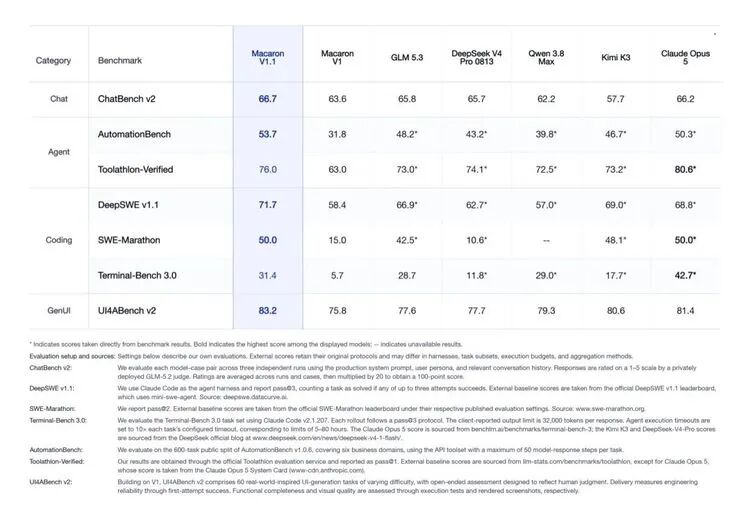
These benchmark scores intuitively prove that the newly added ~8B parameters have effectively improved the model's performance. The specific improvements also reflect what problems Mind Lab believes the model needs to solve.
In long-horizon coding tasks, V1.1 requires fewer steps and tokens to complete tasks. The core approach is to standardize SWE trajectories into five stages at the data level: reproduction, positioning, editing, verification and recovery, so as to reduce exploration rounds with low relevance.
In complex office scenarios, V1.1 focuses on enhancing tool calling security, requiring the model not only to know how to call tools, but also to know when to refrain from taking actions, so as to avoid exceeding the user's intention and authorization scope.
These modifications precisely correspond to several most common problems encountered by enterprises when using models. With the support of Mint Recursive, Mind Lab completed this round of model update in only two weeks.
The logic of Mint Recursive is not complicated: it splits a model update into several links including evaluation, data preparation, training, re-evaluation and deployment, so that post-training can be carried out repeatedly along the same workflow.
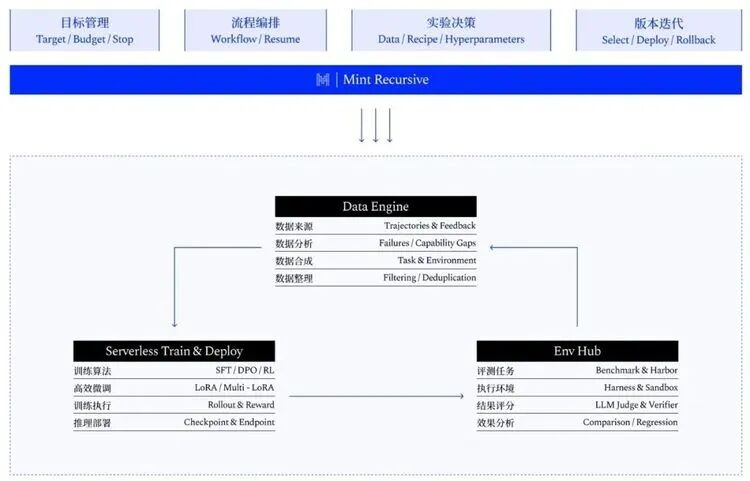
According to the official introduction, when using Mint Recursive, the first step for enterprises is to build their own benchmark, that is, a set of tasks and criteria used to judge whether the model completes the work correctly.
The platform will first run the base model through a round of benchmark evaluation, save the task execution trajectories, help the team see at which step the model makes mistakes, and then decide which problems are worth solving through post-training.
For example, if an enterprise wants to train its own office agent, in addition to whether the task is completed, it may also care about how many steps and tokens it consumes. If only the final result is checked, the inefficient paths of the model are very likely to be ignored.
Next, enterprises can organize existing data, or construct new training samples based on failed task trajectories, select training methods such as SFT, DPO or reinforcement learning, and decide to adopt LoRA or full-parameter update according to budget and task requirements.
The newly trained version can be deployed directly, or go back to the initial benchmark for testing. If the performance meets the requirements, it can be launched, and the issues collected after launch can also become the materials for the next round of training.
The key to this workflow is that it is an integrated and sustainable process with "one unified ruler for measurement".
The problem with many model training projects lies in the inconsistent evaluation standards used before and after training: the data team pursues one type of effect, the training team optimizes another set of metrics, and the business department uses a third set of criteria for acceptance after launch.
With Mint Recursive, enterprises can realize full life cycle management of models, from clarifying the purpose of training, to tracking what is produced, to confirming which version is running in the production environment, and continuously iterating along the same set of records.
A single independently trained vertical model will quickly depreciate as the foundation model upgrades; a system that can continuously produce "the next version" has the potential to become a long-term asset.
2
Empowering enterprises to control the evolution direction of their models
This also caters to the current demands of enterprises.
In the past, when enterprises used large language models, one of the core considerations was which vendor's API to choose.
However, as foundation models continue to be open-sourced and the model capability rankings keep changing, selecting a specific model alone is increasingly difficult to form a long-term moat. The best-performing model today is GLM, but a few months later it may become Kimi, Qwen, DeepSeek or MiniMax.
All enterprises can switch models, but no matter how they switch, the most critical thing is still each company's understanding of its own business.
This gap is even more prominent in agent scenarios. General models can call tools, but they may not understand a company's business rules, cost requirements and authorization boundaries. Enterprises increasingly need to convert task trajectories, expert judgments and user feedback into learnable experience for models, so as to control the improvement direction and launch standards of their models.
From this perspective, Mint Recursive is serving this demand at four levels: low entry barrier, high cost-effectiveness, sustainable iteration and high freedom — enabling enterprises to get started easily, afford the service, continue training for a long time, and allowing professional teams to further explore in their own way.
The low entry barrier first comes from the benchmark.
In the past, many enterprises have accumulated internal question banks and evaluation criteria when selecting APIs; when entering the post-training stage, these resources can exactly serve as the starting point to judge where the model needs to be modified and whether the modifications take effect after training.
This also explains why the early customers of Mint Recursive are concentrated in the finance, AI for Science and healthcare industries: they have a high degree of AI adoption, and have accumulated clear business rules, evaluation methods and task data, without needing to define from scratch what "the model completes the task correctly" means.
The second level is high cost-effectiveness, to make the service affordable for enterprises.
Full-parameter training is still too resource-intensive for most enterprises. LoRA only updates a small number of newly added parameters, which can verify the effect with a small initial investment. According to the quotation on Mind Lab's official website, the special model training service starts at a minimum of 1000 US dollars.
In July this year, NVIDIA summarized the core metric of post-training as "intelligence per dollar". What enterprises care about most is whether the limited budget can bring real business improvement. On Mint Recursive, different LoRAs can share the same resident base model, and training and deployment are billed based on actual usage, eliminating the need to replicate a complete model for each business version.
The third level is iterability. Foundation models are iterating, the ways models are adopted by enterprises are iterating, and even enterprises' own businesses and users are iterating. In Mint Recursive, each LoRA can be independently trained, evaluated, launched and recalled; new problems emerging in the production environment can also be incorporated into the next round of training. Old LoRAs may become obsolete as the base model upgrades, but the enterprise's own benchmarks, data and evaluation criteria can still continue to play a role.
Last but not least, freedom. Throughout the entire cycle, enterprises can adjust the plan on their own, or set goals, budgets and constraints to let the system assist in selecting data, algorithms and parameters.
LoRA is just one of the solutions provided by Mint Recursive. The platform also supports full-parameter training, and allows users to choose methods such as SFT, DPO and reinforcement learning. Enterprises can directly configure the base model, data, algorithms and commonly used loss functions, or customize loss functions, reinforcement learning environments and training loops through the Python SDK, to migrate existing verl, TRL, OpenRLHF or PyTorch training code to the platform.
Combining all these advantages, enterprises can start with a low-cost controllable experiment, and then gradually expand the training scale according to the actual effect.
Mint Recursive has a very clear positioning: enterprises do not need to become a model lab first to start training their own models.
3
From application to lab, then back to the market
On the surface, Mint Recursive only organizes post-training into several steps: evaluation, data preparation, training and deployment. What actually supports these operations behind the scenes is the infrastructure capability that Mind Lab has accumulated since 2025 when it conducted post-training on trillion-parameter models such as Kimi K2.
To make this service run smoothly, the team has solved several types of problems: splitting ultra-large models to train on a large number of GPUs to avoid long waiting for computing power; making the model follow a consistent computing path during data generation and training as much as possible to reduce "wrong learning"; and realizing simultaneous execution of training, inference and version switching through asynchronous training and LoRA hot update. Related capabilities have also been integrated into mainstream ecosystems such as Megatron-Bridge, VERL and AReaL, reducing the workload for enterprises to migrate their existing training code.
All these efforts lead to one result: what enterprises see is a simple API call, while the platform undertakes the distributed training, state management and fault recovery work behind the trillion-parameter models.
At this node, looking back at the changes of this company is quite interesting. An application team that originally developed personal agents incubated a lab, trained its own model, and now takes out the model training system to serve enterprises.
When building the personal agent Macaron, the first challenge to face is how to understand a specific person: remember his preferences, get familiar with his habits, and make past interactions useful for the next service. The team noticed the importance of personal memory from this point, and Mind Lab took the question one step further — can these experiences be embedded into the parameters to change the way the model handles tasks?
Around this question, they conducted research, trained LoRA models, and accumulated the infrastructure that supports all these works. With the launch of Mint Recursive, these capabilities that originally served their own exploration are being organized into products that can be used by other enterprises.
From application to lab, then from lab back to the application market, problems encountered in products become research directions, and tools developed during the research process become new business opportunities.
However, serving one's own products and serving external customers have different requirements after all. When developing Macaron and running Mind Lab, the team knows exactly what problems they want to solve, and can continuously adjust products and training plans. For enterprise customers, tasks, data and budgets are constantly changing, and customers may not even have figured out exactly what they want the model to achieve.
Previously, it accumulated a set of research and engineering capabilities from its own application problems; next, whether it can use this set of capabilities to stably solve other people's problems will determine whether Mint Recursive can become a long-term viable business.
This article is from the WeChat official account "Siliconist Pro", written by HUANG Xiaoyi, and published with authorization from 36Kr.