The more transparent the pricing is, the more valuable good doctors become — New changes in the survival logic of small and medium-sized medical aesthetic institutions
In 2026, the medical aesthetic industry is undergoing a structural adjustment.
The *2026 Annual Insight Report on China's Medical Aesthetics Industry* (hereinafter referred to as the "Report") released by Deloitte China and Allergan Aesthetics shows that the scale of China's medical aesthetic market in the first half of 2026 is about 1.285 trillion yuan, representing a year-on-year increase of 6.8%. After experiencing rapid expansion, the industry growth rate is returning to a more rational range.
At the same time, the light medical aesthetic sector is still expanding. The report shows that the proportion of light medical aesthetics has exceeded 75%, and the market size is expected to reach 700 billion yuan by 2030. The inclusion of medical aesthetic consumption in the CPI index also reflects that such consumption is shifting from a "niche luxury service" to a more daily life choice, becoming a core component of national consumption.
However, although demand has not disappeared, consumers' decision-making patterns have changed.
More and more people will search, compare prices and check real reviews before placing an order. They not only pay attention to products and prices, but also attach greater importance to the professionalism of doctors, service guarantees and operation safety.
The maintenance demand for light medical aesthetics continues to be released, consumption frequency is increasing, and price transparency and rational decision-making have gradually become the norm.
This means that the competition focus of the medical aesthetic industry is shifting from traffic expansion to professional capability and operational efficiency. In the past, the simple strategy of relying on channel diversion to achieve rapid growth is increasingly difficult to support long-term operation.
For medical aesthetic institutions, especially high-quality small and medium-sized institutions with strong medical and service capabilities, a more realistic issue is emerging: the capabilities of doctors and service teams can usually only be perceived by consumers after they arrive at the store, but the competition for customer acquisition and trust has already begun before consumers step through the door.
How can professional capabilities be seen by consumers and continuously translated into business growth?
01
Customer Acquisition Dilemma:
Why Are Small and Medium-sized Medical Aesthetic Institutions Harder to Be Noticed?
For small and medium-sized medical aesthetic institutions, operational pressure is first concentrated in the customer acquisition link.
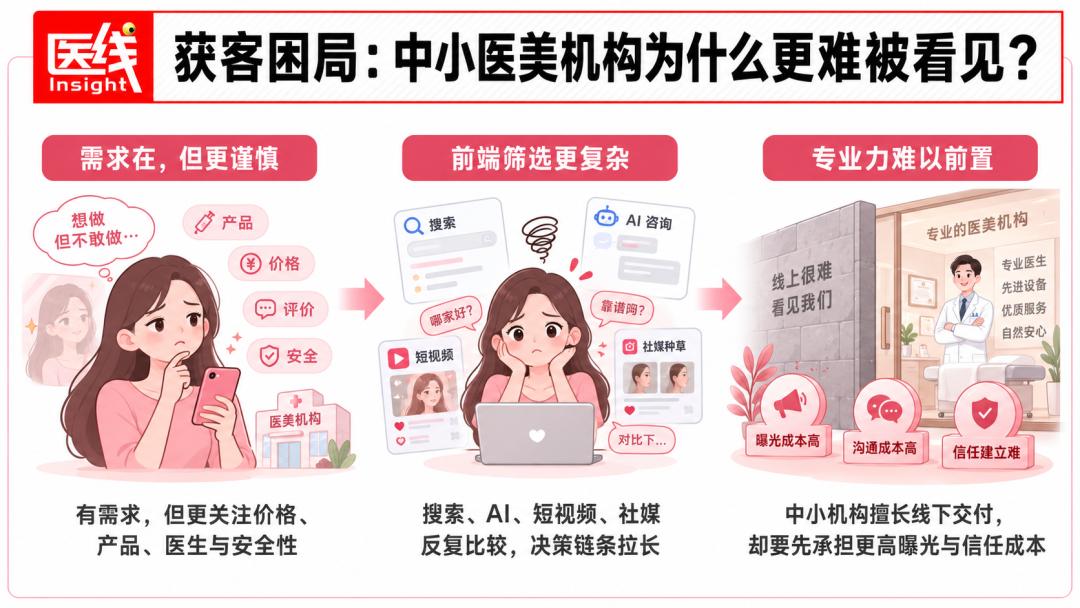
Medical aesthetic consumption has a distinct feature: before consumers actually arrive at the institution, it is difficult for them to fully perceive the surgical skills, face-to-face consultation capabilities, service experience and post-operation delivery quality of an institution.
These capabilities that determine long-term reputation and repurchase rate can usually only be reflected in the actual service process.
Before that, they have often completed a round of complex screening through searches, AI inquiries, short videos, social media and platform reviews.
With more and more information available, decision-making has become more cautious instead.
A person in charge of a medical aesthetic institution in Shenzhen, who is a senior practicing doctor, said: "The overall market environment is not good. People want to receive medical aesthetic services, but many of them do not dare to try easily."
Between "wanting to try" and actual consumption, there are multiple layers of judgment on prices, products, institutional qualifications and safety.
Consumers need to spend more time filtering information, while institutions need to pay higher costs to achieve one effective user reach.
This creates a practical problem for high-quality small and medium-sized institutions: their professional capabilities may be ignored in consumers' pre-screening process before they even have a chance to be experienced.
This problem has further intensified after the industry entered the stock competition stage.
Data from Qichacha shows that as of February 2026, there are more than 180,000 existing medical aesthetic-related enterprises in China. Although this statistical caliber covers various companies including upstream equipment, consumables and downstream service providers, the number of clinics and hospitals directly engaged in medical aesthetic services is still huge.
At the same time, the *2026 Annual Insight Report on China's Medical Aesthetics Industry* shows that in the first half of 2026, the net number of newly added medical aesthetic institutions across the country was about 100, a significant drop from about 500 in the same period last year.
The number of institutions remains at a high level while new expansion has slowed down significantly, indicating that industry competition is shifting from incremental expansion to stock operation.
For small and medium-sized institutions, their operational priorities have also changed accordingly.
First, leading institutions have stronger brand recognition, more sufficient advertising budgets and a more complete content matrix. Second, small and medium-sized institutions naturally lack scale advantages in front-end competition.
To obtain a stable customer base, small and medium-sized institutions need to continuously invest in content production, private domain operation and consultation communication. The customer acquisition pressure of small and medium-sized institutions has gradually extended from the simple traffic cost to the entire front-end operation chain: they need more exposure, longer communication cycles, and have to bear higher costs to build user trust.
However, the part that professional medical aesthetic institutions are really good at is still offline service delivery.
The person in charge of a comprehensive medical aesthetic institution in Beijing told Medical Insight: "High-quality institutions and doctors are still widely recognized by customers, especially for high-value projects. However, customer retention heavily depends on the service impression of the first visit. Clear impressions formed during the whole process of arrival, communication, service and doctor delivery can only bring long-term user retention through continuous high-quality delivery."
As long as professional capabilities can be put into the actual delivery process, high-quality small and medium-sized institutions still have the opportunity to form long-term customer relationships through doctor skills and service experience.
It is not difficult to find that operational pressure is mostly concentrated before professional capabilities are brought into play. Institutions need to invest more and more resources in user discovery, information communication and trust building.
02
Squeezed from Both Ends:
The Operational Accounting of Small and Medium-sized Institutions Is Getting Harder
Apart from customer acquisition, another pressure comes from prices and costs.
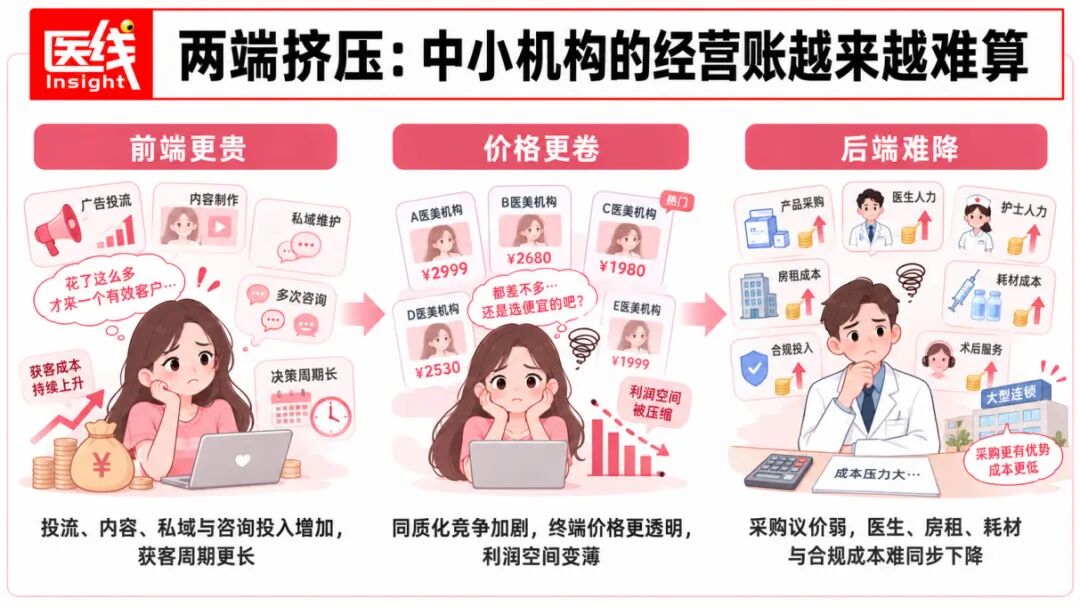
With the continuous expansion of upstream supply and intensifying homogenized competition, terminal prices are becoming more and more transparent. It is more convenient for consumers to compare prices, and the prices of various projects are under continuous pressure.
For individual or regional institutions, the decline of terminal prices may not bring a synchronous drop in procurement costs.
Small and medium-sized institutions have limited procurement scale, and their bargaining power in the upstream is usually weaker than that of large chains, so it is difficult for them to obtain the same level of procurement prices and supply conditions.
In addition, offline medical delivery also needs to bear the costs of doctors, nurses, consultants, rent, consumables, compliance and after-sales services. These expenditures are highly rigid and cannot decline synchronously with terminal prices.
Based on the above factors, the operational pressure faced by small and medium-sized institutions has gradually formed a squeeze from both ends.
On the front end, the consumer decision-making cycle is extended, and institutions need to invest more resources to complete customer acquisition and trust building. On the back end, project prices are continuously transparent, while there is no equivalent room for decline in procurement and medical service costs.
For small and medium-sized institutions, the key test in the next step is to reduce repeated investment in non-medical links such as customer acquisition, demand matching and supply chain, so that limited resources can be more concentrated on links that truly constitute long-term competitiveness, including doctors, services and medical delivery.
03
Breakthrough through Collaboration:
From Working Alone to Professional Division of Labor
When customer acquisition, demand insight and supply chain management are becoming increasingly heavy operational burdens for small and medium-sized institutions, a new question arises: do all these links have to be completed independently by one medical aesthetic institution?
The "Special Beauty Gallery" model recently launched by Meituan Medical Aesthetics provides a collaboration sample worthy of observation.
Medical Insight noticed this model in Shenzhen as early as April this year. After investigation, this model is not complicated. In terms of division of labor, it is closer to a joint operation mode.
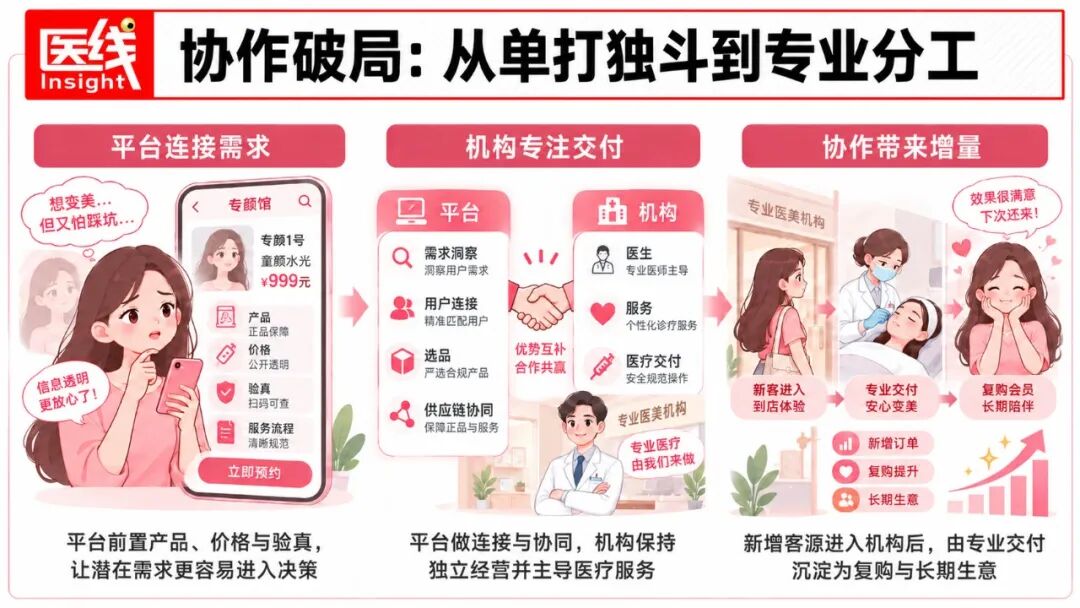
Based on consumer data and trend insights, the platform connects with upstream brands intensively, selects products strictly, purchases goods uniformly for some high-demand standard light medical aesthetic products, places product information, prices, processes and other contents in advance to match real consumer demands. Institutions reuse their existing doctor and service systems to complete professional medical delivery, and remain independent business entities. The platform does not replace institutional operations, and medical services are always led by institutions and doctors.
In a sense, what the "Special Beauty Gallery" is verifying is another possibility: the platform gives full play to its capabilities in demand insight, user connection and supply chain coordination to help small and medium-sized medical aesthetic institutions reduce part of the operational pressure in non-medical links, so that institutions can focus more on the doctor services and delivery that they are really good at.
The most direct value is to bring more clear potential demand to the institutions.
Many consumers do not lack medical aesthetic demand, but they have been stuck in the stage of "wanting to try but not daring to do so" due to opaque prices, difficulty in judging product quality and selecting qualified institutions.
Under the "Special Beauty Gallery" model, through the platform entrance, product information, prices, product verification and service processes are further placed in advance, so that consumers can get clearer consumption expectations before arriving at the store, and part of the potential demand that was originally in the wait-and-see state is more likely to enter the actual decision-making process.
For institutions, this provides a new customer entrance, and also has the opportunity to share part of the costs of front-end customer acquisition, user reach and information communication.
The person in charge of a comprehensive medical aesthetic institution in Beijing also calculated this account: "First, the Special Beauty Gallery can bring a certain amount of orders. The second advantage is that in the past, the same initial contact usually required more front-end investment, and there is no extra customer acquisition cost under this model - this is the biggest benefit from our perspective."
In his view, "Special Beauty Gallery" is a relatively good form that combines the advantages of the platform with institutions. "We choose to cooperate with the 'Special Beauty Gallery' model because we consider it to be a relatively long-term trend of the future market."
But incremental customer sources are only the first step.
For a professional institution, the more practical point is that under the "Special Beauty Gallery" model, there is no need to build a new set of systems for doctors, nurses, reception and after-sales services.
A medical aesthetic institution in Shanghai said: "The appointment scheduling is well controlled. Reusing the original systems of doctors, nurses, reception and after-sales services can bring supplementary income."
Users may enter the institution for the first time because of transparent prices and the platform entrance, but whether they can finally be retained still depends on doctor skills, service experience and continuous high-quality delivery.
It is also in this process that the original professional capabilities of institutions have the opportunity to further transform from "capabilities" into long-term user relationships and sustainable business.
04
Efficiency Reconstruction:
Bring Professional Capabilities Back to the Core of Operation
If demand connection solves the problem of "where customers come from", then for small and medium-sized institutions, another value of collaboration lies in further reducing the operational costs of non-medical links, so that limited resources can return to doctors, services and delivery itself.
For small and medium-sized institutions, their upstream bargaining power for high-demand standard products is usually inferior to that of large chains.
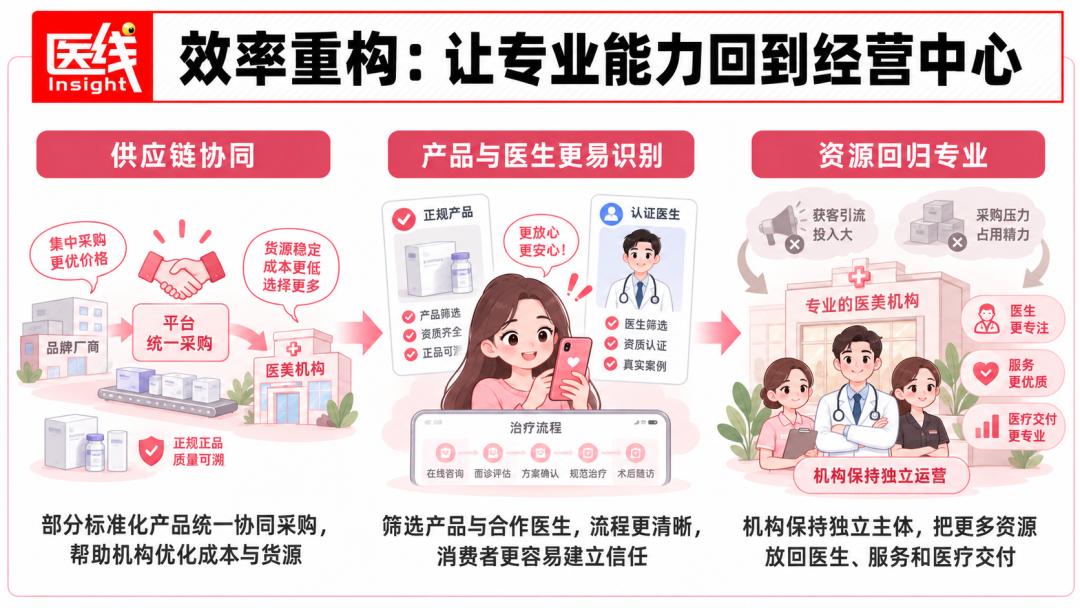
Under the "Special Beauty Gallery" model, the platform uniformly connects with upstream brands and strives for better supply conditions through large-scale procurement, thus helping institutions reduce part of their procurement costs.
In addition, Medical Insight learned that the platform only selects one upstream brand for in-depth cooperation for each category, which is based on the balance among product quality, upstream partnership and institutional profit space.
For example, the "Special Beauty Gallery" has launched a skin booster product, using LePu Medical's Yueyayan and Flora skin boosters, priced at 999 yuan. According to feedback from reviews, consumers are highly satisfied with this project.
There are also threshold requirements for institutions and doctors. The platform will comprehensively evaluate the institutional situation from multiple dimensions including institutional qualifications, doctor professionalism and medical delivery capabilities. Cooperating doctors need to be compliant, have more than 3 years of practicing experience, and pass the dual training and certification of the brand side and Meituan. After cooperation, industry mentors with rich industry experience, academic background and product operation experience will continue to provide training and standardized support for cooperating doctors - screening is the entry, and continuous training support is the guarantee for more stable service delivery.
For consumers, the qualifications of institutions and doctors have been verified before they arrive at the store. For high-quality small and medium-sized institutions, the professionalism of doctors and service capabilities can be partially demonstrated before consumers enter the door.
The person in charge of a medical aesthetic institution in Shenzhen said that the institution did not need to worry about much after cooperating with the "Special Beauty Gallery": "The whole process from customer invitation, arrival docking to the entire reception process is well done. The mini-program clearly shows every process, and customer satisfaction is very high."
The experience of a consumer in Beijing confirms this point: "I have wanted to try skin booster for a long time, but I never dared to do it. I couldn't understand the price, and I didn't know which institution to choose. The 'Special Beauty Gallery' has platform guarantees, and I can see the price and process clearly before placing the order. It was my first time to come to this institution. I was quite surprised after I went there. The doctor is more professional than I thought, and the service is also very good. I should go there again."
It is worth mentioning that medical aesthetic institutions remain independent business entities throughout the cooperation process. The platform is mainly involved in non-medical links such as demand connection, information display and supply chain coordination. It does not open its own institutions, does not compete for benefits with institutions, and medical services are always led by institutions and doctors.
It can be seen that while reducing customer acquisition and procurement costs, professional barriers are always firmly held in the hands of institutions themselves.
At present, the "Special Beauty Gallery" has been piloted in some institutions in Shenzhen, Shanghai and Beijing, and is also expanding to more cities and more categories, with initial results achieved, but its subsequent development remains to be continuously observed.
In the future, as prices become more transparent, the importance of doctor professionalism, service quality and continuous delivery capabilities will further rise.
Especially for high-quality small and medium-sized medical aesthetic institutions, how to truly translate professional capabilities