A quantum AI team secured two rounds of financing within three months.
It is learned from PE Daily AI that Qingxing Heterogeneous Computing, a star quantum artificial intelligence enterprise incubated by Tsinghua University, has completed its Series A+ financing, with investors including Jinkai Capital, Anhui High-Tech Investment, Daode Investment, Lishi Investment, Zhongzi Fund, Xuhui Capital, Senlan Group, the founder of Jingdong Group, etc.
Together with the previous Series A round, the company has completed two rounds of financing within three months, with a total financing amount of nearly 100 million yuan.
In 2021, Yu Teng, an alumnus of the Department of Computer Science of Tsinghua University, led the team to found Qingxing Heterogeneous Computing. The company initially focused on AI systems based on classic heterogeneous computing power, and is now undergoing a transformation — advancing to the frontier of next-generation quantum-inspired AI models, with its products covering a wide range of AI and quantum computing industry chains.
At present, general quantum computers are still in the development stage, and it is unrealistic for enterprises to wait until the hardware is fully mature before developing corresponding products. Qingxing Heterogeneous Computing chooses to enable quantum-inspired high-dimensional intelligence to perform large-scale inference based on existing GPU computing power, focus on model reconstruction from parameters to structures, solve industry pain points, and greatly optimize the use efficiency of TOKEN.
Considering the demand for computing power in the era of general artificial intelligence, this choice has considerable imagination space. After all, in the implementation of AI, the market has long expected models with higher knowledge density and higher energy efficiency ratio.
A Tsinghua-originated team starting from heterogeneous computing
Qingxing Heterogeneous Computing was founded in 2021. In the early stage, the team focused on developing parallel computing system software to solve the problems of AI system construction and performance in heterogeneous processor environments. It soon began to promote the cooperation of prototype products of the program factory with upstream and downstream enterprises, and successively completed three rounds of financing within half a year in 2022.
As we all know, for quantum AI models to be applied in real computing environments, algorithms, chip adaptation and system operation are all indispensable. That is why when the team shifted its R&D focus to quantum AI in 2025, it chose to settle in Shanghai — where the whole machines of quantum computing, algorithms, artificial intelligence computing power and application scenarios are gathered, so that the team can access relevant equipment and demands faster.
Up to this year, Qingxing Heterogeneous Computing has officially released the quantum-inspired vision-language model RiverONE. According to the introduction, it uses simulated quantum computing to generate parameters in the model construction stage, and the model performs inference on classic GPUs after training, without the real-time participation of quantum computers. This allows the team to develop, deploy and iterate products using existing hardware.
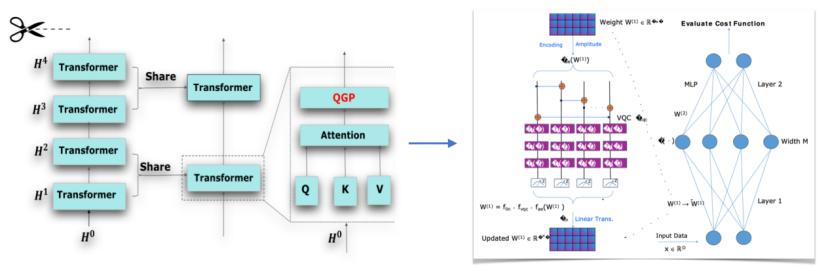
Schematic diagram of Quantum Generated Parameter (QGP)
According to the third-party test report, in the specific test of quantum calibration chart understanding, RiverONE, with only 1.9 billion parameters which is less than one-tenth of that of the comparison model, reaches at least 95% of the performance of NVIDIA Ising Calibration 1, providing a more lightweight model solution for professional scenarios.
At present, the products of Qingxing Heterogeneous Computing have been gradually connected to the computing power industry chain and verified in real scenarios.
As early as 2023, the company reached an official cooperation with AMD, a global computing power giant, and became its AI system supplier. In August this year, Jiefang Daily reported that the cooperation between Qingxing Heterogeneous Computing and upstream quantum computing and AI computing power infrastructure enterprises has also made phased progress.
Biren Technology disclosed that the two sides have carried out adaptation tests on mainstream quantum computing frameworks such as Cirq, PennyLane and Qiskit on its GPU products. Within the scope of this round of tests, there were no abnormal interruptions affecting the conclusion during the 48-hour stability test. For quantum software that requires long-term R&D, being able to run continuously on different frameworks and domestic hardware is the basis for further expanding the application scope.
Similarly, the Xiyun C series GPU of MetaX has cooperated with Qingxing Heterogeneous Computing to complete the adaptation of the Ising quantum calibration multimodal model in the vLLM inference framework, and passed the international calibration benchmark QCalEval test; Taichu Electronics, together with the 100% domestic computing power base of Loongson, has adapted the full set of quantum-inspired models and operators of Qingxing Heterogeneous Computing on Day 0; Qianhe Yibang, a game scenario-oriented chip enterprise incubated by NetEase, has also signed a cooperation agreement with Qingxing Heterogeneous Computing, and will adopt the game acceleration and adaptation support services provided by the latter.
Two rounds of financing in three months
Unlocking the imagination space of the quantum AI track
Can quantum-inspired artificial intelligence support the development of a large-scale enterprise?
The answer is becoming increasingly clear — with the popularization and implementation of AI technology, the global computing power is in continuous shortage, and models with higher knowledge density and higher energy efficiency ratio will gain more market opportunities, which is exactly the space for quantum computing to participate.
Multiverse Computing from Spain provides a reference case. This enterprise started with quantum software, applied tensor network method to AI model compression, and launched CompactifAI, which enables large models to occupy less storage and computing resources. Its technical papers show the model compression experiments and record the performance trade-offs on different tasks.
Subsequently, the business path of Multiverse has become wider and wider: by providing compressed models and APIs, it explores offline operation on devices such as mobile phones, and promotes adaptation with hardware manufacturers and enterprise customers. In 2025, the company announced the completion of 189 million euros of Series B financing; in 2026, it announced a target fundraising plan of up to 500 million euros for Series C round.
At present, Japan's Marubeni Corporation has signed a memorandum with Multiverse to study the promotion of its compression technology in the Japanese market. It can be said that computing methods derived from quantum science can find entry points in the existing AI market, and customers care about whether the models can run on their own devices, reduce costs and maintain the required performance.
If Multiverse mainly compresses existing models to meet the extensive enterprise deployment demands, Qingxing Heterogeneous Computing focuses more on using simulated quantum computing and quantum-inspired algorithms to participate in the comprehensive reconstruction of models from parameters to structures, and promotes this future-oriented technical exploration to the stages of model release, private deployment delivery and cloud service internal test.
In the end, the outside world will still pay attention to the product delivery — can the quantum-inspired large model represented by RiverONE maintain its performance on more real data? Can the adaptation experience be precipitated into replicable software capabilities? Can the representative cases on cloud, edge and end sides generate continuous orders?
Looking further ahead, as the quantum computing industry chain takes shape gradually, Qingxing Heterogeneous Computing will also open up the downstream market for China's quantum computing industry, and explore a new path to serve the explosive incremental market of general artificial intelligence.
As Xuhui Capital said, the quantum AI track has huge industrial imagination space. Qingxing Heterogeneous Computing, founded by the team led by Dr. Yu Teng, has made breakthroughs and realized industrial landing on the technical route of enabling quantum-inspired high-dimensional intelligence to perform large-scale inference based on existing GPU computing power and focusing on model reconstruction from parameters to structures, greatly optimizing the use efficiency of TOKEN and solving the pain points of the industry.
"Xuhui Capital continues to lay out the cutting-edge intersection track of quantum and AI, will continue to give full play to the advantages of the state-owned sci-fi innovation platform, connect the local computing power, scenarios and industrial partner resources in Xuhui, and continue to empower and accompany the invested enterprises. We expect Qingxing Heterogeneous Computing to seize the opportunity, develop downstream application tracks for China's quantum computing industry, and build a Chinese quantum-inspired AI benchmark in the incremental market of general artificial intelligence."
Anhui High-Tech Investment also believes that Qingxing Heterogeneous Computing is deeply engaged in the cutting-edge track of integrated innovation of quantum and artificial intelligence, focuses on independent R&D and engineering implementation of core quantum AI technologies, and has scarce original technical barriers and differentiated development paths. "At present, quantum AI is the core future track to break through the bottleneck of traditional intelligent computing power and cultivate new quality productivity. Adhering to the concept of investing in early-stage and hard technology, Anhui High-Tech Investment is optimistic about the technical accumulation and growth potential of Qingxing Heterogeneous Computing, and will rely on the advantages of the state-owned platform to continuously empower the enterprise's technology iteration and scenario implementation, and help Anhui seize the new high ground of the development of quantum intelligent industry."
The industrialization window has been opened, and the imagination space of China's AI+quantum computing is gradually unfolding.
This article is from the WeChat Official Account "PE Daily AI", author: Yu Mengying, authorized for release by 36Kr.