The total accumulated financing has reached 13.9 billion yuan, with JD and Ant Group making moves on the same day. Why is the AI healthcare sector so highly sought-after?
People who have accompanied their parents to seek medical treatment probably understand that sense of powerlessness: staying up late to grab expert registration slots at midnight, running back and forth between different departments, and the most dreaded line is "We cannot handle this case, go to a hospital in a big city".
China has more than 300 million elderly people. They are the group that needs doctors the most, yet they are exactly the ones who are farthest from high-quality medical resources.
In the past few years, products including Doubao, Qianwen and Kimi have made ordinary people get used to the habit of "asking AI for help when problems arise". But the products that can truly support and safely carry out medical diagnosis and treatment are not these general-purpose products that know a little about everything, but a new batch of specialized large models deeply cultivated in the medical field.
In 2026, this track suddenly pressed the acceleration button: financing amount doubled, industry giants entered the market on the same day, and medical insurance began to pay for related services. All these changes will eventually fall on the same core issue — people's way of accessing medical care is being rewritten.
PART 01
$100 Million Financing, Company With Valuation of Tens of Billions of Yuan
Let's first look at the speed at which this company obtains funds.
In early August this year, Shanghai SenseTime Shancui Medical Technology Co., Ltd. (referred to as "SenseTime MedTech") completed a Series B financing of over $100 million, and only a few months have passed since the completion of its Series A financing.
The investors of this Series B round include Lianchuang Capital, CECC Digital Finance Fund, Lianmei Group, as well as a number of large insurance capital, direct investment arms of securities firms and asset management institutions. The funds will be mainly used to strengthen the R&D and productization capabilities of the medical world model, accelerate global business layout, and expand new directions such as medical embodied intelligence.
What is more critical is the next step: according to reports from market media, SenseTime MedTech will become the first medical world model company with a valuation exceeding 10 billion yuan, officially entering the Pre-IPO stage and preparing for the last round of financing before listing.
What makes it capable of achieving this?
In 2022, SenseTime MedTech was spun off from SenseTime Technology to operate independently, focusing on two core businesses: medical large model and intelligent agent operating system. Its "medical world model" can be understood as a "general command center": the self-developed large model "Da Yi" sits in the core, coordinating a group of specialized sub-models with their own strengths — for medical image reading, pathological analysis and endoscopic operation, each performing their own duties; plus the medical knowledge base, toolkits and diagnosis and treatment rules, forming a complete medical AI platform.
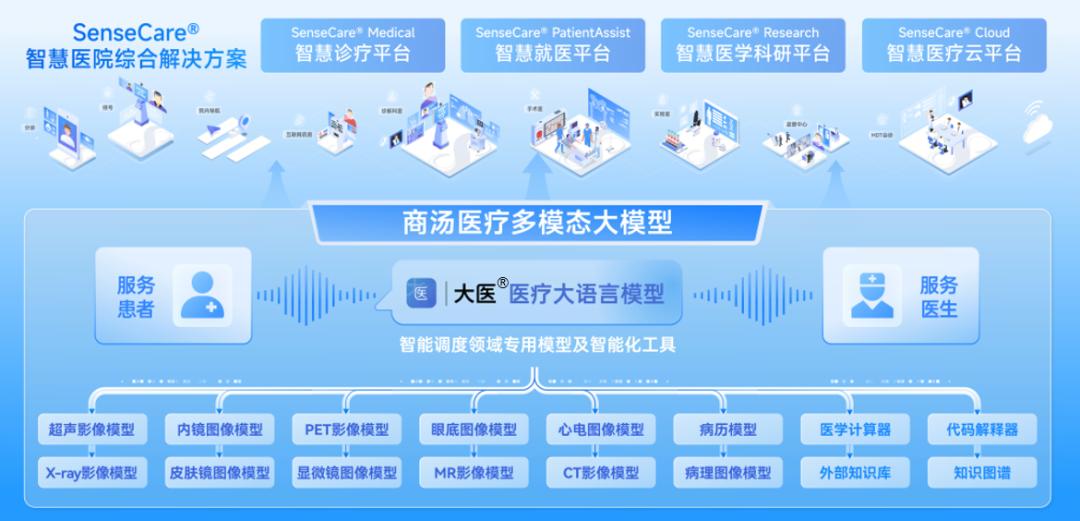
Source: SenseTime MedTech
Technology alone is not enough, and the recognition from hospitals is the real touchstone to test its value.
At present, 5 core scenarios cooperated by SenseTime MedTech with top tertiary hospitals including Xinhua Hospital, Ruijin Hospital and Pulmonary Hospital have been selected as "core achievements of Shanghai smart healthcare artificial intelligence construction", forming a replicable demonstration model.
This set of solutions has covered hundreds of hospitals across the country, including West China Hospital, Tsinghua Chang Gung Hospital and other medical institutions, and has also gone global — settled in Singapore Parkway Hospital under IHH Healthcare, with a total number of service recipients exceeding 10 million.
From the tertiary hospital demonstration, to nationwide replication, and further expansion to Singapore, SenseTime MedTech has realized the commercial closed loop that most medical AI companies cannot complete.
Looking back at its financing pace, it has been moving forward almost at a fast speed: at the beginning of 2025, it completed the first round of financing of over 100 million yuan after the spin-off; in November of the same year, it completed the Pre-A+ round of hundreds of millions of yuan; in April 2026, the Series A financing of over 500 million yuan was closed, with its valuation exceeding 1 billion US dollars; after the completion of the Series B round in July this year, the post-investment valuation stood at 100 billion yuan. Calculated based on the publicly disclosed amount, SenseTime MedTech has accumulated more than 1 billion yuan in financing within a year and a half.
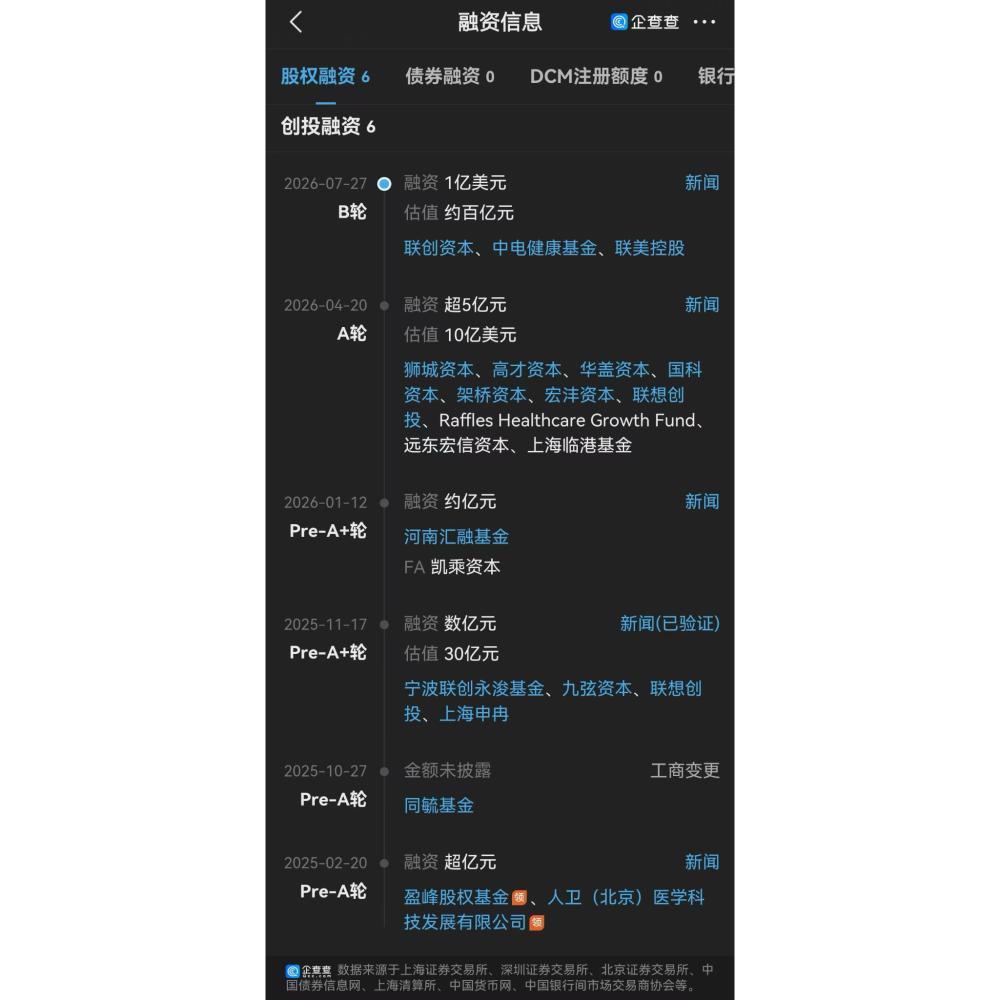
Source: Phoenix WEEKLY
Technology support, landing verification and capital empowerment — the three lines are intertwined, which is the answer to its 100-billion-yuan valuation.
PART 02
Two-way Strong Resonance, the Chinese Speed of AI Doctors
SenseTime MedTech is not an isolated case, and the entire track is heating up rapidly.
According to industry statistics, after the AI medical financing amount stagnated at the line of 3.7 billion yuan for two consecutive years, it directly jumped to 13.9 billion yuan in 2026; in the first half of this year alone, the total domestic medical and health investment and financing amount reached 72.56 billion yuan, a year-on-year increase of 41.7%.
The overseas market is also hot: Rock Health data shows that in the first quarter of 2026, U.S. digital health start-ups raised $4 billion in financing, hitting the strongest start after the pandemic.
The data on the enterprise side is more intuitive: as of January this year, there are more than 108,000 medical AI-related companies; as of June, 134 Class III AI medical image-assisted diagnosis software products have been approved.
Recently, two Internet giants have added fuel to this track.
On August 12, Ant Group announced that the "Good Doctor Doctor Version" was renamed "Ant Afu Doctor Version", and simultaneously launched the AI medical assistant and AI avatar assistant, connecting both doctors and patients, opening the access channel for Internet hospitals, and reaching strategic cooperation with Wolters Kluwer and Deep Potential.
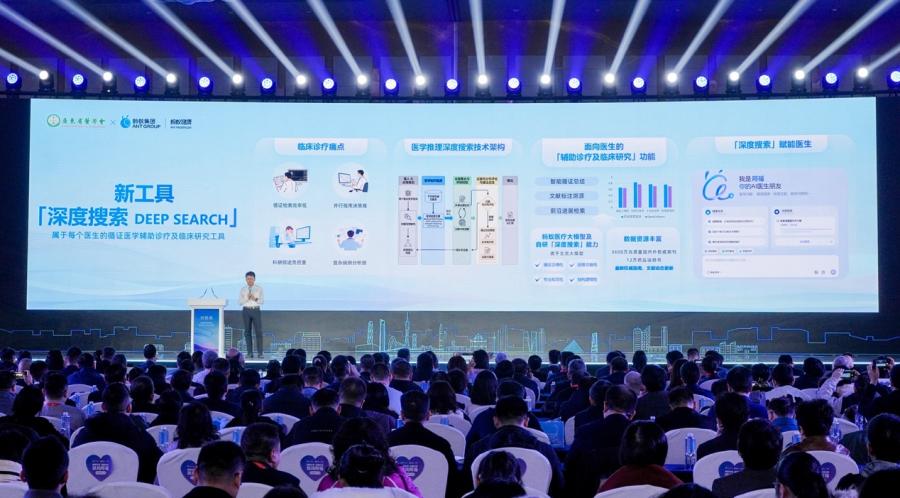
Source: Guangzhou Daily
Ant has very strong resources in hand: Good Doctor platform has more than 300,000 real-name registered doctors, the C-end Ant Afu has more than 30 million monthly active users, with over 10 million daily health consultation sessions. Through this AI workstation, doctors can create their own AI intelligent agents to answer questions 24 hours a day, search for literature and clinical guidelines, retrieve medical records for intelligent analysis, hand over the pre-consultation work to AI, and only deal with the core key links themselves.
On the same day, as if competing on the same stage, JD also announced its new moves in the AI medical field.
On August 12, JD Health announced that it will fully connect its AI doctor assistant "JD Zhiyi", which has been in operation for half a year, to the cloud-based primary medical platform Yunqueyi APP, and simultaneously open its auxiliary diagnosis tools and pharmaceutical supply chain capabilities. The two sides will jointly build a new integrated health service model of "AI-assisted diagnosis + primary care doctors + pharmaceutical supply chain".
Since its launch in January this year, JD Zhiyi has served more than 1 million doctors in total, supporting over 20 million assisted diagnosis and treatment decisions. Yunqueyi covers 31 provincial-level administrative regions and nearly 2795 county-level administrative regions across the country, radiating more than 800 million residents. The newly launched deep thinking mode is specially designed for the most troublesome scenarios for primary care doctors, such as multiple coexisting diseases, multiple medication use and difficult case consultation; more than 200 medical calculators and scientific research assistants are also fully equipped.
One path is to deepen upward, serve the existing doctor groups and open up C-end consultation services; the other is to extend downward, embed AI capabilities into the work scenarios of primary care doctors. Different paths lead to the same consensus: this track requires heavy investment.
It is not only these two companies that are betting on this track. The outpatient diagnosis accuracy rate of iFlytek Spark medical large model reaches 93.1%, and its specialized AI capability has reached the level of chief physicians in tertiary hospitals for the first time, with a plan to cover 90% of primary medical institutions across the country within 3 years; Tencent Health takes the dual large models of DeepSeek and Hunyuan as the base, serving more than 1000 hospitals, and has landed in more than 10000 medical institutions as a whole; United Imaging Intelligence's "Yuanzhi" medical large model continues to lead in industry evaluations, completed a 1 billion yuan Series A financing in 2025, and obtained more than 20 Class III certificates this year...
What is more important than the entry of giants is the emergence of payers for related services.
Since April 1, 2026, 12 AI-assisted diagnosis services have been officially included in the Class B catalog of the National Medical Insurance — hospitals can get reimbursement for purchasing AI diagnosis services, the out-of-pocket ratio for insured people has dropped to 15%-30%, and 837 hospitals across the country have implemented related services. This is the world's first national-level action to include AI diagnosis in medical insurance on a large scale. In May, the AI AutoVision chromosome karyotype assisted diagnosis software from Dasheng Biology obtained the world's first large model Class III medical device registration certificate.
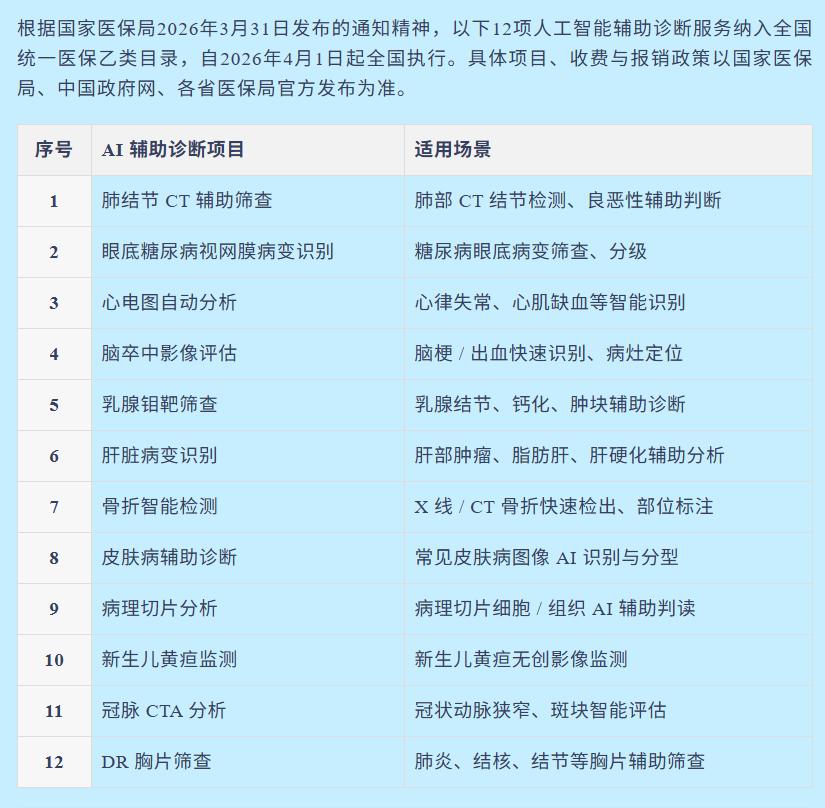
Source: Huiying AI Technology
Once the gate on the payment side is opened, AI medical care has stepped from "technology demonstration" to the stage of "real commercial realization". The judgment of CITIC Securities is that in 2026, the payers of AI medical care will be clearer and the payment capacity will be stronger, which is expected to become the year with the highest commercialization certainty. IDC reminds that the biggest gap in the industry is no longer the model capability, but whether the hospital system can "accept and apply it well" — the competition is shifting from technology competition to landing competition.
Frost & Sullivan predicts that the size of China's AI medical market will increase from 8.8 billion yuan in 2023 to 315.7 billion yuan in 2033, with a compound annual growth rate of 43.1% — nearly 36 times growth in ten years.
PART 03
Looking at the Whole Country from Wuhan, the Scenarios Have Already Been Implemented
All the grand data will eventually fall into the trivial matters around the elderly.
In July this year, Wuhan released the innovation application achievements of "Artificial Intelligence + Medical Care": 116 typical application scenarios — 32 more than the 84 reference guidelines announced by the National Health Commission, plus 31 large models and intelligent agents, 29 intelligent terminal products, and 33 high-quality datasets. This list jointly released by the Municipal Bureau of Economy and Information Technology and the Municipal Health Commission is one of the best samples to observe the city-level AI medical implementation .
Looking through this list, you will find that geriatric diseases are the absolute protagonist.
Stroke rehabilitation is the key priority. Wuhan Central Hospital has built an AI intelligent rehabilitation ward for post-stroke hemiplegia based on brain-computer interface, where AI dynamically analyzes and customizes rehabilitation plans, and cooperates with exoskeleton robots to carry out precise training; Tongji Hospital uses AI to reconstruct the neural circuits after stroke, making rehabilitation have quantifiable targets; Hankou Hospital applies AI algorithms to the minimally invasive surgery system for cerebral hemorrhage.
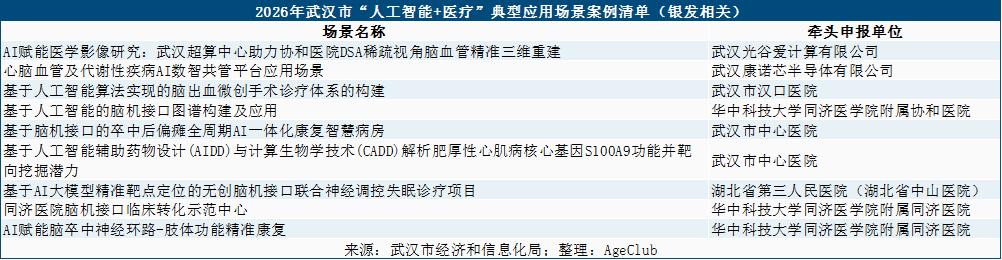
Chronic disease management is the main battlefield for the elderly. Liyuan Hospital has built a full-chain platform of "screening - grading - follow-up" for diabetic foot, directly targeting the biggest threat of diabetic foot amputation for patients; Hubei Provincial Hospital of Integrated Chinese and Western Medicine uses the "Sanyi Care" AI model to manage diabetes; Union Hospital has launched a chronic disease health management intelligent agent; the Geriatric Hospital Affiliated to Wuhan University of Science and Technology — the only geriatric hospital among the 116 scenarios, uses the intelligent hand diagnosis system integrating AI vision and tactile sense to bring traditional Chinese medicine palpation services to the grassroots level.
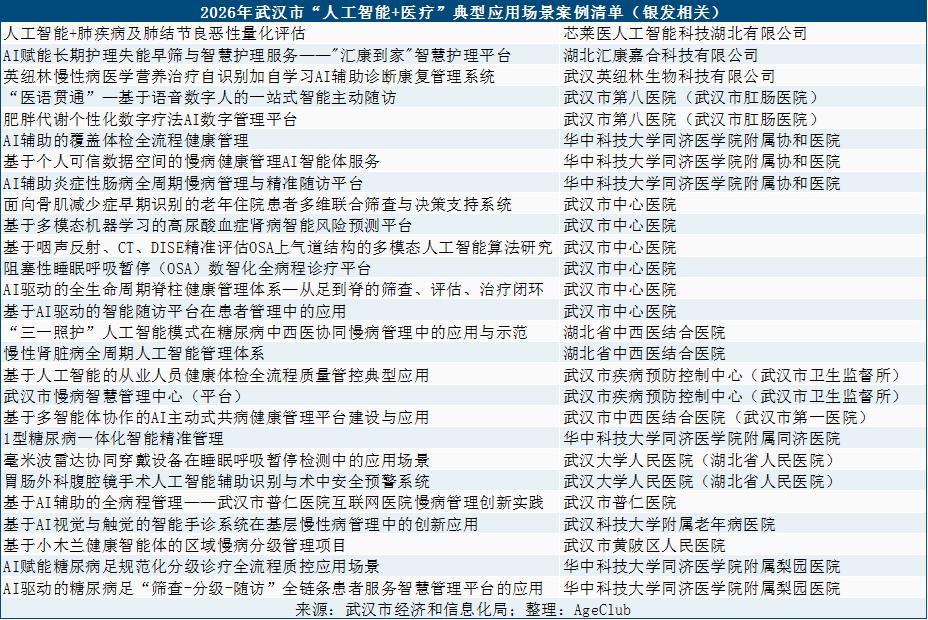
Supporting datasets are also being accumulated: the real-world dataset of cardio-cerebrovascular comorbid chronic diseases from Tongji Hospital, the multi-modal brain-computer interface dataset for dysphagia from Hankou Hospital, and the chronic atrophic gastritis dataset from Provincial Hospital of Traditional Chinese Medicine. Scenarios generate data, and data feeds back to the model — the flywheel of development is spinning.
Wuhan is not a special case.
According to statistics from Shenzhen Municipal Health Commission, nearly 450 artificial intelligence products have been implemented in medical institutions at all levels across the city, including 404 clinical medical products. In the ICU of Peking University Shenzhen Hospital, with the help of Mindray Qiyuan large model, doctors complete the retrospective integration of diagnosis and treatment data in 5 seconds, and generate structured medical records in 1 minute.
The intelligent agent matrix of Peking Union Medical College Hospital has covered more than 110 intelligent agents in fields including rare diseases, cardiopulmonary imaging, and tumor radiotherapy, and has been sunk to counties and towns in more than 30 provinces across the country. Among them, the "Union Taichu" rare disease intelligent agent has a genetic variation analysis accuracy of 99%, and the collaboration efficiency is 33% higher than manual work, and has been promoted to 419 hospitals. In community institutions in Xicheng District, Beijing, relying on the digital doctor assistant for chronic kidney disease of Peking University First Hospital, the mastery rate of community doctors in kidney disease screening and diagnosis has reached 100%.
