Nearly 8 million people watched the viral event, even Elon Musk was stunned. Engineers are fuming that Claude Code is "squeezing their souls dry": they work 12 hours a day just to keep pressing the Enter key.
"Claude Code is absolutely sucking the very soul out of me."
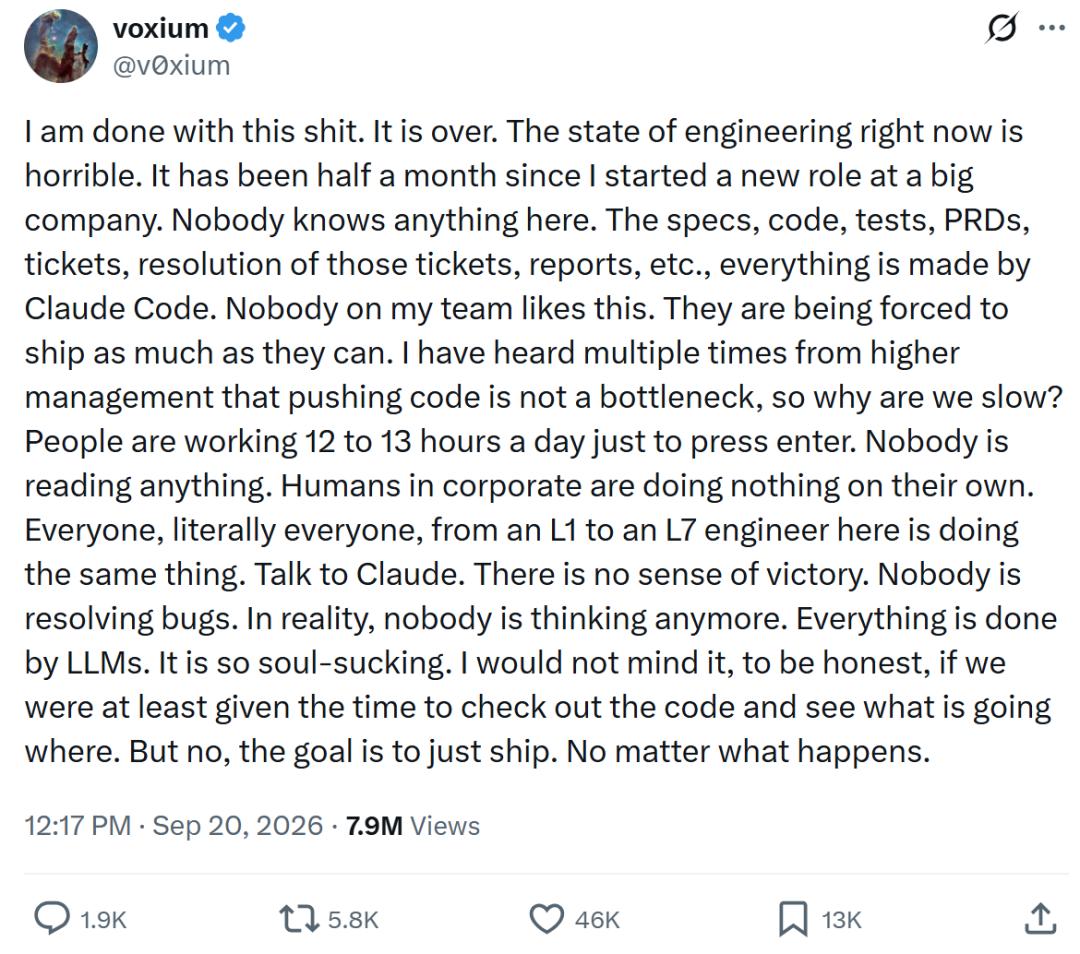
Recently, a rant posted by an anonymous engineer on the X platform racked up nearly 8 million views. The engineer, who goes by the online handle voxium, claimed he had just joined a large company half a month ago and described his new role as having his "soul drained", with the culprit being neither his boss nor colleagues, but Anthropic's AI programming tool — Claude Code.
Nearly everything from product specifications, PRD, testing, to work orders, code, bug fixes and reports is generated by Claude Code, and engineers have to work 12 to 13 hours a day just to "press the Enter key".
As soon as the post went viral, the tech community was abuzz. Elon Musk replied with a single word "Yikes", and Chamath Palihapitiya, venture capitalist and co-host of the All-In Podcast, went even further with a sharp comment: "AI is turning a generation of technical experts into people pressing buttons at casino slot machines."

Sounds a bit exaggerated? The truth is, the scenario described by voxium is playing out on a massive scale.
01
"No one is doing any real thinking anymore"
Fearing retaliation from his employer, voxium did not reveal his real name or the company he works for on X. He said that just half a month after joining the company, he found that almost all the work of the team revolves around Claude Code.
"Nobody here knows anything," he stated. All specifications, code, tests, PRDs, work orders, work order solutions, reports... are almost entirely completed by Claude Code. What makes him even more frustrated is that the company does not give engineers more time to think just because AI can write code. Instead, the management requires everyone to deliver outputs as quickly as possible.
"I have heard senior leaders say more than once that writing code is not the bottleneck at all, so why are we still so slow?"
As a result, engineers started working 12 to 13 hours a day, constantly prompting Claude to keep executing tasks — from L1 to L7, engineers of all levels seem to be doing the exact same thing: talking to Claude, then pressing Enter.
"There is no sense of achievement at all, and no one is actually fixing bugs. At the end of the day, no one is doing any real thinking anymore."
Regarding this phenomenon, voxium believes that the root cause lies in the management approach. In many enterprises, the Sprint cycle, the number of PRs, and the number of launched features are easily taken as indicators to measure the efficiency of the R&D team. But more features do not necessarily mean a better product.
Therefore, when AI can generate code quickly, people naturally get tempted: since AI can write it, just let it write more. Product requirement documents can be written by AI, system design can be done by AI, front-end UI can be generated by AI, and back-end code can also be produced by AI... Eventually, code production itself gets faster and faster, but the work that engineers really need to invest time in understanding and verifying has not increased synchronously.
In a subsequent interview, voxium even used a tech buzzword that became popular in 2026 — "Human meat proxies", which can be understood as "human proxies": humans only pass the output of AI directly to the next stage, without actually analyzing the content.
He raised a simple but sharp question: "If everything is automated, what is left for us?"
02
This is not just a complaint from voxium alone
This kind of worry is not unique to voxium.
Back in June this year, Deedy Das, a partner at Menlo Ventures, discussed a similar phenomenon: many experienced engineers have found that they spend more and more time not writing code, but understanding, reviewing and correcting a large amount of AI-generated code. He described this change as a state close to an "identity crisis".
In some cases, AI may even add extra inspection costs.
In 2025, METR conducted a randomized controlled trial on 16 experienced open source developers, covering 246 real development tasks. The study found that under the experimental conditions at that time, developers using AI tools took 19% longer to complete tasks than their peers who did not use AI. More ironically, these developers felt they were roughly 20% faster — there was a nearly 40 percentage point gap between perception and reality, and they did not even realize they were slowing down.
This September, Liu Shengyu, Machine Learning Systems Engineer at DeepSeek, also publicly talked about the impact of AI on his professional work. He said that in the past, AI mainly helped him check documents, read code and find bugs, but now it can handle GPU-related code such as CUDA, PTX and SASS, and participate in operator optimization. He even judged that in another six months to a year, AI may be able to write operators as well as or even better than he can. In the future, he may have to shift from writing operators personally to managing and scheduling AI Agents.
This echoes voxium's concern in a way: The first thing AI changes may not be "whether programmers have jobs", but what exactly programmers do every day. From writing code personally, to designing tasks, breaking down requirements, supervising Agents, reviewing results, and finally verifying whether the software actually solves users' problems — the role of engineers is changing.
In addition, no matter how advanced AI programming tools become, one problem always exists: AI can write code very quickly, but it takes time for humans to understand the code. If enterprises only keep increasing the "generation volume" and "launch volume", this gap will become more and more obvious.
03
Netizens are divided: Is this even considered "soul-sucking"?
Of course, not everyone agrees with voxium's statement.
Some netizens believe that pressing the Enter key all day with a high salary is by no means a "soul-sucking" experience: "The real 'soul-sucking' job is that I worked alone in the warehouse for 8 hours a day from October to March of the next year to fill chlorine gas into bottles. This guy has no idea what it really means to have his soul drained, he's just bored."
Some people said bluntly: "I bet 99.9% of people would be happy to press the Enter key at work with a six-figure salary." Others pointed out that if working 12 to 13 hours a day is the problem, what really needs to be fixed is the working hours, not AI: "If you know what you should do, just change to another job."
At the same time, some netizens put forward completely different views.
For example, one netizen argued that before mocking voxium as a "highly paid tech elite who complains about everything", people should pay attention to a bigger trend: Programmers are likely to be the first group of white-collar workers impacted by AI.
"Before you laugh at him as a 'whining overpaid tech guy', you need to know that tech practitioners are the canaries in the AI mine. AI models were trained on massive amounts of code in the early stage, and programmers are one of the first and most active groups to use AI automation tools. But the situation described by voxium is actually spreading to more and more white-collar occupations. When AI masters almost all the knowledge in the world, do we still need so many 'knowledge workers'? In the future, there will be more and more jobs that can be done by just pressing a few buttons."
04
Where exactly did engineers lose their "soul"?
In fact, in a subsequent interview with Business Insider, voxium also explained that he is not opposed to using AI at all, he just cannot accept that the team has no time to examine the AI-generated code.
"I don't actually mind all of this, as long as we are given time to look at the code and figure out what's going on," voxium wrote. "But there is no time, the only goal is to deliver, no matter what happens in the end."
He said a line in an email to Business Insider that is probably the most poignant summary of the whole incident: If engineers lose the opportunity to understand code and solve difficult problems, "there will be nothing left... there will be no soul, and it will all be meaningless."
Perhaps this is the core of the problem: AI can write code, generate reports, and output all kinds of "deliverables" on demand, but when engineers no longer need to understand what they are doing, and when "pressing Enter" becomes the entire content of a day's work, what is left of this job may really be nothing but a soulless "human proxy".
After all, code can be generated faster and faster, but what software engineering really needs is never just code. So what's your take on voxium's remarks?
References:
https://www.businessinsider.com/software-engineer-viral-post-captures-soul-crushing-downside-ai-coding-2026-9
https://www.techspot.com/news/113937-engineer-claude-code-has-made-job-soul-sucking.html
This article is from the WeChat public account "CSDN", author: Zheng Liyuan, authorized for release by 36Kr.