Is the new AI narrative worth one trillion dollars?
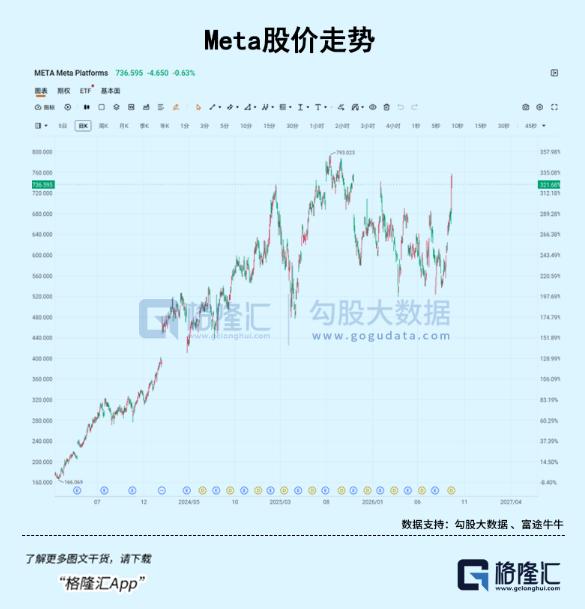
The night before last, Meta, the US tech giant, staged a dramatic sharp surge in its stock price — it jumped 11.43% in a single trading day, with its market value swelling by 193.8 billion US dollars (about 1.29 trillion RMB) in just one day.
On the same day, AMD also rose by nearly 10%, with its market value breaking through the 1 trillion US dollar mark for the first time.
The trigger for this market carnival is Muse, a personal AI agent that has exceeded 2.5 million downloads and topped the free App Store chart in the US region just two weeks after its launch.
However, while the capital market is boiling over this boom, e-commerce giant Amazon has directly blocked Muse, which can help users compare prices and make purchases, on the grounds of privacy and security risks.
On one side is the skyrocketing download volume on the App Store, while on the other side is the "blocking the door" in core business scenarios. The market selectively ignores the latter and pays for the new narrative. This inevitably raises a question:
Has Muse truly fully ignited a new stage of AI trading?

The Nasdaq Finds a New Narrative
If you are following Meta Muse, don't miss the Meta Connect 2026 conference, which will open at 7 a.m. tomorrow (September 24), where new updates may be presented to the public.
Muse is significantly different from previous conversational agents. It is no longer just a chatbot, but a super agent that can independently complete complex workflows such as sending and receiving emails, booking itineraries, filling out forms, cross-platform product price comparison, and automatic renewal checks.
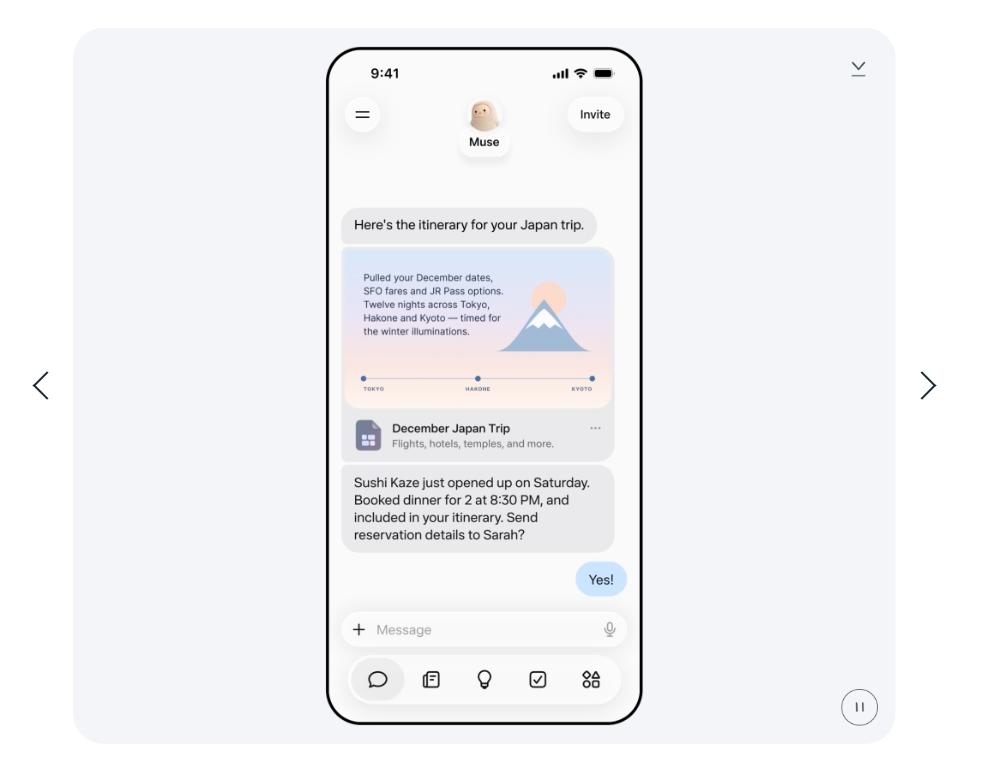
What is more disruptive is that Muse has cross-application memory and long-context association capabilities, and has been directly embedded in Meta AI, WhatsApp, Instagram and Facebook. This means that within just over ten days after its launch, Muse has seamlessly integrated into the daily workflows of billions of global users behind the Meta ecosystem.
What really makes stock investors too excited to sleep is the disruptive AI hardware operation mechanism behind Muse.
Traditional chatbots rely on GPUs to complete the inference and return of text tokens, and the calculation stops once the user closes the webpage. AI agents involve a large number of task orchestration, tool calls, API requests, environment sandboxes, state memory and multi-round task loop execution links, which are highly dependent on CPU computing power support.
After Muse went viral, two independent yet mutually complementary logical chains have formed around it in the capital market.
One is the new narrative in the capital market: why the market needs this story, how to understand Muse, and how to form expectation gaps and investment labels. The other is the incremental growth of hardware entities, which answers what new resource consumption has been added to the industrial chain, which hardware links will benefit, and how supply-demand gaps and price increases will emerge.
At present, the only AI demand that has been fully realized is coding, but there are only about 30 million programmers in the world, and the ceiling of paying willingness is clearly visible.
The personal agent represented by Muse targets billions of ordinary consumers. The main demand group has expanded from tens of millions to billions, and the ceiling and computing power demand are at a level never seen before. Personal agents are therefore regarded as the second growth curve after coding, and the popularity of Muse has provided real data verification for this curve.
At the same time, along the transmission path of computing power, it has involved the entire upstream semiconductor manufacturing sector.
The reason why chip stocks have rallied collectively is that the market realizes that AI computing power demand is evolving from "GPU single-drive" to "CPU+GPU collaborative support", and the value of server CPUs is facing a systematic revaluation.
Since virtual machine management, operating system resident, memory scheduling and headless browser startup are all highly dependent on CPUs, server CPUs have instantly been promoted from supporting roles to the core carrier of the agent execution layer.
In addition, complex workflows need to maintain multi-round tool call states and long-cycle memory management, which leads to a sharp increase in KV Cache capacity and memory bandwidth pressure, directly driving demand for HBM, DRAM and NAND storage.
Furthermore, server CPUs are also the largest end application of ABF substrates, but the current global top three substrate manufacturers (Japan Ibiden, Unimicron, Samsung Electro-Mechanics) are operating at full capacity, and their resources are prioritized for large GPU customers such as NVIDIA and Google, resulting in a long-term supply-demand gap of more than 50% for Intel and AMD's CPU substrates.
On the supply side, TSMC plans to raise its foundry prices by 10%, AMD plans to increase its chipset prices by 10% in the fourth quarter of 2026, and there is also news that Intel will raise PCCPU prices by 10% and can only meet 50% of the market demand.
This series of price increase and shortage signals, although essentially the result of the evolution of the semiconductor capacity cycle and the bargaining power of wafer fabs, not directly caused by the popularity of Muse, have been taken by the market as strong evidence for the "full-chain CPU shortage" narrative.
But does this logic naturally replace coding and become the main line of the next round of AI trading? Will it even bring larger returns?
Revaluation Is Still Premature
With the Nasdaq rising for two consecutive days, the entire Wall Street seems to be paying for this deduction. However, this round of sharp rise is more like a risk preference recovery under the loose macro environment, and funds are pricing for "assumptions" rather than "realized returns".
The market has begun to reassess such a scenario:
When a truly practical personal intelligent agent needs to run in a virtual machine for a long time and continuously occupy CPU, memory and storage resources, then when the user scale expands from millions to hundreds of millions, or even billions, related hardware demand may see a new round of explosion.
If we return to the real fundamentals, there are still several points in this narrative that need to be gradually verified.
For example, Muse's downloads exceeded 2.5 million in 13 days after launch, which is really impressive, but SensorTower data shows that its daily active users (DAU) on September 18 were only 448,000.
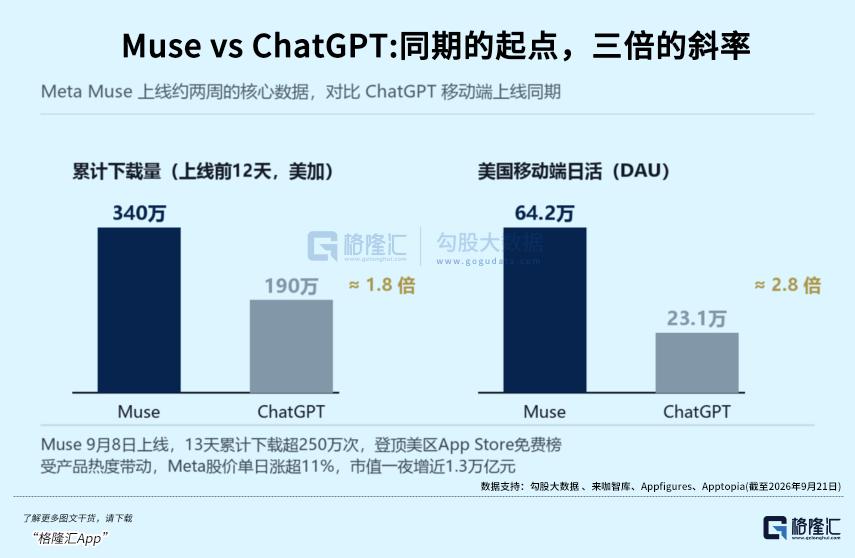
Hundreds of thousands of actual daily active users are a drop in the bucket for Meta's billions of user base, and Meta has not yet announced any next-day retention rate, weekly retention rate and clear commercial subscription price.
The download volume can only represent the reach scale under the strong distribution of giant channels, and the retention rate truly determines the resident life cycle of cloud virtual machines. Under the modern cloud-native architecture, once there is no subsequent interaction from users, the system will immediately trigger the elastic scaling mechanism, and recycle idle isolated Linux containers and computing nodes at the millisecond level.
This means that without the support of high retention, the vCPU occupancy and memory bandwidth consumption in the background will drop sharply; without continuous resource occupancy, the grand narrative of reconstructing the CPU base will never be translated into actual orders for upstream manufacturers.
Secondly, there is a time lag between the advance pricing of capital and order verification.
Although Meta, as AMD's second largest customer (contributing about 5.5% of its revenue), has driven AMD's market value to break through one trillion dollars, there is no public information to verify that the subsequent virtual machine consumption of Muse will bring more large real procurement orders to AMD.
This logic will turn from speculation to real realization only when AMD can truly deliver the expected growth of server CPU orders in the future.
Furthermore, the actual support of the underlying hardware market is quite fragile.
The global PC shipment forecast has been lowered from about 260 million units in 2026 to 250 million units in 2027, and the growth of Intel's client revenue in the second quarter mainly relies on the increase of average selling price (ASP) rather than the expansion of shipment volume.
Putting these clues together, you will find that the market is still in a suspended state. When the stock price is pushed to a historical high in just a few days, what the market is pricing is actually a "new world".
It requires the penetration rate of agents to be extremely fast, and the computing power and token consumption of users to increase exponentially, which in turn forces major cloud manufacturers to continuously invest in hardware. If any link in this chain goes wrong, the story will go in the completely opposite direction:
For example, once the user trial period is over, the penetration rate of agents stagnates, and the growth rate of background computing power consumption slows down significantly, cloud manufacturers will soon realize that the input-output ratio is not ideal. The most direct next step is to cut the original capital expenditure (CapEx) and reduce the procurement of upstream components.
At that time, it is not only the narrative that will be squeezed out of the bubble, but also the overvalued stock price.
What Other Conditions Are Needed
The previous questions just tell us that putting aside the noisy concept speculation, we need to look at the core factors that determine whether this AI story can be realized — the architecture of computing power bearing, the ownership of traffic entrances, and the pricing rules of macro capital.
The essence of task-based agents is "operating system resident + environment sandbox scheduling".
When an agent needs to maintain multi-round tool call states and long-cycle memory management, the pressure on KV Cache capacity and memory bandwidth will rise exponentially.
This means that the core value of the computing architecture is shifting, breaking the previous single belief that "computing power equals GPU", and bringing the marginalized standard x86 or Arm CPUs back to the center of the stage.
But this is only the dimensional upgrade at the technical level. What really made Meta's market value surge by nearly 200 billion US dollars in a single day is the secondary distribution of the governance right of Internet traffic.
In the past, the commercialization of AI was mostly limited to tens of millions of programmers, but the popularity of Muse has shown the market the huge market ceiling of agents facing billions of consumers.
The reason why Amazon is on high alert for Muse is that once the intelligent agent completes cross-platform price comparison and order placement for users, traditional e-commerce will be completely deprived of traffic entrances and reduced to a pure warehousing fulfillment party. Shopify chose to integrate Muse because it does not have an exclusive entrance in the first place, and integrating Muse means adding an extra sales channel.
Therefore, it is not all the computing power that should be re-priced. The core commercial barrier of consumer-grade agents lies in the absolute control over user workflows and transaction paths.
The story of the entrance sounds very attractive, but the real commercial realization path has not yet been implemented.
In the past few years, the commercialization path of AI has been extremely single. It either relies on selling API parameters and billing by token consumption, or is limited to specific groups with high payment willingness such as programmers.
But personal agents take a completely different path — its core barrier is not simply the model capability, but the scale effect, user experience, and seamless penetration into daily workflows.
At this stage of high concurrency and high computing power consumption, profits will first flow to cloud sandboxes and hardware infrastructure, and large manufacturers must continue to pay for computing power.
Although Meta has the entrance advantage of billions of users and claims that "most users are free, and heavy users pay for subscriptions", the specific subscription pricing, revenue sharing model with advertisers and even commission ratio are still unclear.
Will it rely on subscription fees to cover the high CPU computing power cost, or extract commissions by taking over the transaction entrance?
Before these landing commercial paths are finalized, the market's fanaticism about entrance reconstruction is essentially paying a premium in advance for a highly uncertain business expectation.
Epilogue
The popularity of Muse just gives hot money a very convenient reason to rush for positions. With oil prices falling sharply and inflation easing, the market is in a window of rising risk appetite, and funds are eager to find the next tech story.
Back to the original question, this is not a valuation revaluation driven by performance realization, but a sentiment advance and position replenishment that catches up with the macro window.
What the market buys is only a set of unproven long-term assumptions. Since it is an assumption, we need to wait patiently for verification. No matter how impressive the download volume is, if it cannot retain users and generate cash flow, it will eventually be just a fleeting cloud. (End of full text)
Gelonghui Statement: The views in this article are all from the original author and do not represent the views and positions of Gelonghui. Special reminder: Investment decisions need to be based on independent thinking. The content of this article is for reference only, and does not constitute any practical operation suggestions. Trading risks are borne by the parties themselves.
This article is from the WeChat official account "Gelonghui APP" (ID: hkguruclub), author: Freddy, published with authorization from 36Kr.