The Hong Kong Exchanges and Clearing has started.
The curtain rises.
On September 21, The Stock Exchange of Hong Kong released the consultation paper for the second-phase competitiveness review of the listing mechanism, focusing on three major areas: discloseable transactions, connected transactions, and spin-off listings.
Looking ahead, a series of changes are brewing in Hong Kong's stock market listing this year: from the adjustment of listing thresholds to the adoption of confidential submission of listing applications for all companies, the formulation of new Chapter 18D, and the review of the market capitalization threshold under Chapter 18C, the implication of these moves is self-evident. More importantly, this is just the beginning.
At present, more than 500 enterprises are queuing up outside the Hong Kong Stock Exchange, forming a long queue, and the eagerness of all parties to complete their IPOs is palpable.
Changes Coming to Listing in Hong Kong, Consultation Launched
Specifically, this consultation paper puts forward several core suggestions.
Under the current rules, a transaction with a scale reaching 25% is classified as a "major transaction", which requires an announcement, a circular, and a shareholders' meeting for voting. This consultation proposes that the threshold for major transactions be raised from 25% to 50%. Transactions between 25% and 50% are only classified as discloseable transactions, which only require the publication of an announcement, with no mandatory requirement for a circular or shareholder voting. However, transactions involving the provision of financial assistance and/or securities or other investment activities will still retain the 25% threshold.
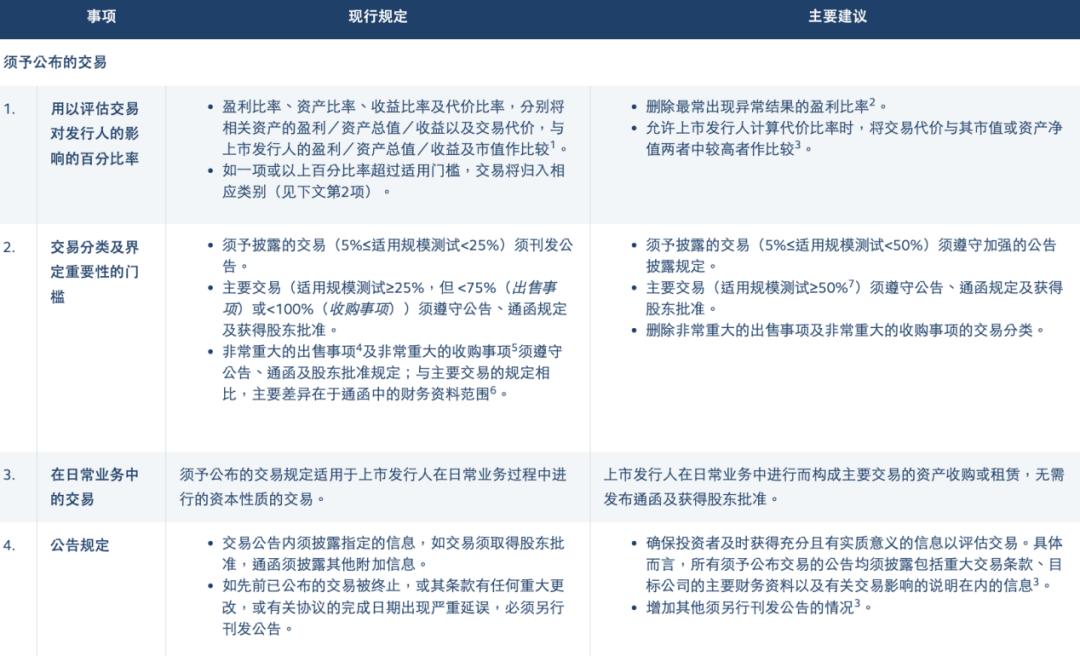
The Stock Exchange of Hong Kong also proposes to remove the two categories of "very substantial acquisitions" and "very substantial disposals", and bring them into the unified major transaction framework.
Meanwhile, the Stock Exchange of Hong Kong plans to optimize the method for measuring transaction scale. Specific measures include: removing the profit ratio test, retaining four tests of asset ratio, revenue ratio, consideration ratio, and equity ratio; when calculating the consideration ratio, the higher of the market capitalization or the net asset value can be used as the comparison benchmark.
The underlying reason is that the profit ratio is prone to abnormal results, and the importance of a transaction can still be effectively measured through indicators such as revenue ratio and asset ratio. In addition, for asset-heavy enterprises, market capitalization may not accurately reflect the actual financial status of the enterprise.
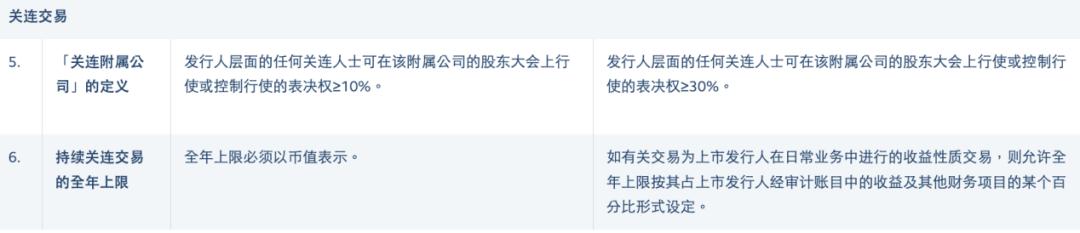
In terms of connected transactions, the Stock Exchange of Hong Kong proposes in the definition of "connected subsidiary" that the shareholding threshold for connected persons be raised from 10% to 30%. The Stock Exchange of Hong Kong also proposes that if the relevant transaction is a revenue-generating transaction conducted by a listed issuer in its ordinary course of business, the full-year cap can be set as a percentage of the revenue and other financial items in the audited accounts of the listed issuer.
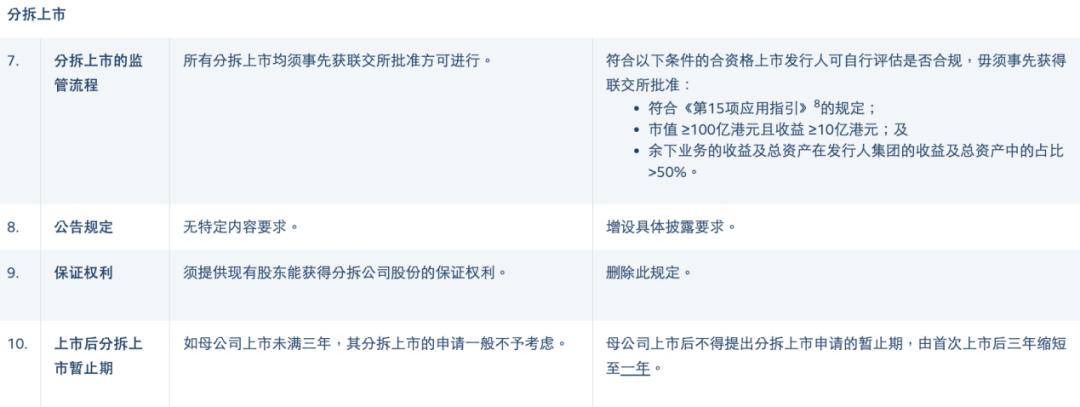
Spin-off listing is a key direction of market attention. Under the current rules, a parent company that has not been listed for three years cannot in principle submit a spin-off listing application. This proposal plans to shorten the spin-off moratorium period from 3 years to 1 year. At the same time, a "self-assessment mechanism" will be introduced: qualified issuers do not need to apply for prior approval from the Stock Exchange of Hong Kong for low-risk spin-off projects, and the company can judge compliance on its own; and the original guaranteed share allocation for parent company shareholders in spin-off listings is planned to be cancelled.
This rule directly reduces the time cost for listed companies to spin off their incubated businesses for independent listing. For technology and industrial groups listed in Hong Kong, the capital path for spinning off hard technology subsidiaries and independent business segments has been greatly shortened. Of course, the rules still retain constraints: the parent company must retain substantial main business after the spin-off, and cannot become a pure holding shell company, to prevent arbitrage through simple asset split.
Wong Sut Chuen, Head of Listing of Hong Kong Exchanges and Clearing, said: "This reform aims to give issuers greater flexibility and certainty when conducting corporate transactions, improve efficiency in terms of time and cost, while maintaining investor protection through timely, high-quality information disclosure and effective board accountability mechanisms." The consultation period will end on November 30, 2026.
The Direction of the Tide
Looking back at this year, a series of changes have been brewing in the Hong Kong stock market.
To attract more enterprises to list in Hong Kong, the revised Listing Rules of the Hong Kong Stock Exchange officially took effect in July: all companies can submit listing applications confidentially, the weighted voting rights rules have been relaxed, and the market capitalization threshold for secondary listing applicants has been reduced from HK$10 billion to HK$6 billion.
Shortly afterwards, market news came that the Hong Kong Stock Exchange is studying the addition of a brand new Chapter 18D to the Main Board Listing Rules, which allows newly established small companies that cannot meet the profit requirements to list, and merges GEM (Growth Enterprise Market) with the Main Board. If implemented, this will be another important expansion of Hong Kong's listing regime.
John Lee Ka-chiu, Chief Executive of the Hong Kong Special Administrative Region, recently revealed that the Hong Kong Stock Exchange will officially launch a consultation on revising the listing regime for specialised technology companies (Chapter 18C) in the first half of next year, including reviewing the market capitalization threshold and other aspects.
Chapter 18C, which came into effect in March 2023, has opened up a listing channel specifically for unprofitable specialised technology companies, covering five major sectors: new generation information technology, advanced hardware and software, advanced materials, new energy, energy conservation and environmental protection, new food and agricultural technology. Now, this chapter has reached its revision window.
A series of regulatory relaxations have brought a boom of listing in Hong Kong, and there was even a spectacular scene where 7 IPOs rang the bell at the same time in one day.
However, after the middle of the year, the market sentiment has changed subtly.
New share prices falling below their issue prices have become increasingly common. Public data shows that as of September 15, among the 108 new shares listed this year, 82 have fallen below their issue prices, with a break rate exceeding 70%, far exceeding the level of the previous two years.
The hot sectors get even hotter, while the cold sectors get even colder - the structural differentiation of Hong Kong stock IPOs is intensifying. Capital is concentrating on a small number of high-quality targets, innovative technology enterprises with high growth potential are highly sought after, while enterprises lacking growth stories face lukewarm subscription or even withdrawal of listing applications.
At this moment, more than 500 enterprises are still queuing up outside the Hong Kong Stock Exchange. However, given the current market situation of Hong Kong stocks, the question of "whether the new share can be successfully issued, and whether the price will fall below the issue price after listing" is challenging every queuing enterprise. The tide is turning, and the market maintains cautious optimism.
This article is from the WeChat official account "PE Daily" (ID: pedaily2012), written by Zhou Jiali, authorized for release by 36Kr.