Commercial aerospace enterprises have secured nearly RMB 2 billion in financing, and the large-scale reusable rocket is scheduled to make its maiden flight in 2027 | Hard Kr Exclusive
Author | Nan Huang
Editor | Silai Yuan
36Kr Exclusive learned that commercial aerospace firm Deep Blue Aerospace has completed two rounds of financing, with a total scale of nearly 20 billion yuan. Investors include local state-owned assets such as Wuxi New District Investment Holding Group and Wuxi Venture Capital, investment institutions such as Yida Capital, Hisong Capital, Shanghai Free Trade Zone Fund, Zhuoyuan Capital, Wanshi Capital and Huafu Capital, industrial capital such as Baotong Technology, Hongrun Construction and Youluoka, as well as industrial chain enterprises such as Suzhou Sibeilao.
The funds from this round will be mainly invested in the R&D, commercialization and industrialization promotion of the company's two existing lineages of recoverable and reusable launch vehicles. At the same time, it will greatly promote the construction of engine mass production capacity, ground facilities such as launch test facilities, and the introduction of core talents.
Since its establishment, Deep Blue Aerospace has focused on the liquid oxygen kerosene recoverable rocket route. Among them, the medium launch vehicle "Nebula-1" has a near-Earth orbit carrying capacity of 4-6 tons, which can fully and quickly respond to the full-rocket dedicated launch business and rideshare launch demands. The core product "Nebula-2" is positioned with a 25-ton level near-Earth orbit carrying capacity, targeting the launch demands of large low-orbit constellations. Its Thunder RS engine has recently completed multiple 100-second and 200-second long-duration test runs, and the 200-second single-engine test run has covered the full flight duration.
According to the plan, Nebula-2 is scheduled to complete its maiden flight test in 2027, and the "chopstick capture" tower capture scheme will be adopted in the future to realize the recovery and reuse of the first stage.

Deep Blue Aerospace's large recoverable rocket (Source from the enterprise)
China's commercial aerospace is going through a key transition, where enterprises are shifting from completing technical verification to building engineering delivery capabilities. As various companies have successively completed key nodes such as engine test runs and rocket orbit insertion, they have not only broadened the capital's imagination for this track, but also the industry's evaluation dimensions are evolving. The progress of engine mass production and real order demands have become the key dimensions currently inspected by the industry.
The underlying logic of this transformation is rooted in the economic structure of the commercial aerospace industry. If the launch cost cannot be effectively reduced, the commercial model of constellation construction will be difficult to establish. At present, domestic private rockets are still in a critical stage of cost reduction, and the networking demand for low-orbit constellations usually requires hundreds of launches for support. If the cost remains at a high level, the large-scale networking of satellite companies will be substantially restricted.
Recoverable technology is the key to unlocking this space. At the technical route level, Deep Blue Aerospace's rocket design has taken the recovery capability as a key constraint from the very beginning of the architecture. The iteration of the two recoverable rockets Nebula-1 and Nebula-2 not only improves the carrying capacity, but also provides different payload transportation schemes for different markets, customers and scenarios. After the breakthrough of recoverable technology, the launch frequency and reliability are expected to be improved, and the cost can also be reduced.
The first stage of Nebula-2 adopts a parallel scheme of 11 Thunder RS engines. The core logic of this scheme is to exchange the number of engines for the thrust regulation accuracy in the recovery section. The takeoff section requires large thrust, while the recovery section requires small thrust, which is a fundamental contradiction in the design of recoverable rockets.
The scheme of a single engine with greater thrust has no obstacles in the takeoff section, but in the recovery section, even if the thrust is throttled to the lowest gear, the total thrust may still be greater than the weight of the rocket body, resulting in the rocket being unable to decelerate stably, and even appearing to be "pushed forward" instead of "falling down".
After the first stage of Nebula-2 adopts 11 130-ton engines in parallel, only 1 to 3 of them need to be ignited during recovery, the total thrust can finely match the requirements of the landing condition. Only when the granularity of thrust regulation is fine enough can stable soft landing be achieved.
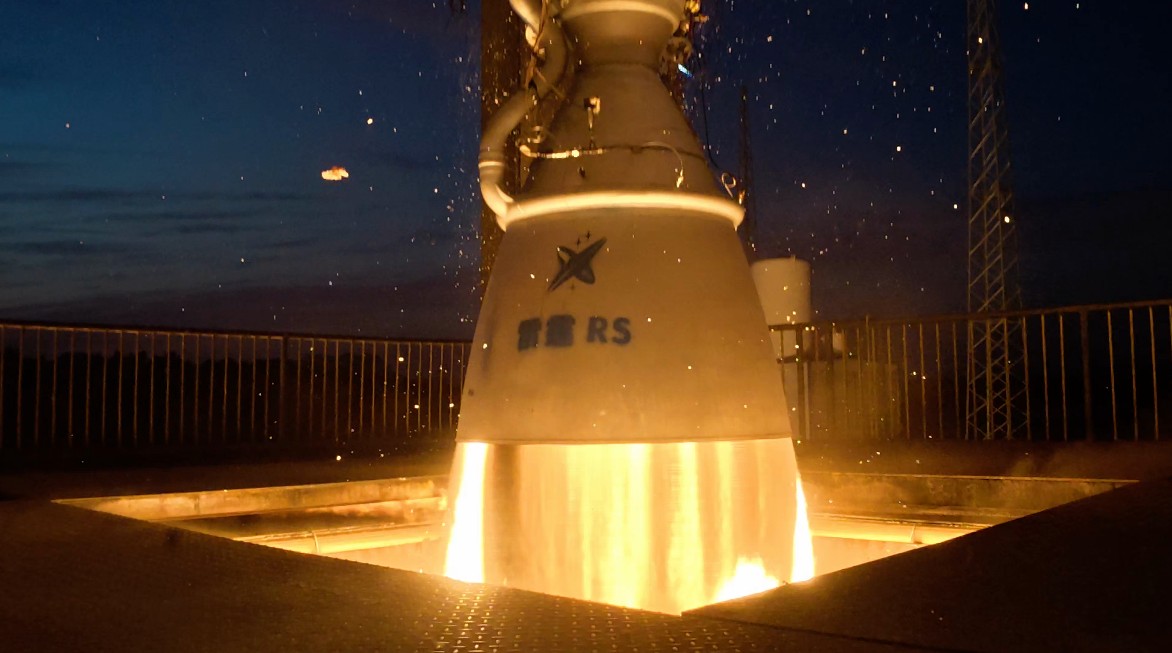
Thunder RS engine test run (Source from the enterprise)
Multi-engine parallel connection is a recognized engineering difficulty for large liquid rockets. From single-engine test run to 11-engine cooperative operation, what needs to be crossed is far more than the engine technology itself, but also the system integration capability, that is, how to make 11 engines work cooperatively on the same rocket body and in the same time sequence.
Synchronous start is the first threshold. In engineering, the strategy of grouping and time-sequence starting is adopted. The starting sequence and valve response time of each engine need to be precisely matched, and the delay of any one engine will lead to asymmetric thrust.
The difficulty of fault isolation lies in the extremely short judgment window. The system needs to complete three actions: identification, isolation and thrust reconstruction within the millisecond level, and the on-board control system completes the thrust compensation and attitude balancing of the remaining engines synchronously.
Thrust equalization involves the common problem of the storage tank and the delivery system. The flow resistance of each pipeline is different, which requires the engine to have the working ability of wide inlet pressure. At the same time, the resonance risk and thermal coupling effect brought by the simultaneous operation of multiple engines of the same model need to be actively avoided in structural design and control strategy.
This means that 11 engines need to maintain coordinated thrust output during the whole process of takeoff, deceleration and landing. Any deviation of a single engine requires the system to complete judgment and compensation within the millisecond level. This is the system-level verification node that must be passed before the maiden flight of Nebula-2.
The cooperative verification of the power system is the core proposition of the takeoff section, while the recovery section faces another set of completely different engineering constraints.
Nebula-2 is currently focusing on the land tower capture scheme, and plans to launch the "chopstick capture" test, using the tower manipulator to capture the returning rocket body, with only the capture interface reserved on the rocket.
Huo Liang, founder of Deep Blue Aerospace, told 36Kr that the most prominent practical bottlenecks in China's commercial aerospace at the present stage are mainly concentrated in the two dimensions of talent and capital. This is an industry-wide problem, not the individual dilemma of a single company.
In terms of talents, commercial aerospace has extremely high requirements for engineering experience, but talents who have really experienced complete model development, test runs and flight iterations are extremely scarce. This is directly related to the stage of the industry. Due to the short starting time of domestic commercial aerospace, the talent supply cannot keep up with the expansion speed of the industry. At present, Deep Blue is accelerating the introduction of core engineering talents from mature model teams, and shortening the experience accumulation cycle through team agglomeration to improve the overall R&D efficiency of the limited talent team.
In terms of capital, commercial aerospace is essentially a long-cycle, heavy-investment engineering competition. From engine test runs to rocket flight verification, each link requires continuous capital support, and the return cycle is far longer than that of the general manufacturing industry. This means that if an enterprise does not have a clear product path and rhythm, its capital will be easily scattered. Deep Blue uses two complementary products, Nebula-1 and Nebula-2, to cover the launch demands from small-scale to large-scale networking, and promotes the batch test run and delivery of engines at the same time, so that every investment can correspond to a specific engineering node.
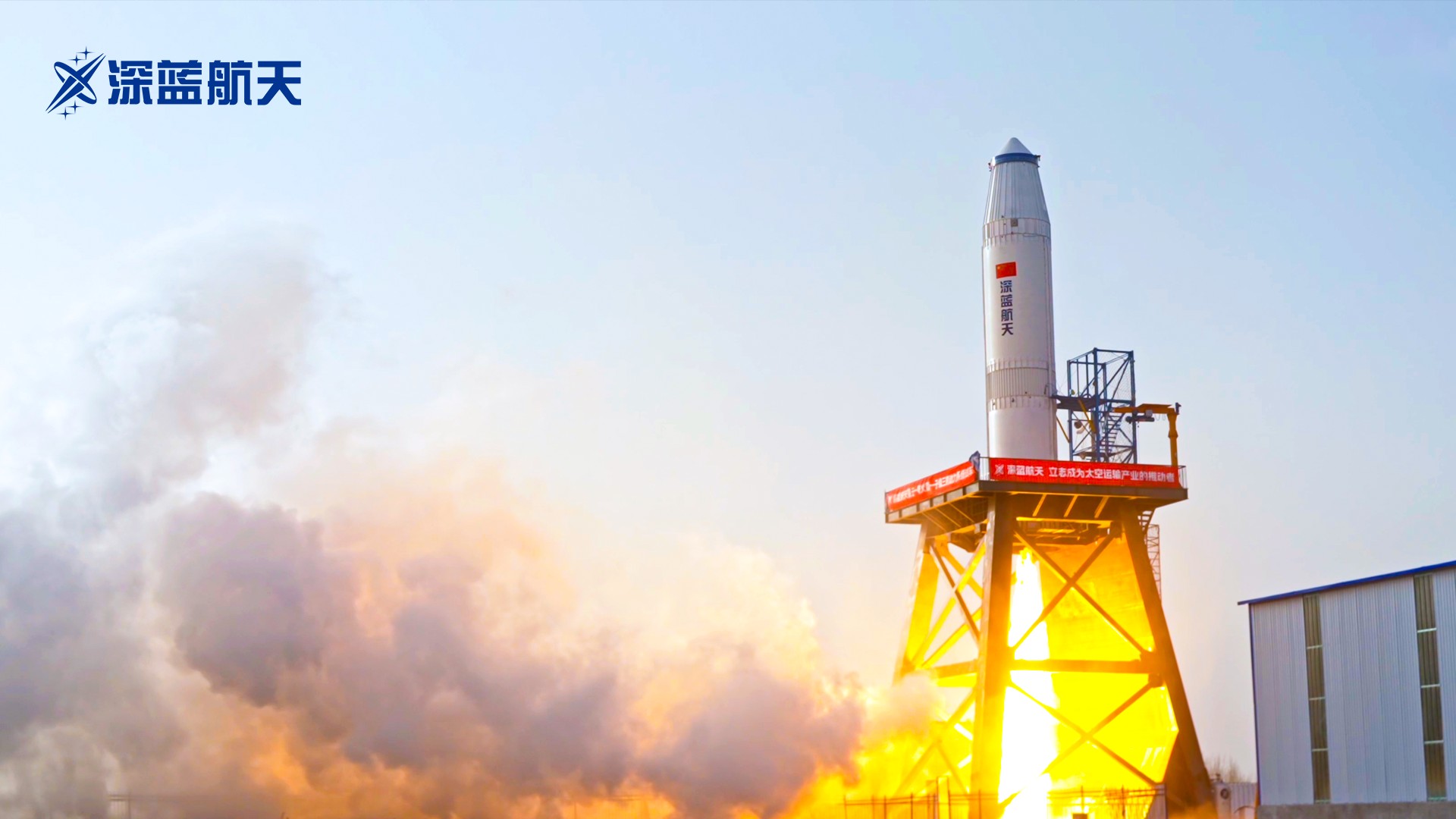
200-second long-duration power system test run of the first stage of Deep Blue Aerospace's "Nebula-1" rocket (Source from the enterprise)
However, whether the engineering nodes can be promoted on schedule also depends on whether these links are restricted by external conditions. Test run scheduling, parts supply, manufacturing cycle, any link that depends on the outside world will directly affect the conversion efficiency of capital and talents.
In response to this, Deep Blue Aerospace chose to build key links by itself to reduce the impact of external dependence on the development rhythm: relying on advanced manufacturing processes such as 3D printing to shorten the rocket development cycle and accelerate the iteration speed. At the same time, it arranges test facilities and supporting resources in advance, so that capital investment is concentrated into reusable engineering assets, instead of being consumed by external dependencies. In this way, the investment of talents and capital can be steadily transformed into model development and mass production capabilities along an independent and controllable path.
Based on the above engineering and industrial capacity building, along this main line of capacity, the medium and long-term rhythm of Deep Blue Aerospace is roughly divided into three steps.
The first step is to push the recoverable rocket from verification to implementation. Starting from low-altitude vertical takeoff and landing tests, it will gradually move towards higher altitude, more orbit-entry-level recovery verification, and break through the two bottlenecks of engine mass production and supply chain stability at the same time. The goal is to make the rocket go from "being able to launch" to "being able to launch stably, recover and reuse".
The second step is to form stable launch service capabilities. After the recoverable technology is successfully implemented, the launch frequency and performance capacity will be gradually improved, and the commercial launch service market will be expanded while undertaking national tasks and constellation networking demands.
The third step is to extend to the upstream space infrastructure capabilities. When the launch cost drops structurally due to reuse, Deep Blue Aerospace will be able to participate in a wider division of labor in the space industry, and turn the recoverable rocket from a technical capability into a replicable engineering system and commercial closed loop.
At present, the industry watershed does not lie in a single test run or successful maiden flight, but in whether recoverability, mass production and supply chain can be turned into stable industrial capabilities. Recoverability is the key path to cost reduction, but multi-engine parallel connection, sea splashdown, tower capture all still require system-level verification and continuous iteration.
What all players will compete for next is who can reduce and stabilize the launch cost, delivery rhythm and performance capability inch by inch. On this path, all participants are accelerating their climb.
The following is an excerpt of the interview between 36Kr and Huo Liang, founder of Deep Blue Aerospace (slightly edited):
36Kr: Nebula-2 is positioned with a 25-ton level near-Earth orbit carrying capacity, targeting the launch demands of large low-orbit constellations. Why did you choose 11 Thunder RS engines in parallel for the first stage, instead of a scheme with fewer engines and greater single-engine thrust? How do you balance weight, reliability and development cycle?
Huo Liang: The choice of 11-engine parallel connection is essentially not simply for the takeoff thrust, but an architecture choice made around the recovery condition. To be more precise, it is to exchange the number of engines for the thrust regulation accuracy and fault redundancy in the recovery section.
The scheme with greater single-engine thrust has no obstacles in the takeoff section, and even the architecture is more concise. But the real constraint of a recoverable rocket lies in the recovery section: when the first stage returns, the weight of the rocket body is far less than the takeoff weight, and the engine needs to work stably at a very low thrust level. If a scheme with fewer engines and greater thrust is adopted, even if the engine is throttled to the lowest gear, the total thrust may still be greater than the weight of the rocket body, resulting in the rocket being unable to decelerate stably, and even appearing to be "pushed forward" instead of "falling down". This contradiction is difficult to bypass by control strategies.
After 11 130-ton engines are connected in parallel, only 1 to 3 of them need to be ignited during recovery, and the total thrust can finely match the landing condition. Only when the granularity of thrust regulation is fine enough can stable soft landing be achieved. This is the core logic for Nebula-2 to choose 11-engine parallel connection.
We noticed that the first stage of SpaceX's Starship rocket abroad uses as many as 33 engines, and it is currently planning to increase the number of engines. The first stage of Relativity Space's Terran R rocket uses 13 Aeon R engines. This indicates that using multiple engines for the first stage of recoverable rockets is a scheme widely adopted by new large rockets in the world.
As for the trade-off among weight, reliability and development cycle, the key is to use system complexity to exchange for recovery capability and redundancy reliability, and then use the breakthrough of manufacturing process to digest the pressure of development cycle.
11 engines in parallel indeed increase the difficulty of system integration, but it also brings two key benefits: first, only 1 to 3 engines need to be ignited during recovery to obtain appropriate landing thrust; second, when a single engine fails, the remaining engines still have thrust compensation space. A multi-engine system can provide more diverse power combinations, providing better redundancy for the launch and recovery process.
Theoretical calculations show that if more than 2 engines' redundancy can be achieved during the launch ascent and recovery flight phases, the reliability of the power system is expected to reach 100%.
In order to prevent the complexity brought by parallel connection from prolonging the development cycle, Thunder RS adopts a large number of 3D printing integrated forming processes, which transforms engine manufacturing from "precision assembly" to "mass production", and uses manufacturing efficiency to offset the cost of system complexity.
Therefore, this is not simply "the more engines, the safer", but a route that is more in line with the engineering logic of recoverable rockets is selected among takeoff thrust, recovery throttling, fault redundancy and development rhythm.
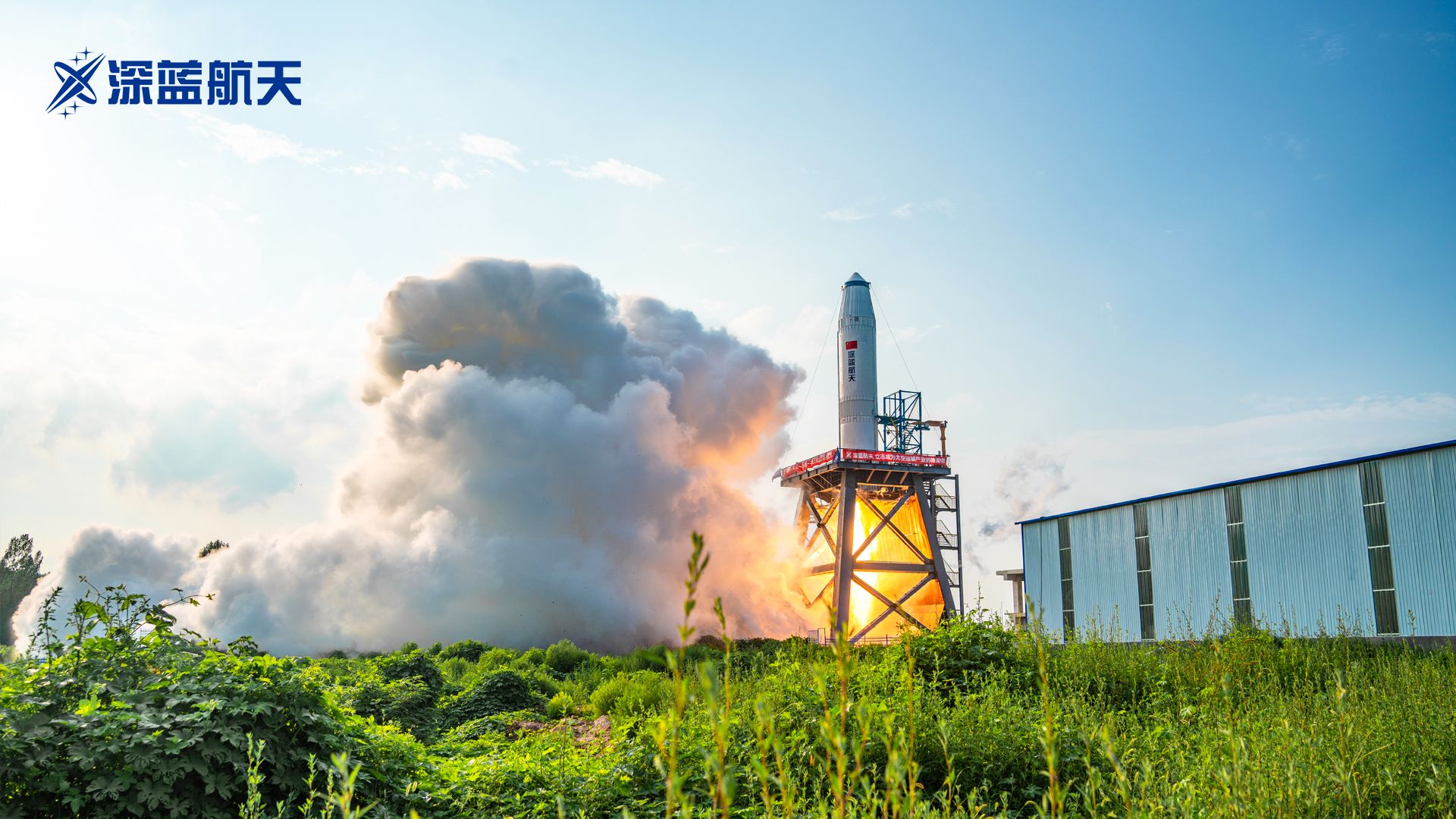
Liquid rocket engine and power system test platform base in Jinan, Shandong (Source from the enterprise)
36Kr: At present, the industry's analysis logic for commercial aerospace has changed significantly. Capital no longer simply pays for technical milestones, but values order and mass production delivery capabilities more. As a front-line participant in the industry, what substantive changes have you observed in the market's valuation criteria for liquid recoverable rockets?
Huo Liang: This change is indeed very obvious. In the past two years, the valuation judgment of the primary market for liquid recoverable rockets is shifting from "focusing on technical nodes" to "focusing on delivery certainty". But this is not a one-size-fits-all process, but a gradual process — the valuation anchor of capital is gradually migrating from technical milestones to delivery capabilities.
However, objectively speaking, the domestic liquid recoverable rocket industry as a whole is still in the verification period, and the industry has not yet entered the stage of large-scale mass production and delivery. Therefore, capital does not require enterprises to produce mass delivery records now, but requires enterprises to prove that they have the capabilities and paths to move towards delivery: whether the mass production of engines has made substantial progress, and whether the orders are real demands.
Capital is willing to give patience to enterprises with clear delivery paths; capital will become more and more cautious about those that only have technical narratives and no visible delivery paths.
From the perspective of Deep Blue Aerospace, technical milestones are the admission ticket, and delivery capability is the foundation of valuation. The company is currently promoting the verification of recoverable technology and the preparation for engine mass production as planned, while continuously accumulating order reserves and performance capabilities. The industry stage determines that not everyone can have mass