Dialogue with Zhu Jun: For Walmart China that has returned to growth, private labels, hit products and the lean SKU strategy are not the answers
Author | Ren Cairu
Editor | Qiao Qian
On September 16, 2026, Walmart opened its first new "new-generation store" at New Light World Plaza in Wenjiang, Chengdu. This marks that Walmart's store transformation has officially moved from the "old store renovation" stage to the "new store construction" stage.
"The new-generation store is not simply shrinking the size of large stores. More importantly, it is re-answering what kind of supermarket customers really need today," Zhu Jun, President of Walmart China Store Format, said at the media store tour the day before the opening.
This sentence also summarizes Walmart's transformation over the past few years. At the end of 2024, the "new-generation store" that Walmart spent years polishing was first launched in Kunming. Since then, Zhu Jun has continuously shared Walmart's transformation logic — returning to the original point of "customer first", re-targeting the urban mass middle-class small families and single people, and re-designing products, pricing and omni-channel operations accordingly.
Looking back to around 2020, traditional hypermarkets were in the most obvious stall period. Domestic and foreign supermarket operators such as Carrefour, Yonghui and Wumart either gradually withdrew from the Chinese market or were mired in losses. Walmart also faced severe pressure: the number of its stores in China shrank from 420 at the peak in 2019 to only 278 by the end of 2025. The rapid growth of Sam's Club was once offset by the weak performance of Walmart's hypermarket business.
The period with the most intensive store closures was also the starting point for Walmart to reshape itself. Over the past four to five years, Walmart has gradually focused its transformation on several core directions: re-identifying target customers, building differentiated product portfolios, improving end-to-end efficiency, and transforming physical stores into the core of omni-channel operations.
Up to now, Walmart has re-entered a new store opening cycle, and its performance has returned to growth. In its recently released second-quarter financial report for fiscal year 2027, Walmart mentioned that "Sam's Club continued its strong growth momentum, and Walmart's store business achieved accelerated growth, with the two formats advancing side by side." In the appointment notice for Zhu Jun to be promoted to President of Walmart China Store Format issued in July this year, it was also mentioned that the sales of this format had achieved double-digit growth.
The newly opened Wenjiang store covers an area of about 3,800 square meters, with nearly 10,000 SKUs. A single-layer U-shaped shopping route connects 16 consumption scenarios; fresh flowers, baked goods, daily meals and ready-to-eat products are placed in more prominent positions, with lower shelves and wider aisles. In the first few days after opening, the store was so crowded with customers that queuing for admission was required all day long.
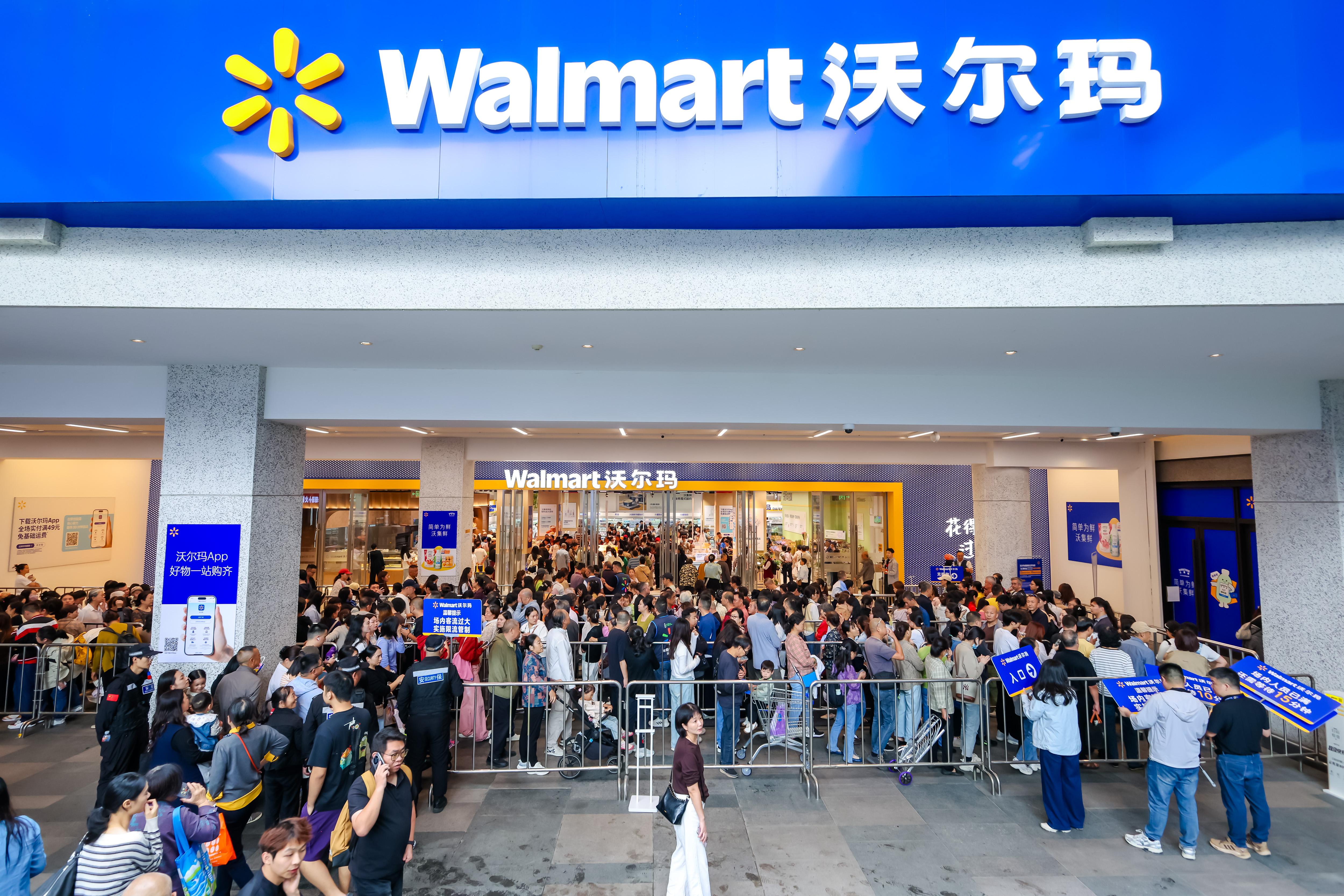
The opening of Walmart's new store in Wenjiang, Chengdu
In fact, back in April this year, Walmart's current "new-generation store" had been launched in Chengdu in the form of old store renovation. The difference of this Wenjiang store is that it is the first brand-new store opened after this store format has basically matured. Compared with old store renovations, it is less restricted by physical conditions, and can fully present Walmart's vision for "new-generation stores" from site selection and design perspectives.
It is reported that based on the new-generation store format, Walmart plans to complete the renovation of more than 100 existing stores this year, and open about 6 to 7 new new-generation stores before the Spring Festival; the omni-channel system composed of "new-generation stores", "community stores" and the Walmart App will also quickly enter more cities.
The transformation ideas formed over the past few years will now be tested under large-scale operations. At this node, we had another in-depth communication with Zhu Jun. Walmart's form may continue to change, but the thinking of this retail giant after four to five years of exploration is worth recording. These are the marks of its rethinking on the essence of retail in the Chinese market, which is full of drastic changes and fierce competition.
Therefore, before describing the changes of Walmart's new-generation stores in detail, we first extract the core viewpoints Zhu Jun shared in this communication:
On the starting point of transformation:
1. Our overall transformation, including the development of new-generation stores, is more of a response to three questions: First, who are our customers? Second, what value can our product power bring to them? Third, under the proposition of differentiation, omni-channel operation and trust building, what kind of value can we provide to customers?
2. You may feel that Walmart's statements are similar to those of other retailers. But I believe that after every store tour, you will trust our Walmart team — not just me, but all our front-line teams. Only by truly standing in the customers' shoes, understanding what they need, creating value beyond their expectations, and allowing them to spend less and live better, can we cope with such fierce market competition.
3. This year marks the 30th anniversary of Walmart's entry into China. Thirty years is a very long time. Everything we have done recently and over the past 30 years has revolved around our mission. To let customers "Save money, Live better" is our only goal.
On products and private brands:
4. Everyone has a lot of explorations and questions about private brand "Great Value". I have always said that this is not our KPI, and we have never pursued a specific proportion of private brands.
5. Whether it is a private brand or a supplier's brand, it is not a mandatory option. I think this issue has been overly exaggerated today.
6. Creating value for customers is the shared responsibility of us and brand owners, which requires both sides to keep the same pace and rhythm. This is a stage of development, and we will have more and more products from supplier brands in the future.
7. I believe that customers today need small surprises in life, and emotional value is very important. Some people get emotional value from socializing, some from music, some from sports, and some from visual effects. What I can do for everyone is to make the visual presentation of products better.
8. I always emphasize to the purchasing team to be a little more emotional. If you arrange everything rigidly with clear rules and frameworks, you will not be able to bring surprises to customers.
9. I generally don't talk to the team about "hidden gem products" or "hit products", which will make the team pursue these goals mechanically and take distorted actions. I would rather keep talking to them about customer needs.
On omni-channel operations:
10. Order fulfillment is obviously a core point based on customer service experience, which is very important. If the demand can be met through large stores, we will use large stores to solve it. If it needs to be solved through small stores, why not? If it must be solved through front-end warehouses, we will use front-end warehouses.
01 Private brand is a phased method, not the essence of product transformation
Looking back at Walmart's product transformation in recent years, the consistent main line is to first determine who we serve, and then figure out what this group of people really needs.
The most distinct change in the Kunming store at the end of 2024 was "subtraction". Traditional hypermarkets relied on large space and rich SKU portfolios to attract as many people as possible. After Walmart started its transformation, it targeted urban mass middle-class small families and single people, deleted a large number of repetitive and inefficient products, and allocated space to products with better quality, smaller packaging, good taste and affordable prices.
In 2025, its private brand "Great Value" completed brand renewal, with the brand value proposition summarized as "Simple for Freshness", which means simple ingredients, and emphasizes fresh raw materials, fresh origin and fresh experience.
At the Wenjiang store, this value proposition remains unchanged, but the focus of product development has moved a significant step forward. Ingredient list, freshness, taste and price have become a set of "basic requirements". Walmart has begun to spend more energy answering the question of how to help customers discover unperceived needs and how to make customers truly like these products emotionally.
During the store tour, Zhu Jun mentioned the "emotional value" in product details many times. When picking up flavored milk products, he would ask everyone to step back a little, and find that the illustration on the packaging box and the illustration on the inner product are perfectly matched; for many products displayed in the store, Walmart requires that the pattern and selling points of the PDQ (display carton) be completely consistent with the packaging of the products inside the box, so that customers can see the complete content from any angle; Great Value's "Osmanthus Narcissus Oolong Kombucha Sparkling Water" uses a glass bottle, which makes a short soft sound when opened, is suitable for drinking in autumn after being iced, and the price of 5.99 yuan per bottle is very attractive.
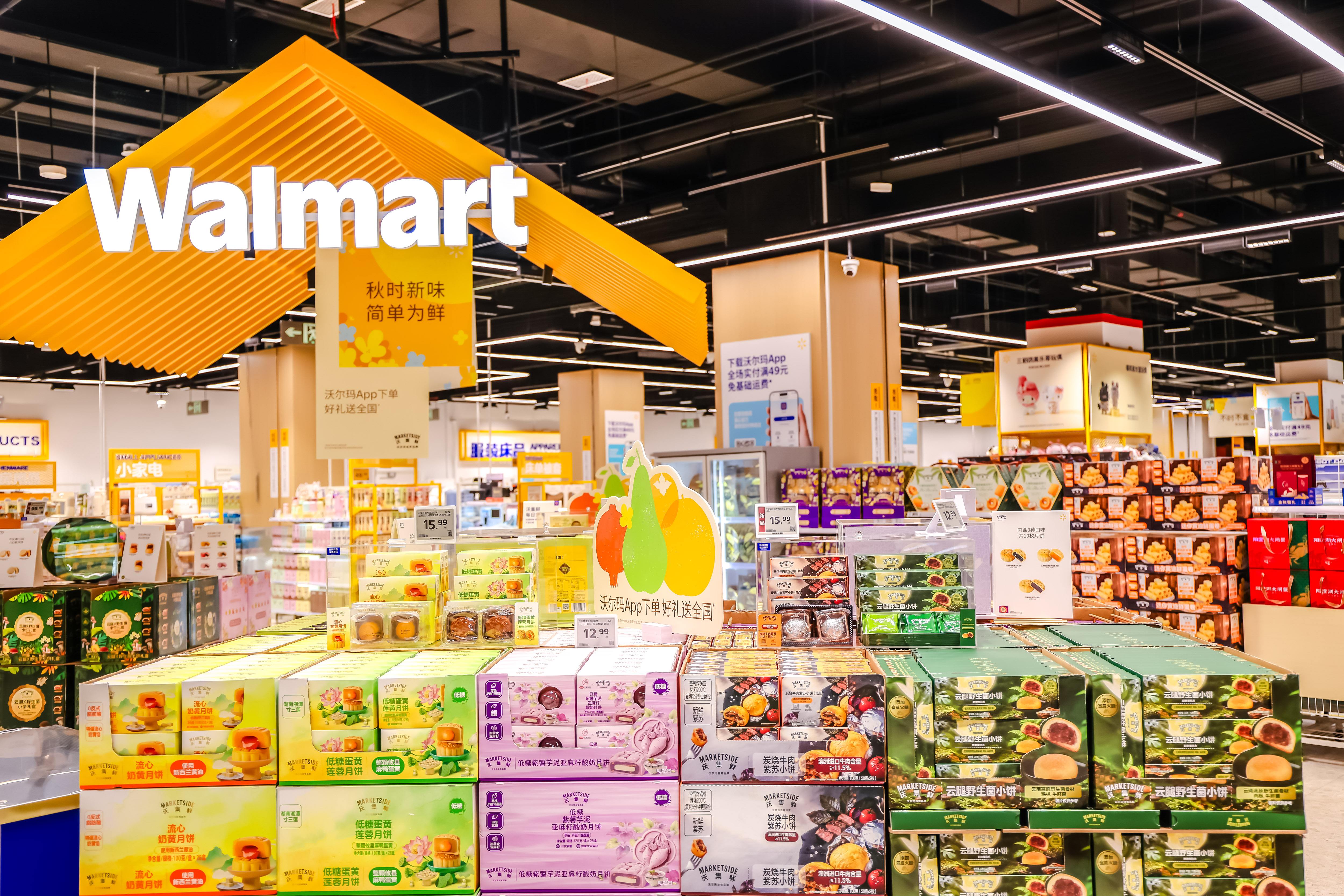
PDQ display in Walmart's new-generation store
Zhu Jun quoted a sentence from Zhu Xiaojing, President and CEO of Walmart China: "The soul of products comes from rationality and is completed by sensibility." He then emphasized, "When developing products today, sensibility is very important. If you do everything in a rigid and formulaic way, you will not bring surprises to customers." This has become a clear requirement for Walmart's purchasing team at this stage.
It is not new for retailers to talk about emotional value, but the risk is that beautiful packaging and novel tastes can easily degenerate into a faster cycle of hit product imitation. Zhu Jun rarely asks the team to develop hit products, because he believes such goals will lead to distorted operations. He more often asks purchasers: Would you buy this product yourself? Will your family buy it? What problem does it actually solve? "You are also a customer, why do you have to make things so disconnected from real life?"
The role of purchasers has also changed from "purchasing manager" to "product manager", and Zhu Jun prefers to call them "customer advocates": for a bottle of water, we need to consider whether it will fall out of the side pocket of a child's schoolbag, or whether it is too heavy to carry home; adding a spout to the grain bag can prevent moisture, but we cannot copy this design for flour, because residues left in the spout may breed insects.
Nowadays, Walmart's private brand "Great Value" seems to be in a period of explosive growth, but for internal teams, it is more like a way to establish new differentiated standards in the transformation stage, rather than the ultimate goal.
Zhu Jun has emphasized many times before that the proportion of private brands is not the KPI of Walmart's team. He told 36Kr that more products from supplier brands will appear in Walmart's stores in the future.
"Customers buy products that can meet their real needs, and they don't care whether they are private brands or not." For retailers, the real difficulty is not printing their own trademarks on more packages, but making suppliers and purchasers work together around the same group of customers.
The same logic applies to the number of SKUs. Selecting high-quality SKUs has become a common practice in supermarket transformation. The area of Walmart's new-generation store format has been reduced from about 10,000 square meters in the past to more than 3,000 square meters, but it still retains nearly 10,000 SKUs. "Reducing the number of SKUs blindly is not the goal. Making sure every SKU has value is the goal."
Regarding the area and SKU quantity of Walmart's new-generation stores, Zhu Jun explained: "We first define the target customer group and product portfolio, then confirm that a store of about 3,000 square meters can present these products well, instead of drawing a small store model first and then stuffing products into it."
Shrinking the store area and reducing SKUs are the visible physical results, but the more internal change of Walmart is that since the hypermarket era, it no longer needs to serve all people, but focuses on a specific group of customers to do a thorough job. Most of these problems need to be considered based on its own advantages and real customer needs. Including private brands and selected SKUs, every popular industry formula at present is not necessarily a universal golden rule.
02 From verifying "who to serve" to resuming new store expansion
After the Wenjiang store, Walmart will successively open new-generation stores in Nanning, Shenzhen, Liuzhou, Beijing and other places before the Spring Festival, and further accelerate the expansion of new stores next year. At the same time, after opening more than 20 community stores in Shenzhen, Walmart's community store format is also expanding out of Shenzhen to cities such as Suzhou, Guangzhou and Hangzhou.
Before the expansion, Walmart's Jinniu Store at Chengdu CapitaMall opened in April this year (the first old-renovation store of the "new-generation store" format) has brought key feedback.
Walmart has a large number of stores, but Zhu Jun pays closer attention to the operating data of the Jinniu store in Chengdu. Since the renovation, he has almost checked its passenger flow data every day. The surprising point is that the passenger flow rises steadily during the day, and the passenger flow curve rises rapidly after 6 p.m., with the peak passenger flow lasting until after 9 p.m.; in addition, the online orders of this store have also increased significantly.
Compared with the more common middle-aged and elderly customer groups in traditional hypermarkets, urban mass middle-class small families and single people are more likely to consume after work. Therefore, such a passenger flow curve also reflects from the side that Walmart is gaining the target customer group it wants.
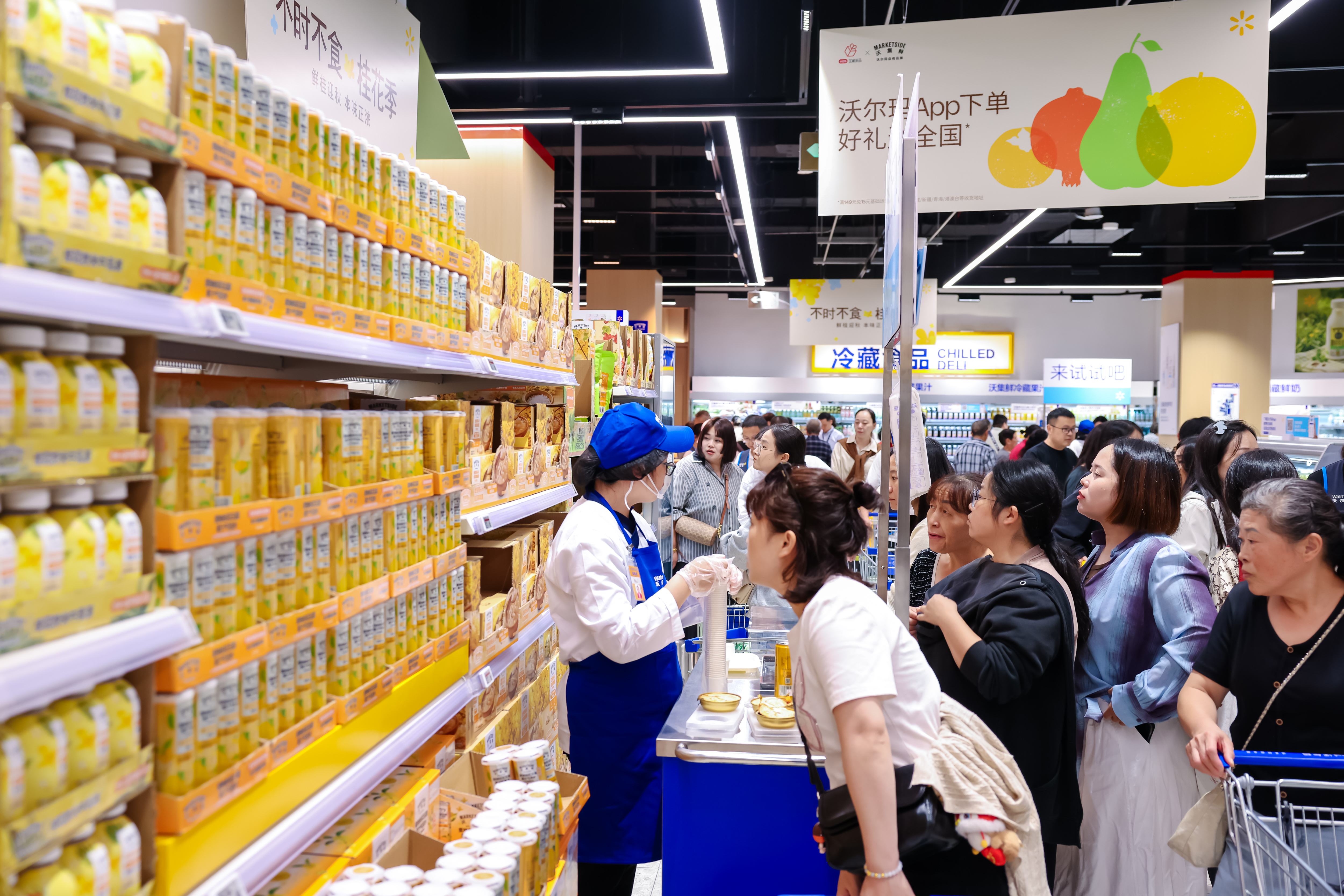
Tasting counter in Walmart's new-generation store
In terms of expansion and store format distribution, Zhu Jun also does not rely on too many fixed "formulas" or "methodologies". Where the customer needs are, and whether the available site conditions are suitable, determine what format Walmart will adopt. "If the shopping mall can provide 3,000 to 4,000 square meters of space, we will open a new-generation medium-sized store; if the site is smaller and the surrounding demand is more suitable for high-frequency replenishment, we will open a community store."
At present, Walmart's omni-channel system consists of three channels: medium-sized stores based on the "new-generation store" standard, which undertake the function of one-stop shopping and more online order fulfillment; community stores are close to residential areas, with smaller area, and the shopping space is fully returned to customers; Walmart App, as an online channel, connects near-field, city-wide and national distribution services. Among them, multiple channels target different consumption scenarios of the same group of consumers, so they share the same product portfolio, with only differences in richness and category focus.
This system still has unanswered questions, especially in the field of instant retail. As early as when the Kunming store was launched, Walmart proposed "omni-channel operations centered on physical stores"; the Wenjiang store implements this concept more specifically: heavy goods and high-frequency products are placed close to the picking area, and both packaging and display are designed to ensure that employees can find and deliver goods quickly. Within 5 kilometers around the store, the App provides delivery services with a fastest 30-minute lead time; for areas not covered by physical stores, some standard products can be delivered nationwide.
Zhu Jun has not given a definite route on whether front-end warehouses are needed in the next step and how to further improve delivery speed. He told 36Kr, "I am also learning, and the goal of learning is to understand what customers really need. One definite conclusion is that customers want faster delivery."
How to achieve "faster delivery"? "If large stores can fulfill the orders, we use