Mind Lab is dedicated to building a self-iterative post-training platform, to empower more enterprises to own their own models.
Written by Xinyi Wang
Edited by Yuxin Zhang
If you have chatted with investors casually recently, you will come to a conclusion: the focus of the AI circle has once again returned to models and AI Infra (infrastructure). The model side corresponds to the current cooling of application popularity, with heat shifting upstream; while one of the focuses of AI Infra lies in post-training platforms and inference platforms.
Yesterday, Mind Lab announced its latest achievement: the launch of Mint Recursive, an industry-oriented model post-training and inference platform, as well as Macaron-V1.1, a model post-trained based on this platform.
Macaron-V1.1 is a 752B parameter model post-trained based on GLM-5.3. Back in July, Kaijie Chen, founder of Mind Lab, told us that the interval between Macaron-V1-Preview (post-trained on GLM-5.1) and Macaron-V1 (post-trained on GLM-5.2) was less than a month. And the iteration is still accelerating. It is understood that Macaron-V1.1 took less than two weeks to iterate from the previous generation.
Macaron-V1.1 consists of a 744B base model and four 2B LoRA expert modules, of which the four LoRAs are responsible for Chat, Agent, Coding and Generative UI respectively.
Upgraded from the 1B LoRA in V1 to the current 2B LoRA, the team is also exploring a more ideal expert parameter scale. According to the Benchmark results, compared with V1, V1.1 has been comprehensively improved on 6 Agent benchmarks, with particularly outstanding performance on SWE-Marathon (long-horizon AI programming capability).
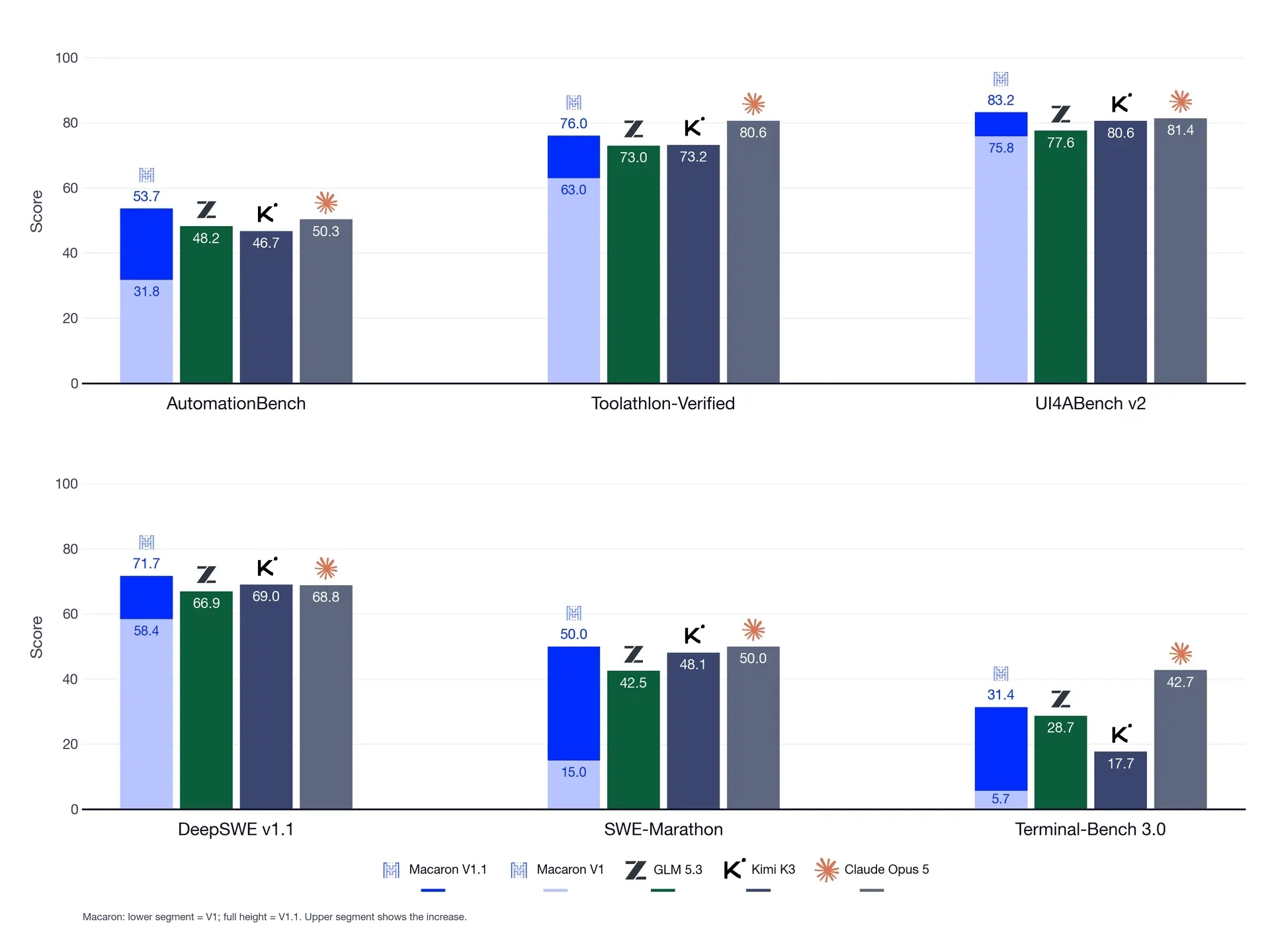
△Macaron-V1.1 benchmark performance, source: the enterprise
More notably, Macaron V1.1 is fully trained on the Mint Recursive platform.
Mint Recursive is a post-training and inference platform whose workflow includes evaluation, data processing, post-training, and deployment and inference. Users can call the platform's training and deployment capabilities via API and Python SDK; it can also access feedback from the production environment to enable continuous model improvement in real-world tasks. Mind Lab has already verified the feasibility of this full workflow during the iteration of the Macaron V1.1 model.
At this very node, Mind Lab has released a series of achievements, precipitating the know-how accumulated in the fields of continual learning and infrastructure over the past period into a set of services that can be provided externally.
Building post-training Infra
It comes as no surprise that Mind Lab is working on both models and supporting infrastructure.
Back in January this year, they took the lead in launching the early version of Mint Recursive - an infrastructure platform for LoRA training and inference, providing customers with full-process solutions for large model post-training.
At the same time, focusing on the development of Infra is gradually becoming a consensus across the industry.
A few days ago, Jie Tang, founder and chief scientist of Zhipu AI, published a long post on X elaborating their latest progress in using AI to improve AI. They enabled the Infra Agent driven by GLM-5.3 to automatically optimize GLM-5.3's own inference engine, allowing a cluster of more than 100,000 domestic chips to increase end-to-end throughput to 3 times the initial baseline in less than two weeks.
What Zhipu AI is doing is to let AI self-improve the inference layer Infra. While models are involved in optimizing themselves in both cases, the problems they aim to solve are different: Mind Lab is building a post-training platform that aims to optimize the entire process from post-training to deployment and inference, covering steps including data processing, evaluation, deployment, and feedback collection.
The Mint Recursive platform consists of three modules: Train&Deploy, Env Hub, and Data&Experience. This platform supports algorithms such as SFT (Supervised Fine-Tuning), RL (Reinforcement Learning), DPO (Preference Training), and full-parameter fine-tuning, and is compatible with open-source models of various sizes such as GLM, Qwen, DeepSeek, Kimi, and MiniMax. After training, the model can be deployed with one click, and there is a supporting evaluation system to prepare for the next round of model training.
In September last year, Thinking Machines Lab, founded by Mira Murati, former CTO of OpenAI, published a technical blog titled "LoRA Without Regret", which theoretically and experimentally proved that as long as the method is appropriate, the effect of LoRA can be comparable to that of full-parameter fine-tuning. Since then, LoRA has almost become a widely adopted solution in the post-training field.
It is worth mentioning that Mind Lab has been focusing on the "LoRA" post-training paradigm, and this time they have gone a step further on this route: in Mint Recursive, they have adopted LoRA to make both training and deployment a Serverless mode. Customers do not need to purchase GPUs or manage clusters by themselves, and can be billed directly based on Token usage.
On the training side, what Mint Recursive aims to achieve is to make models smarter - using the LoRA method to train only a small number of additional parameters, continuously learning from business feedback and iterating capabilities according to business goals, so that the models can better understand the business, while significantly reducing the post-training cost for enterprises.
On the deployment side, the four business versions corresponding to the four LoRA expert modules are each a lightweight Adapter mounted on the same base model. These Adapters do not interfere with each other and are very flexible. Each Adapter can be upgraded, launched, and taken offline independently, and historical versions are also retained for customers to compare and roll back. Customers can also merge a certain Adapter into the base model to turn it into a complete and independent model.
This is exactly the core idea of LoRA: share the base model, and only conduct targeted post-training for each business scenario. The advantage is that the cost of model post-training, deployment, and iteration can be greatly reduced, and weight adjustment is also more flexible.
Every step of post-training, including required data, evaluation, and feedback, cannot be separated from the support of Infra. It is a natural choice for Mind Lab to expand from doing post-training to building post-training Infra.
But before delivering the Mint Recursive solution, they have made a lot of preparations:
In 2025, Mind Lab began to conduct post-training research on trillion-parameter models such as Kimi K2, and the infrastructure of Mint Recursive was initially built at that time;
Subsequently, at the end of 2025, they contributed the industry's first 1T parameter level LoRA-RL to NVIDIA Megatron-Bridge, supplementing Megatron with experience in lightweight reinforcement learning for super-large-scale base models;
In mid-2026, they participated in multiple open-source projects such as Volcano Engine's reinforcement learning training framework veRL and NVIDIA's next-generation training backend megatron_lite, providing a number of LoRA and reinforcement learning solutions;
In July 2026, the Macaron-V1 series was officially released and open-sourced, verifying the effectiveness of this training solution in tasks such as Agent and Coding.
Infra is very important, but not all companies are capable of building Infra, nor do they need to build Infra independently.
The engineering difficulty of post-training for trillion-parameter models far exceeds imagination. For a startup, every part including video memory scheduling for distributed training, precision alignment for training-inference consistency, and weight hot update for asynchronous RL is a hard nut to crack.
Kaijie Chen told us that reinforcement learning for training small models is actually very easy, but once the scale goes up, the difficulty will become extremely high, especially since they have superimposed the LoRA-based continual learning training method on top of reinforcement learning.
At present, Mint Recursive mainly provides three types of services: experts work with enterprises to complete training in a form similar to FDE; automated training based on the platform; and independent training by enterprises through API and Python SDK.
Train an enterprise-specific model
More and more enterprises want to own their own models, which is also why the lightweight post-training and continual learning training paradigm is widely recognized.
From the perspective of implementation, the enterprise side is perhaps the most urgent scenario for customized models. "General large models can only cover 20%-30% of scenarios in various industries, and the remaining 70%-80% of the parts require vertical continual learning to optimize," Kaijie Chen mentioned.
The overseas market has taken the lead in verifying this trend. Fireworks AI, a Silicon Valley company focusing on open-source model inference and post-training hosting, reached a valuation of 17.5 billion USD in July this year, with ARR exceeding 1 billion USD and daily Token processing volume exceeding 40 trillion.
Joanne Wen, CEO of Fireworks AI, mentioned in a conversation with HSG: "Post-training is no longer an exclusive game for model teams. After AI products find PMF and start scaling up, post-training is almost a required course that they cannot avoid."
Specifically, compared with model vendors, the barriers of AI product companies lie in the data, real tasks, feedback, and preferences generated from real user usage. More than 95% of the traffic on the Fireworks platform comes from customer-specific fine-tuned dedicated models, rather than general base models. This logic is defined by Joanne Wen as "owning your own intelligence".
The choice of "application companies building their own models" is happening in more and more enterprises - The competitive point of AI products has gradually shifted from the product itself to the experiential intelligence of the product, including its own judgment, taste, business data, and understanding of customers.
The most unique assets of application companies come from the real production environment: they know exactly what users want to accomplish, what results are considered good, where repeated failures occur, and how professionals actually judge results. How to enable enterprises to own their own intelligence and integrate industry experience into the base model?
What Mint Recursive is trying to achieve is to enable enterprises to build their own evaluation systems, reward mechanisms, and training data, and turn post-training into a closed loop of continuous iteration: after serving users, the model accumulates data of real task scenarios, and the trajectory of each interaction, whether successful or failed, is fully recorded.
Among them, the failed trajectories are quite valuable: where mistakes are made, why they happen, and how to fix them. After the platform identifies the problems and solutions, these judgments and trajectories will directly become new training data. After the new model trained with new data is launched, new feedback will be generated, which will become the input for the next round of training, and the cycle goes on.
The Env Hub (environment) link in the platform is easy to be ignored, but it is particularly critical. A technical blog about Agentic RL from NVIDIA mentions that doing Agent reinforcement learning requires an environment to define datasets, verifiers, and states. The environment is not only a training ground for models, but also an evaluation ground. Evaluation, synthetic data processing, and reinforcement learning can all be completed in one set of environment.
Although the Recursive (recursion) feature in Mint Recursive is still in its initial form - humans are still in the recursion loop, and it is still far from the scenario where the model trains itself fully automatically, the direction of model iteration is very clear. For customers, what is more important is not the model itself, but the front-line business scenarios and unique real business data owned by the enterprise.
Image source | Provided by the enterprise

Welcome to follow us~

Welcome to communicate with us~
This article is from the WeChat official account "Intelligence Emergence", written by Xinyi Wang, and published with authorization from 36Kr.