36Kr Global · AI | From Production to Operation: How AI Reshapes the Competition Chain of Overseas Expansion

Reducing costs by nearly 90% and boosting efficiency by dozens of times, generative AI brings explosive productivity to the short drama industry.
This further fuels the global expansion of micro short dramas: enterprises can produce and translate more content in a shorter period, and test different themes and markets at lower costs, driving a new round of rapid growth in the global short drama market. DataEye Research estimates that the overseas AI drama/manhua drama market will reach 650 million U.S. dollars in 2026, marking a roughly 550% increase from the approximately 100 million U.S. dollars in 2025.
However, after the supply increases, new problems emerge. There are still translation, localization, transcoding, storage and distribution processes between the generation of a short drama and its availability to overseas users. After entering emerging markets, differences in network environments, terminal devices and languages will further increase delivery costs, and massive content has brought greater challenges instead.
This contradiction is not unique to the field of content going global. AI makes content production and product development faster, but it cannot shorten the necessary links for global operation. The more video content there is, the more complex the subsequent localization process and global distribution link will be; as the speed of application development and launch increases, model services are not necessarily closer to users, and problems of cost, security and stable delivery will appear accordingly. With more and more users and easier access to overseas users, it is more likely to generate fragmentation among markets, channels and business processes.
When overseas business grows on a large scale, the systemic pressure originally scattered after production will surface one by one. Enterprises not only need to produce and acquire customers faster, but also need a systematic global operation capability to support the growing content, products and users after the release of production efficiency.
01 After the growth of content supply, localized distribution becomes a new cost
Micro short drama is one of the typical industries whose productivity has been greatly liberated by AI, but the global expansion of short dramas is far more than translating Chinese content into another language. When a piece of content enters different markets, it is necessary to process subtitles, pictures, dubbing and transcoding, and distribute it according to local network and terminal conditions. When the number of content increases from dozens to hundreds and thousands, these easily overlooked tasks will quickly accumulate into huge costs.
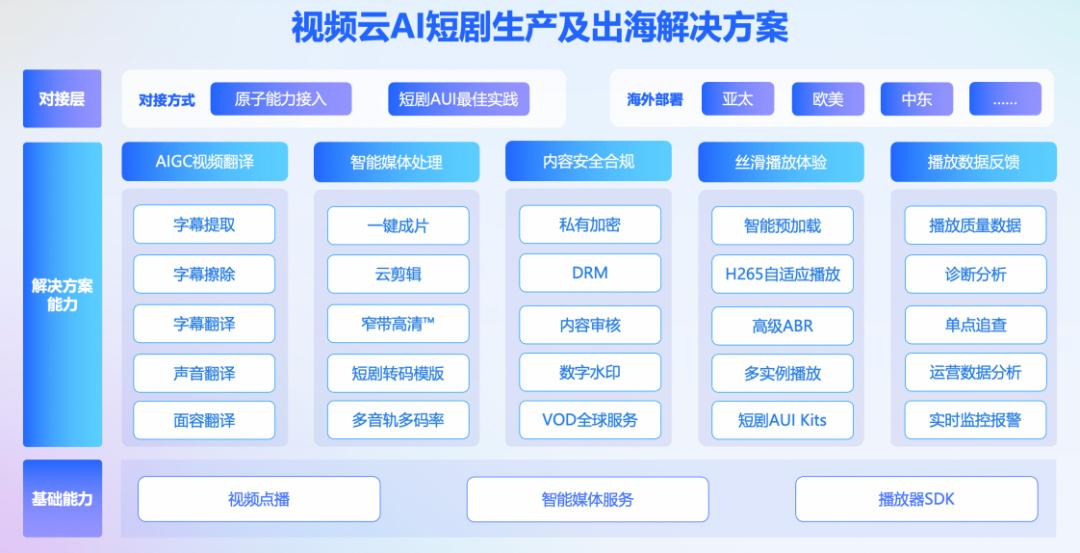
The solution required for micro short dramas to go global therefore extends to the whole process of content production and global distribution. At the recent Yunqi Conference, Alibaba Cloud shared a set of video cloud AI short drama production and global distribution solutions, integrating generation, translation, transcoding and global distribution into the same link.
On the production side, it optimizes the localization speed while reducing the cost of content generation. Under the video cloud solution, customers can first generate 480P content, and then supplement it to 720P/1080P through super-resolution, which greatly reduces the generation cost while maintaining the final delivery specification. In the past, when a short drama entered different language markets, it was often necessary to process subtitles, dubbing and pictures separately. The global distribution solution processes in batches through subtitle extraction, subtitle erasure, translation and synthesis, and can further carry out multi-language sound-level translation, processing audio-video synchronization and background sound while retaining the original timbre and tone. For short drama platforms that need to enter multiple markets at the same time, this is equivalent to compressing the originally scattered localization work into one process.
After the production efficiency is improved, the distribution is also optimized synchronously to keep up. In the past, adding a new language often meant completing a full video transcoding and storage again. The larger the content scale, the higher the cost of repeated processing. The video cloud realizes one-time transcoding and multi-language distribution, reducing the overhead of repeated transcoding for different language versions; the narrowband high-definition can reduce the transmission bit rate while maintaining the picture quality, compressing the distribution traffic from the source, and cooperating with global CDN distribution and weak network environment adaptation to further deliver massive content to users in different markets. For example, for the weak network environment, the video cloud optimizes through the end-cloud joint algorithm, realizing a 40%+ reduction in bit rate and 87% reduction in stutter rate for short drama platforms in weak network links, providing a smoother playback experience.
For short drama platforms, undertaking and distributing massive supply at a controllable cost is a problem that must be solved in the next stage of large-scale growth. From production to distribution, the new content supply brought by AI is supported by a whole video cloud global distribution link.
02 Global growth of AI applications, delivery and security become new thresholds
The same challenge also occurs in the AI application field, with an even more complex link.
In the past, when software products entered overseas markets, the first problems to solve were development, customer acquisition and localization. After AI lowered the development threshold, more and more AI applications can enter new countries and regions in a very short time, but the model services themselves are still often deployed domestically or concentrated in a single region, and the cross-border link directly affects the user experience of AI applications that require long connections and streaming output. The longer users wait for the first token, or the stutter or connection interruption during the generation process, may lead to request retries or task re-runs, increasing additional model invocation and computing resource consumption.
AI applications also face more prominent security and cost risks than traditional applications. DDoS, CC, malicious crawlers and high-frequency API scans may continuously generate model requests and consume reasoning resources. Problems such as prompt injection and sensitive information leakage are more likely to appear in the full link of requests and responses. Every risk may mean real computing power expenditure.
For AI applications, the distance between global users and model services will eventually turn into experience, cost and security challenges. What Alibaba Cloud ESA (Edge Security Acceleration) solves is exactly this global delivery link. It serves not only a single type of AI product, including MaaS model services, multi-model aggregation platforms, but also AI Agent, AI office, Vibe Coding, AI site building and other applications. The common point of these AI application products is that users are distributed all over the world, while the model services and applications themselves are often still deployed centrally. It is necessary to maintain a relatively consistent access experience in different markets and establish a unified security baseline at the same time.
With ESA (Edge Security Acceleration), global users access nearby global nodes, and then connect to the actual model services through intelligent routing and cross-border networks; capabilities such as long connection maintenance, fault switching and request rate limiting can reduce interruptions caused by network fluctuations. VPC private network back-to-source avoids the origin station being directly exposed to the public network, and capabilities such as WAF, DDoS, Bot and API security intercept abnormal traffic at the edge side, plus AI security capabilities such as prompt protection and sensitive information detection, to keep risks out before model invocation as much as possible.
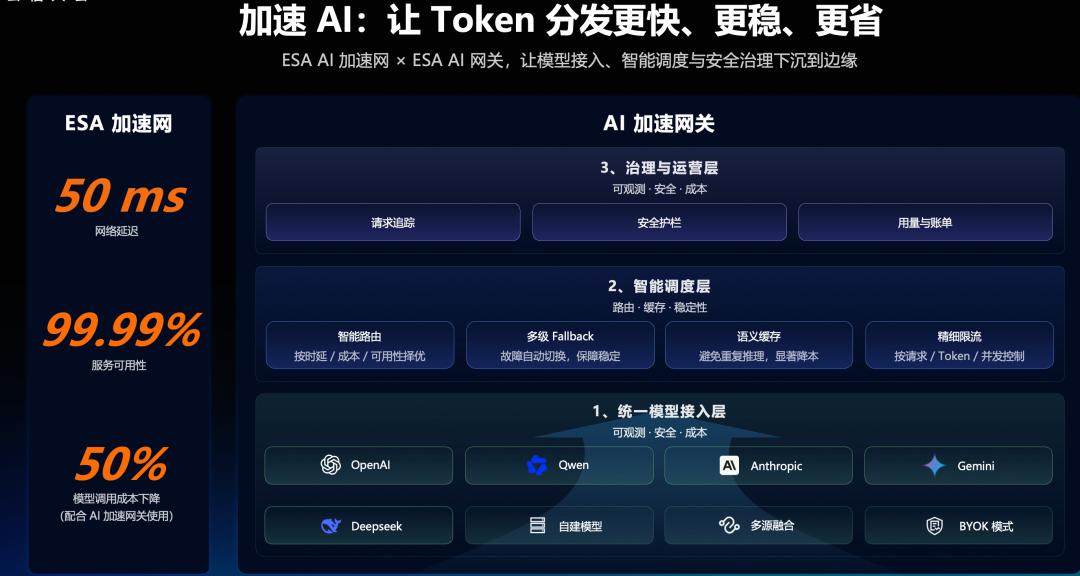
There are also efficiency problems in model invocation. For AI applications that access multiple models at the same time, it is difficult to take into account latency, cost and availability by fixedly invoking a certain model. The ESA AI acceleration gateway can reduce duplicate requests through semantic caching, and then combine with intelligent model routing to select according to the latency, cost and availability of different models, and switch automatically when the service is abnormal. AI applications such as Bailian multi-modal application, QwenWork, Qwen Cloud International Station and MuleRun have all accessed this delivery link to reach global users.
Users will not lower their requirements for delivery just because the application is developed faster. After the development efficiency is improved, whether the model service can achieve the balance of speed, cost and security and continuously deliver to global users determines whether it can be truly transformed into business efficiency.
03 After acquiring users, global expansion enters a longer operation cycle
When enterprises can stably deliver products to global users, the next step is no longer just customer acquisition, but continuous operation.
In the past, enterprises going global paid more attention to how to acquire users through overseas placement and channel systems, but when customer acquisition costs continue to face pressure, user life cycle value is becoming more and more important. However, communication channels and modes preferred by different overseas markets are different, and the information required for user registration, purchase, consultation, after-sales service and repurchase also varies. If these channels and business processes are fragmented from each other, user operation will easily stay at the stage of sending a single message and fall into silence again.
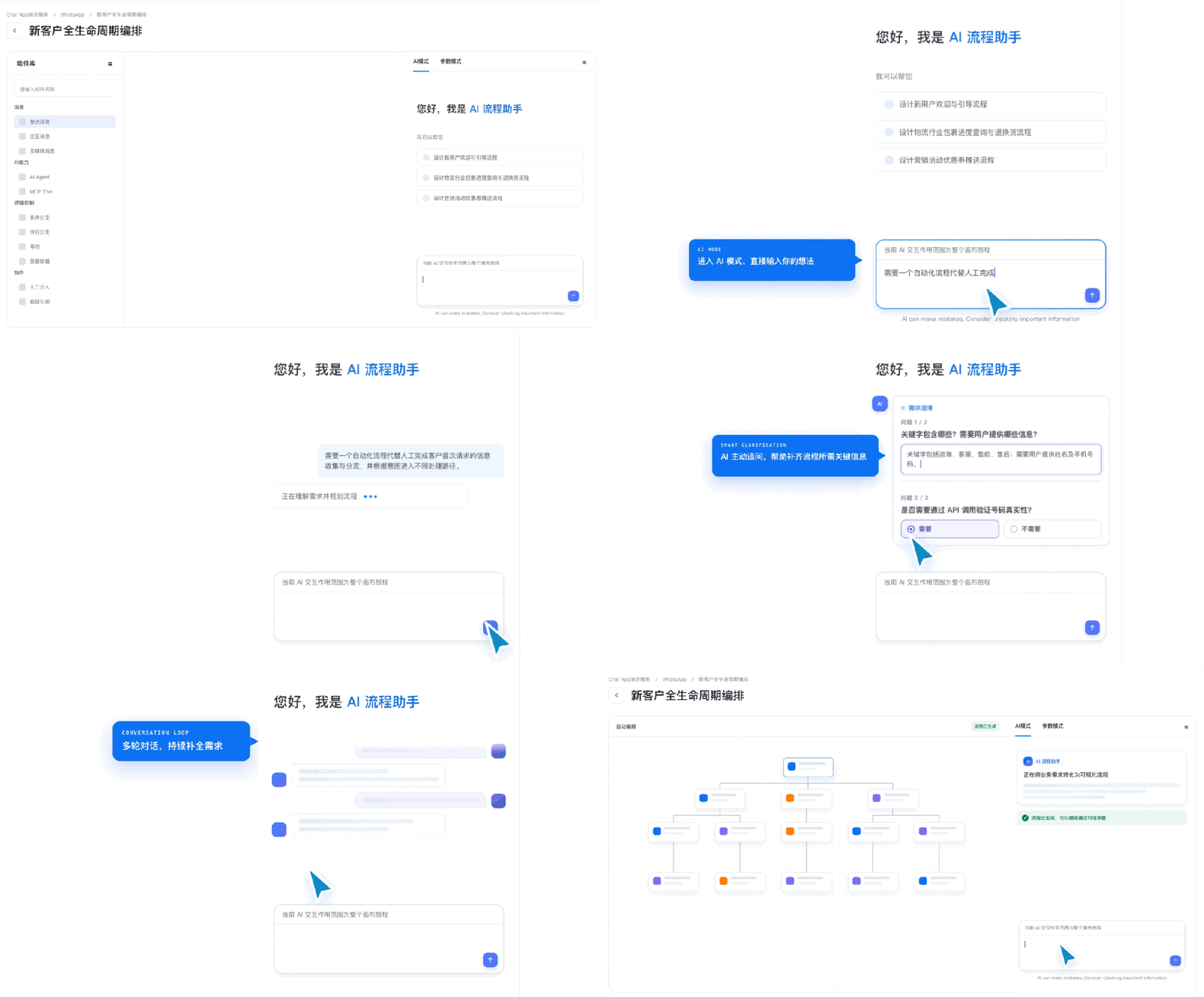
Alibaba Cloud Chat App message service combines multi-channel communication, operation process orchestration and AI-assisted construction. Channels such as SMS, WhatsApp, LINE, Telegram and Viber are connected in a unified manner. Enterprises can arrange the touch time, channels and content around user status, and then enter the next process according to user responses. The "Agentic Journey" released at this year's Yunqi Conference allows enterprises to start from describing business scenarios and operation goals, and let AI actively ask questions, clarify requirements and build processes; when activity strategies or user operation requirements change, they can also adjust through natural language, lowering the threshold for process construction and modification, and accelerating the speed from idea to execution.
Taking cross-border e-commerce after-sales service as an example, enterprises can orchestrate intention recognition, business system query and manual takeover into a continuous service process through Agentic Journey. When a customer asks about the logistics progress on WhatsApp, after the AI recognizes the intention, the process calls the order interface to obtain the status, and then generates a natural language reply; if it involves return or exchange, it collects the reasons through dialogue and enters the corresponding branch according to the policy. Complex problems or strong negative emotions will trigger manual takeover, and customer service can view previous dialogues and customer information to continue processing.
This process enables automatic response across time zones for common problems such as order queries, leaving human energy for problems that require judgment and coordination; at the same time, it precipitates groups such as returns and exchanges and customer feedback to provide basis for subsequent follow-up. Its value is not only to reply to a message faster, but also to connect customer needs, business data and processing actions, reduce repeated queries and transfer communication, and promote the service continuously.
From content distribution to application delivery, and then to user operation, AI has greatly improved the efficiency of individual links. What enterprises going global need to solve next is to make these links operate continuously and efficiently along the global business system link.
04 Competition for global expansion in the AI era shifts from production capacity to systematic capability
In the past, the primary problem faced by enterprises going global was how to produce good products and content that adapt to the whole world. As AI lowers the threshold for content production and software development, work that used to rely heavily on manpower such as translation, localization and customer service has gradually become an automated process, accelerating the speed for enterprises to enter new markets.
However, the faster the production end is, the greater the pressure on subsequent links. The faster the short drama production speed, the greater the cost of distribution and localization; the faster the AI application goes online, the higher the stability requirements for global delivery; after the user acquisition efficiency is improved, the gap in retention and operation is also exposed.
This is the change that is taking place in the competition for global expansion in the AI era.
AI has lowered part of the entry threshold for globalization, but the links after production have become a new efficiency battlefield. This is why from content distribution, AI application delivery to user operation, Alibaba Cloud is continuously extending AI efficiency improvement to more links of the global operation system. For enterprises, whether they can continue to grow on a large scale ultimately depends on whether they can establish a system capability that supports global operation, undertake more content, serve more markets, connect more users, and turn the production efficiency released by AI into real business growth.
Image | Enterprise provided, Unsplash
Upcoming Events
The registration channel for 2026 Beijing International Investment and Trade Fair is now open
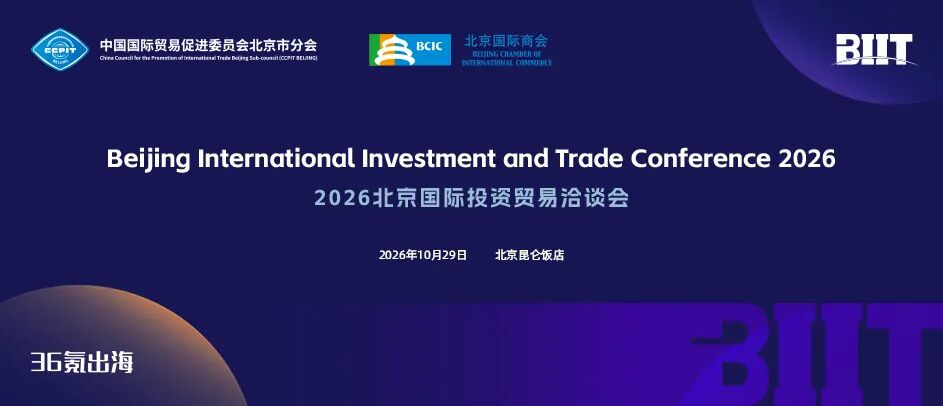
On October 29, the "2026 Beijing International Investment and Trade Fair" co-hosted by CCPIT Beijing and Beijing Chamber of International Commerce will be held at Beijing Kunlun Hotel. The conference focuses on Beijing's investment opportunities, cross-regional industrial coordination and two-way cross-border empowerment, bringing together Chinese and foreign government representatives, leading industry enterprises, think tank experts and investment institutions. The conference is now open for event registration and 1-on-1 business negotiation applications for enterprises, building a pragmatic docking and negotiation platform for two-way investment and industrial cooperation between Chinese enterprises and overseas government and enterprises. You are welcome toclick "here" to submit your registration application. Enterprises with clear docking requirements must submit their B2B negotiation intentions at the same time when registering. The main conference adopts a screening system, and we will arrange the review as soon as possible after receiving your registration and notify you separately.
The full agenda and guests of "Dubai Business Forum · China" are released, and registration is entering the countdown
The 5th "Dubai Business Forum · China" will be held in Shenzhen on October 14, and the official full agenda has been officially released. This forum brings together many successful entrepreneurs, industry leaders and senior government representatives from China and Dubai, to carry out in-depth dialogues on core topics such as bilateral cooperation, AI opportunities, industrial investment, and logistics infrastructure. Representatives of many Chinese enterprises such as Baidu Apollo Go, Tencent Cloud and Huawei Cloud will share practical experience and regional insights of landing in Dubai; core institutions such as Dubai Chamber of Commerce, Dubai Department of Economic Development, and Dubai Future Foundation will interpret policy trends and industrial directions on the same stage. The registration review is now in the final stage, please scan the QR code below orclick "here" to register. All registration information will be uniformly reviewed and screened by the organizer, and you will be further notified of the specific meeting arrangement after passing the review.
