Quenching thirst by drinking poison, multiple express delivery companies have raised their prices once again.
A new round of price hikes for express delivery has started.
According to reports from a number of authoritative media including 21st Century Business Herald, Hunan Daily and CLSA, a number of express delivery companies recently issued notices stating that the price per shipment will be officially increased from 00:00 on September 20, 2026.
Based on comprehensive information, the increase range varies in different regions.
I. Price Increase Per Shipment, the Continuation of Anti-Involution
Express delivery companies including ZTO, YTO, STO and J&T issued notices stating that starting from 00:00 on September 20, 2026, the express service fee for all outlets and cooperative customers in Jiangsu region will be uniformly increased by no less than 0.1 yuan per shipment.
This price increase is mainly based on the operating cost of the outlets themselves and the need for network stability. The broader background is that the peak season is coming, and it is necessary to ensure the stable operation of the delivery network and maintain a healthy and sustainable business order.
In addition to Jiangsu, the Anhui region also ushered in a price increase at the same time, with a unified minimum increase of 0.15 yuan per shipment on the basis of the original implemented price. This adjustment applies to all delivery customers' delivery services.
The reason for the price adjustment is similar to that in Jiangsu, to ease cost pressure and ensure stable operation of service quality and service network. STO Express also stated that it will gradually improve the long-standing problems such as low terminal delivery fees and difficult operation of outlets caused by low-price competition.
This is not the first price increase this year.
In March and April, express delivery enterprises such as J&T, ZTO, YTO and STO have already raised their express delivery prices.
Whether it is the increase in the price per shipment in March and April or this increase, when viewed on the timeline, every price increase is the continuation and deepening of the "anti-involution" in 2025, and it is another phased action to promote "anti-involution".
For express delivery companies, although the price increase per shipment each time is not much, considering the total shipment volume of the companies, the total revenue is considerable. If each shipment is increased by 0.1 yuan, 100 million shipments will bring 10 million yuan in revenue, and 1 billion shipments will bring 100 million yuan in revenue.
Up to now, "anti-involution" is no longer a direction that needs to be demonstrated for feasibility, but an action that must be taken. In the past, the express delivery industry was deeply trapped in price wars and involution, with prominent contradictions such as the tug-of-war between grassroots income and service quality, and between franchisees and superior companies.
Under this background, raising the price per shipment is an important path to promote "anti-involution".
However, it should be noted that "anti-involution" ultimately needs to solve not only the price problem, nor just the profit problem of the express delivery company's headquarters, but the improvement of the entire express delivery chain, including the survival status of terminal outlets and the rights protection of the courier group. Only when the grassroots status is improved with the price increase, can the express delivery industry truly get out of the quagmire of involution.
Interestingly, after several price increases, express delivery companies have been shouting loudly about the slogan of improving the grassroots survival status, but the voices of complaints from the grassroots are still loud, and this contradiction is not accidental.
II. The Contradiction Behind the Price Hike: Where Has the Money Gone
Delivery Guide observed that when express delivery companies announce the increase of price per shipment, there are always voices inconsistent with the caliber of express delivery companies, for example: "Only the delivery price for outgoing parcels is raised, not the delivery fee for incoming parcels." "It only treats the symptoms but not the root cause. What should be adjusted most is the couriers' delivery fee." "Stop promoting it blindly."
"Don't use the excuse of stabilizing outlets."
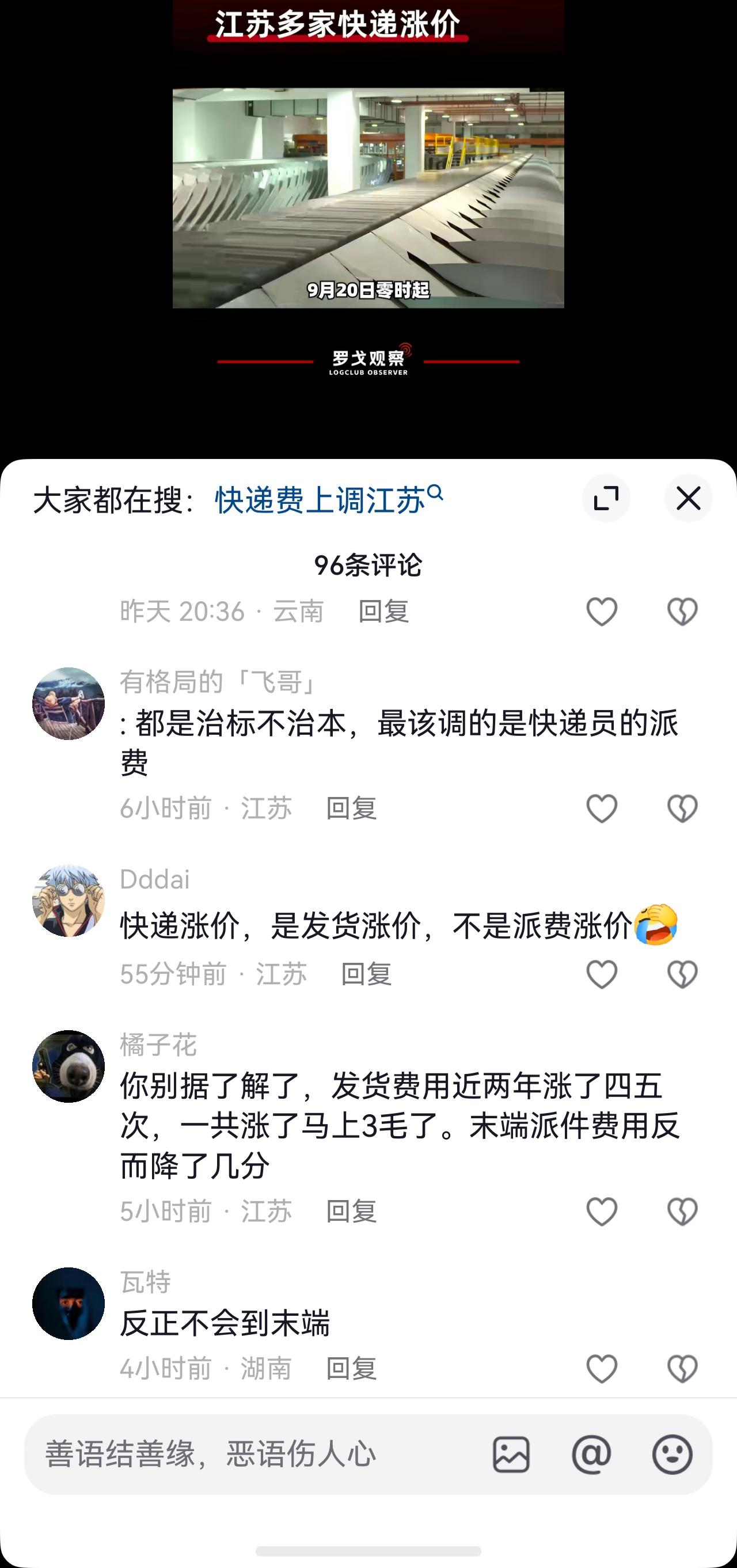
It is precisely these discordant voices that reflect the bug behind the price increase per shipment: there is an obvious mismatch between the intention of the increase and the reality.
Since the "anti-involution" in 2025, express delivery companies have raised the price per shipment for many times. In contrast, the delivery fee for couriers has been falling. This means that express delivery companies directly skip from the first step to the last step in the so-called chain of "price increase per shipment - improving grassroots status - stabilizing service network - increasing corporate profits".
"Last year the price increased by 0.2 yuan, this year it increased by 0.15 yuan, but neither the delivery outlets for incoming parcels nor the outlets for outgoing parcels get a share of the extra revenue."
"After the price hike, has the couriers' delivery fee increased?" "It has been secretly reduced."
Where has the new revenue from the price hike gone? Everyone has a common answer: the headquarters of the express delivery companies. This sum of revenue may be used for intelligent upgrading, other cost consumption, or shareholder profit sharing.
The reason for such differences lies in the different demands between the headquarters of express delivery companies and the grassroots.
As the rule maker, the headquarters of express delivery companies needs market share, business volume and impressive financial reports. Its logic is scale-oriented and profit-oriented: with large business volume, low cost and high profit, it is easy to tell a good business story.
As the executors, franchisees and couriers need to consider the gap between execution cost and income.
The two sides have inconsistent goals and do not work in the same direction, which is why there are always discordant voices since the implementation of "anti-involution".
Essentially, people are not opposed to price hikes, but to the price hikes that "only adjust the price without adjusting the distribution method". In the end, the contradiction between the headquarters of express delivery companies and the grassroots is increasing rather than decreasing.
III. Spillover of Costs
The cost of this contradiction is not only borne by outlets and couriers alone, merchants and consumers are also not spared.
"The express delivery price hike tide, all express delivery companies have raised prices collectively, how much more have e-commerce friends paid?" Someone asked like this.
For merchants, the rise in express delivery fees means higher costs. How to deal with this sum of money? Either the merchants reduce their own profits, or pass the cost on to consumers, for example, quietly modifying the product price, or quietly modifying the free shipping threshold.
But the problem is that compared with the past, after merchants or consumers bear this part of additional cost, they may not get better delivery services than before.
After all, in the price hike tide, the income of grassroots personnel in the terminal link has not increased, and consumers cannot enjoy better delivery experience due to the price increase.
As a result, an awkward closed loop is formed: express delivery companies announce price hikes, merchants pay the bill, the grassroots status of express delivery companies remains unchanged, and consumers may secretly bear the cost of price hikes while the services they enjoy remain the same.
All in all, Delivery Guide believes that the real "anti-involution" of the express delivery industry is not just about express delivery companies raising prices, but requires re-formulating the benefit distribution mechanism, at least forming a virtuous cycle among the headquarters, franchisees and couriers within the express delivery companies.
This article is from the WeChat official account "Delivery Guide", and 36Kr publishes it with authorization.