Qwen's new top leader makes his debut, can Liu Dayiheng withstand the pressure?
When talking about who bears the most pressure in China's AI circle, Wenfeng Liang, Zhilin Yang, Shunyu Yao and Jie Tang are all on the list. But from now on, Dayiheng Liu is also shouldering tremendous pressure, no less than the others.
On March 4th, after Junyang Lin left a message saying "Farewell, my beloved Qwen", Qwen entered a six-month period without a top leader.
At the beginning, the top position of Qwen was temporarily taken over by Jingren Zhou, CTO of Alibaba Cloud. Later, the Tongyi Large Model Division and the Future Life Laboratory merged to form the Token Foundry Division, which is directly led by Yongming Wu.
On September 22nd, at the main forum of the Yunqi Conference in Hangzhou, after the speech by Yongming Wu, CEO of Alibaba Group, Dayiheng Liu, who joined Alibaba in 2021 and was in charge of pre-training, post-training and programming in the post-Junyang Lin era, took the stage as the head of Qwen.
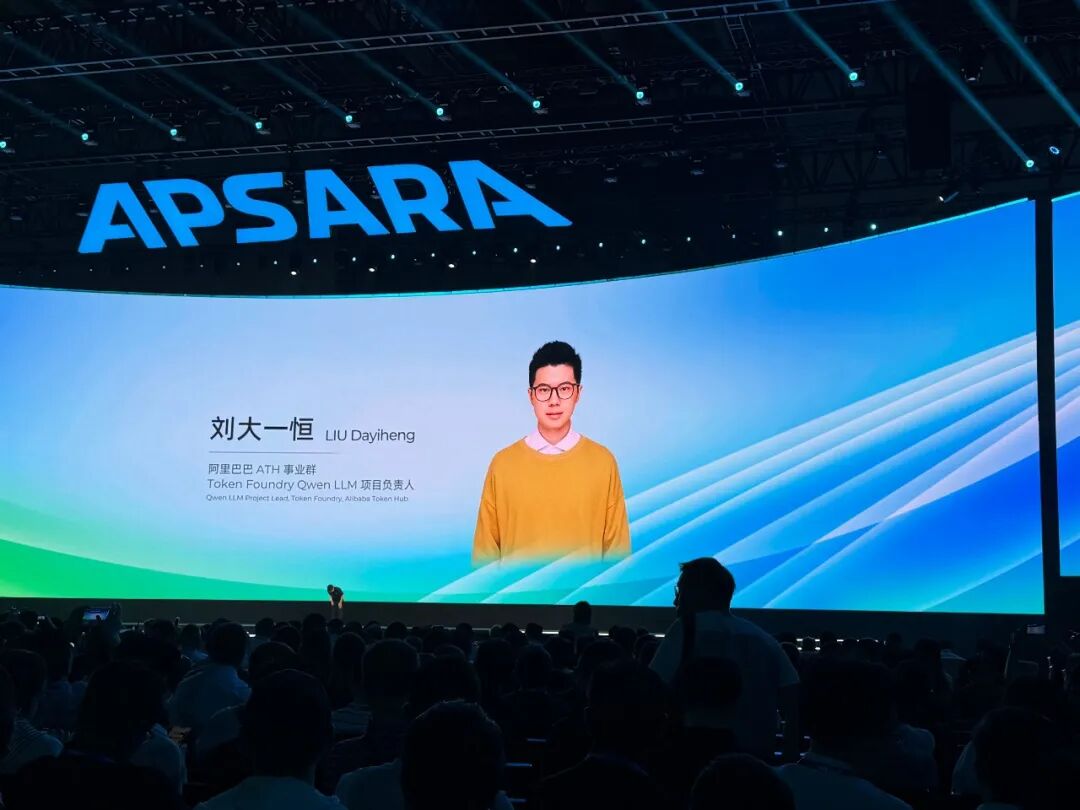
This is also his first public appearance as the new top leader of Qwen.
In terms of open source ecosystem, Qwen still ranks first in the world, with 3 billion downloads, 300,000 derived models and more than 460 open source models, topping the Hugging Face leaderboard for a long time.
But the model itself does not have an optimistic position. Although the flagship Qwen 3.8 Max ranks first in the Agentic Index of Artificial Analysis, it only ranks seventh in the intelligence index.
Therefore, when Dayiheng Liu took the stage today, what he presented was not only a roadmap, but also a statement. After losing its core leader, when competitors at home and abroad are catching up one after another, what exactly will Qwen rely on to move forward?
Can Dayiheng Liu withstand the pressure?
Qwen's Roadmap
At the Yunqi Conference, Yongming Wu defined the three cornerstones of the "machine intelligence era" as AI models, AI chips and AI cloud, and put forward two judgments: the total amount of thinking generated by machines in the future will be more than 1000 times that of human beings, while this proportion is less than 3% today; today's AI Coding is just like the electric light in 1882, which replaces existing work but is not enough to create a new era.
At the same time, Yongming Wu said that the Qwen team is making progress in Recursive Self-Improvement (RSI), and future models will be scaled up to 5 to 10 trillion parameters.
Shortly afterwards, Dayiheng Liu took the stage and introduced the future roadmap of Qwen as the head of Qwen.
Centering on this judgment, he laid out Qwen's roadmap, which can be roughly divided into five lines.
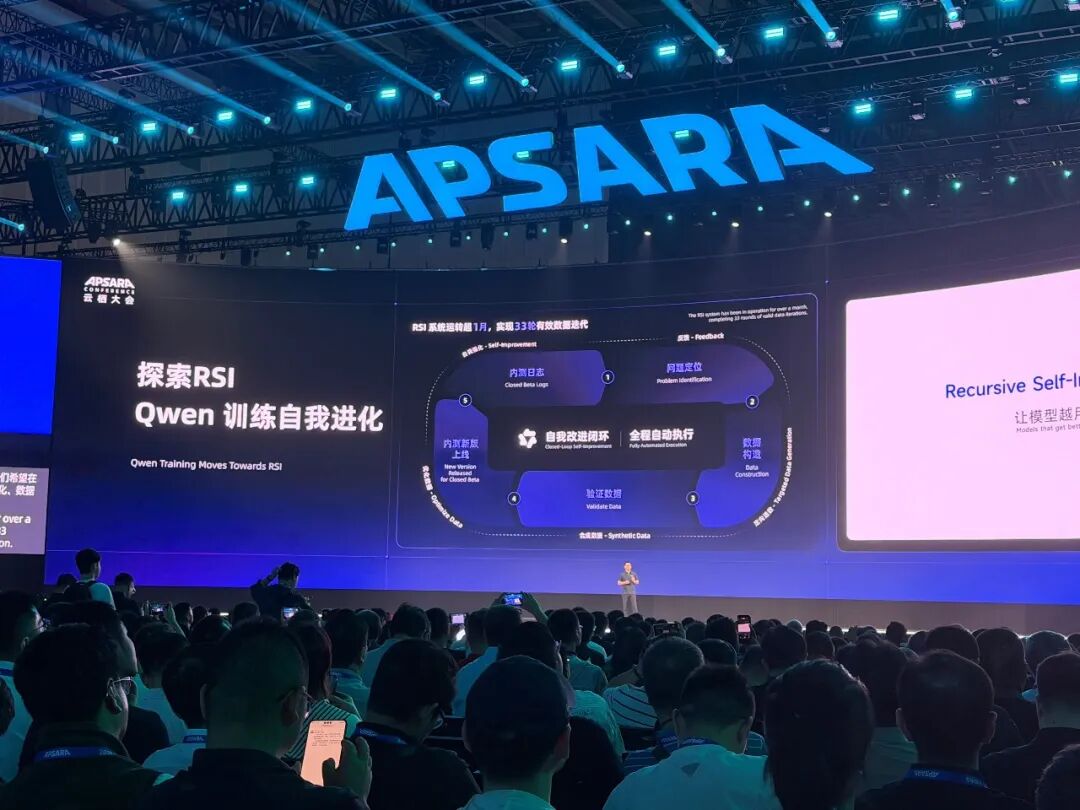
The first line is self-improvement, which refers to the RSI mentioned by Yongming Wu.
Qwen3.8-Max can already independently build training pipelines, construct training data, design experiments and locate defects with almost "zero human participation", and has completed continuous iteration for more than one month with 33 rounds of effective iterations.
As a result, its Artificial Analysis evaluation score increased from 40 to 45, representing an improvement of about 12.5%.
In terms of hardware collaboration, it has independently adapted to the new architecture of C-Sky, increasing the throughput of a single instance of the inference framework by 96%. In terms of chip co-design, relying only on the bus module specification, it reduced the physical implementation area by 42% through 60 hours of self-iteration and more than 10,000 calls to EDA tools.
However, Dayiheng Liu said that RSI is currently "initially involved in model training, inference and chip-model collaboration and other links", and it is not yet in a fully unmanned mature state.
The second line is architecture iteration.
Qwen4 based on the new generation architecture has entered the training phase, and Qwen4-27B will be prioritized for the open source side. As for the subsequent Qwen4.5 and Qwen5, the plan is to expand the parameter scale to the order of 5 trillion to 10 trillion.
Dayiheng Liu emphasized in his speech that the expansion of parameter scale is still one of the core paths to ASI. At the same time, Qwen3.8-Flash open sourced the next-generation architecture in advance, and the official said that the training cost has been reduced by nearly 90%.
The third line is unified multi-modality.
Dayiheng Liu believes that Qwen3.8-Omni marks Qwen's entry into the stage of unified multi-modal understanding.
Supporting products include the image model Qwen-Image-3.1, the audio model Qwen-Audio-3.1, the simultaneous translation model Qwen3.8-LiveTranslate, as well as music models, world models and the next-generation video generation model scheduled to be released in November.
The fourth line is open source and openness.
"The value of AI should not belong only to a few enterprises, but should become a basic capability that users all over the world can access, use and create," Dayiheng Liu said, "so that more people can afford AI, have access to AI, and participate in creating AI."
Then Dayiheng Liu said that Qwen will continue to adhere to open source and openness in the future.
The data given by Dayiheng Liu shows that Alibaba has open sourced more than 460 models in total, the Qwen series has been downloaded more than 3 billion times worldwide, and the number of derived models exceeds 300,000, ranking first in the world.
Only two months after the release of Qwen3.8-27B, the total number of downloads of the entire Qwen family has surpassed that of open source models such as DeepSeek and Llama, making it the most liked model series on Hugging Face.
The fifth line is end-side and terminal implementation.
On the desktop side, the open sourced 27B model can run locally. On the mobile side, Alibaba released Qwen Intelligence, a full-stack solution for AI mobile phones, enabling mobile phones to complete complex cross-application tasks.
In addition, it also involves AI glasses, desktop robots, and the Xuan Tie C950 CPU based on RISC-V, which can natively run Qwen3.8-27B.
These five lines do not operate independently, and together they form Alibaba's complete strategy in AI.
RSI deals with "how the model improves itself", architecture iteration deals with "how high the performance ceiling can reach", multi-modality deals with "what it can understand", open source deals with "who can use it", and end-side deals with "where it can be used".
What they serve together is the goal of "real-world Agent" mentioned by Dayiheng Liu, which enables the model to evolve from a dialogue tool to a system that can independently complete tasks.
Dayiheng Liu's first appearance in public from behind the scenes has covered the three major directions of hardware, software and strategy.
About Dayiheng Liu
Dayiheng Liu is from Zigong, Sichuan Province. The name "Dayiheng" is not common, and many people even thought it was his Alibaba alias.
In 2012, he was admitted to the College of Computer Science of Sichuan University. In 2015, he was recommended for the "3+2+3" bachelor-master-doctor continuous program with the first comprehensive ranking, and his supervisor is Professor Jiancheng Lyu.
In 2017, Dayiheng Liu went to the National University of Singapore for exchange. In 2020, he received his doctorate in computer science from Sichuan University.
From undergraduate to doctorate, he stayed at Sichuan University all the time, with no overseas education experience and no background from Tsinghua University or Peking University. This is different from the common path in the AI circle of "undergraduate from top domestic university — overseas doctorate — experience at large tech companies".
His first entry into the public eye was related to a paper.
In 2019, he published a paper at ACL (Annual Meeting of the Association for Computational Linguistics), which was the first time that a postgraduate student at Sichuan University published a paper at ACL.
He later mentioned in an interview that he did not submit his resume to Huawei. Instead, after the paper was published and the school's official website reported his scientific research achievements, Huawei took the initiative to contact him.
After that, Dayiheng Liu rose to fame overnight.
In 2019, he participated in the Natural Questions (NQ) global long-term public competition held by Google.
The task of this competition can be summarized as: let the system "read the entire Wikipedia page" and then answer the question entered by the user in the Google search engine.
It has two difficulties. The first is the long document: a Wikipedia page often has thousands or tens of thousands of words with high information density. The second is the open domain: there is no preset scope for the questions, and anything may be asked.
Long documents and open domains were the two most recognized difficult problems in natural language processing at that time.
It is also difficult to get a ranking in this competition, because the competing teams include Google AI, IBM Research and other teams.
Even so, the model proposed by the team where Dayiheng Liu is located took the first place in the world when submitted and remained there for three months. Among them, the single model surpassed single human performance in all test indicators of the competition for the first time, and the ensemble model ranked first in the world on the public leaderboard.
The project developed by Dayiheng Liu is called RikiNet, which stands for Reading Wikipedia, "a neural network for reading Wikipedia". Its core logic is to take the entire Wikipedia page as the reading object, and then locate the answer from the entire page.
RikiNet consists of two modules: one is the "dynamic paragraph dual-attention reader", which is responsible for capturing long-distance dependencies in ultra-long text and filtering out irrelevant content; the other is the "multi-layer cascaded answer predictor", which uses the hierarchical relationship between long answers (paragraphs) and short answers (fragments) to sequentially predict the position of the short answer, the paragraph where the long answer is located and the answer type.
In 2020, after multiple rounds of selection by Huawei, he was selected for the first tier of the "Genius Youth Program", becoming the first student in Southwest China to be selected for the first tier. There were only 5 people in the whole country that year, with a maximum annual salary of 2 million yuan.
In 2021, he joined Alibaba DAMO Academy as an Alibaba Star campus recruit and participated in the R&D of Qwen.
He once joked: "I am neither a genius, nor a teenager anymore."
In Qwen, Dayiheng Liu has long been in charge of pre-training, led the R&D of the entire series of language models from Qwen 1 to Qwen 3.5, and deeply participated in the series of Qwen multi-modal, programming, and mathematics (Qwen-Math), and has participated in the open source work of more than 300 Qwen models in total.
Dayiheng Liu is also listed as an author in the most well-known technical reports of the Qwen series, Qwen2.5 and Qwen3.
Dayiheng Liu is one of the few people in the team who spans the three core modules of pre-training, programming and post-training. Pre-training determines the underlying capability of the model.
Post-training such as reinforcement learning, alignment, inference and Agent determines the performance of Qwen in actual business. Programming determines the commercialization capability of Qwen.
That's why Dayiheng Liu talked about the complete Qwen roadmap in his first public speech. For him, it was just a long-standing work report.
After several rounds of restructuring, Qwen needs someone who "can stabilize the overall situation". The top leader of Qwen can only be Dayiheng Liu.
Differences Between Dayiheng Liu and Junyang Lin
In the past three years, the public image of Qwen has been largely tied to Junyang Lin personally.
He was born in March 1993, a little younger than Dayiheng Liu.
After graduating in 2019, he joined Alibaba DAMO Academy and started as a senior algorithm engineer. In 2020, when "Tongyi Qianwen" was launched, he was a core architecture member, leading the R&D of multi-modal basic frameworks such as OFA and Chinese CLIP.
At the end of 2022, the language and vision teams of DAMO Academy were merged into Alibaba Cloud to form the Tongyi Lab, and he was officially appointed as the technical leader of the Tongyi Qianwen series of large models.
In the following years, Junyang Lin led the open source work of the Qwen series, making Qwen a leading model family in the global open source ecosystem.
In 2025, Junyang Lin was promoted to P10, becoming one of the youngest P10s in the history of Alibaba.
The biggest difference between Junyang Lin and Dayiheng Liu lies in their "working styles".
Junyang Lin is a public-facing person. He is active on social media, interacts with Elon Musk, posts recruitment posts in person, emphasizes "model as product", and advocates that researchers should be like product managers to turn research achievements into systems available in the real world.
He is not only the technical leader, but also the top publicist and spokesperson of Qwen.
Dayiheng Liu has long been behind the scenes, with very few public appearances. His style is relatively low-key and stable, and he grew up together with Qwen.
In March 2026, the Tongyi Lab planned to transform the Qwen team from "vertical integration" to "horizontal division of labor".
The specific method is to split the originally closely linked links such as pre-training, post-training, text, multi-modality and infrastructure into relatively independent departments.
This contradicts the full-link deep collaboration that Junyang Lin has long advocated. He believes that splitting and breaking up the team will slow down iteration and increase communication costs. Then he submitted his resignation.
Less than half a year after leaving Qwen, Junyang Lin officially announced the establishment of "Pragmatik Labs" in Shanghai, internally referred to as p7k, with the direction of "next-generation AI Agent spanning the digital world and the physical world".
The company's post-money valuation of the angel round is about 2 billion US dollars, jointly led by Gaorong Ventures and HSG, with each investing about 100 million US dollars, Tencent participating with about 20 million US dollars, and Shanghai Future Industry Fund participating.
The difference between Junyang Lin and Dayiheng Liu also represents the different eras that Qwen is in.
During the years when Junyang Lin was in charge, Qwen was in the stage of growing from an internal Alibaba project.
At this stage, what is needed is someone who can explain the technology clearly, build trust in the open source community, and define products externally.
What Dayiheng Liu is facing is organizational convergence and commercialization pressure after the establishment of Alibaba's Token Foundry.
This stage pays more attention to stable delivery, cross-module coordination and organizational continuity. The transition from "rapid technological development" to "commercial implementation" is exactly the recent change of China's entire AI industry. Junyang Lin's departure and Dayiheng Liu's taking office just fall at this turning point.
It is impossible to draw a final conclusion for now whether Dayiheng Liu can withstand the pressure, but overall, he is indeed the best candidate for this position, without exception.