The $1 Trillion AMD: Lisa Su's 12 Years
On September 21, AMD's closing price rose 9.95% to $615.52, marking the first time the company's market capitalization exceeded $1 trillion. So far this year, the stock has surged by roughly 187%, compared with a roughly 17% increase in the Nasdaq Composite Index over the same period.
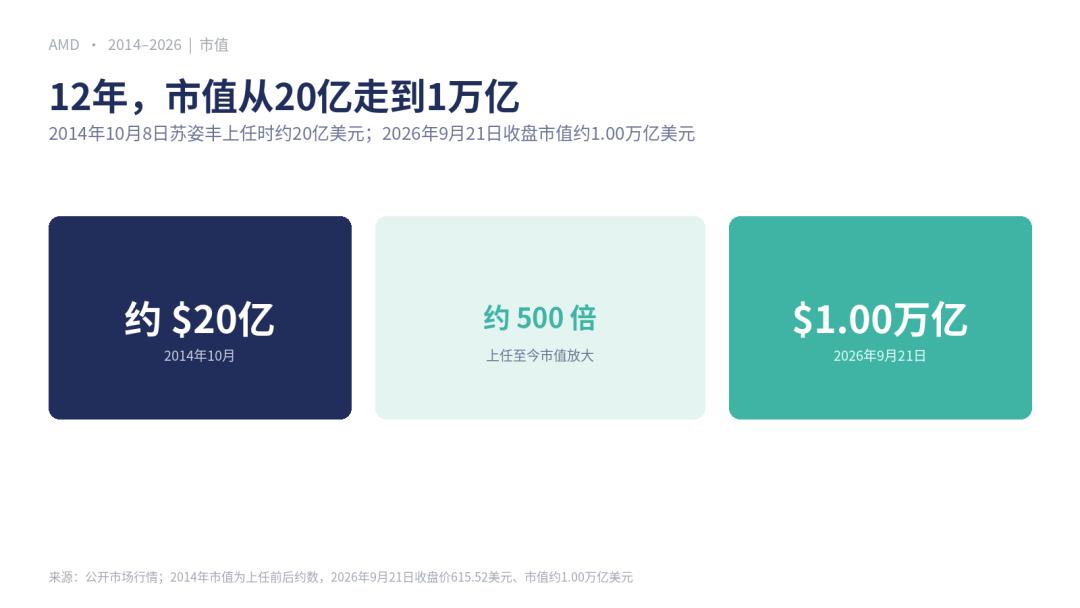
Looking back to October 8, 2014, when Lisa Su took over as CEO, the company's market capitalization was just over $2 billion. In nearly 12 years, its market value has expanded by about 500 times.
For years, the capital market has been repeatedly asking the same question: in the AI era, who else is needed besides NVIDIA? AMD is now part of the answer. But its breakthrough of the $1 trillion market cap milestone is not just a result of gaining the upper hand in the old game of competing with Intel for server market share and with NVIDIA for graphics cards. What has truly reshaped the company's revenue structure is the data center business.
The old battlefield for CPUs and GPUs has not disappeared; it has just been incorporated into new delivery models.
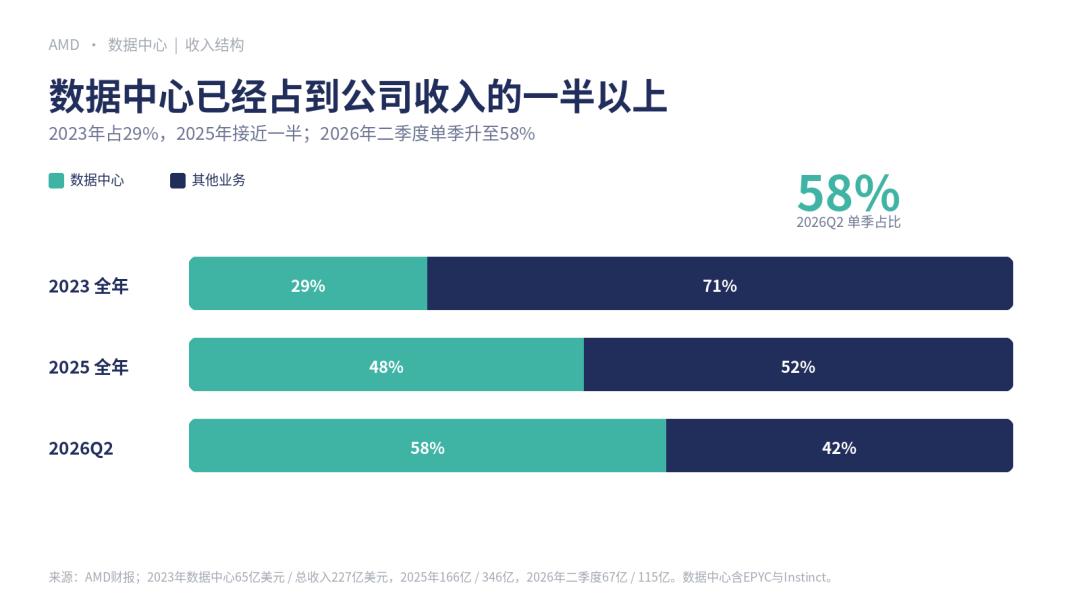
In 2023, AMD's data center revenue reached $6.5 billion; $12.6 billion in 2024; and $16.6 billion in 2025, more than tripling in two years. The company's total annual revenue in 2025 was $34.6 billion, with data center business accounting for nearly half of that figure. The growth accelerated further this year: the business generated $5.8 billion in revenue in the first quarter, up 57% year over year, and $6.7 billion in the second quarter, up 107% year over year, accounting for about 58% of the total revenue in that quarter.
Its product lineup has also changed: Ryzen and EPYC used to be its most well-known brands, but now Instinct, MI450, ROCm and Helios are more frequently mentioned. AMD has begun quoting prices by racks and systems. Chip revenue is still its main income source, but the company no longer only wants to sell individual chips.
What made NVIDIA pull far ahead was never just that a certain GPU ran faster. What it sold was a complete set of ready-to-use solutions: GPUs, CPUs, networks, switches, racks, software, plus CUDA. Customers are not buying a single acceleration card, but a fully operational AI factory that can be put into production immediately.
AMD used to have competitive CPUs and decent GPUs, but it lacked complete server systems that could compete head-to-head with DGX and NVL.
It has been filling this gap over the past few years. In 2022, the company acquired Xilinx, and later took over Pensando, a data center networking firm. In March 2025, AMD completed the acquisition of ZT Systems to bring in full rack design capabilities. All these assets were later integrated under a unified brand: Helios.
In July, AMD launched the Helios rack-level system. A single unit contains 72 Instinct MI455X — the flagship of the MI450 series — plus 18 EPYC Venice processors, integrated with Pensando networking and ROCm. According to the company's own data, the token output per dollar in inference scenarios can be up to about 30% higher than that of competitors.
This is a figure released by the manufacturer that should be viewed with a certain degree of caution, but the direction it conveys is clearer than the number itself: AMD is ready to compete at the system level.
A launch event cannot prove whether a company is a qualified AI infrastructure platform; actual orders are the real proof.
In October 2025, OpenAI signed a multi-year agreement with AMD, planning to deploy a total of 6 gigawatts of AMD GPUs. The first 1 gigawatt of deployment will use MI450, scheduled to start in the second half of 2026. In February this year, Meta also signed a long-term deployment agreement for up to 6 gigawatts. The first batch will also use custom GPUs based on the MI450 architecture, paired with EPYC and Helios.
Reuters reported that the total procurement scale could reach up to about $600 billion over the next five years; other media have put forward even higher estimates, but there is no total contract value confirmed by both parties at present. In July, Anthropic followed suit, planning to deploy up to 2 gigawatts of MI450, with the first batch scheduled for the first half of 2027. AMD also promised to invest up to $5 billion in Anthropic.
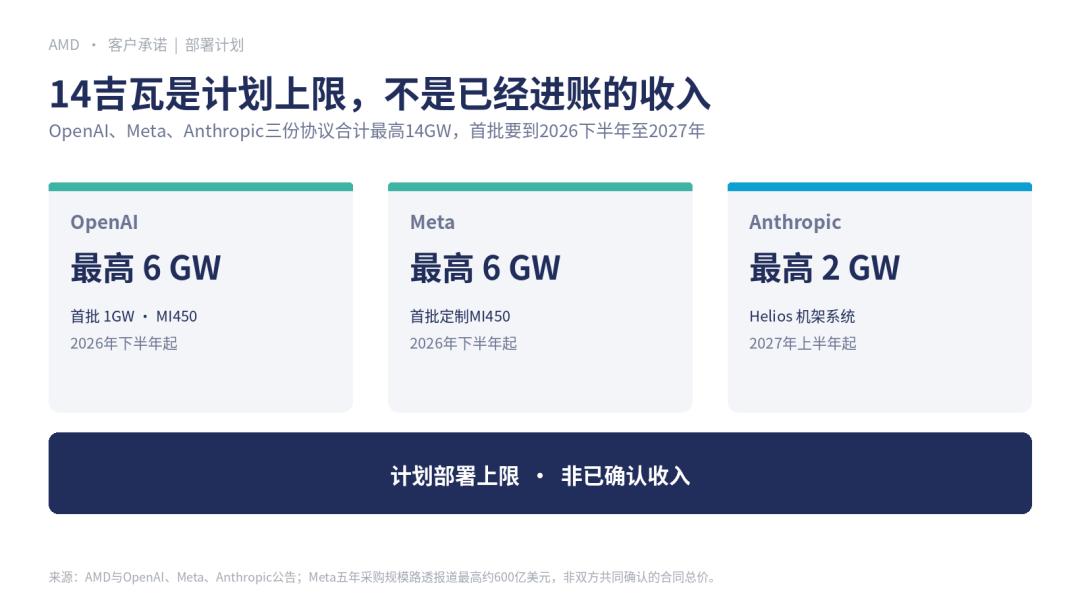
The three agreements add up to 6 gigawatts, 6 gigawatts and 2 gigawatts. These companies will still purchase a large number of NVIDIA products, as no one wants to rely on only one supplier. For AMD, this is a golden opportunity: it does not have to defeat NVIDIA first. Becoming a reliable second choice is already enough to support a huge business.
One supplementary note: these gigawatt figures are the upper limits of planned deployment, not revenue that has already been recorded.
AMD has not put all its efforts on GPUs. Since its launch in 2017, EPYC has been continuously taking server market share from Intel. In data centers, GPUs are responsible for large-scale parallel computing, while a large number of CPUs are still required for task scheduling, data processing, storage, networking and general-purpose computing.
The company stated in its first quarter earnings report that inference and Agentic AI are driving up demand for both CPUs and accelerators at the same time. This is its judgment, not an absolute industry consensus, but the combination of its product portfolio is indeed rare: GPUs for acceleration, EPYC for computing, Pensando for networking, Helios for racks, and ROCm for software.
Today, a $1 trillion market capitalization means the market has paid for the company's future in advance. In 2025, AMD's revenue was $34.6 billion. The $1 trillion market cap is not pricing its current profits, but discounting the value of its AI data center business in the coming years.
At its 2025 Analyst Day, the company estimated the long-term total addressable computing market to be around $1 trillion by around 2030. In July this year, it raised its 2030 potential market size estimate to about $2 trillion.
There is still a high wall in front of AMD: NVIDIA's market capitalization exceeds $5.3 trillion, and it leads in data center revenue, software ecosystem and CUDA developer base. While AMD's chips can deliver similar peak performance, there is always a cost for customers to migrate their existing systems.
To maintain its $1 trillion market capitalization, AMD not only needs to make its MI450 a few percentage points faster, but also needs to ensure that ROCm is sufficiently usable in the next two to three years, that Helios can be delivered stably at scale, and how much of the total 14 gigawatts of planned deployment will eventually be converted into actual revenue.
This road is not a straight line. Its second-quarter revenue and profit beat expectations, but its forward guidance fell short of some investors' expectations, leading to a pullback in its stock price in August. This breakthrough of the $1 trillion mark is driven by a series of consecutive subsequent rallies.
The transaction structure can better explain what the market is betting on than slogans.
When it signed the agreement with OpenAI last year, AMD granted the other party warrants for up to 160 million shares with an exercise price of about 1 cent per share. The shares are not given for free: the vesting of the warrants is tied to both GPU procurement and deployment, and AMD's stock price, with the last tranche's stock price condition set at exactly $600.
In February this year, Meta obtained up to 160 million warrants with a similar structure. If both agreements are fully exercised, the potential dilution will account for about 10% of the existing share capital for each. The $600 threshold was crossed by AMD's closing price on September 21, but the first tranche of warrants will not be automatically vested just because the stock price reached $615; it will only take effect when the first gigawatt of GPUs is actually delivered.
A year ago, $600 sounded like a distant target, but now the market has priced in this level first; the next step is to see whether the actual business performance can consolidate this valuation.
This article is from the WeChat Official Account "Surge Business", written by Lin Geng, and published with authorization from 36Kr.