Entrepreneurs are starting to collectively tighten their purse strings.
More "second-time entrepreneurs" are emerging.
They do not necessarily only use second-hand goods, but no longer insist on starting everything from the newest, largest and most complete setup. The store can be smaller, the number of staff can be reduced, and the equipment can be pre-owned. They just get the business running first before making further adjustments.
Entrepreneurs used to fear being described as "small" the most. Today, "small" has instead become an active choice. They no longer spend money for superficial decency, rein in their desire for expansion, and turn frugality into a habit.
The slightly shabby "stinginess" has even begun to be regarded as a virtue.
#01
Recruitment even takes body size into consideration
A large number of recycled equipment are sold on site before being transported back to the warehouse. After 8 years in the second-hand catering equipment business, Gou Ge no longer worries much about sales channels.
His second-hand equipment store in Beijing receives over 10,000 visitors per month, and at least 7 out of 10 visitors make a deal. "Equipment for hot pot, barbecue and milk tea shops sells the best. These categories have the highest closure rate, and new shops of these types keep opening up," Gou Ge says.
Food ingredients determine product quality, labor determines serving speed and service quality, and rent for good store locations is never cheap. Cost-conscious catering business owners therefore focus on equipment and decoration. Buying second-hand equipment can cut equipment costs by half, and they no longer insist on full renovation: only minor modifications and a small amount of soft furnishings are needed before the shop opens.
The counter-style dining model that has swept through shopping malls is essentially a product of cost reduction and efficiency improvement, allowing employees to take on multiple roles, boosting work efficiency, and cutting down unnecessary floor space.
A Guang runs a fresh-boiled beef restaurant on a street side in Dongdaqiao, Beijing. The shop is very cramped, covering only 55 square meters with 15 dining seats arranged in a row, leaving less than 1 square meter of space for each single diner. During peak hours, customers have to wait outside the shop for more than an hour.
When someone walks through the aisle, they will disturb a whole row of diners who are eating. People sit back to back and squeeze past each other. If the space is any smaller, "one person might have to squat down and the other jump over him". When recruiting new employees, A Guang will even consider their body shape, fearing that they will block the narrow passage in the kitchen.
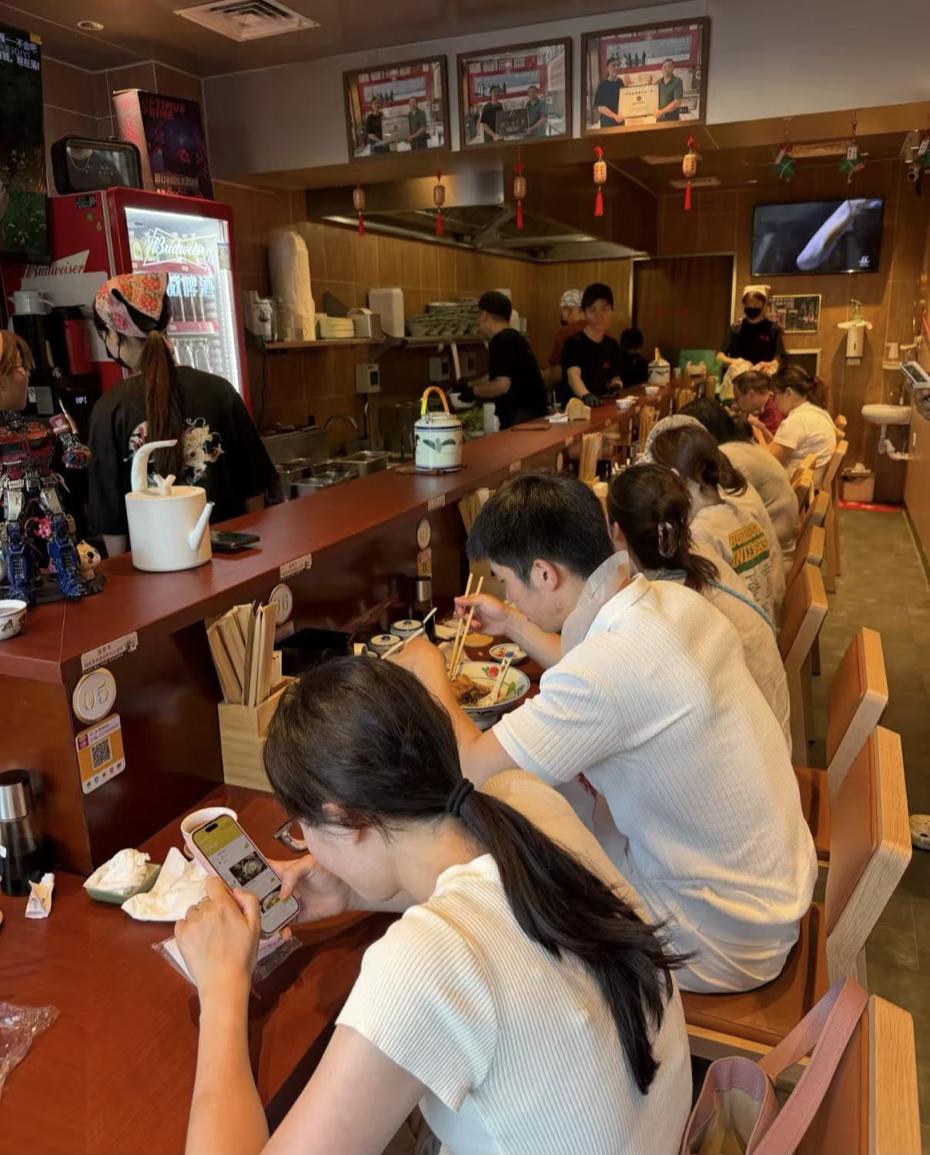
Figure | A Guang's fresh-boiled beef restaurant
Ten years ago, the Japanese restaurant that A Guang co-founded in Shenzhen covered 300 square meters and took a high-end reservation-only route. The decoration was exquisite, and the tables were custom-made in Japan with one table costing nearly 20,000 yuan. The total investment for one single restaurant reached several million yuan.
Now, he has to deal with the cramped space of his small shop every day. There is no room for a large refrigerator in the store, so even if ingredients are delivered twice a day, storing them in the refrigerator is like playing a sliding puzzle game. When he wants to launch a new dish in different seasons, he has to first consider the working procedures, workflow, and where to place the pots and spoons.
Recently, A Guang opened a second shop to serve the overflowing customers from the first one. Even as the business improves, he still refuses to rent a larger storefront, hoping to keep risks within his affordable range.
The fast food brand Huogaogao that Lao Sun operates in Shenzhen has its smallest store covering only 35 square meters.
The stores are located in every available spot in the CBD area. Almost all the indoor space is reserved for the open kitchen, with several dining tables placed in the outdoor seating area. All tableware is disposable. During meal peaks, customers line up in front of the counter to take their food away.
To improve the efficiency of on-site cooking and order turnover, only 10 stir-fry dishes are provided and rotated for sale. In addition to stir-fries, there are also pastries and snacks to cover the breakfast and dinner periods.
Huogaogao does not provide delivery services, avoiding being constrained by platforms and high commission fees. Group meal orders from nearby office buildings are booked via WeChat group sign-up for unified delivery.
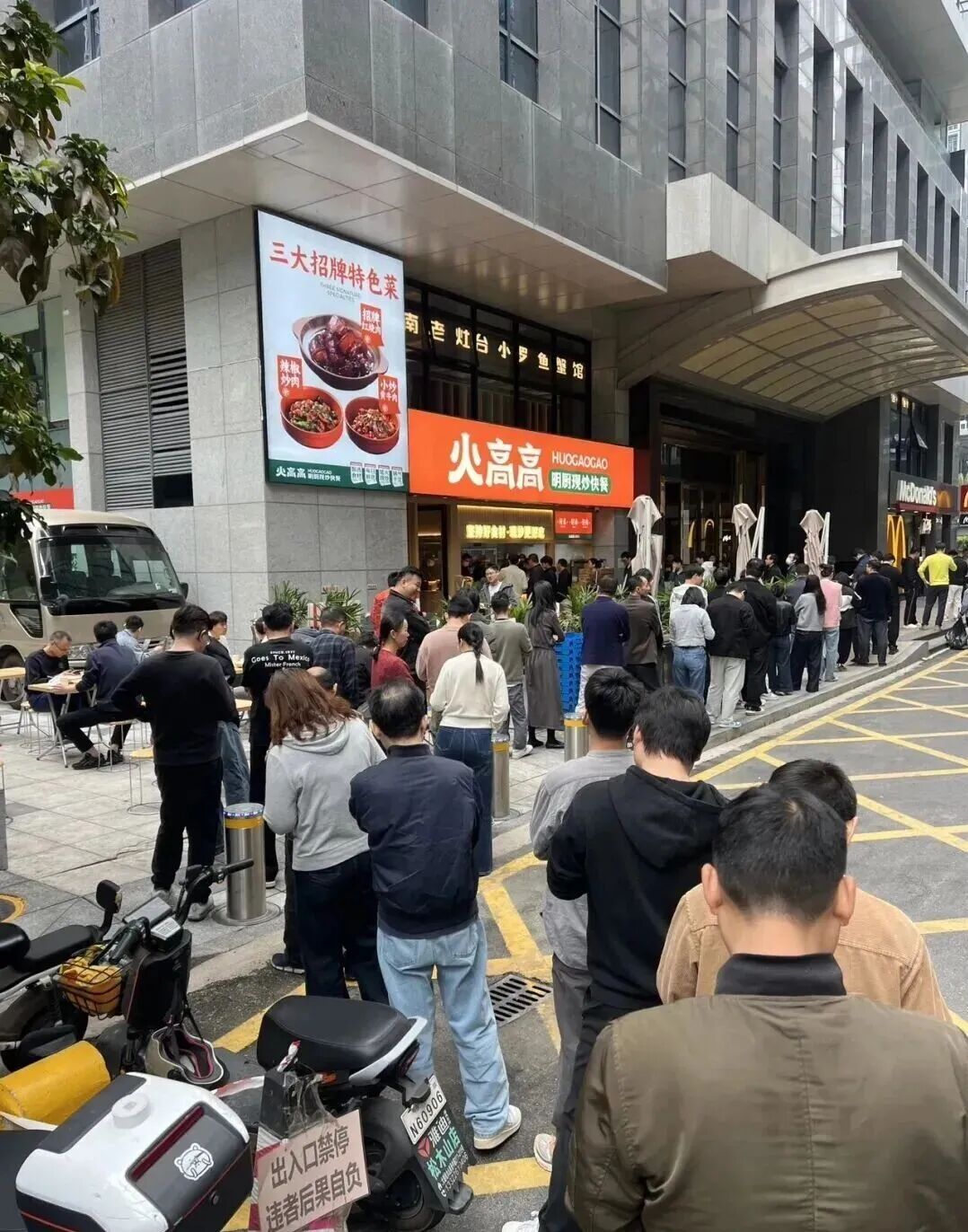
Figure | Huogaogao open-kitchen on-site stir-fry fast food
Labor costs are also not impossible to cut. Lao Sun once heard a "efficient shift scheduling" plan at a catering franchise exhibition, which requires the turnover per person per hour to reach more than 100 yuan. The scheduling is done by first estimating the daily turnover, then calculating backwards the total working hours that can be arranged. More hourly workers are scheduled during peak hours, and the number of on-duty staff is reduced during off-peak hours.
To help hourly workers get familiar with the work faster, the operation process is simplified: ingredients are pre-processed and delivered daily, and stir-frying is done with a wok-style cooking machine, with hourly workers following the instructions in their headphones to stir the food.
What shocked Lao Sun is that to save every penny, the time spent on labor is calculated in seconds, and the amount of ingredients used is calculated in grams. In this case, peeling and shredding potatoes is even regarded as a high-cost and extremely wasteful process. After thinking of the scene from Charlie Chaplin's *Modern Times*, Lao Sun finally gave up the idea of entering the catering industry.
#02
Reserve capital for trial and error
The *2026 White Paper on China's Catering Chain Development* shows that by the end of 2025, there are approximately 7.47 million catering merchants recorded in the Meituan system, with the total number slightly decreasing by 0.1% year on year. At the same time, the number of merchants marked as closed for the whole year reached 3.39 million, up 9.4% year on year. The total number of shops has not increased significantly, but far more shops are closing down.
Among them, new merchants that opened in 2025 account for 23.8% of all closed merchants, and merchants that opened in 2024 account for 41.3%, adding up to 65.1% in total — meaning nearly two-thirds of the closed businesses had an operating period of less than two years.
Gou Ge's recycling business is also expanding. In 2024, his team recycled equipment from nearly 6,000 closed stores, and the number reached about 7,000 in 2025. In the first half of this year, more than 4,400 stores' equipment has been recycled. According to Gou Ge's estimate, the number may reach 9,000 for the whole year.
The recycled equipment is also getting newer. In the past, machines that had been used for three to five years could be seen, but now many devices have only been used for half a year or a year, and still look 80% to 90% new when brought back. There are even business owners who bought a batch of second-hand equipment from Gou Ge to open a shop, but closed the project two months later and returned the exact same batch of equipment to him.
In Gou Ge's view, one of the reasons why catering business is getting harder is that there are too many shops. Many popular categories are highly dependent on the supply chain, making it difficult for products to stand out, while new shops keep opening. Some brands are busy recruiting franchisees, attracting a large number of inexperienced newcomers. The number of stores has increased, but their actual operation capabilities have not kept up.
When these new catering practitioners arrive at Gou Ge's store, most decisions have already been made. The store has been rented, the rent has been paid to the landlord, and the decoration is almost finished. Even if Gou Ge wants to give advice, it is hard to change anything, because the bulk of the investment has already been spent.
It is not only newbies that face failure. A hot pot restaurant owner that Gou Ge knows once ran 7 self-operated stores in Beijing. Later, his stores closed one after another. He sold his apartment in the second ring road of Beijing and his car, but still owed more than 1 million yuan in debt. When they went to eat ramen together later, the man could not even afford to pay the bill.
Those who are still opening new shops have started to tighten their next budget.
A chain brand in Beijing used to spend 150,000 to 200,000 yuan on equipment for one single store from him. Since last year, the procurement amount per store has been controlled at 50,000 to 80,000 yuan. The imported high-end equipment they used to prefer can now be replaced with ordinary equipment, as long as it works properly.
One of his old customers who he remembers very well is Mr. Cai, who used to run a grilled fish restaurant and set up street stalls, and tried seven different catering projects in total. For his eighth project, his business "downshifted" to hand-pulled noodles with soybean paste. He opened about 30 stalls in food courts, and later launched 6-yuan hand-pulled noodle shops in communities, opening nearly 9 more stores.
In Gou Ge's view, the reason why this customer can stay in the catering industry all the time is that he always controls the cost of each investment, leaving room for trial and error. Every project he runs brings new experience that can be applied to his next attempt.
Talking about how to leave room for trial and error, Gou Ge gives an example: if you have 1 million yuan in hand, you don't have to invest all of it in one shop at once. You can first take out 100,000 or 200,000 yuan to try. If the project does not work, adjust it in time, and the remaining money can still support you to keep going. "You will always have the capital to try new things," he says.
The "stinginess" of entrepreneurs is no longer just a phased coping strategy. Figuring out where to spend money, what can be compromised, and the maximum loss one can afford for a single failed trial has become a calculation that must be done before starting a business.
The money saved can also be the capital to restart the business next time.
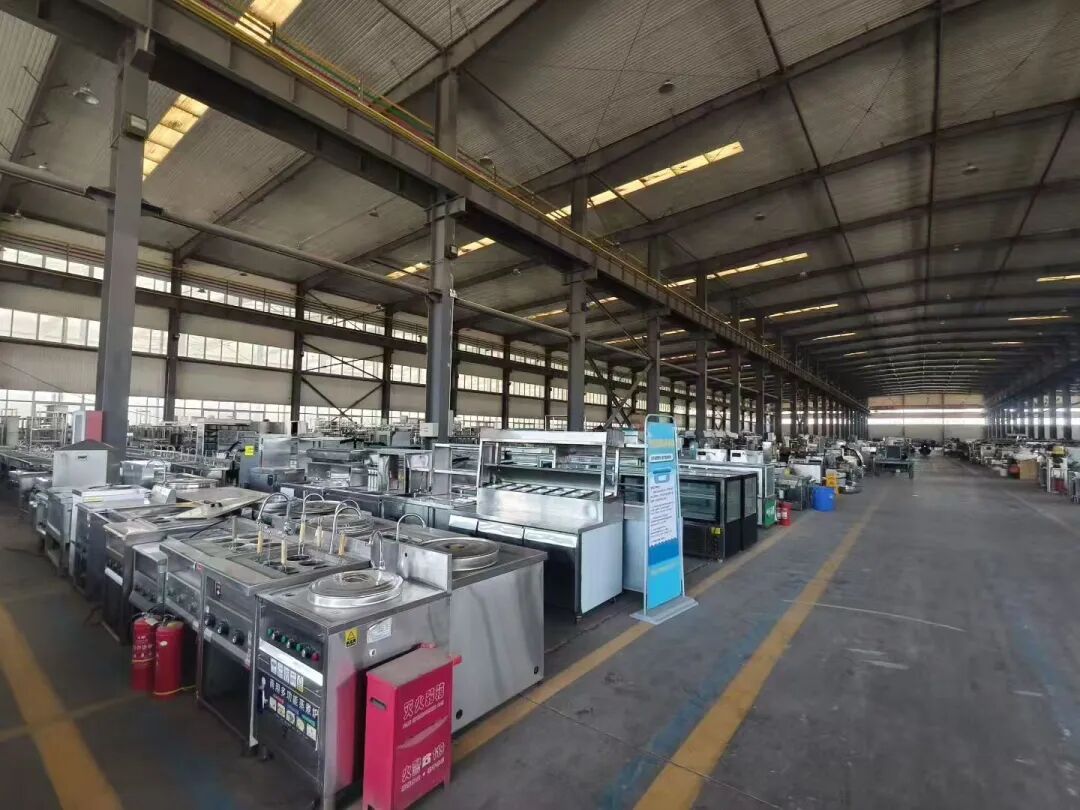
Figure | Gou Ge's second-hand catering equipment mall
#03
Downsize the business
This trend is not limited to the catering industry.
Xiao Shui runs a women's clothing business in a small county in Hubei province, but her shops are not street-side stores. Both of her shops are located in the county's CBD shopping mall, selling a women's clothing brand from Hangzhou, with the average price of each piece of clothing over 500 yuan.
In the first few years, the business was not bad. Customers who bought clothes offline tried them on before paying, so there were almost no returns. The shop accumulated many regular customers, many of whom would come back to check new collections every once in a while.
In the past two years, Xiao Shui has increasingly felt that selling clothes offline is getting harder. Many people think a 500 or 600 yuan piece of clothing is too expensive, and there are more and more platforms to buy clothes online. The total rent of her two mall shops is nearly 50,000 yuan per month, and gradually the sales revenue can no longer cover these costs.
Last year, Xiao Shui closed both of her mall shops and rented a cheap studio whose rent is only one-twentieth of the previous rent. Now she travels to clothing markets like Thirteen Lines and Nanyou in Guangzhou to source goods herself, only takes a few pieces for each style, and runs livestreaming sales.
Xiao Shui is indeed much more tired, but she no longer has to bear the high rent of two mall shops. She can now sell the clothes she likes at ease, and every yuan she earns is more solid.
When A Guang first started his cross-border e-commerce business, his team only had two people. As the business grew, A Guang started to recruit more staff and expand product categories, and the team size increased to 10 people.
As the dividends of the cross-border e-commerce industry gradually faded, costs for advertising, warehousing, and logistics kept rising, and the profit per item was squeezed thinner and thinner. Wages, rent, utilities, and property management fees, which he originally hoped to dilute through scale expansion, have instead become the heaviest burden that A Guang cannot easily get rid of.
"I have lost all my money, but I still have to pay salaries to my employees," A Guang says. When sales decline and inventory piles up, all the pressure falls on him.
Now, A Guang has disbanded the team and returned to the two-person couple partnership model. He no longer expands product categories blindly, but refocuses his energy on the truly profitable business.
Such changes can be seen in many more small businesses. Some people move their nail art studios directly into residential buildings; florists take orders online first and then purchase flowers from the market; some pet shops no longer set up full-time positions for low-frequency services such as pet photography and pet grooming, and call part-time workers to provide on-site services only when there are orders.
In the past, storefronts, team size, and the number of outlets were all proof that a business was growing. When the business just got better, people would think of adding more elements: make the shop larger, hire more staff, and open the second and third stores. Even if the business scale expanded a little too fast, people always believed that the next round of growth would solve all the problems.
Today, consumers are more careful with their spending, there are more peers in the market, and the extensive, gambling-style entrepreneurship can no longer adapt to the current market environment.
Entrepreneurs have also changed their mindset. Their shops are getting smaller, their teams are getting leaner. If two people in the family can finish all the work, they will not rush to hire a third person; if 50 square meters is enough, they will not rent a 100-square-meter store; they will keep inventory as low as possible, and buy second-hand equipment instead of new ones if possible. The business owner sources goods, receives customers, shoots videos, and keeps accounts by themselves, turning as few things as possible into fixed costs.
This group of entrepreneurs is becoming more and more like "modern misers", wanting to split every yuan into halves to spend. In the past, being reluctant to spend money made people look uncompetitive; now, knowing what money does not need to be spent has become a real capability.
From a 300-square-meter large restaurant to a small shop of more than 50 square meters, A Guang is more satisfied with his current life. Apart from sleeping, he spends almost all his time in the shop, enjoying the process of chatting with customers. His small shop is like a Chaoshan-style late-night diner, crowded but full of human warmth.
As for whether he will open a large store in the future, A Guang says he will let nature take its course, but it is certain that he will never invest all his net worth into a business like he did in his first entrepreneurship.