The combined valuation of three AI giants exceeds 5 trillion US dollars, surpassing the total sum of U.S. technology IPOs over the past 45 years.
If you want to gauge how far AI has advanced toward the public market, just look at the valuations of the largest companies in this sector.
According to *The Wall Street Journal*, OpenAI is raising funds at a valuation of $1.2 trillion; Anthropic has a potential valuation of $2 trillion after going public; SpaceX currently has a market capitalization of approximately $2 trillion. Combined, the total valuation of the three companies is slightly higher than $5 trillion.
According to data compiled by Jay Ritter, emeritus professor at the University of Florida's Warrington College of Business, between 1980 and 2025, a total of 3,365 technology companies completed IPOs, with a combined market capitalization of approximately $4.1 trillion on their first trading day. These three companies alone have surpassed the total sum of U.S. tech IPOs over the past 45 years.
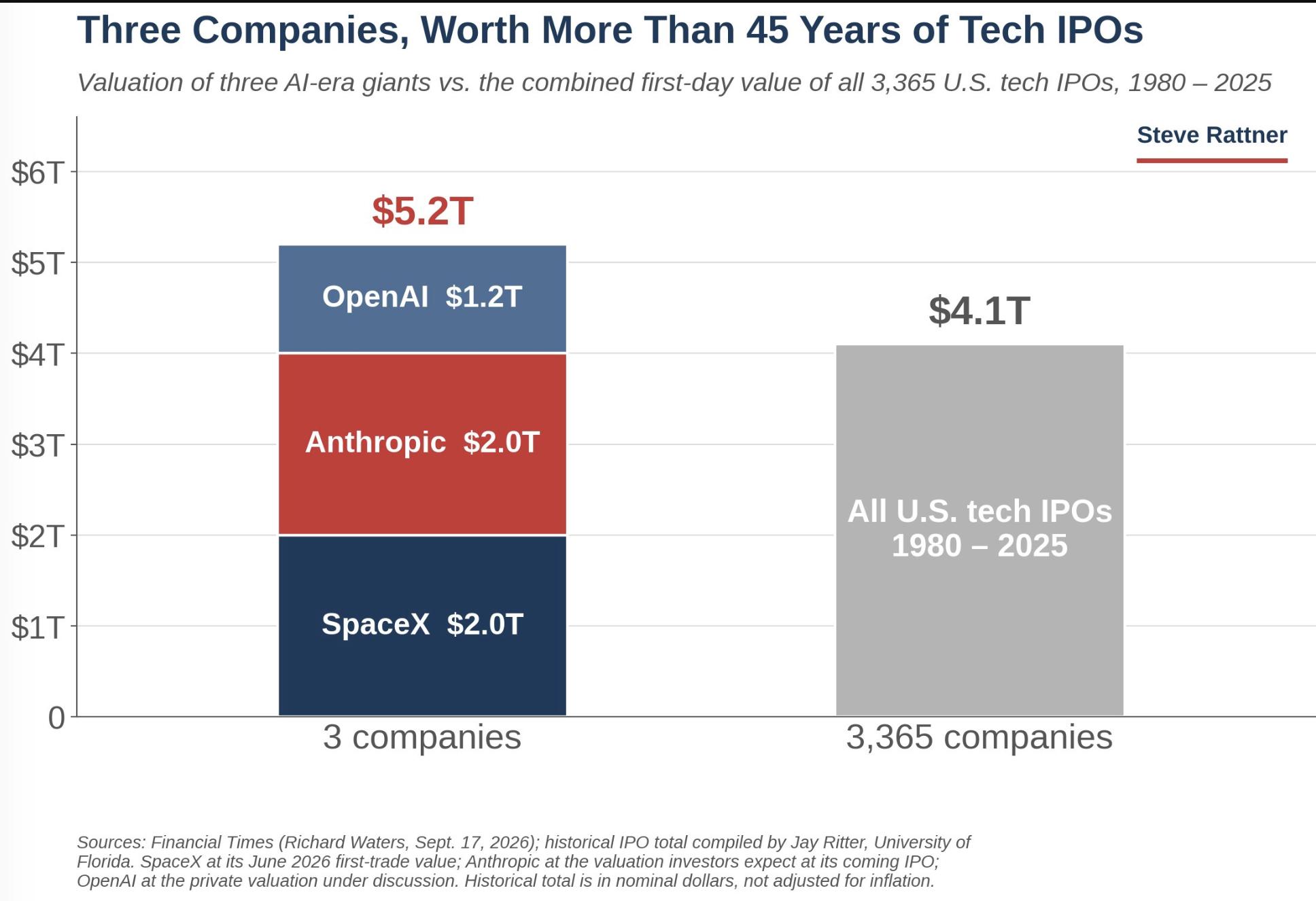
Steve Rattner, a columnist for *The New York Times*, posted the comparison chart on X, noting that the historical data has not been adjusted for inflation. In other words, if measured by actual purchasing power, the gap will only be more staggering.
Timeline of the Three Companies
The respective listing paces of these three companies are piecing together an unprecedented capital landscape.
Led by Dario Amodei, Anthropic is currently advancing its IPO plan with a target valuation of about $2 trillion, which is expected to surpass SpaceX to become the largest IPO in history. The company is projected to generate more than $100 billion in annualized revenue in 2026, a sharp increase from the $65 billion figure in July. Anthropic has postponed its IPO from the previously scheduled October to November to present its full third-quarter financial results. The company is working with investment banks including Morgan Stanley and Goldman Sachs, and is close to finalizing a $15 billion revolving credit facility. Investors expect the company's computing power to reach 5 GW by the end of the year, doubling next year to match that of OpenAI.
OpenAI's listing path is more prudent. On March 31 this year, OpenAI announced the completion of a $122 billion private placement financing at a valuation of $852 billion, led by Amazon, NVIDIA and SoftBank, which was open to retail investors for the first time. In June, the company secretly submitted its U.S. IPO application. But on September 12, CEO Sam Altman explicitly stated that it will not go public in 2026, saying that in the current context where AI safety issues are receiving high attention, going public now is "not wise". Previously, the market once expected its potential valuation to reach up to $1 trillion, and the listing time may be postponed to after 2027. It is worth noting that OpenAI loses billions of dollars every year and is not expected to turn profitable before 2030.
SpaceX was listed on NASDAQ on June 12 this year. With an issue price of $135 per share, an opening price of $150, and a closing price of $160.95, up 19.22%, its market capitalization reached $2.1 trillion, making it the seventh largest listed company in the world. The IPO raised $75 billion, with total subscriptions exceeding $350 billion, 3.7 times oversubscribed. Prior to the IPO, SpaceX completed the acquisition of xAI, and the combined entity has a valuation of $1.25 trillion. The capital market's pricing of SpaceX implies extremely high growth expectations, while famous short-seller Jim Chanos bluntly stated that this is an "IPO full of hopes and dreams", driven by enthusiasm for Musk and AI rather than fundamentals.
The "Spray-and-Pray" Logic of Traditional VCs Is Collapsing
The staggering valuations of these three companies show that early investors and Wall Street have placed unprecedented high hopes on AI. And deeper changes are taking place within the venture capital industry.
The business model of traditional VCs is built on probability theory: invest in ten companies, nine fail, and the success of the tenth can offset all losses. However, the infrastructure construction of AI and the R&D of general large models require the deployment of computing clusters, power support and top talent reserves amounting to tens or even hundreds of billions of dollars. The capital threshold has been rigidly raised to a level close to that of national infrastructure projects, and the fault tolerance rate has been compressed to nearly zero.
The data confirms this trend. In the first half of 2026, global startups raised about $5.1 trillion in financing, of which OpenAI and Anthropic alone absorbed about $2.17 trillion, accounting for 43% of global venture capital. The first quarter was even more extreme: four deals, namely OpenAI's $122 billion, Anthropic's $30 billion, xAI's $20 billion and Waymo's $16 billion, totaled $1.88 trillion, accounting for more than 60% of the total global venture capital in the quarter. PitchBook data shows that AI accounted for as high as 87.5% of U.S. venture capital in the second quarter.
Capital is highly concentrated in leading institutions. In the first half of this year, only Andreessen Horowitz, Founders Fund and Thrive Capital raised a total of about $250 billion, accounting for nearly one-third of all new capital raised by U.S. VCs in the same period. For most small and medium-sized VCs, they neither have the capital to participate in super-large financing rounds, nor can they achieve effective hedging through decentralized strategies, so their survival logic is facing fundamental challenges.
Hardware Industry Chain: The "Shovels Sellers" of the AI Boom
Another notable feature of the AI capital feast is that the hardware industry chain has obtained unprecedented revaluation.
NVIDIA is the biggest beneficiary. By late September, its market capitalization has reached about $5.3 trillion, a nearly 15-fold increase from the $360 billion at the beginning of 2023 when the AI wave started. Since 2026, NVIDIA has invested a total of nearly $500 billion, covering almost all links of the AI industry chain upstream and downstream.
Memory chips have also undergone revaluation. Micron Technology's stock price has soared more than 1100% in the past two years, and its market capitalization exceeded $1 trillion in May 2026. As of September 22, Micron's stock price closed at $1096, with a market capitalization of about $1.24 trillion. This rally reflects the explosive demand for high-bandwidth memory in AI data centers.
The change in cost structure is even more staggering. According to the latest estimate from Bernstein Research, building a 1 GW AI data center with NVIDIA's next-generation Vera Rubin architecture requires a total capital expenditure of about $470 billion. The cost of a single Vera Rubin NVL72 rack is about $9.1 million, of which the cost of memory and storage-related components alone is as high as $3.2 million. Morgan Stanley predicts that the total announced capital expenditure of the world's largest tech companies in 2026 has exceeded $7 trillion, up 69% from 2025.
According to UBS estimates, the capital expenditure of global hyperscale manufacturers will be about $1.0 trillion in 2026, further rising to about $1.45 trillion in 2027, and the total from 2026 to 2028 will reach about $4.1 trillion. However, revenue realization still lags behind — according to IDC forecasts, the global generative AI market will be close to $1.5 trillion in 2027, and the revenue volume is far from covering the trillion-dollar level of capital expenditure.
The Bubble Debate
Against the backdrop of the capital feast, disagreements are also prominent.
Ray Dalio, founder of Bridgewater Associates, said in a podcast in August that AI shows "typical signs of a bubble". Wu Chaoze from China Securities has a different view, arguing that "there is no bubble in the AI industry itself", and most of the bubble perception comes from the time mismatch between the huge underlying capital expenditure and the closed loop of the business model.
Worrying signals are accumulating. FactSet data shows that the proportion of incremental debt of hyperscale manufacturers in capital expenditure has risen from 9% in FY2024 to 32% by mid-2026, and the free cash flow of the five major hyperscale manufacturers in 2026 is close to zero or negative. Goldman Sachs warns that nearly 50% of the profit growth of S&P 500 companies in 2026 is driven by AI-related investment. This profit growth model that is highly dependent on a single theme will face systemic risks once AI investment slows down.
In addition, Jay Ritter's research also reveals a historical pattern: companies listed between 1980 and 2024 have an average return 20 percentage points lower than the market in the three years after IPO; if the price-to-sales ratio exceeds 40x, the performance is even 58 percentage points lower than the market. Anthropic's $2 trillion valuation corresponds to about 20x price-to-sales ratio based on $100 billion annualized revenue — which has not yet touched the 40x danger line, but SpaceX's $2.1 trillion market capitalization corresponds to $186.7 billion revenue in 2025, with a price-to-sales ratio as high as 112x, far exceeding the historical warning level.
What is more tricky is the opacity of the valuation method itself. Jay Ritter points out that the valuation method of VC funds for their held assets gives them considerable operating space — underperforming investments can maintain historical book value, while outperforming ones are marked to market, resulting in a systematic overestimation of overall returns. According to PitchBook data, the total valuation of global unlisted unicorn companies has reached as high as $5.3 trillion. When Anthropic and OpenAI finally open the door to IPOs, how to convert this huge amount of paper wealth into real absorption capacity in the secondary market will become a key issue hanging over Wall Street.
The fact that the valuations of the three AI companies have surpassed the sum of 45 years of tech IPOs is not only a confirmation of the transformative potential of AI technology, but also an extreme test of the pricing capacity of the capital market. Whether the AI dividend can spread to a wider range of fields will determine whether this capital feast is the beginning of a new era or the peak of another bubble.
This article is from the WeChat official account "Tech Business", and is authorized for release by 36Kr.