How is the real estate market performing in the "Golden September"?
Since August, core cities including Beijing, Shanghai, Chengdu, Xi'an and other cities have implemented city-specific policies to release housing demand by lowering home purchase thresholds, increasing the loan limit of housing provident fund, and issuing home purchase subsidies. Entering September, the characteristics of the traditional peak sales season have emerged to a certain extent, but the overall market is still in the bottoming-out stage, with obvious differentiation between different cities and projects. According to data from the China Index Academy, from September 1 to 20, the transaction area of new commercial residential properties in 30 key cities increased slightly by 1.4% year-on-year. First-tier cities continued to maintain growth, the market recovery was still concentrated in high-quality sectors and projects in core cities, and structural differentiation continued; the number of second-hand residential transaction units in 20 key cities increased by 13.1% year-on-year, the transaction volume in Beijing and Shanghai has achieved year-on-year growth for 7 consecutive months, and the second-hand housing market shows relatively active performance.
Looking ahead to the future market, the overall market during the "Golden September and Silver October" period will still be dominated by structural recovery. In the short term, the projects entering the market in September and October will mainly come from the stock projects accumulated in the early stage, and the direct impact of the 8·28 New Deal on the recent supply rhythm is relatively limited. The market performance still depends on the release of demand and the marketing intensity of projects. The market performance of high-quality projects in some hot cities is relatively stable, and the marketing discounts of individual projects have been adjusted. But on the whole, there is still obvious differentiation in price and destocking performance, and new home sales in most cities continue the bottoming-out trend. With more sufficient price adjustments and richer housing source options, the second-hand housing market will still undertake part of rigid demand and replacement demand, and the transaction performance may continue to be relatively active.
Trading Market: The transaction volume of second-hand housing in key cities continues to grow in September, and the transaction volume of new housing increases slightly year-on-year
(I) New Housing Market: Remaining generally stable, core cities continue to grow, and market differentiation remains obvious
According to data from the China Index Academy, since September (1-20), the transaction area of new homes in 30 key cities has increased slightly by 1.4% year-on-year, and that of first-tier cities has increased by more than 10% year-on-year. On a cumulative basis, from January to September (1.1-9.20), the new home transactions in 30 key cities reached about 72 million square meters, down 8% year-on-year.
In terms of key cities, key cities such as Beijing, Shanghai, Suzhou and Ningbo maintain a growth trend. Driven by the optimization of demand-side policies in August, Beijing and Shanghai have maintained high market activity. From September 1 to 20, the transaction area of new commercial residential properties increased by 23% and 22% year-on-year respectively; Guangzhou saw a slight year-on-year increase of 3%, marking 3 consecutive months of year-on-year growth. Among second-tier cities, Wuhan recorded a transaction volume of 450,000 square meters, up 18% year-on-year, while Suzhou and Ningbo increased by 29% and 21% year-on-year respectively.
Figure: Weekly transaction trend of new homes in Beijing and Shanghai from 2024 to 2026
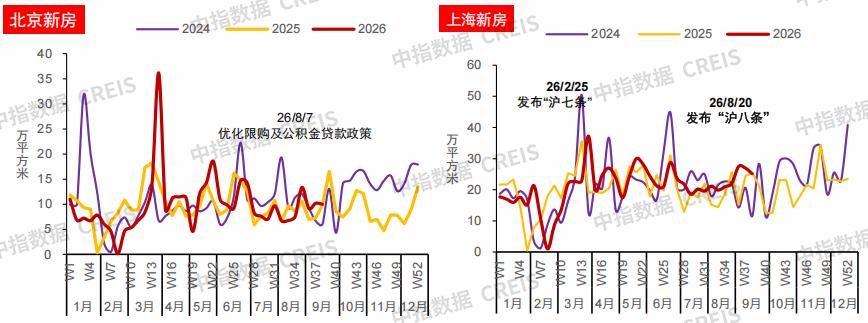
In terms of new home supply, according to data from the China Index Academy, since September, the approved listing area of new commercial residential properties in 30 key cities has decreased by about 32% year-on-year, and the supply continues to shrink. However, from the perspective of monthly supply rhythm, the new home listings in September are mostly concentrated in the second half of the month. Combined with the marketing nodes before the National Day holiday, the scale of new homes obtaining pre-sale permits at the end of the month may increase. The supply rhythm in some key cities has accelerated significantly. For example, from September 1 to 20 in Beijing, the number of new homes listed reached 4,890 units, exceeding the full-month scale of each month this year, of which nearly 3,500 units were listed in the single week of September 14-20, with multiple newly opened projects in Tongzhou, Chaoyang, Changping and other regions.
(II) Second-hand Housing Market: Transaction resilience continues, maintaining a year-on-year growth trend
Compared with new homes, the second-hand housing market continues to deliver good transaction performance. According to data from the China Index Academy, from September 1 to 20, 82,000 second-hand residential units were transacted in 20 key cities, up 13.1% year-on-year. On a cumulative basis, from January to September (1.1-9.20), 1.08 million second-hand residential units were transacted in 20 key cities, up 6.8% year-on-year.
In terms of specific cities, the transaction volume of second-hand housing in core cities such as Beijing, Shanghai, Ningbo and Suzhou maintains year-on-year growth. Among them, from September 1 to 20, 10,000 and 16,000 second-hand residential units and second-hand commercial housing units were transacted in Beijing and Shanghai respectively, still increasing by 2.2% and 24.3% year-on-year respectively. The transaction scale of second-hand housing in Beijing and Shanghai has achieved 7 consecutive months of year-on-year growth, and market activity continues; the transaction scale of second-hand housing in Shenzhen remains basically the same as the same period last year. As of September 20 among second-tier cities, 13,000 second-hand residential units have been transacted in Chengdu, up 2% year-on-year, Ningbo and Suzhou saw an increase of over 30%, while Xiamen, Nanjing and Hangzhou recorded an increase of over 10%.
Figure: Weekly transaction trend of second-hand housing in Beijing and Shanghai from 2024 to 2026
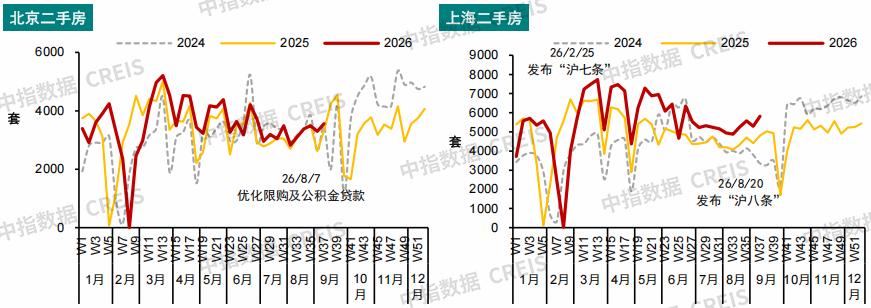
From the perspective of market structure, the proportion of second-hand housing in housing transactions has further increased. According to data from the Ministry of Housing and Urban-Rural Development, from January to August, the national online signing area of second-hand housing reached 549.23 million square meters, up 10.6% year-on-year, accounting for 52% of the total housing transaction volume. Data from the China Index Academy shows that this feature is more prominent in key cities, and the proportion of second-hand residential transactions in 30 key cities reached 68% from January to August.
On the whole, second-hand housing transactions maintain growth, and the center of market transactions further tilts towards the stock housing market; under the combined effect of demand recovery and supply adjustment, the new housing market presents the characteristics of partial improvement in core cities and the overall remaining in the bottoming-out stage.
Land Market: The land market continues the shrinking trend after the 8·28 New Deal, core location and sales certainty are important considerations for real estate enterprises to acquire land
Figure: Weekly transfer revenue and average premium rate trend of residential land in 300 cities
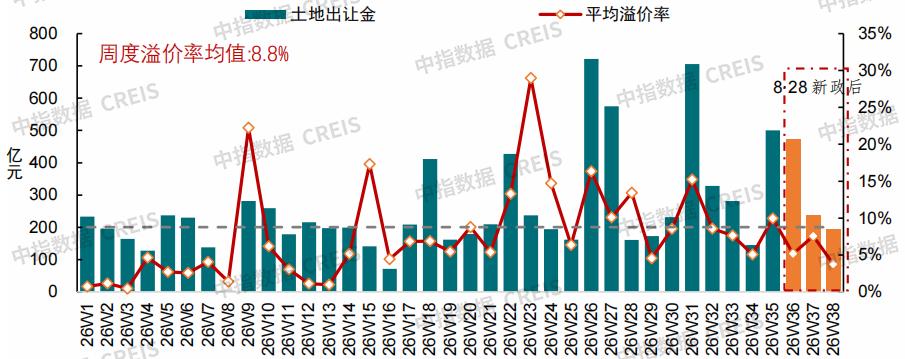
After the implementation of the 8·28 commercial housing sales system reform, arrangements such as existing home sales and capped pre-sales have raised the capital occupation and payback cycle of real estate enterprises, making land acquisition calculations generally more prudent. Limited funds are being concentrated on plots with confirmed locations, controllable total prices, and relatively clear destocking expectations.
According to data from the China Index Academy, from September 1 to 21, the planned construction area of residential land transactions in 300 cities was 21.98 million square meters, with land transfer revenue reaching 85.8 billion yuan. In terms of premium rate, the average premium rate of residential land in 300 cities from September 1 to 21 was 6.5%, down slightly from August. Most cities mainly record transactions at the base price or low premium, while high-quality plots in core cities maintain a certain degree of popularity.
From September 22 to 30, the planned construction area of residential land to be auctioned in 300 cities is about 20 million square meters, with a total starting price of about 95 billion yuan. Among them, many land plots will be auctioned in Beijing, Shanghai, Guangzhou in late September, and high-quality plots in Jing'an and Hongkou North Bund of Shanghai, Yuegezhuang of Fengtai District in Beijing, Yuzhu and Pazhou of Guangzhou will be concentrated for auction, whose auction results will become an important reference for observing the investment willingness of real estate enterprises.
This article is from the WeChat Official Account "China Index Academy", author: China Index Research, authorized for release by 36Kr.