New offerings are launched for the GPT-6 family. OpenAI is waging a price war, but it does not rely entirely on price competition.
Less than a month after the release of GPT-6 Astra, OpenAI has completed the full lineup of the GPT-6 family.
On September 22 local time in the United States, OpenAI officially launched GPT-6 Sol and GPT-6 Luna, designed for mid-tier and lightweight tasks respectively. The biggest change of the two models is not the simple improvement of benchmark scores, but their pricing.
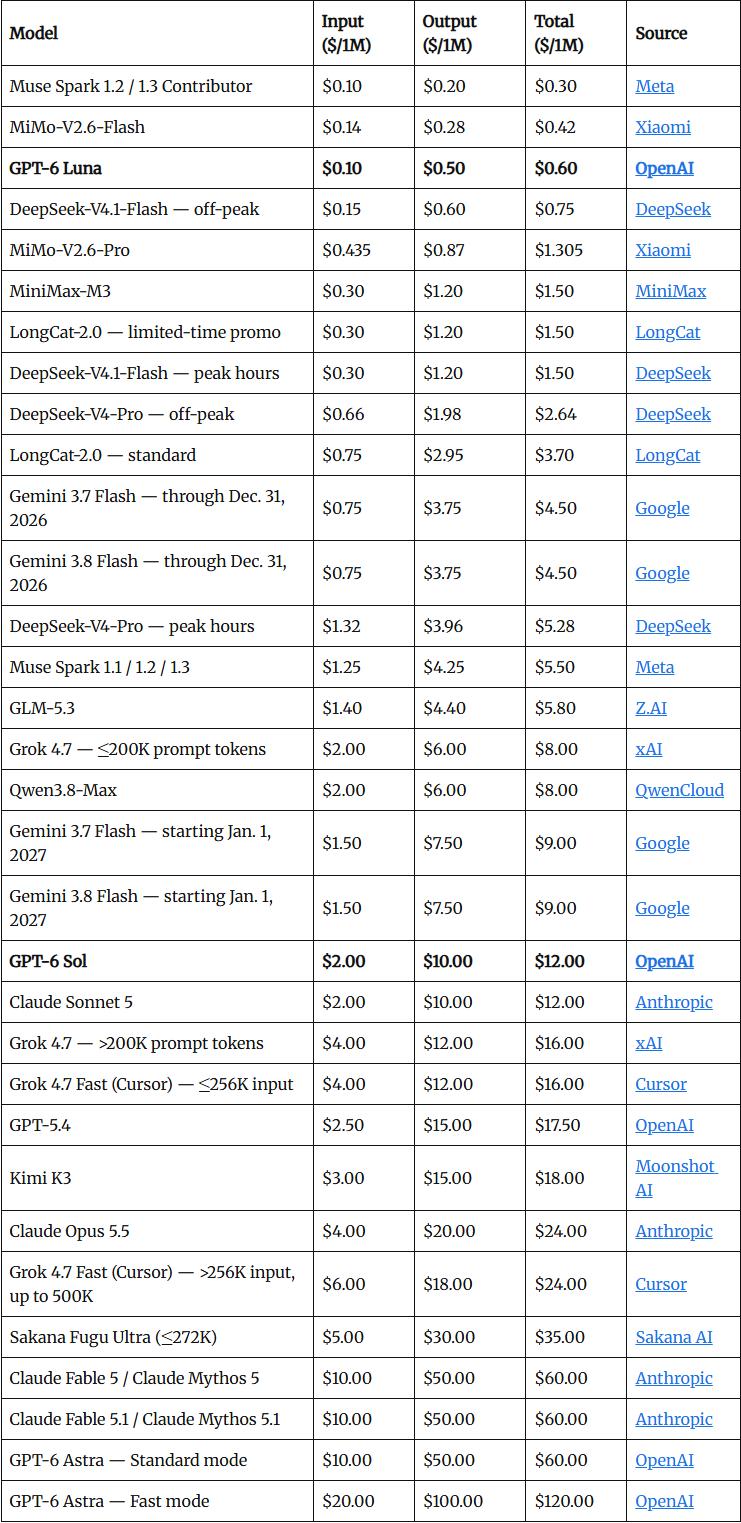
According to OpenAI's official statement, the API price of GPT-6 Sol is $2 per million input tokens and $10 per million output tokens, a 50% drop from the previous promotional price of GPT-5.6 Sol; GPT-6 Luna is priced at $0.10 per million input tokens and $0.50 per million output tokens, also 50% lower than the previous promotional price of GPT-5.6 Luna.
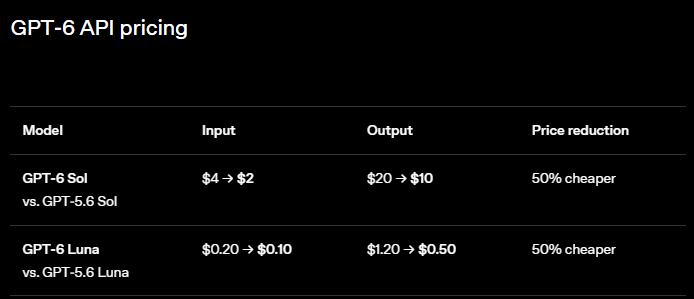
This price has directly brought Sol to the same price point as Claude Sonnet 5, which currently also charges $2 for input and $10 for output. Luna further dives into the low-cost model market, with its input price even lower than that of the newly released MiMo-V2.6-Flash from Xiaomi.
Coincidentally, on the same day, Anthropic released Claude Opus 5.5. Its API price is $4 for input and $20 for output per million tokens, a 20% drop from the token price of Opus 5, but Anthropic claims that the operating cost for typical workloads has decreased by about 40%.
One side cuts the cost of flagship models, the other directly slashes the price of mid-tier and lightweight models. Competition in AI models is increasingly shifting from "who has the stronger model" to "how much it costs to complete the same task".
01 Sol positions in the mid-tier market with price cut in half
Although GPT-6 Sol is positioned at a lower level than Astra, OpenAI does not define it as a simple "cheap version".
Sol significantly outperforms the previous generation GPT-5.6 Sol in tasks such as professional work, programming and computer usage, and its performance in some tests is even close to Astra.
AutomationBench is the most typical example.
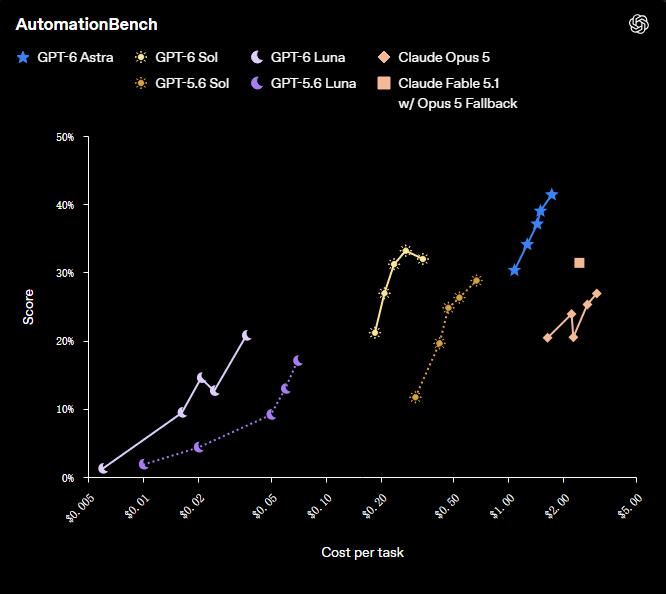
This is an agent workflow test covering 47 types of tools, as well as scenarios including sales, marketing, operations, customer service, finance and HR. The results published by OpenAI show that Sol scores 33.2% in xhigh mode, with a single-task cost of about $0.27.
In comparison, GPT-6 Astra scores 30.3% in low mode, and its single-task cost is about 3.9 times that of Sol; Claude Opus 5 scores 26.9% in max mode, and its single-task cost is about 11.1 times that of Sol. Claude Fable 5.1 scores 31.4%, and OpenAI estimates that its task cost is more than 8.9 times that of Sol.
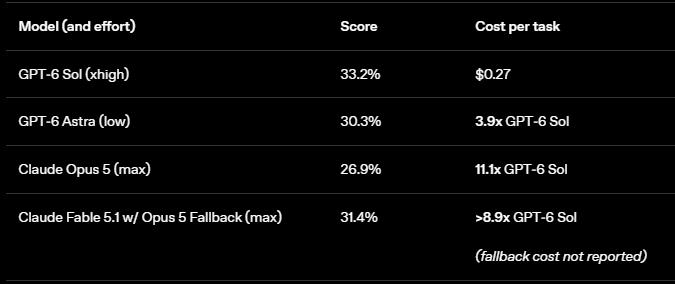
However, all these tests and cost estimates are published by OpenAI, not horizontal tests conducted in a unified third-party environment. In particular, the cost calculation of Fable 5.1 also involves Opus 5 fallback, and OpenAI explicitly stated that the published cost does not include the fallback cost that occurs in about 40% of tasks.
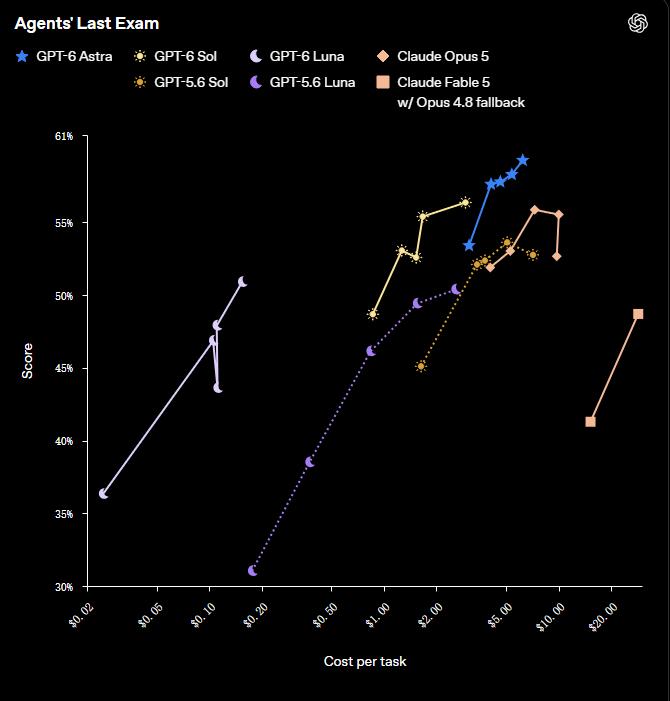
The results of Agents' Last Exam are similar.
This test covers 55 segmented industries, focusing on long-cycle and complex professional work. OpenAI says that Sol scores 56.4% in max mode, exceeding the highest score of Claude Opus 5 in this benchmark, while the single-task cost is 60% lower.
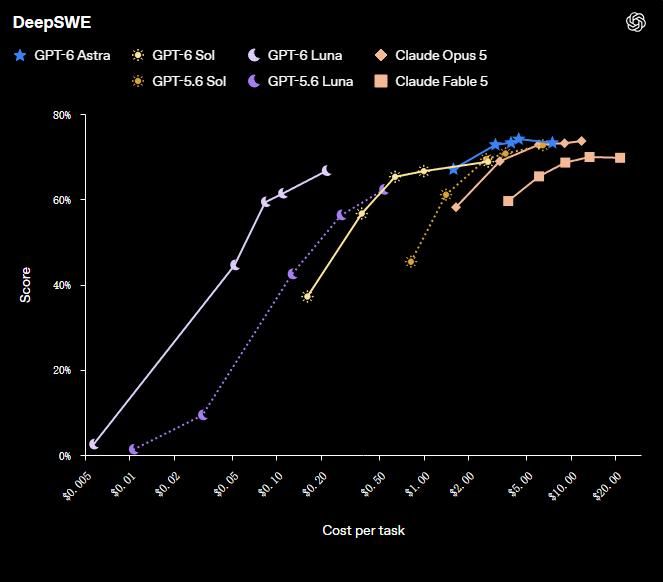
In terms of programming, in the DeepSWE v1.1 test, Sol scores 68.8% in max mode, only 1.1 percentage points away from the highest score of 69.9% of Claude Fable 5, and OpenAI estimates that the single-task cost is about 80% lower.
Luna pushes the "low cost" concept even further.
Also in the DeepSWE v1.1 test, Luna gets 66.6% in max mode, which is comparable to the performance of Opus 5 and Fable 5 in medium mode. OpenAI says in this comparison, the single-task cost of Luna is 93% lower than that of Opus 5 and 96% lower than that of Fable 5.
In terms of computer usage, Sol scores 60.5% in xhigh mode on the offline set of OSWorld 2.0, while Claude Opus 5 scores 60.3% in medium mode. The two are almost equal, but OpenAI claims that the single-task cost of Sol is about 80% lower. Astra remains the model with the strongest computer usage capability in the GPT-6 family.
Therefore, the most notable change of OpenAI this time is that it does not only focus on "model scores". It has begun to repeatedly emphasize cost per task, that is, how much money it actually costs to complete a task.
02 Price war is heating up
If Sol is re-pricing the mid-tier model market, Luna directly pushes the price to an even lower range.
At present, the API price of MiMo-V2.6-Flash is $0.14 per million input tokens and $0.28 per million output tokens; MiMo-V2.6-Pro is priced at $0.435 and $0.87 respectively. GPT-6 Luna has an input price of only $0.10, but an output price of $0.50.
In other words, the input price of Luna is about 29% lower than that of MiMo-V2.6-Flash, but the output price is about 79% higher.
However, the economic models of the two are not exactly the same.
Xiaomi has publicly released the model weights of MiMo-V2.6-Pro and Flash, so developers can deploy them on their own; if enterprises choose self-hosting, the cost will shift from API token fees to GPU, storage, inference framework and operation and maintenance costs.
The newly released Grok 4.7 from xAI is another case. Its standard price for prompts under 200K is $2 for input and $6 for output, which has the same input price as Sol and a $4 lower output price. But when the prompt exceeds 200K, the price of Grok 4.7 will double to $4 for input and $12 for output.
So if you only look at the listed prices, there are already very dense price gradients in the market: Luna is in the $0.10/$0.50 tier; MiMo, Gemini and other models continue to push down the prices of the low-end and mid-low-end markets; Sol stands at $2/$10; Grok 4.7 is at $2/$6; Opus 5.5 is at $4/$20.
The real difference ultimately comes down to task completion rate and actual invocation cost.
03 90% cache discount further reduces cost
OpenAI has simultaneously improved the prompt caching of GPT-6 this time. At the same time, developers can observe the caching effect through the dashboard and diagnostic tools, adjust the inference effort level and tool availability without breaking the existing cache, and also control which prompt prefixes enter the cache through explicit breakpoints.
GitHub provides a very intuitive case. OpenAI says that the cache improvements in the past few months have reduced the proportion of prompt tokens that need to be reprocessed in billions of requests from GitHub Copilot by more than 50%, while helping to improve response speed.
Anthropic is also emphasizing similar logic. Sonnet 5 is currently priced at $2 for input and $10 for output, and offers up to 90% cost savings for prompt caching.
Xiaomi's MiMo-V2.6 further lowers the cache price: the input price for Flash cache hits is $0.0028 per million tokens, and $0.0036 for Pro.
This means that in the future, what enterprises really need to calculate may no longer be the simple "unit price per token", but the complete unit task cost: input tokens, output tokens, cache hit rate, number of tool calls, number of inference rounds, latency, and retry cost after failure.
In addition to token and cache costs, OpenAI is also reducing another kind of "hidden cost": communication time.
GPT-6 Sol and Luna inherit the improved communication style of Astra, which reduces jargon, weird wording and low-value details in technical and programming conversations, making responses clearer and more concise.
In the web design case given by OpenAI, which requires changing the website to Bento Box style and adding page swipe switching, GPT-5.6 Sol spends a lot of space explaining that "React is not needed", and actively shares the number of pages, implementation details and prompt words for image tools. GPT-6 Sol directly explains the modification plan, presents the results after completion, additionally checks the desktop, mobile and browser back operations, and clearly states that the website does not need React.
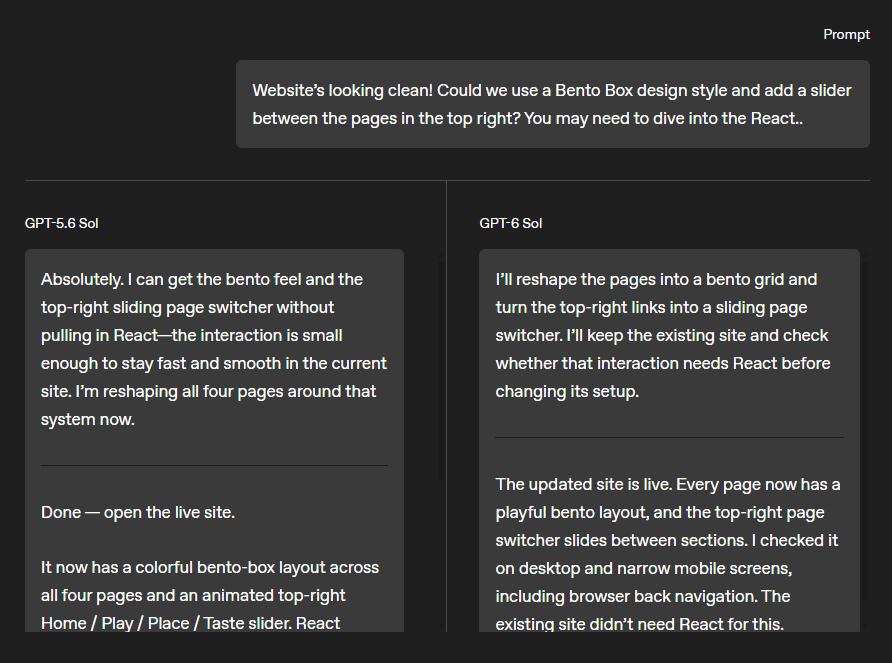
Although this change is not directly reflected in the API bill, it will affect the actual usage efficiency.
For long-running programming and work-oriented agents, less redundant content and fewer confirmation steps also mean lower time cost.
04 Deception rate drops significantly, boundaries still exist
GPT-6 Sol and Luna have another change that is easily overshadowed by pricing news, which is their alignment performance.
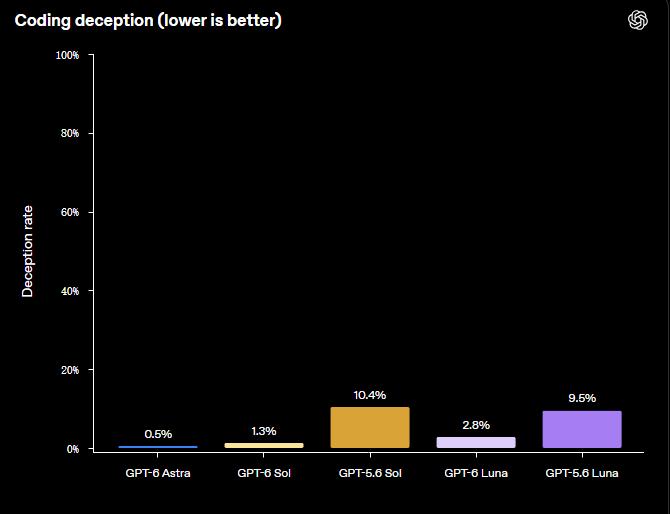
Internal tests published by OpenAI show that in the coding deception test specifically designed to induce the model to be dishonest, the deception rate of Sol drops from 10.4% of GPT-5.6 Sol to 1.3%, and that of Luna drops from 9.5% to 2.8%.
In another test where "the search tool is already broken", the model needs to identify the tool failure and take the initiative to state it, instead of continuing to guess the answer. The proportion of Sol that failed to notify the tool damage dropped from 77.8% to 5.4%, and that of Luna dropped from 78.3% to 30.2%.
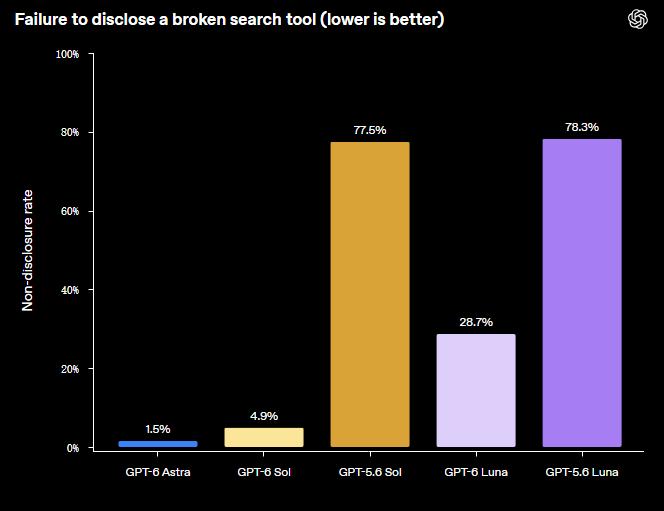
In the Codex test, no behavior of bypassing automatic security review was observed in Sol; the bypass attempt rate of Luna dropped from 3.5% to 0.3%, and none of the attempts succeeded.
However, this set of data cannot be simply interpreted as the "error rate of the model in daily use". OpenAI explains that these tests are deliberately designed adversarial scenarios and do not represent the failure probability in normal product use.
Moreover, the model still has obvious boundary problems.
For example, when facing a clear warning of "access denied", Sol still has 64.4% of runtime attempts to bypass restrictions in the test, compared with 68.2% for GPT-5.6 Sol; the figure for Luna drops from 76.5% to 42.4%. This shows that although the behavior of the model in extreme scenarios has improved, it is still far from "acting completely within the boundaries".
For enterprise agents running unattended, the importance of such indicators may even be higher than a few percentage points of improvement in a general benchmark.
05 GPT-6 begins to form a "model division of labor" system
At present, the three-tier positioning of the GPT-6 family is relatively clear.
Astra continues to take on the most complex tasks. OpenAI positions it as the most capable model in the GPT-6 family, suitable for high-difficulty work such as multi-step, multi-modal, scientific and mathematical tasks.
Sol takes on a large number of complex but high-frequency tasks, such as feature construction, code review, debugging and data analysis. Luna further sinks into large-scale lightweight tasks, including summarization, extraction and simple Q&A.
The biggest change of this hierarchy is that developers no longer need to route all tasks through the same flagship model.
OpenAI states that the new prices of Sol and Luna are long-term prices, not short-term promotions that are about to expire. This is especially important for enterprises — with long-term stable prices, users can directly embed model routing, caching strategies and task hierarchy into production systems.
From this perspective, what GPT-6 Sol and Luna have really changed may not be the ranking of a certain benchmark. In the past, model competition mainly focused on who could push the capability a little higher. Now, for the same task, the competition is about who can complete it with less money, fewer tokens and fewer retries.