Beyond hot dry noodles, Wuhan is running another nationwide business.
At 4 p.m. on a weekday, which is supposed to be a relatively quiet time of day for a restaurant, there are still more than 200 tables waiting in line at Pick Chill near Jing'an Temple in Shanghai.
Around the May Day holiday this year, this restaurant focusing on American casual dining opened its first store in Shanghai, and has maintained high popularity for several months thereafter. With large floor-to-ceiling windows, low-saturation space, exquisite plating, and an all-day menu covering coffee, muffins, pasta, curry rice and other items, it has almost gathered all the popular elements of the current "aesthetically pleasing dining" trend.
What Shanghai consumers may not know is that behind Pick Chill stands a Wuhan-based company — Wanshi Heyi. In addition to Pick Chill, creative Korean restaurant NEED, cloud-southwest fusion restaurant Yeego, One More Thai, Azabu Shokudo and creative baking brand BANG are all brands under this company.
There are many similar cases. In the past two years, Wuhan catering companies have frequently appeared behind the popular brands such as San Chushan and O'eat in Beijing, Shanghai, Guangzhou and other cities.
Wanshi Heyi, Dechuan, Ganqu Catering Creation, Zhuozhi Fangjian and Fanjia are known in the industry as "the Five Dragons of Wuhan Catering", and almost half of the national "aesthetic dining" queue kings are created by them in batches. "On the track of 'aesthetic dining', Wuhan catering brands have already stood out and taken the lead nationwide." A relevant person in charge of the Wuhan Catering Association mentioned earlier.
In the past, the catering symbols exported from Wuhan to the whole country were hot dry noodles, duck necks and crayfish, with very distinct regional characteristics. Now, what goes out from Wuhan are a number of restaurants that are least like "Wuhan cuisine", such as Yunnan-Guizhou-Sichuan bistros and American-style diners.
Why is it Wuhan in particular that has begun to mass-produce internet-famous catering brands?
01
More friendly for trial and error
Being young is a major reason.
Wuhan has 95 universities and more than 1.4 million college students on campus, ranking the third in the country in terms of the number of college students. Official data shows that the proportion of the young population in the city exceeds one third.
It is obviously not enough to explain the concentrated emergence of aesthetic dining restaurants in Wuhan only by "a large number of young people". Chengdu and Changsha also have a huge young population and strong catering consumption demand, and even have more distinct internet-famous city labels.
The particularity of Wuhan lies in the fact that young consumer demand has formed a superimposed effect with the fully supplied and highly competitive commercial real estate market.
In 2024, the total commercial stock of Wuhan reached 14.36 million square meters, with a per capita commercial area of 1.04 square meters, ranking at the forefront of central Chinese cities; it is expected that 2.96 million square meters of new commercial area will be added in the next three years.
With more and more commercial projects, it has become increasingly difficult to solve the investment promotion problem only by relying on mature chain brands, shopping malls have to continuously look for differentiated content.
"Nowadays, commercial complexes are generally willing to introduce internet-famous catering with topicality. On the one hand, they can make their investment portfolio different from surrounding projects; on the other hand, a restaurant that is becoming popular can itself become a traffic entrance of the mall, converting purpose-driven catering consumption into passenger flow of the entire commercial space." Yongyi, an operator of a shopping mall in Shanghai, told the Reading City Journal.
Take Huafa Zhongcheng Shangdu, which opened in Wuhan in December 2021, as an example. It did not focus all its investment promotion on mature chain stores, but left more space for proprietor-led brands. The first national stores of brands such as NEED, San Chushan, Yeego and Grande Amoo all completed their initial market verification here. Among the nearly 50 catering brands in the commercial complex at present, more than half are the first national stores incubated by proprietors.
Li Min, the founder of San Chushan, recalled earlier that the brand initially put forward the concept of "mountain-style nature, garden hot pot", hoping to use wild ingredients and spatial design to turn Qiaoniu Beef into a new consumption experience. After many communications, the commercial management team of Huafa Zhongcheng Shangdu accepted this idea and gave support.
For a newly established catering brand, the first store itself is an experiment. It is impossible to know whether consumers will come, how to adjust the menu, whether the space is attractive, and what content is easy to be photographed and spread out until the store is opened.
Qian Jun, General Manager of Huafa Zhongcheng Shangdu, also mentioned in an interview with the media that the mall gives proprietor-led brands more tolerance in terms of rent and rent-free period, and leaves more space for outdoor seating areas, exploring together with the brands how they can integrate into the commercial complex.
It is precisely for this reason that the "aesthetic dining" restaurants are not born in super-large commercial complexes such as Wushang MALL and Wuhan SKP, but concentrated in community commercial complexes and small and medium-sized commercial complexes such as Huafa Zhongcheng Shangdu and Intime Creative City.
These commercial complexes are usually surrounded by universities, communities and mature business districts, with relatively stable passenger flow. The market environment that is relatively tolerant to new brands also allows entrepreneurs to complete low-cost testing and rapid iteration locally.
Wuhan is therefore a bit like a "test server" for new catering: it does not have the highest consumption power in the country, but it has a large enough market, enough young consumers, and a large number of commercial complexes willing to trade space for freshness.
02
Expand from Wuhan to the whole country
The key to the popularity of Wuhan's "aesthetic dining" across the country is to form a relatively clear spillover path after the brand proves its feasibility.
Around 2023, after NEED, Yeego, San Chushan and other brands completed the first round of market verification at Huafa Zhongcheng Shangdu, they all chose Wuhan Tiandi as their next stop. The Wuhan Municipal Bureau of Commerce once sorted out that these brands later entered the national commercial systems such as China Resources Mixc, and gradually expanded from Wuhan to other cities.
For example, NEED was founded in 2021, and began to expand outward in December 2023, then entered more than 20 cities including Hangzhou, Wuxi, Nanjing, Chongqing, Chengdu and Shenzhen. By April 2026, the number of NEED's national stores was close to 100, and the number of national stores of several brands such as San Chushan and Yeego also exceeded 30.
In the past, when a restaurant left the local market, it often needed to find new stores, negotiate investment promotion and build local connections. But if it has entered the investment promotion system of a national commercial group, the path can be greatly shortened. At the same time, as long as a brand can prove in Wuhan that it can generate passenger flow, topics and attract the attention of young consumers, it is easier to enter the vision of investment promotion teams in other cities.
No matter it is Western food, Thai food or Yunnan-Guizhou cuisine, internet-famous restaurants do not stick to their origins.
This change in channels is also in turn changing the organizational mode of catering companies. Traditional catering groups usually focus on deepening a single dish or a cuisine, and then consider how to replicate stores, while Wuhan catering creation companies such as Wanshi Heyi are taking a path increasingly similar to consumer brand companies.
Take Wanshi Heyi as an example, its brands cover different categories such as Korean food, Yunnan-Guizhou fusion cuisine, Thai food, Japanese food, American casual dining and baking. Instead of expanding vertically around a certain cuisine, it keeps looking for new categories in different consumption trends.
Public praise is not even the most critical factor. The reputation of Pick Chill in Shanghai is quite polarized. Some people recognize its space and atmosphere, while others think that the waiting heat is far higher than the quality of the dishes themselves.
But from the perspective of shopping malls, the controversy does not prevent it from playing its role. "Having eaten at that hard-to-book restaurant" has itself become a kind of social currency, which means that consumers are willing to move across business districts for a restaurant.
Yongyi told Reading City Journal that shopping malls usually first introduce a popular internet-famous brand, and if it performs well, other brands under the same catering group may also enter later. "These internet-famous catering stores have a listed rent price, but there is also room for negotiation."
As a result, the "Five Dragons of Wuhan Catering" are thriving with this mature organizational capability: identifying trends, defining brands, designing spaces, developing menus, creating first-store popularity, and then entering new cities with the help of commercial real estate.
Commercial real estate happens to need this kind of "continuous new launch", and the two have thus formed an interdependent relationship.
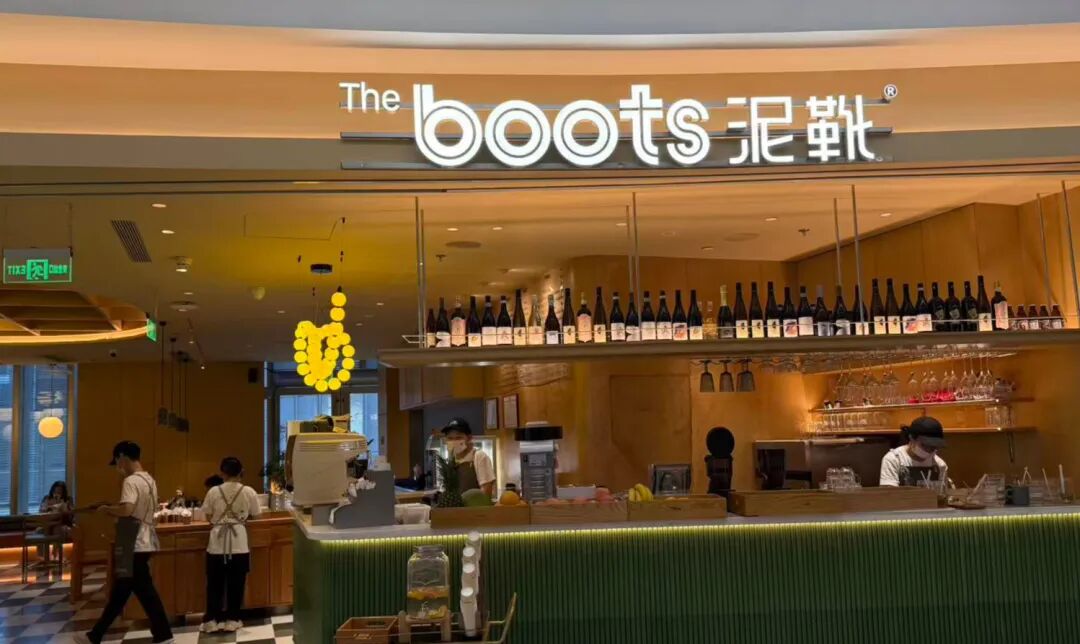
Creative Western food brand Boot & Bread is also a Wuhan-born brand
This mechanism is still being replicated. In September this year, Huafa Zhongcheng Shangdu plans to make Building B9 fully unveiled, and then focus on introducing and incubating 8 to 10 "small catering" brands at the national first-store level.
From NEED, Yeego to the next batch of restaurants that have not yet been named, Wuhan is trying to turn the originally accidental internet-famous restaurants into a repeatable commercial production.
03
What can aesthetic dining leave for Wuhan?
In fact, this change is no longer limited to the catering industry.
In 2024, Wuhan shopping malls introduced a total of 456 first stores, including 7 national first stores, 159 central China first stores, 54 Hubei first stores and 236 Wuhan first stores. In 2025, Wuhan added another 430 first stores.
Major consumer cities across the country are promoting the "first store economy", but the uniqueness of Wuhan lies in the "debut" feature: it does not rely on "bringing in" international brands, national first stores and high-end commercial projects, but produces local brands.
In March this year, 7 departments including the Wuhan Municipal Bureau of Commerce jointly issued the "Several Measures of Wuhan Municipality to Support the Development of Debut Economy", proposing to build Wuhan into "a national incubation base for new consumer brands, a gathering place for brand first stores, and a preferred place for new product debuts". At the same time, the "Proprietor-led Brand" plan will be implemented to guide entrepreneurs, designers and cultural IP owners to open proprietor-led brand stores. The policy also proposes to cultivate more than 20 high-end consumer goods brands by 2027.
This brand production capability first requires a sufficiently large local consumer market.
In 2025, the total retail sales of consumer goods (hereinafter referred to as "total social retail") of Wuhan reached 901.396 billion yuan, a year-on-year increase of 4.5%, of which catering revenue was 54.936 billion yuan, a year-on-year increase of 1.3%. In the first half of 2026, the total social retail of Wuhan was 425.07 billion yuan, a year-on-year decrease of 0.7%, but the catering revenue bucked the trend and increased by 5.2%.
When the overall consumption is under pressure, the catering industry still maintains growth. This is also the market foundation for the continuous emergence of aesthetic dining restaurants in Wuhan.
However, for Wuhan, a city that is sprinting towards a trillion-yuan consumption scale, opening a few more queuing restaurants is obviously not enough.
The turnover of Pick Chill in Shanghai will not be counted into Wuhan's social retail data, and the opening of Yeego in Guangzhou will not directly increase Wuhan's consumption data. But if the brand's R&D, design, operation, brand management and other professional service links continue to develop in Wuhan, then after the stores expand across the country, what Wuhan gets is not just the passenger flow of the first store.
At present, public data is not enough to quantify how much headquarters economy, employment and supply chain benefits these local catering brands have brought to Wuhan. This is also the key to whether "aesthetic dining" can grow from a group of internet-famous restaurants to a real industry.
Therefore, when Wuhan promotes the debut economy, what is really worth observing is not how many first stores have been added, but how many of these first stores can eventually become brands starting from Wuhan.
Aesthetic dining is highly dependent on aesthetic trends and social platforms. The faster the brand iteration, the shorter the life cycle may be. If what Wuhan finally leaves is only constantly changing queuing restaurants, without headquarters enterprises, supply chains, design and marketing institutions, professional managers and long-term brand assets, the so-called "industrial cluster" is still just a round of internet-famous economy.
Conversely, if this batch of catering creation companies can continue to stay in Wuhan and drive the growth of brand management, supply chain and professional service systems, the significance of aesthetic dining will go beyond catering itself.
To measure whether Wuhan is really "taking over" the national aesthetic dining market, we should not only look at how many new queue kings it has created. More importantly, when the queuing crowds disperse, how many companies, talents and industries these brands have left for Wuhan.
This article is from the WeChat official account "Reading City Journal Studio", author: Jing Xing, editors: Liang Li, Wang Chenting, released by 36Kr with authorization.