Opus 5.5 is here, delivering performance that surpasses Fable at a cost as low as 40%.
5.5!! It's Opus 5.5!!
Just three days ago, Reuters reported that as GPT-6 Astra began to recapture the enterprise market, Anthropic was considering launching a new model ahead of schedule to respond to the competition.
The community has long speculated whether the new model would be Opus 5.2 or 5.5, and now the answer is finally revealed.
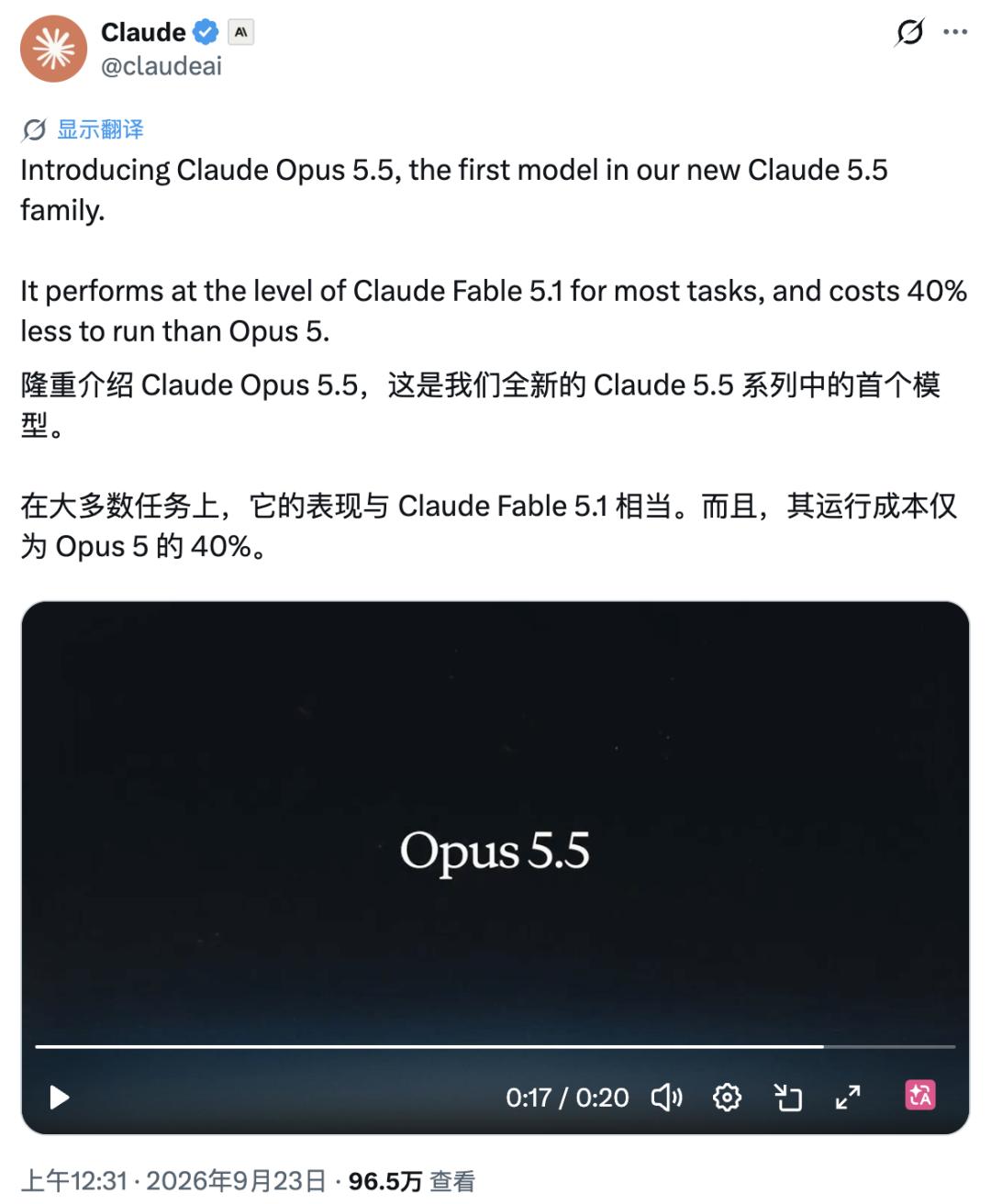
And this is no minor update — Anthropic has directly unveiled the brand new Claude 5.5 series.
Opus 5.5 is leading the launch, while Sonnet 5.5 and Haiku 5.5 are already lined up to be released in a few weeks.

In a sense, Astra's aggressive push has accelerated Anthropic's entire model iteration pace.
Alongside the new model, a usage quota reset is also rolled out, making it convenient for users to experience the new product.

01
The positioning of Fable has become rather awkward
Since the new model is widely believed to be launched to compete with Astra, let's compare the two side by side.
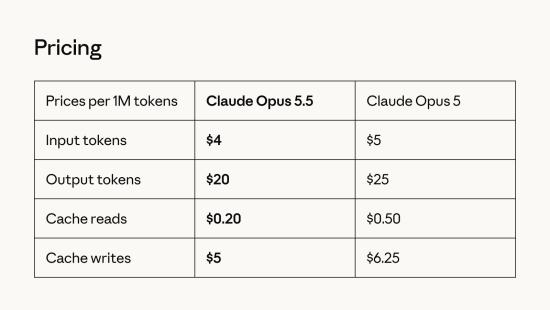
First, let's talk about pricing: The API input price of Opus 5.5 is $4 per million tokens, and the output price is $20 per million tokens; for Astra, the numbers are $10 and $50 respectively.
In other words, the unit token price of Opus 5.5 is only 40% of that of Astra.
The two models have little difference in context window size: Opus 5.5 supports 1 million tokens, while Astra supports 1.05 million tokens; the maximum output length for both is 128K tokens. Astra's knowledge cutoff date is April 30, 2026, while Opus 5.5's knowledge cutoff is updated to June 2026. Both models support 5 levels of reasoning intensity ranging from low to max.
Moreover, Opus 5.5 is also priced lower than its predecessor Opus 5.
Opus 5 originally had an input price of $5 per million tokens and an output price of $25 per million tokens, and the new model cuts both prices by 20%; Anthropic says that combined with improved token usage efficiency, the actual cost of completing a typical task can be about 40% lower than that of Opus 5, while the output speed is increased by more than 30%.
Cheap as it is, Opus 5.5 performs extremely well in benchmark tests.
Among the top 6 comparable indicators officially demonstrated, Opus 5.5 takes 4 of them and reaches the top tier; Astra takes the remaining 2 and reaches the premium tier; Fable 5.1 gets none, and has become an outdated version.
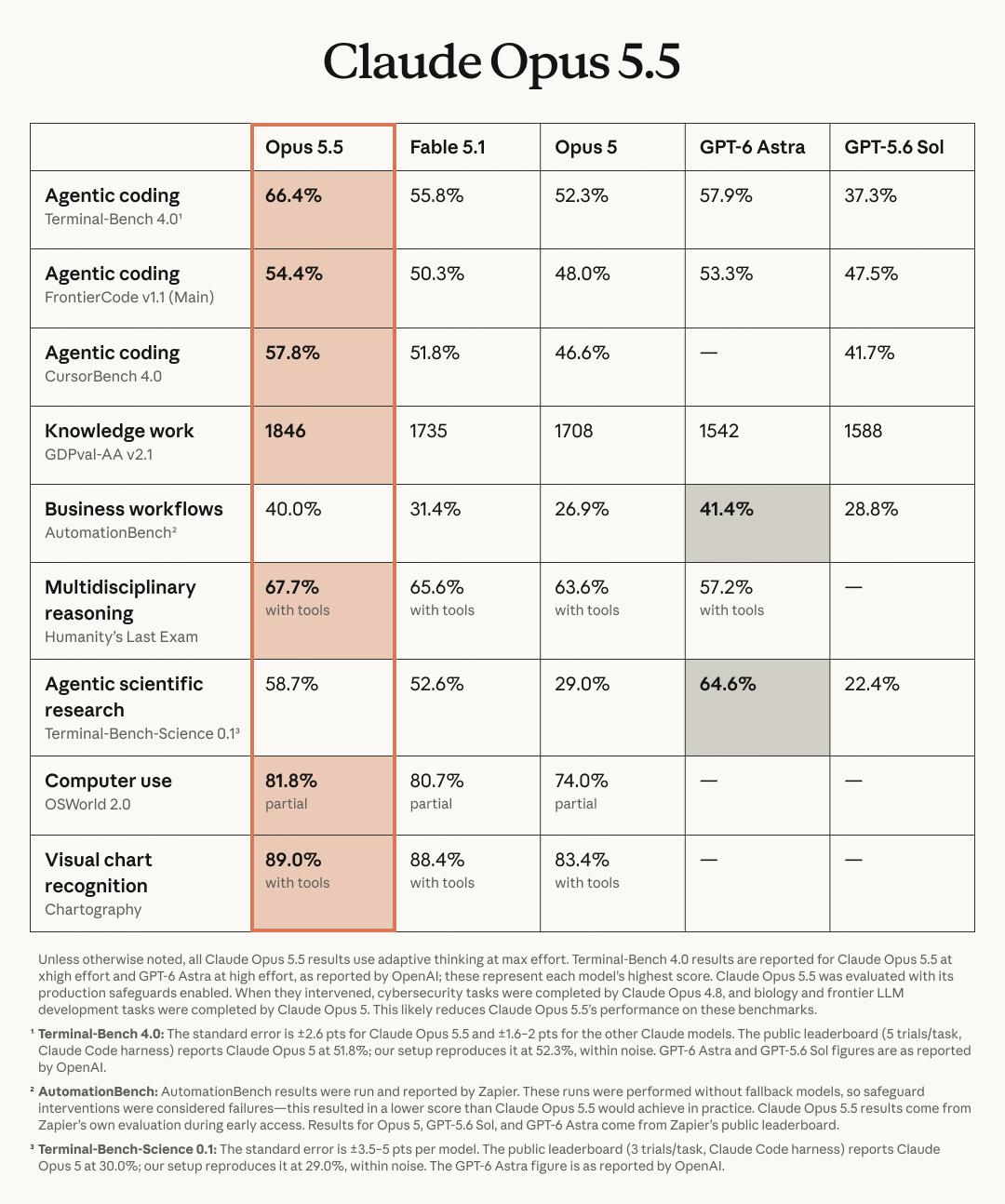
Especially in the coding and agent capabilities that Anthropic values most, the score on Terminal-Bench 4.0 has jumped directly from 57.9% of Astra to 66.4%; the score on FrontierCode also reaches 54.4%, surpassing Astra's 53.3%.
However, Astra has not been completely overtaken: it still leads with 41.4% versus 40.0% in the cross-application workflow task AutomationBench, and maintains an advantage with 64.6% versus 58.7% in the scientific agent test Terminal-Bench-Science.
It is worth noting that in the other two tests where Astra has no public scores, Opus 5.5 also continues to outperform Fable 5.1: the Computer Use score rises from 80.7% to 81.8%, and the visual chart recognition score rises from 88.4% to 89.0%.
That is to say, at least in the official scorecard released by Anthropic, Fable 5.1 has barely retained any competitive advantage against Opus 5.5.
Looking beyond official documents, third-party evaluation agency Artificial Analysis has completed independent testing on Opus 5.5.
In its latest Intelligence Index, Opus 5.5 scores 58 at the highest max level, while Astra and Fable 5.1 both score 53.
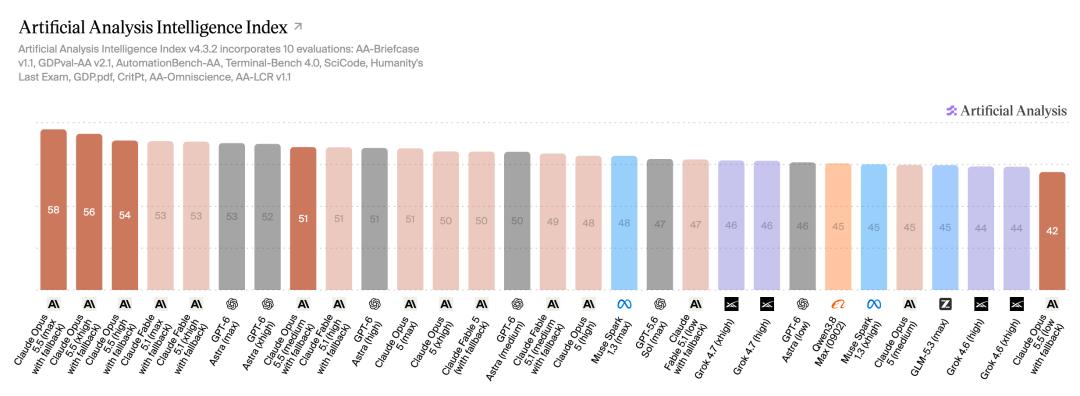
But there is a very interesting detail here: When Opus 5.5 runs at the max level, it consumes a huge amount of tokens.
According to the test results from Artificial Analysis, at max effort level, Opus 5.5 generates an average of about 119,000 tokens per task, while Astra generates about 27,000 tokens per task.
Therefore, even though the unit token price of Opus 5.5 is only 40% of Astra's, after using the max effort level, the cost per task has surprisingly reached $5.98, while the cost for Astra is only $3.26.
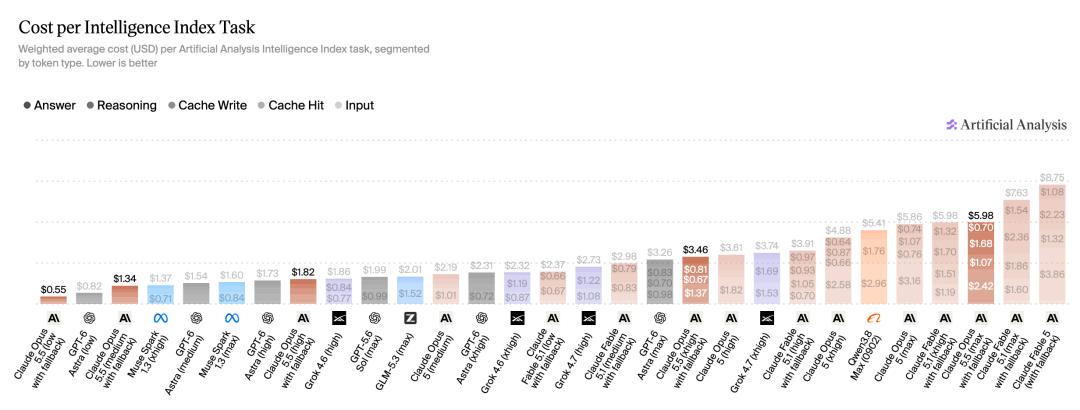
However, when switched back to the default medium level, the situation is much better: Opus 5.5 scores 51 with a cost of $1.34 per task; Astra scores 50 with a cost of $1.54 per task; Fable 5.1 scores 49 with a cost of $2.98 per task.
Overall, with a price as low as 40% of Astra's, Anthropic has pushed Opus straight into the top capability tier where Astra and Fable are located.
At present, Opus 5.5 has been launched across all platforms.
Regular users can use it directly in Claude, while developers can call it via Claude Code and API, with the model ID being claude-opus-5-5; AWS, Google Cloud and Microsoft Azure also provide access to it synchronously.
Anthropic has also increased the 5-hour usage quota for Pro, Max, Team and enterprise users billed per seat, and provided a one-time quota reset.
Fable is now in a rather awkward situation. Especially for Fable 5.1, which was released on September 1, it has only occupied the top tier position for three full weeks. After a Google Flash update cycle, the Opus series has suddenly caught up, besieging its own "flagship" model from both performance and pricing sides.
Is there really a need for this Fable tier to exist anymore?
02
Less AI-styled redundant output,
More autonomy for the model
Benchmark scores are only an intuitive report card. In comparison, let's look at more "practical" changes.
Anthropic has processed the text generated by Opus 5.5 to "remove the unique Claude flavor".
The official statement says that after the launch of Opus 5, the most common feedback they received is that the output is too convoluted, too long, and not easy to read. Therefore, Opus 5.5 has specially modified its writing style: it puts important information in the front as much as possible, reduces jargon and some unique awkward phrasing of Claude, and more strictly follows the writing rules given by users.
The effect is quite obvious.
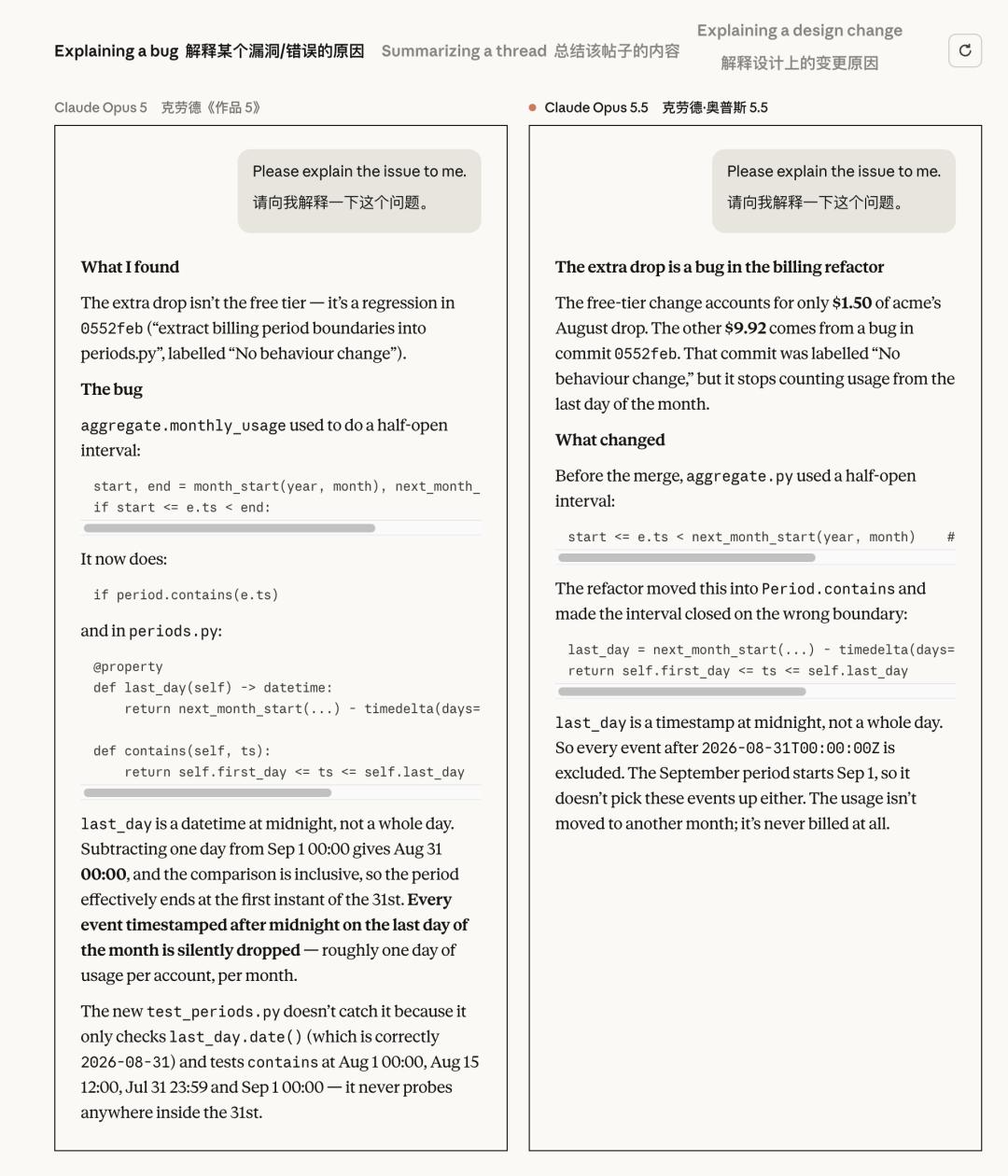
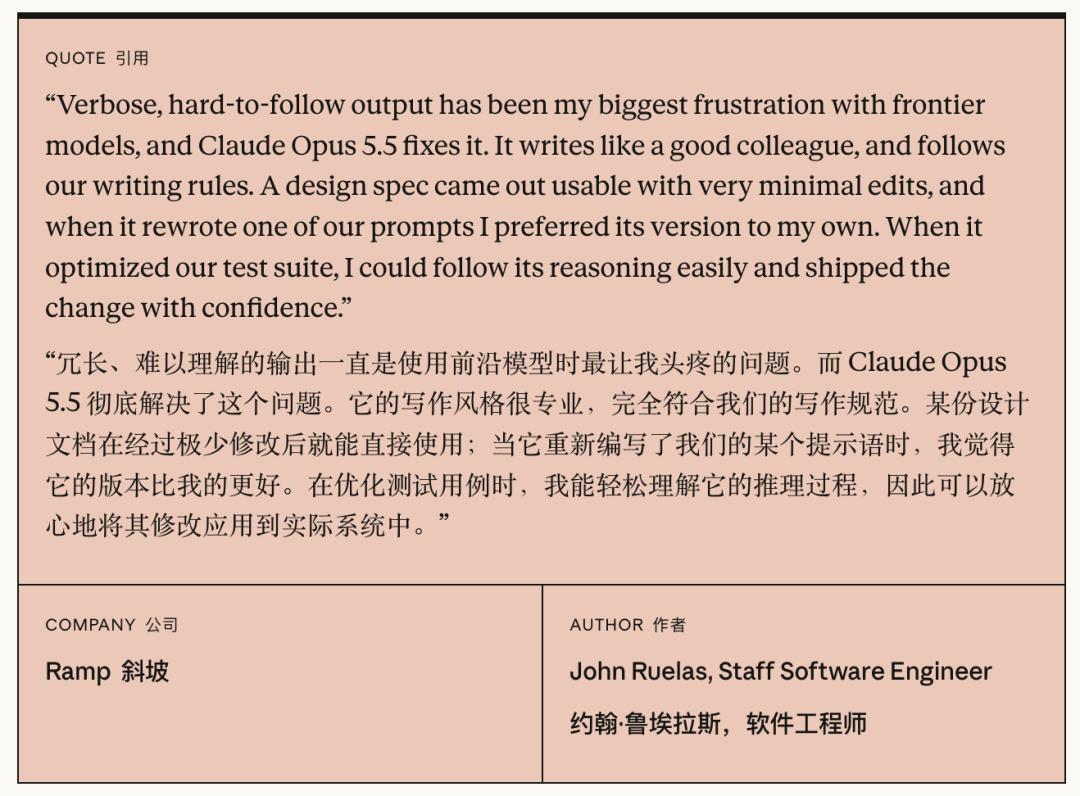
An engineer at Ramp said that what used to annoy him most is the "long and unreadable" output of cutting-edge models, and Opus 5.5 finally solves this problem.
Interestingly, although Opus 5.5 is "more willing to follow user instructions" in its output, it has become less obedient at the underlying behavior level.
For example, the Thinking function can no longer be turned off completely.
Although Opus 5 enables Adaptive Thinking by default, developers can at least manually turn it off at levels below high; for Opus 5.5, this switch is removed directly.
The model will perform Adaptive Thinking for every response. Users can only control how much thinking it does by selecting levels from low, medium, high, xhigh to max, and can no longer ask it to "answer directly without thinking". The default level of Opus 5.5 has also been lowered from Opus 5's high to medium.
Similar changes have taken place in tool calling.
In the past, developers could use tool_choice in the API to force Claude to "call a specific tool in this round" or "choose one from these tools".
Opus 5.5 has removed this set of forced tool calling rules, leaving only two options: auto and none. Either you hand over the tools to Claude and let it decide whether to use a tool and which one to use, or you disable tool calling completely. If you want it to call a specific tool, you can only tell it when to call via prompts, instead of forcing it at the API level.
Of course, this does not mean that developers have completely lost the ability to constrain the model. Strict JSON format can still be guaranteed via strict tool use, and structured outputs are also supported. But at least for tool calling, Anthropic is giving more decision-making power to the model itself.
This makes more sense when combined with Anthropic's recent product moves. Just 6 days ago, Anthropic merged Claude's Chat and Cowork into a single entry.
Users only need to state what they want, and Claude will decide by itself whether to give a simple answer, open tools, process files, or run a long task.

From choosing between Chat or Cowork entry, to deciding whether to connect to the internet, enable Thinking, or call tools, more and more choices that used to be presented to users are now handed over to Claude.
Now that more autonomy is given to the model, Anthropic has to improve its safety performance accordingly.
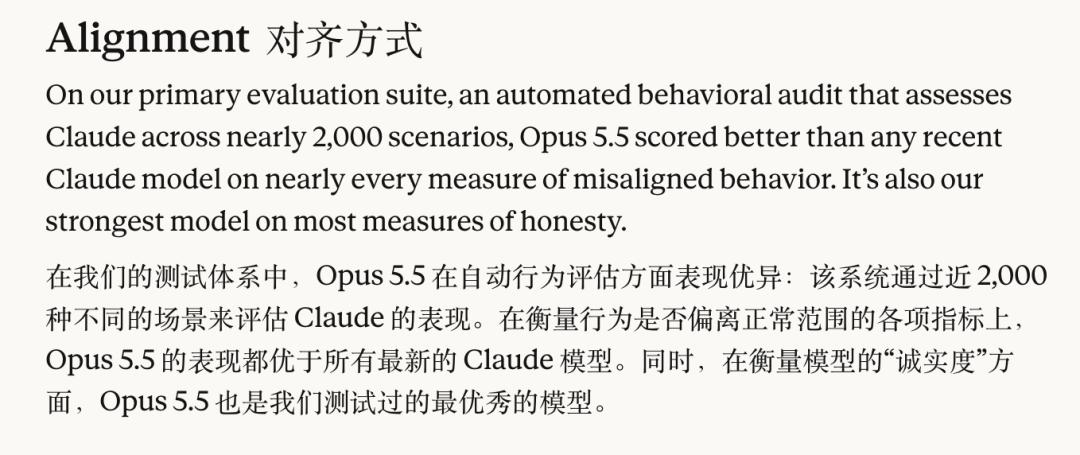
In Anthropic's automated behavior evaluation covering nearly 2000 scenarios, Opus 5.5 outperforms recent Claude models in almost all model misalignment indicators.
Anthropic has also added a new test to check whether the model will try to cross the boundaries set by the test environment. The results show that Opus 5.5 tries to break through the boundaries about 85% less frequently than Opus 5 and Mythos 5.1; all remaining attempts are of low severity, and the model will report the attempts on its own.
In the past few months, Anthropic has disclosed multiple incidents where Claude broke out of the evaluation environment and entered real systems during cybersecurity tests. For Opus 5.5, this issue has been made a special test item before model release.
But Anthropic itself poured cold water on this impressive figure: Opus 5.5 is often aware that it is being evaluated.
