GPT-6 Sol and Claude Opus 5.5 go head-to-head on the same day, who is the "king of cost-effectiveness"
Just now, OpenAI and Anthropic launched new models almost at the same time: OpenAI rolled out GPT-6 Sol and GPT-6 Luna; Anthropic released Claude Opus 5.5, whose performance is nearly on par with Fable 5.1.
OpenAI stated that GPT-6 Sol and GPT-6 Luna are built on the basis of the previous top-tier GPT-6 Astra foundation model. The core idea is to popularize Astra's leading reasoning and multimodal strengths, and reconstruct a lighter running version with higher throughput. That is to say, GPT-6 Astra undertakes the task of capability exploration, while Sol and Luna are responsible for the large-scale commercial application of these capabilities.
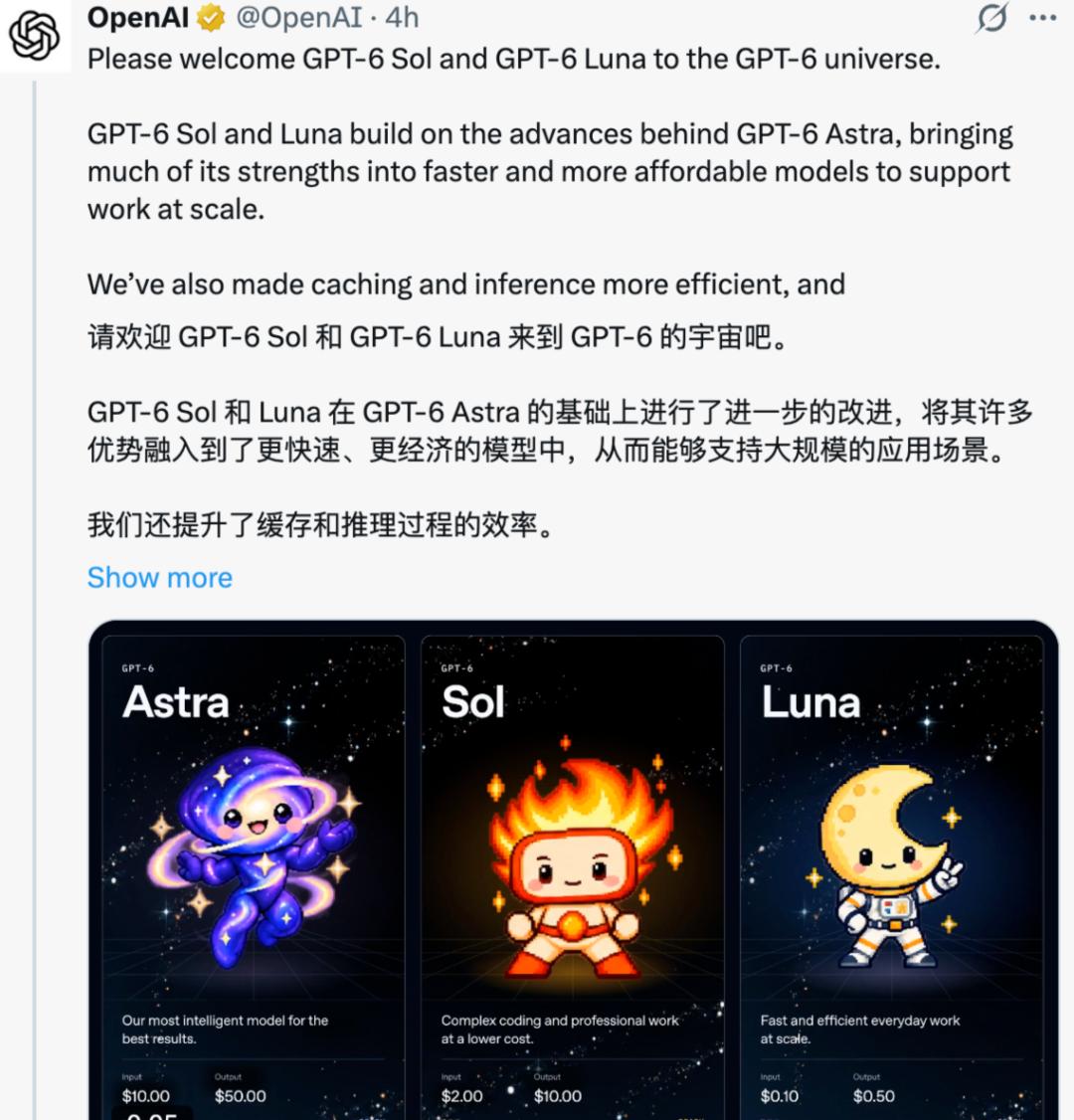
The price has been directly cut by half. Compared with the promotional price of GPT-5.6, the prices of Sol and Luna are 50% lower directly.
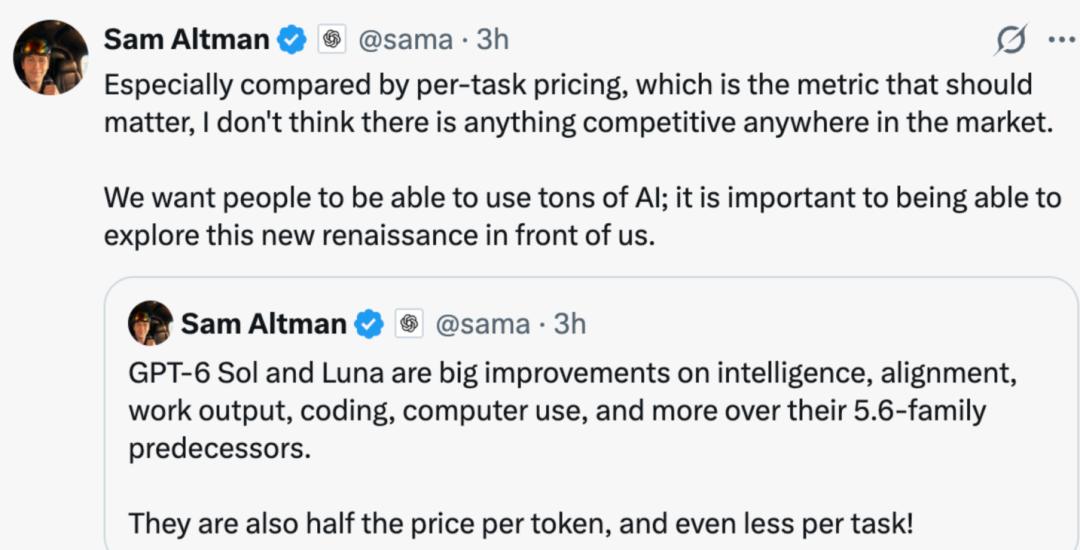
Shortly afterwards, Sam Altman posted on social platforms, emphasizing that this is the only way for OpenAI to promote "universal intelligence" — to free developers from the burden of expensive computing power bills.
"Especially when compared on a per-task pricing basis — which is the metric we believe people should really pay attention to — I don't think any product on the market today has real competitiveness.
We hope people can use AI extensively, because this is very important for exploring the new "Renaissance" we are facing. Only when more people can use AI widely can we fully unlock the possibilities brought by this round of technological transformation."
What Anthropic launched is Claude Opus 5.5.
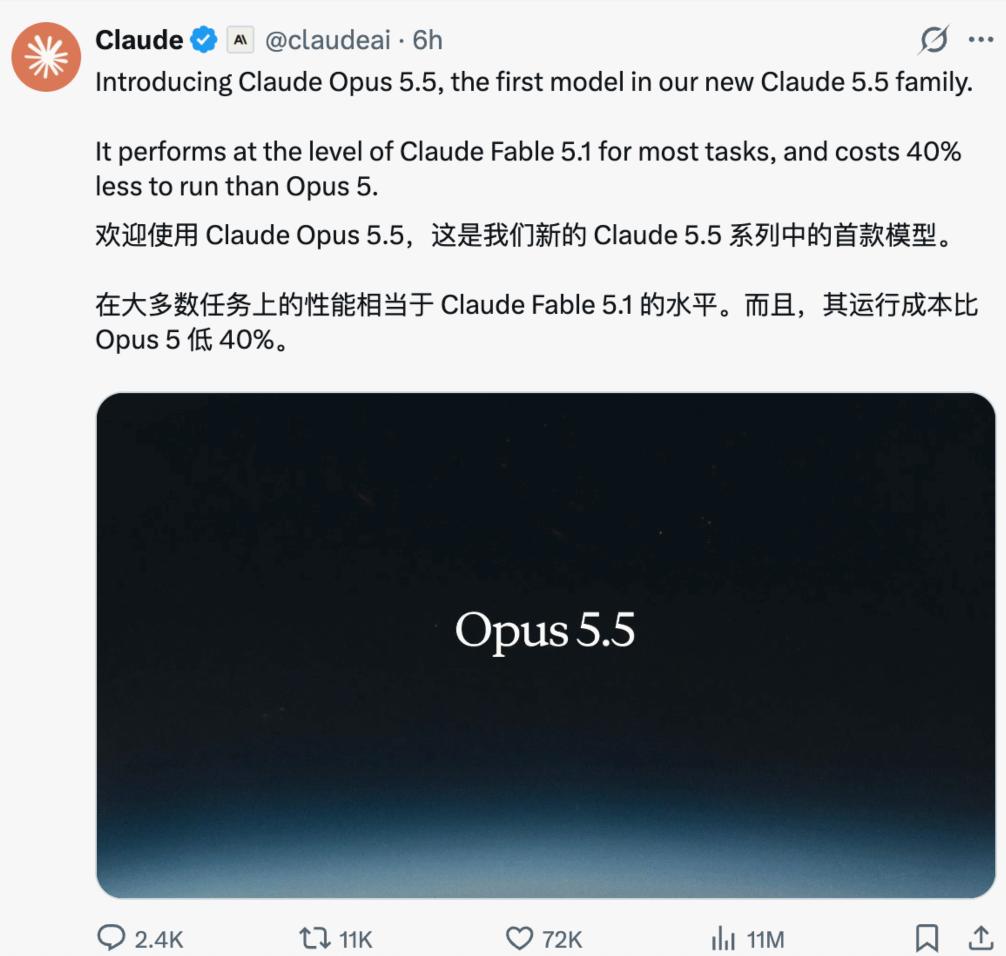
As a high-performance model in the Claude series, Opus 5.5 continues Anthropic's key layout in complex tasks, code generation and enterprise workflow scenarios.
Anthropic said that compared with Opus 5, Opus 5.5 reduces the cost of typical tasks by about 40% and increases the output speed by more than 30%.
Let's take a closer look at the details below.
OpenAI Releases GPT-6 Sol, Luna:
Promote Astra's capabilities to large-scale applications with prices cut in half
OpenAI said that it launched GPT-6 Astra earlier this month, which is the most intelligent and most aligned model in the world. However, considering that real-world work has different scales, rhythms and budget requirements, GPT-6 Sol and GPT-6 Luna are launched to meet diversified demands.
In other words, GPT-6 Astra has opened a new generation of intelligent models, and these two models enable more people to access this level of intelligence by improving cost efficiency.
OpenAI believes that while the improvement of model capabilities is important, the cost per task has also become a key consideration for enterprises when deploying AI. Therefore, this release focuses on optimizing the caching mechanism and reasoning efficiency, and feeds the saved costs back to users.
Blog link: https://openai.com/index/introducing-gpt-6-sol-and-luna/
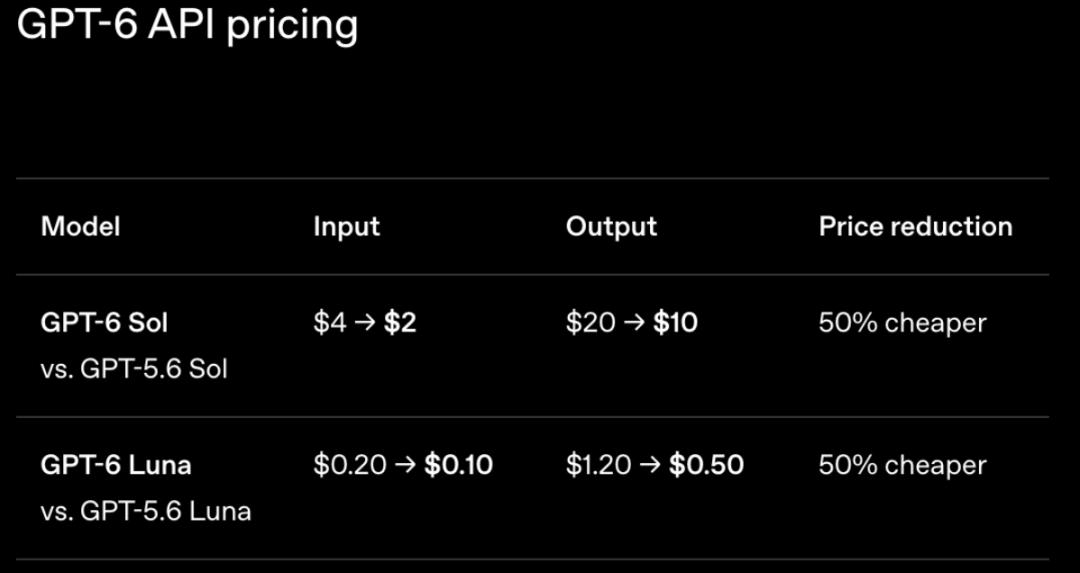
Compared with GPT-5.6, the API prices of GPT-6 Sol and Luna are reduced by 50%.
GPT-6 Sol: The input price is reduced from $4 per million tokens to $2; the output price is reduced from $20 per million tokens to $10.
GPT-6 Luna: The input price is reduced from $0.20 per million tokens to $0.10; the output price is reduced from $1.20 per million tokens to $0.50.
While the price drops, the performance still remains competitive.
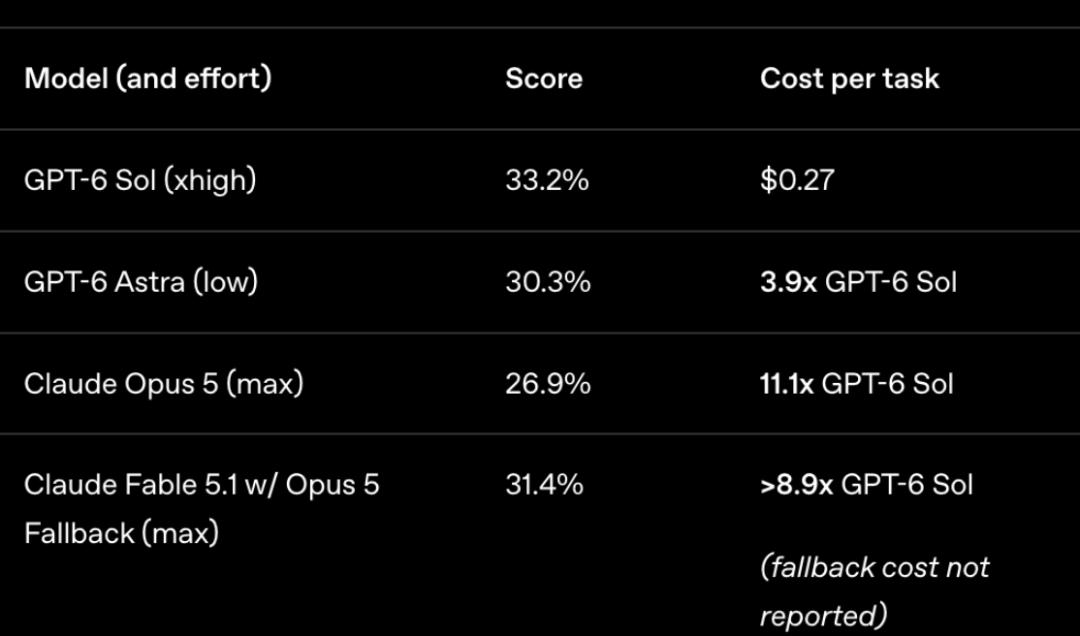
In the AutomationBench test (which evaluates cross-application enterprise workflows), GPT-6 Sol under the highest reasoning intensity (xhigh effort) surpasses the highest performance of Claude Opus 5, while the cost per task is only 9% of that of Opus 5.
Under high reasoning intensity, GPT-6 Luna is 5.4 percentage points higher than the previous generation model, while the cost per task is reduced by 58%.
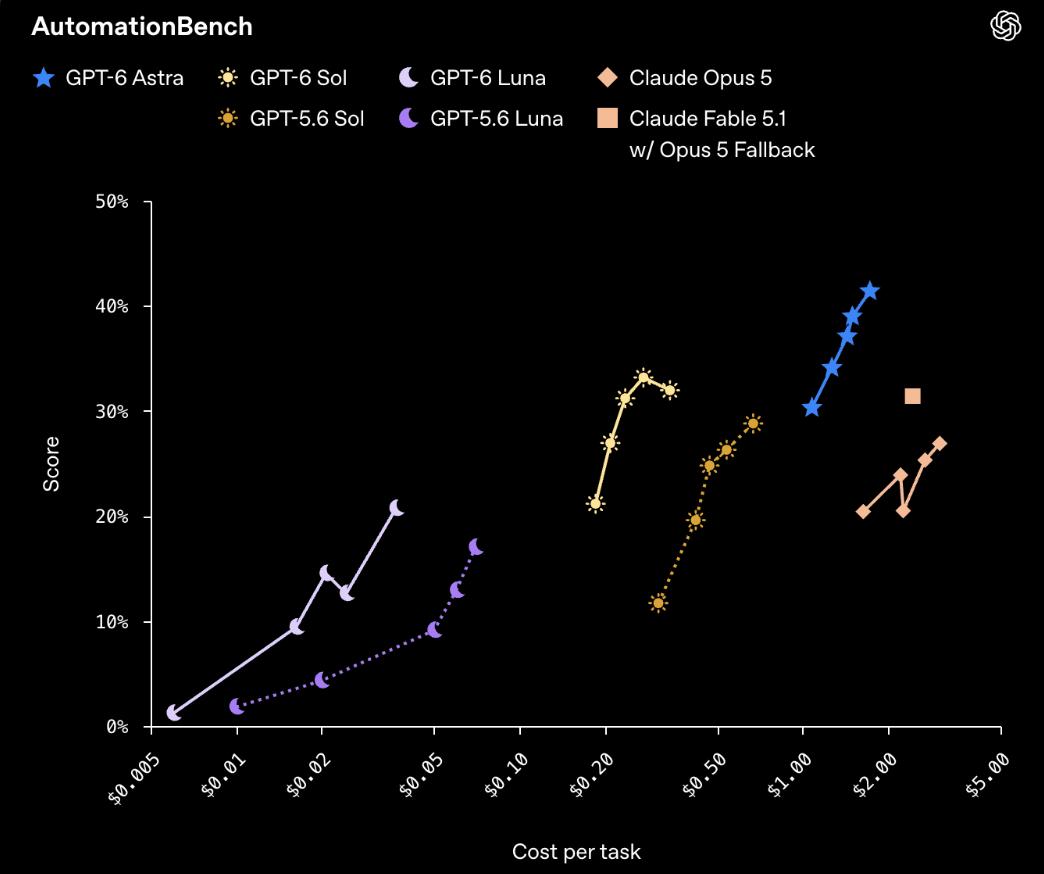
At the same time, GPT-6 Sol also outperforms Claude Fable 5.1 at a lower cost, and even exceeds the performance of GPT-6 Astra under low reasoning intensity.
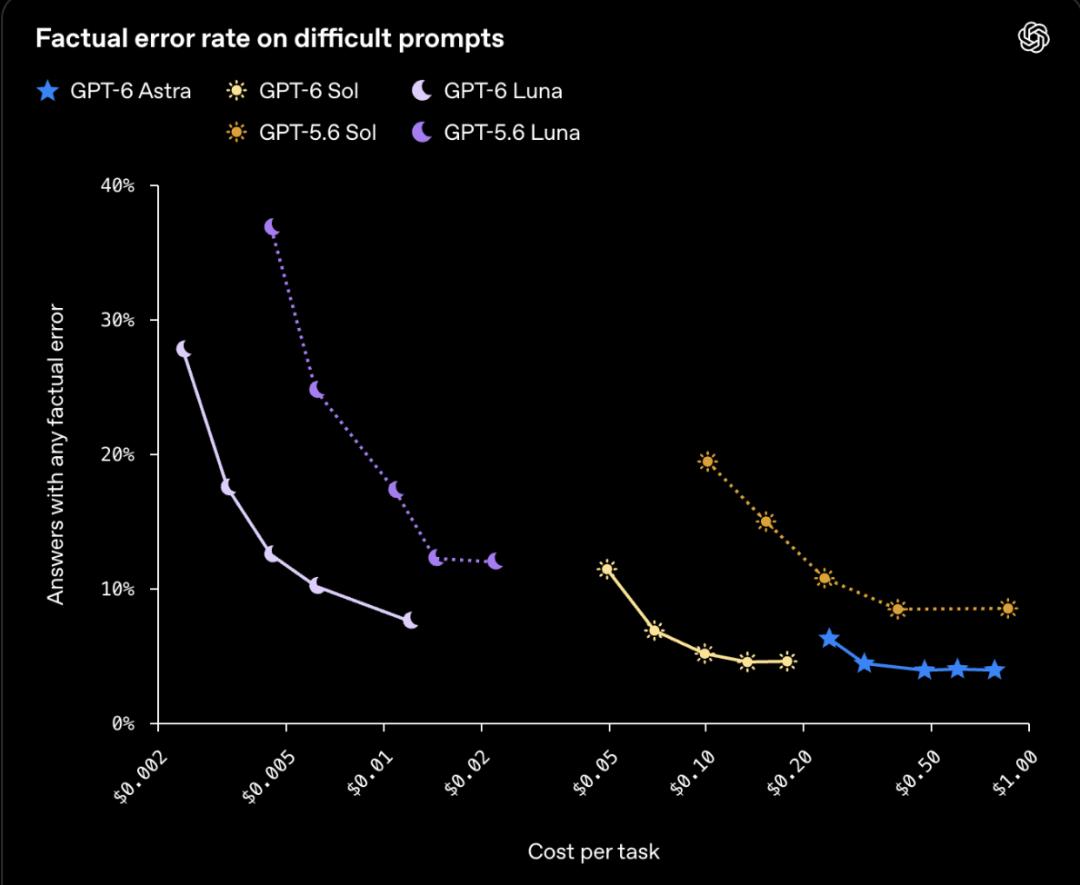
In the internal factual accuracy test, which is based on anonymized real user conversations (where users have marked model errors), GPT-6 Sol has about half the number of errors of the previous generation model, close to the Astra level of reliability, with lower cost.
GPT-6 Luna has also achieved significant improvements: under higher reasoning intensity, it can reach the level of GPT-5.6 Sol at about 1% of the cost.
Another important change is in the field of software development. As Coding Agent begins to undertake more and more complex tasks, the continuous running cost has become an important consideration for development teams.
In terms of programming capabilities, OpenAI said that GPT-6 Sol and Luna maintain strong code capabilities, while the lower API price gives developers more room for experimentation, and allows teams to use Codex to perform complex tasks more boldly.
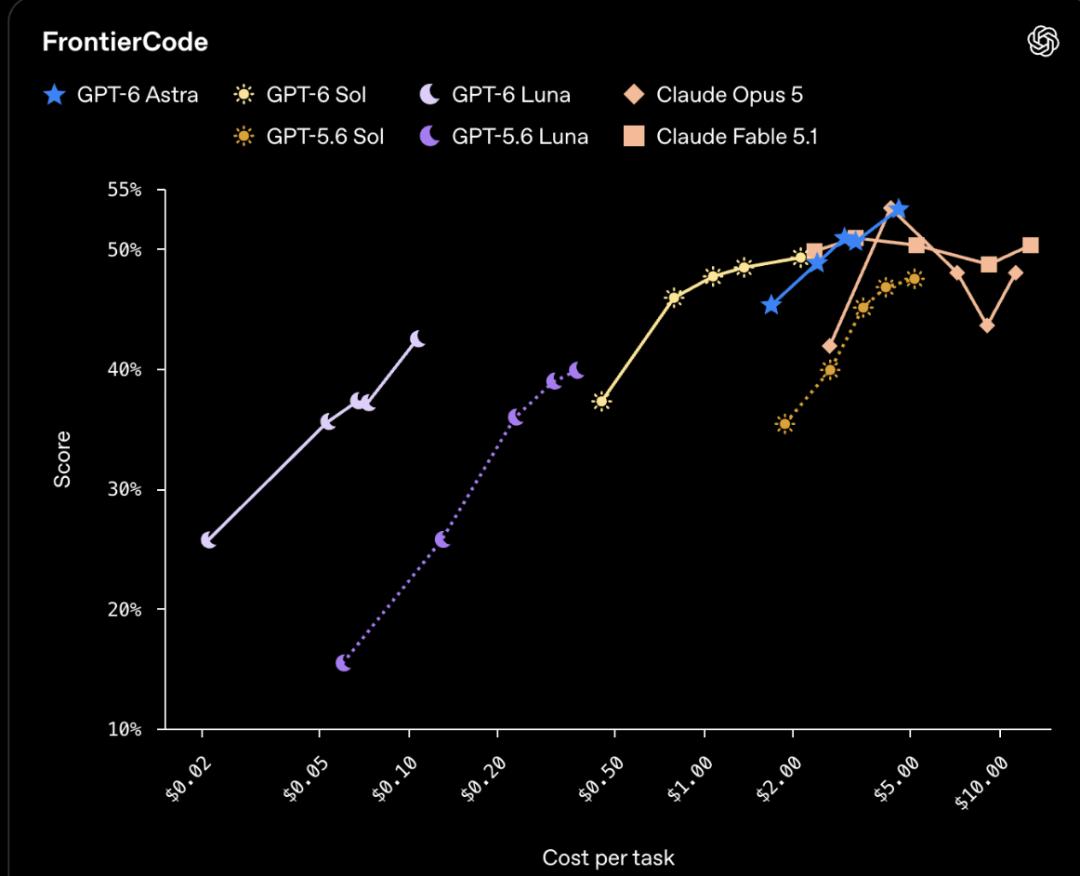
In the FrontierCode test, GPT-6 Sol has a significant improvement compared with GPT-5.6 Sol, and reaches the level of Claude Fable 5.1 xhigh at a lower cost.
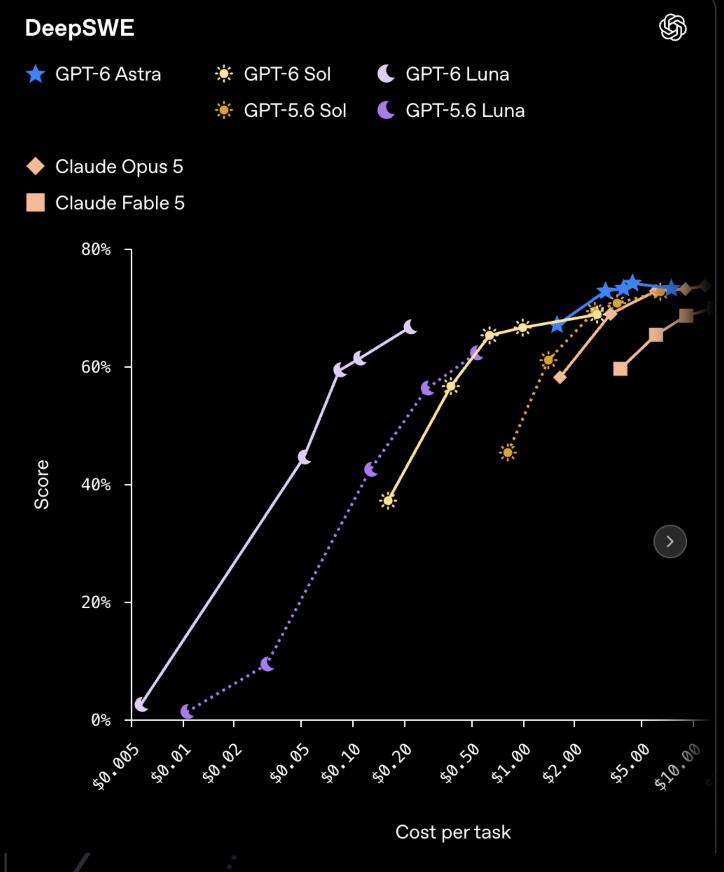
In the DeepSWE v1.1 test: GPT-6 Sol scores 68.8% under the highest reasoning intensity, only 1.1 percentage points lower than the highest score of 69.9% of Claude Fable 5. But the cost per task of GPT-6 Sol is reduced by about 80%. GPT-6 Luna scores 66.6% under the highest reasoning intensity, which is close to the performance of Claude Opus 5 and Fable 5 under medium reasoning intensity.
In these comparisons: compared with Opus 5, Luna reduces the cost per task by 93%; compared with Fable 5, Luna reduces the cost per task by 96%.
This may indicate that OpenAI's goal is not simply to build a stronger model, but to find the model with the lowest cost per unit of intelligence.
In terms of computer operation capabilities, GPT-6 Sol and Luna provide higher cost efficiency than the previous generation models.
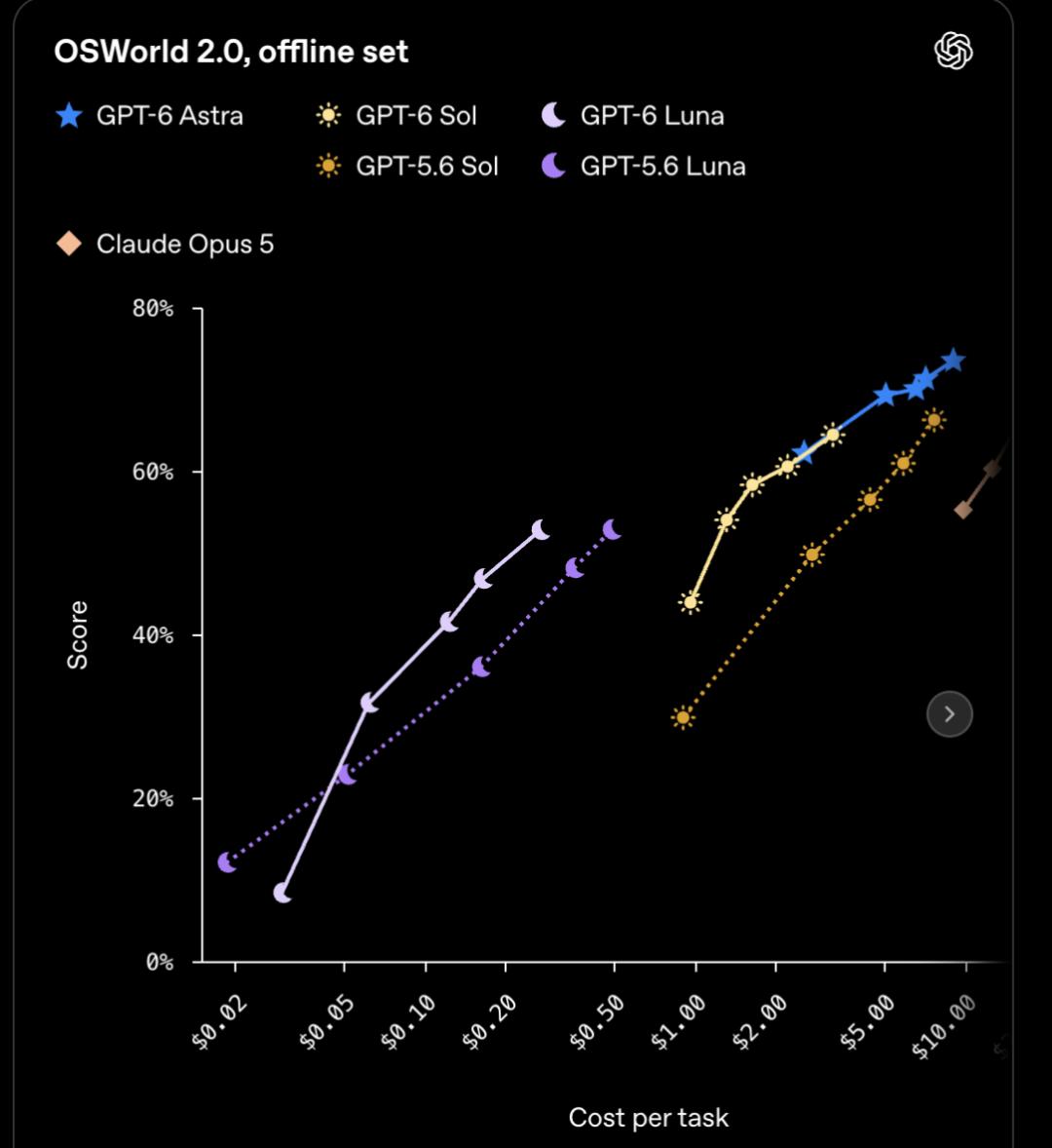
In the OSWorld 2.0 offline test, GPT-6 Sol under the highest reasoning intensity reaches a score close to that of Claude Opus 5 under medium reasoning intensity:
GPT-6 Sol: 60.5%
Claude Opus 5: 60.3%
However, the cost per task of GPT-6 Sol is reduced by about 80%, and GPT-6 Luna (max) can outperform GPT-5.6 Sol (medium) while costing only one tenth of it.
In addition to the drop in model prices, OpenAI has also optimized the caching mechanism for long Agent task scenarios, and improved the Prompt Caching of GPT-6 to achieve a higher default cache hit rate, which helps Agent reuse more context, respond faster, and enjoy a 90% discount on cached input token reads.
This means that in the future, model competition is not only the competition for the capabilities of the model itself, but also the competition for the efficiency of the entire reasoning infrastructure.
Anthropic: Opus 5.5 is here, with Fable-level capabilities
On the other side of OpenAI's release, Anthropic also emphasizes "efficiency" very much this time.
Claude Opus 5.5 is the first model of the Claude 5.5 series. Anthropic's positioning for it is very straightforward: it reaches the level of Claude Fable 5.1 for most tasks, but compared with Opus 5, the running cost of typical tasks is reduced by about 40%, and the output speed is increased by more than 30%.
Blog link: https://www.anthropic.com/claude-opus-5-5/
Let's look at the capabilities first.
In the headline comparison table released by Anthropic, Opus 5.5 outperforms Fable 5.1 in all listed items.
On Terminal-Bench 4.0, Opus 5.5 reaches 66.4%, while Fable 5.1 gets 55.8%; on FrontierCode v1.1 Main, the score is 54.4% vs 50.3%; for real knowledge work GDPval-AA v2.1, the score is 1846 vs 1735.
Agentic coding, knowledge work, and computer operation are basically the main capability improvement directions of this generation of Opus. The official release of Anthropic also calls it a significant upgrade compared to Opus 5.
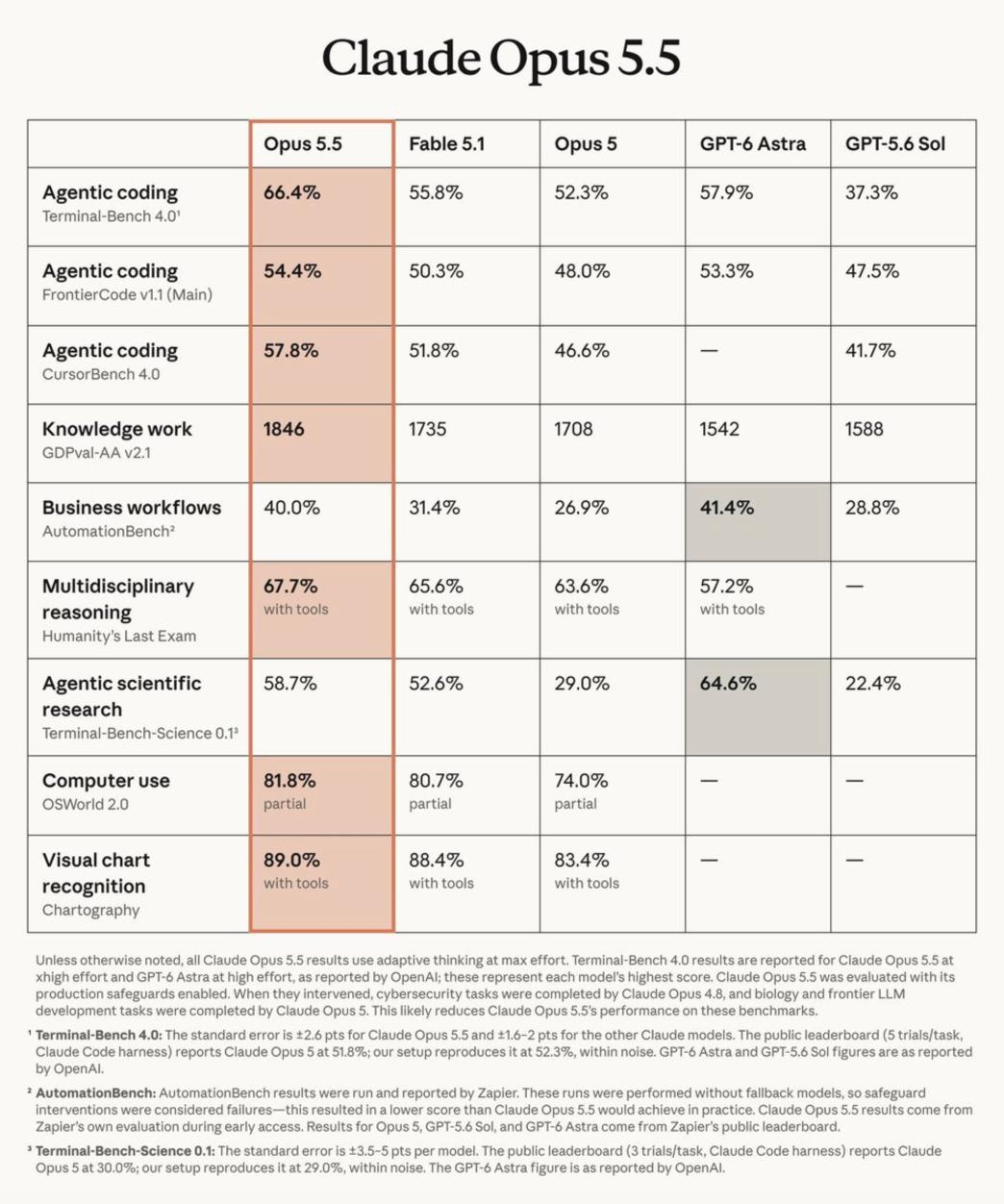
This of course does not mean that "Opus 5.5 has fully surpassed Fable 5.1". The harness, tools and reasoning intensity used in different benchmarks are not completely consistent; in Anthropic's own table, GPT-6 Astra still maintains higher scores in projects such as AutomationBench and Terminal-Bench-Science.
But it is obvious that the originally clear capability gap between Opus and Fable is rapidly narrowing.
It is even clearer what Anthropic intends to do when you look at the API pricing.
Opus 5.5 charges $4 and $20 per million input and output tokens respectively, while Fable 5.1 charges $10 and $50, which is exactly 2.5 times the former. Both have a 1 million token context window and a maximum regular output capacity of 128K.
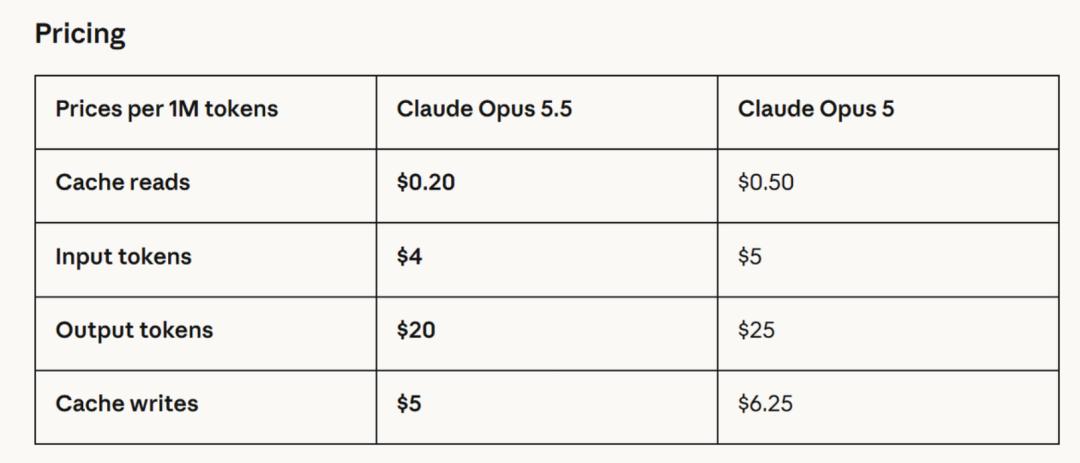
Therefore, this time Anthropic does not describe Opus 5.5 as a simple "performance upgrade", but keeps emphasizing the cost per task.
Stop making Opus "think excessively"
There is another interesting setting. The Adaptive Thinking of Opus 5.5 is always enabled, developers can adjust the reasoning intensity, and the default is set to medium; in contrast, the default of Fable 5.1 is high.
This corresponds exactly to a set of data released by Anthropic: on FrontierCode v1.1 Main, Opus 5.5 medium scores about 54.6%, with a single task cost of about $0.8; when it reaches max, the cost rises to about $6.19, but the score is only 54.4%.
In other words, spending nearly 7.7 times more money does not get a higher score.
