Just now, the new GPT-6 model has upended the market, charging into DeepSeek's home turf at a rock-bottom "bargain price".
DeepSeek, wake up! ChatGPT is coming right to your doorstep.
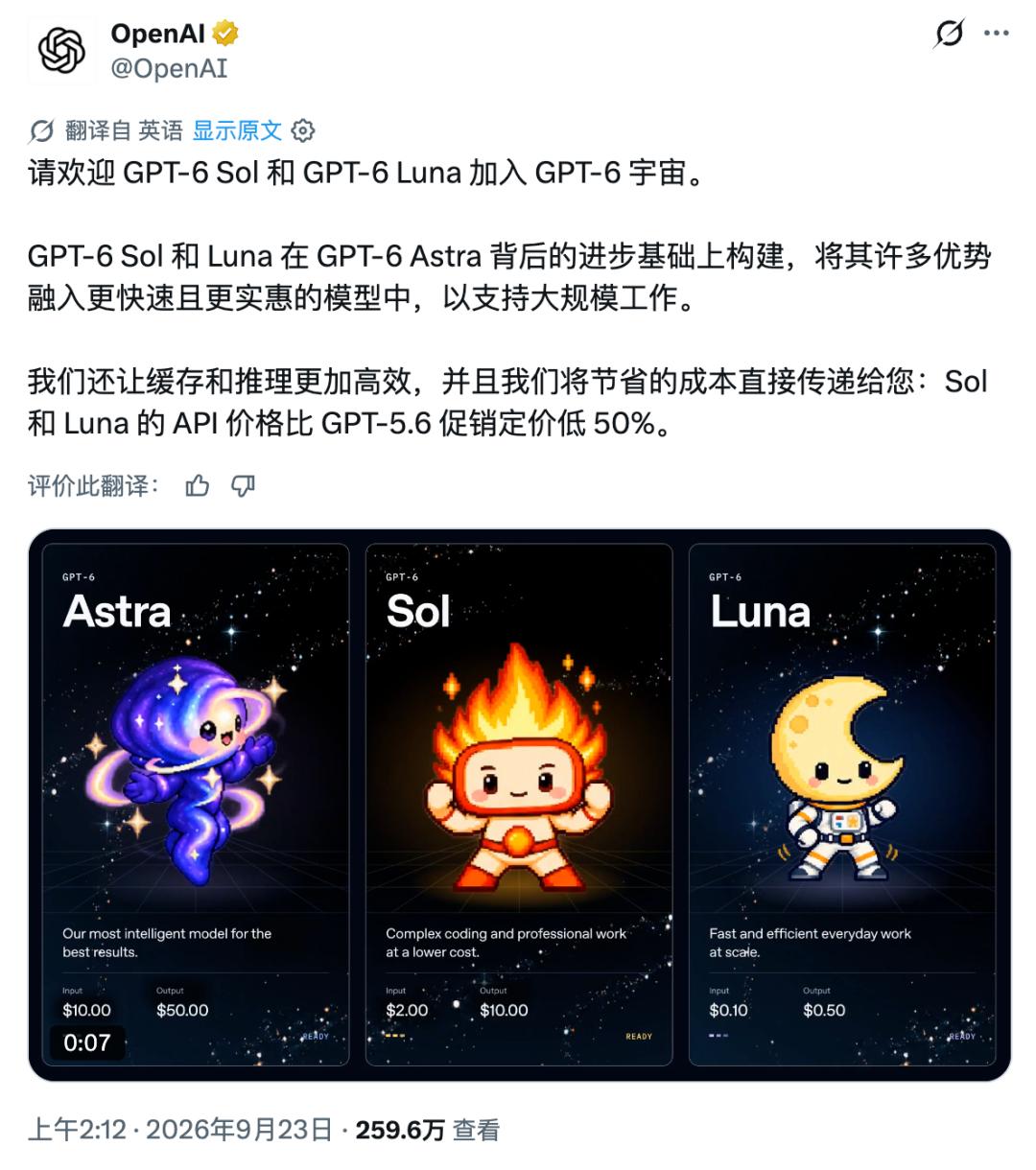
Just now, OpenAI officially released GPT-6 Sol and GPT-6 Luna, cutting API prices to roughly half of the previous generation. Among them, Luna charges $0.1 per million input Tokens and $0.5 per million output Tokens, which is equivalent to about RMB 0.7 and 3.5 respectively.
As a point of reference, the off-peak cache miss input price for DeepSeek V4.1 Flash is RMB 1 per million Tokens, and the output price is RMB 4, which rises to RMB 2 and RMB 8 during peak hours. Calculated based on regular new requests, Luna is already cheaper, and there is no cost fluctuation caused by peak-valley pricing.
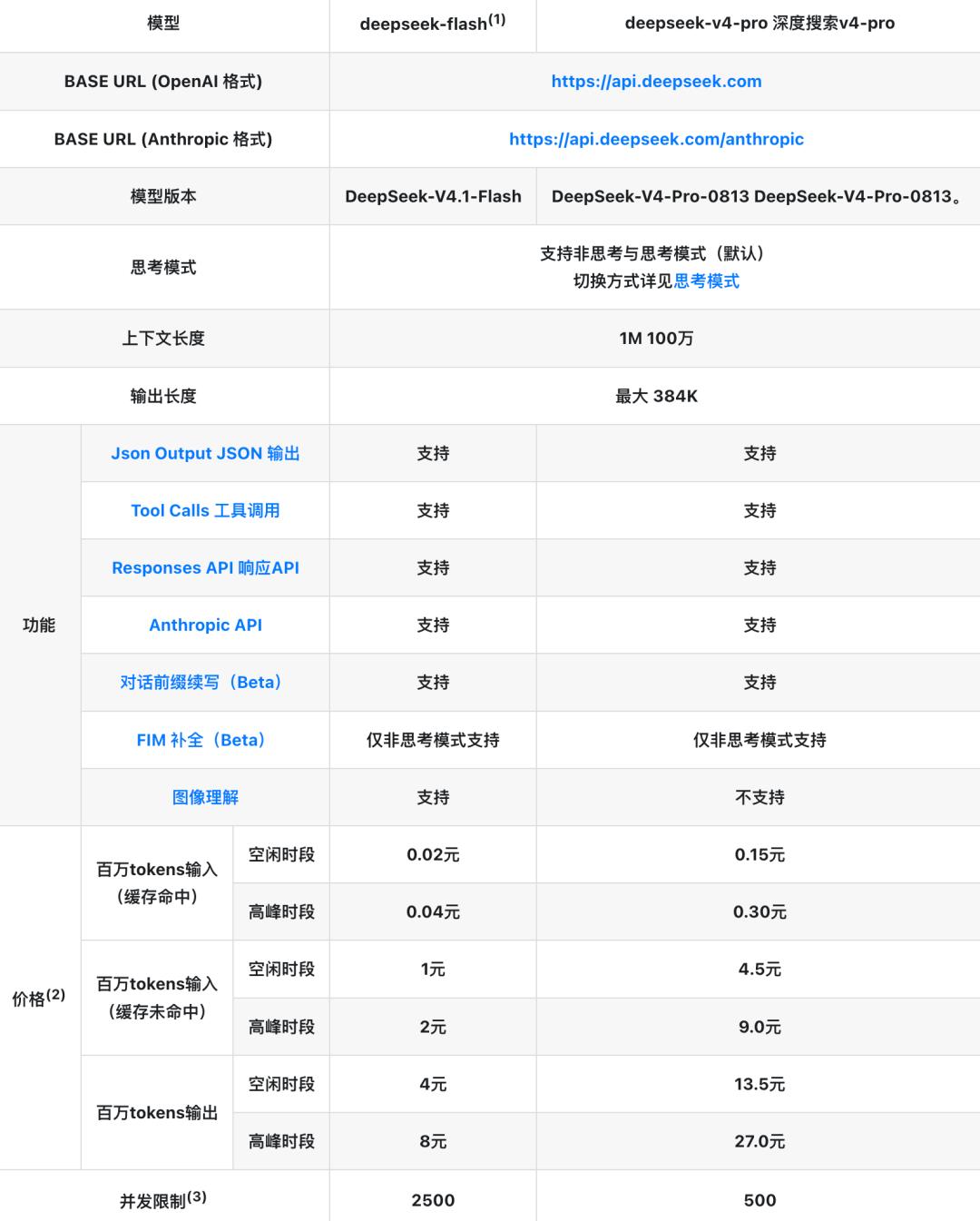
DeepSeek still holds its own price ace. Its off-peak cache hit input only costs RMB 0.02 per million Tokens, far lower than Luna. The overall capability of V4.1 Flash is also significantly higher, with a 1 million Token context window, and supports image-text understanding, tool calling and thinking mode.
However, for regular cache-miss requests, Luna has taken the lead in pulling DeepSeek's model into the same price range, which means DeepSeek's most recognizable low-price label now has a strong overseas competitor.
Astra pushes for the upper limit, Sol and Luna grab the market
Earlier this month, OpenAI released GPT-6 Astra, calling it the company's most capable and most aligned model to date. Astra is designed for highly difficult and high-value tasks, but its pricing of $10 per million input Tokens and $50 per million output Tokens determines that it can hardly become the default option in daily work.
Sol and Luna are tasked with a different mission.
OpenAI stated that the two models adopt a training method similar to Astra, bringing Astra's progress in professional work, factual accuracy, programming, computer operation and alignment to product tiers with faster speed and lower prices.
The new API pricing is beyond expectations.
GPT-6 Sol has been reduced from $4 per million input Tokens and $20 per million output Tokens during the GPT-5.6 Sol promotion period to $2 and $10 respectively; GPT-6 Luna has been reduced from $0.2 and $1.2 to $0.1 and $0.5.
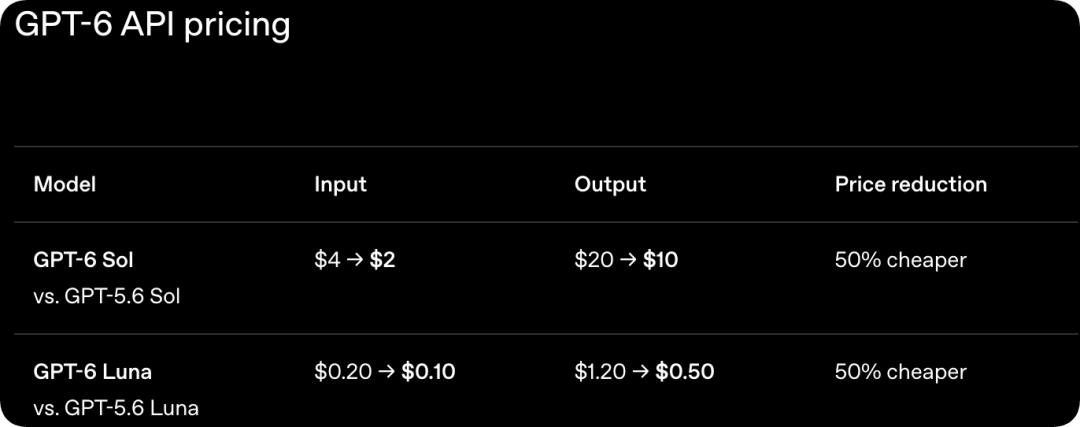
For this round of price cuts, OpenAI attributes it to improvements in reasoning infrastructure and cache efficiency, saying the purpose is to directly pass the benefits to users.
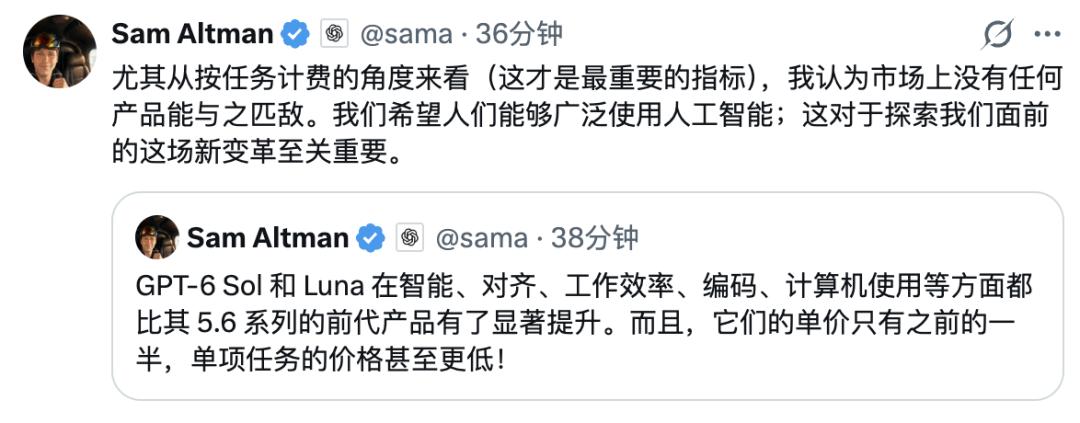
OpenAI CEO Sam Altman emphasized after the release that the truly important metric is how much it costs to complete a task, and in this dimension, he believes no product on the market can currently match Sol and Luna.
The product division of labor has also become clear accordingly.
Astra continues to take charge of the highest capability upper limit, Sol targets mainstream professional tasks that require strong reasoning, programming and Agent capabilities, while Luna undertakes high-frequency, large-scale work at extremely low prices.
The focus of OpenAI's competition this time has extended from the highest score on the leaderboard to how much work can be done per dollar.
Official published results show that the core competitiveness of GPT-6 Sol is concentrated in professional work and Agent tasks.
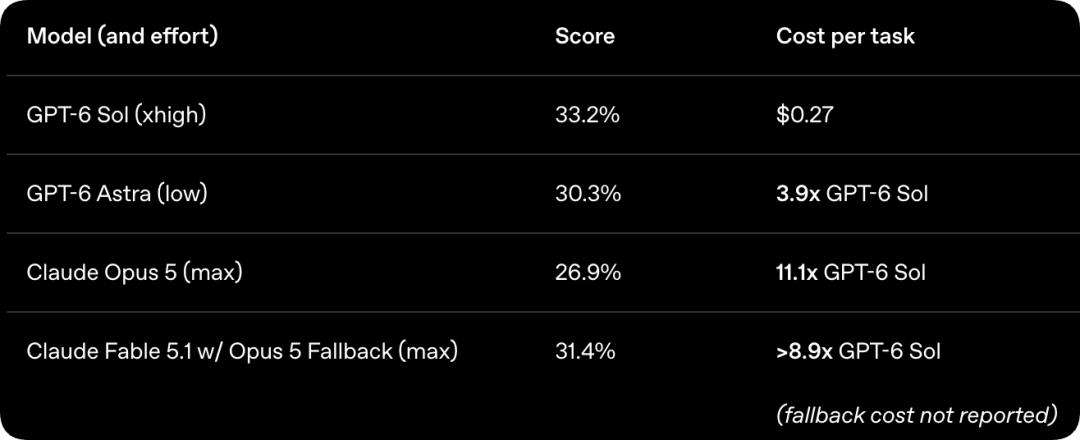
In the AutomationBench test covering workflows such as sales, marketing, operations, customer service, finance and human resources, GPT-6 Sol achieved a score of 33.2% at xhigh reasoning intensity, higher than Claude Opus 5's 26.9% at maximum reasoning intensity, while the cost of a single task is only 9% of the latter.
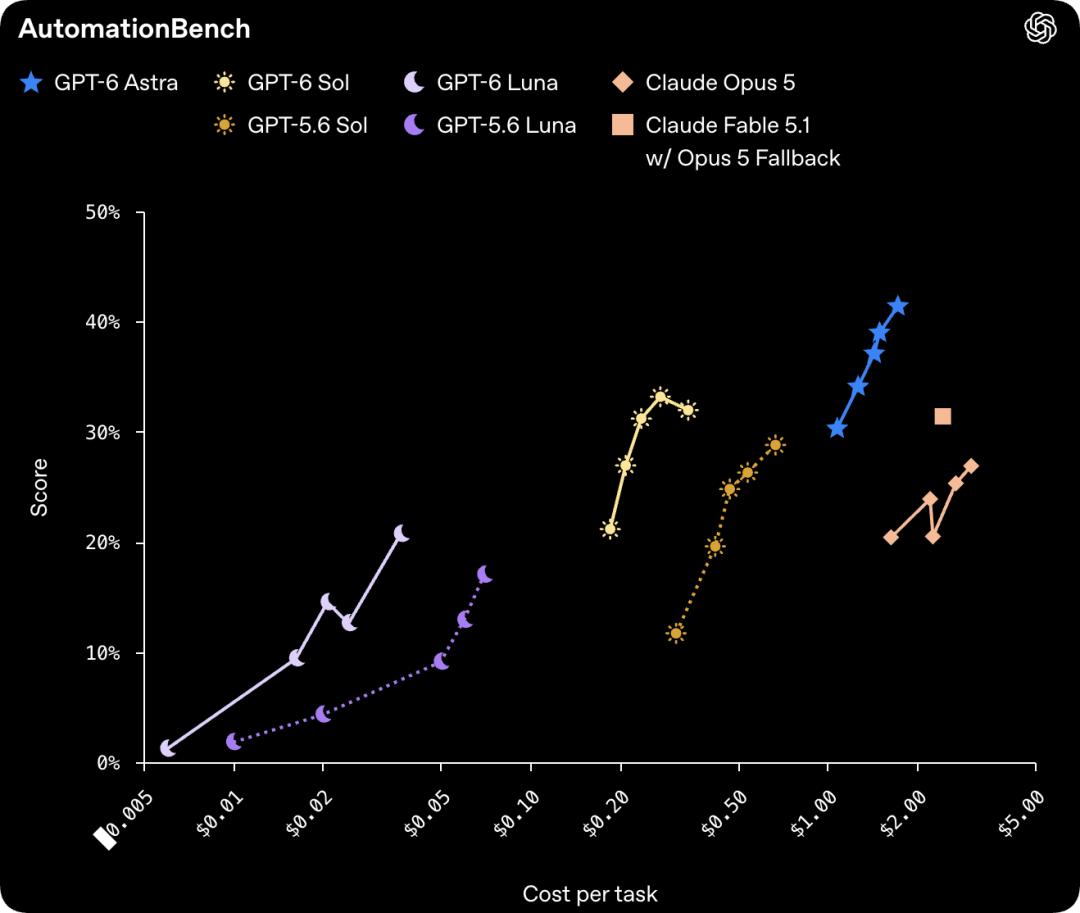
It also outperforms GPT-6 Astra at low reasoning intensity, and achieves higher scores at a much lower cost than Claude Fable 5.1.
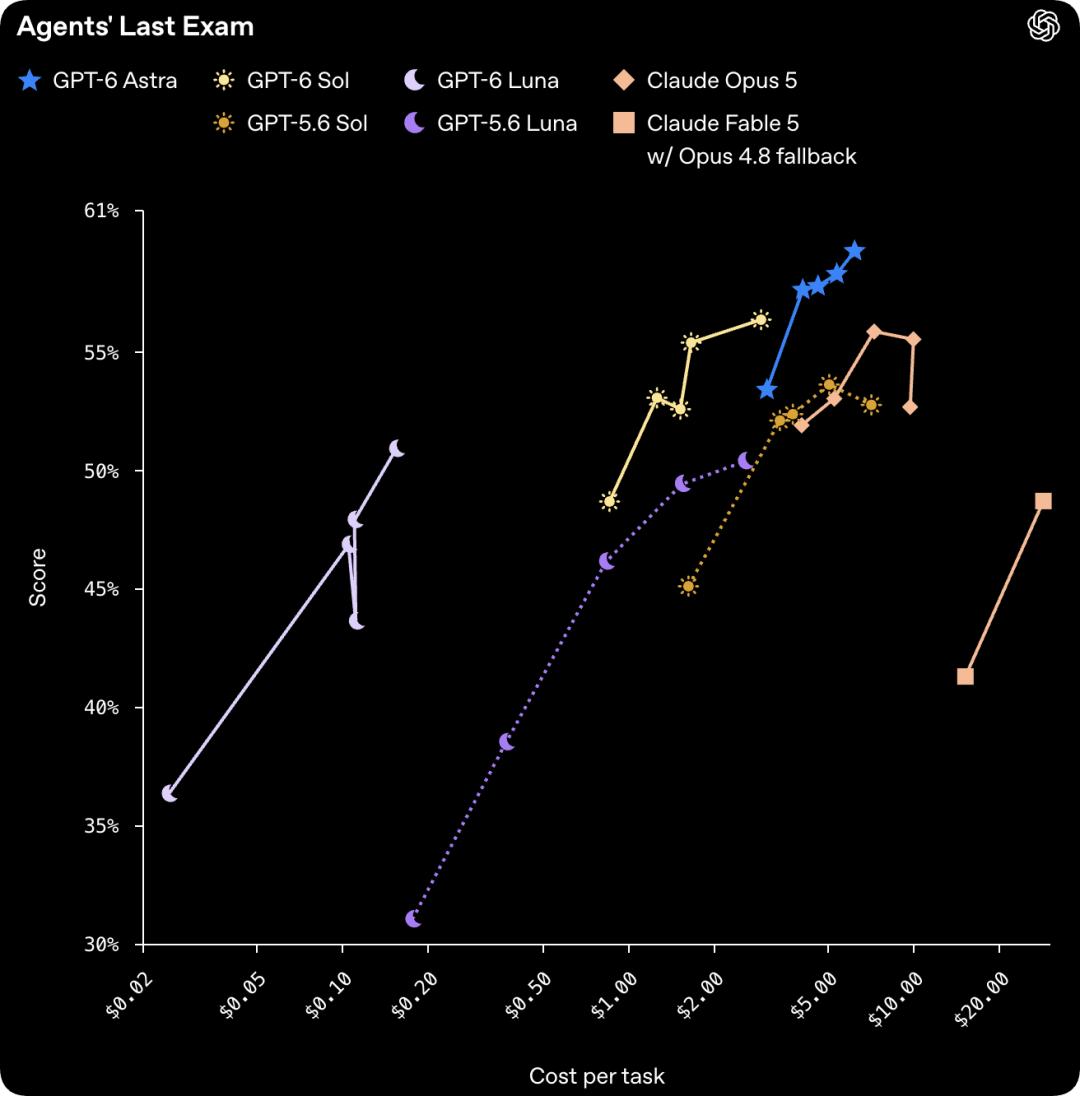
Agents' Last Exam covers 55 niche industries, focusing on long-chain professional tasks with actual economic value. GPT-6 Sol scored 56.4% at maximum reasoning intensity, exceeding Claude Opus 5's highest score in this benchmark, and the cost of a single task is about 60% lower.
Factual accuracy has also been significantly improved.
OpenAI conducted internal tests using anonymous real conversations where users had previously marked factual errors. GPT-6 Sol has about half the number of errors as GPT-5.6 Sol, and is starting to approach Astra's reliability.
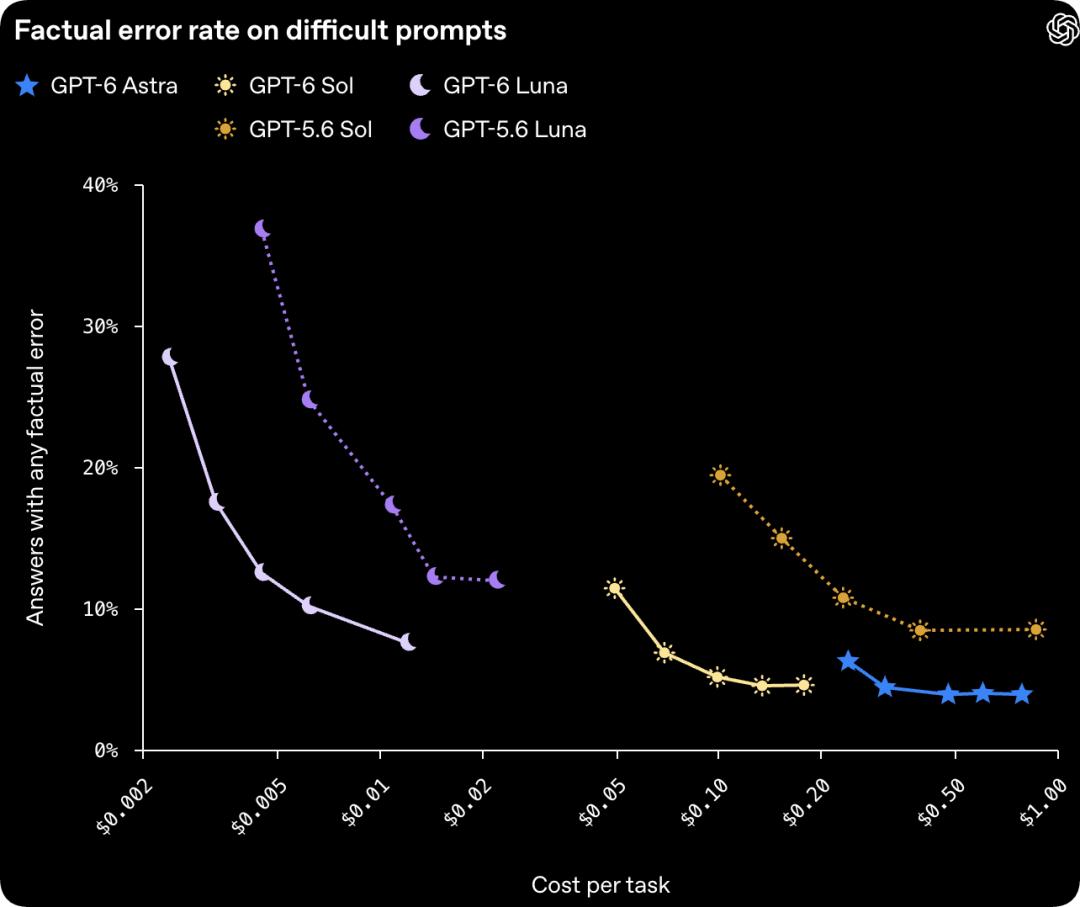
At relatively high reasoning intensity, GPT-6 Luna matches the performance of GPT-5.6 Sol at roughly one percent of its cost.
Stronger programming and computer operation capabilities, OpenAI also starts to compete for ultra-low prices
Programming is one of Sol's most important application scenarios.
OpenAI revealed that the scale of internal researchers using programming Agents is growing rapidly. Calculated at API prices, the median researcher now consumes more than $600 worth of Tokens per day, and researchers at the 90th percentile consume more than $7000. The longer the tasks taken over by Agents, the more obvious the restriction of reasoning cost on usage frequency becomes.
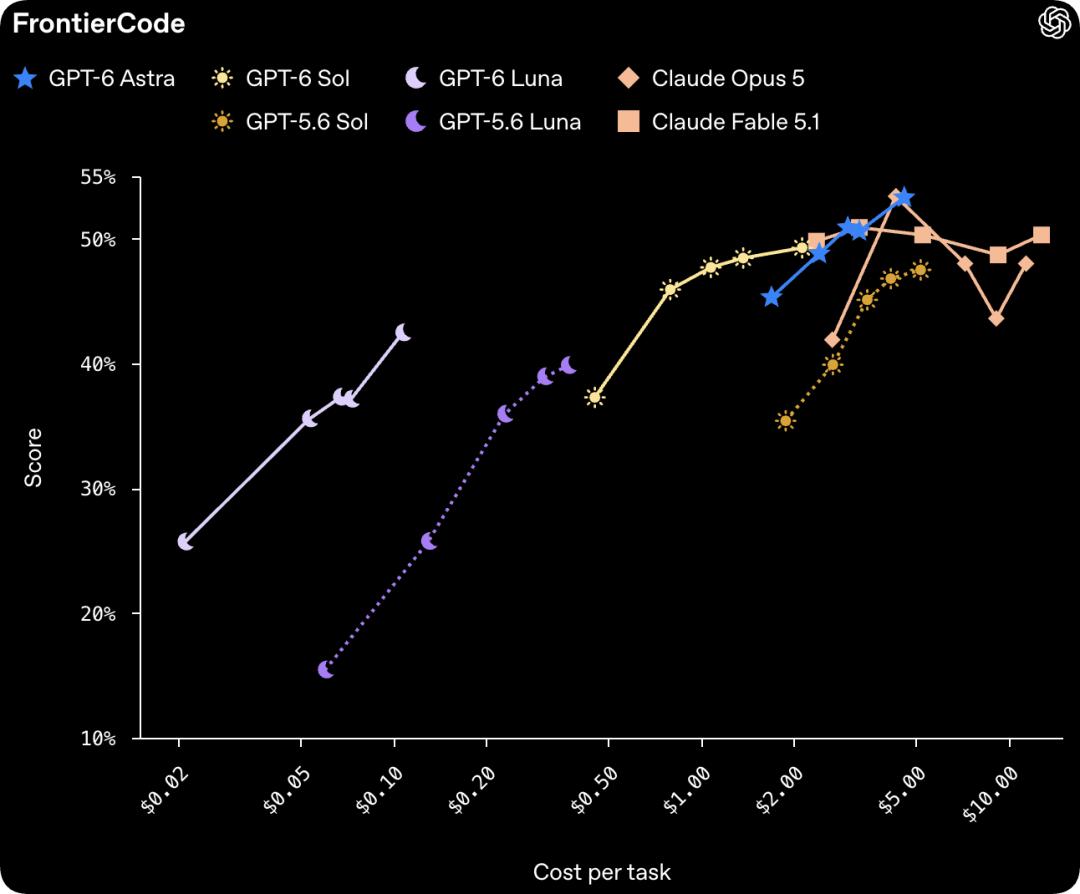
In FrontierCode, which examines whether code can be directly merged into real projects, GPT-6 Sol has made significant progress compared to the previous generation, matching Claude Fable 5.1 xhigh at a lower cost.
In the DeepSWE v1.1 software engineering test on real codebases, Sol scored 68.8% at maximum reasoning intensity, only 1.1 percentage points behind Claude Fable 5's highest score of 69.9%, with the cost of a single task about 80% lower. In comparison, DeepSeek V4.1 Flash scored 74.2%.
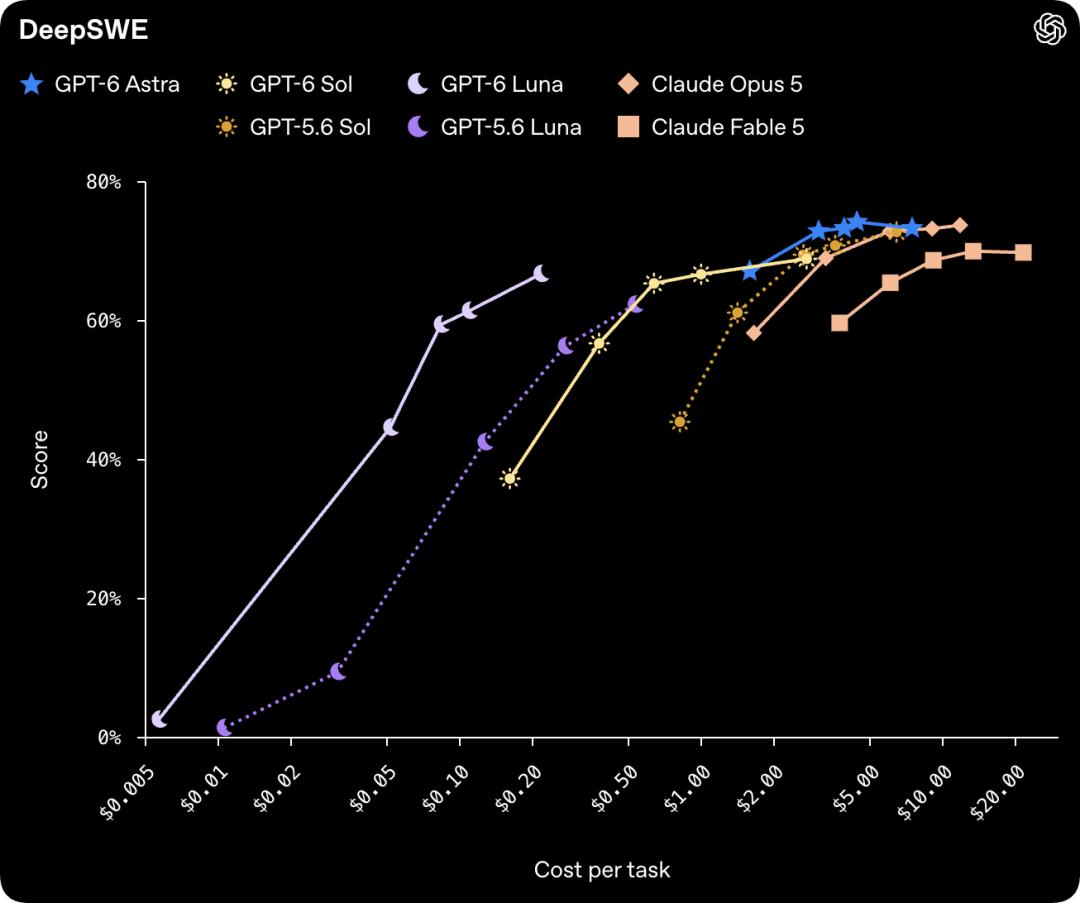
GPT-6 Luna scored 66.6% in the same benchmark, which is close to the performance of Claude Opus 5 and Fable 5 at medium reasoning intensity, but the task cost is 93% and 96% lower respectively.
It may not be suitable for undertaking the most complex software engineering projects, but it is likely to become a more cost-effective execution model for code review, batch modification, lightweight development and multi-Agent concurrent tasks.
In terms of computer operation, Astra is still OpenAI's most capable option, but Sol and Luna further improve cost efficiency.
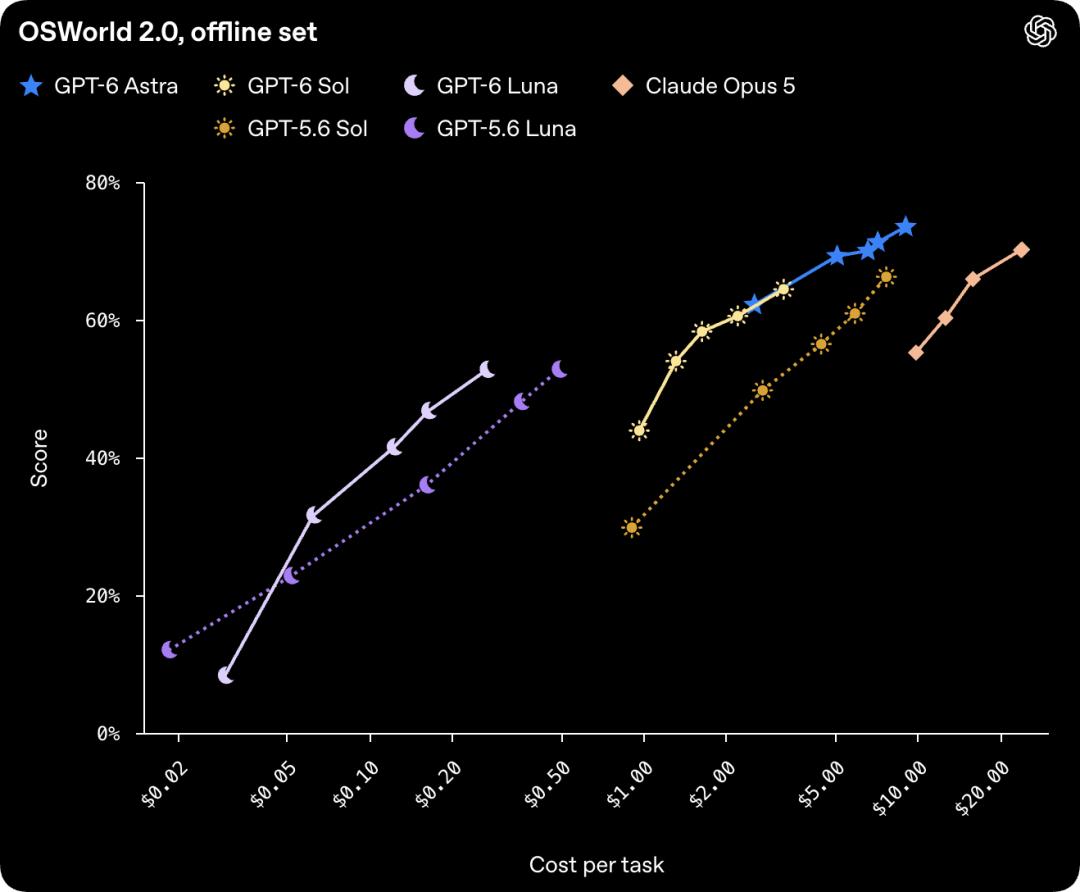
In the OSWorld 2.0 offline test, Sol xhigh scored 60.5%, roughly equivalent to Claude Opus 5 medium's 60.3%, with the cost of a single task about 80% lower; Luna's maximum reasoning intensity score exceeds GPT-5.6 Sol medium, with only one tenth of the cost of the latter.
The model's communication method also inherits Astra's adjustments.
OpenAI says that Sol and Luna will reduce jargon, quirky wording and low-value details, with overall slightly shorter answers, while more clearly stating what they have checked and what they have not checked. For programming and technical tasks that require continuous collaboration, the reliability of expression is becoming as important as whether a single answer is well-written.
After the model was released, we also received the first batch of actual tests from netizens, which quickly showed two completely different evaluations.
Developer Flavio Adamo, who tried GPT-6 Sol in advance, said that tasks that usually took about an hour on GPT-5.6 in the past can now often be completed in about 20 minutes, with Token consumption less than half of the original.
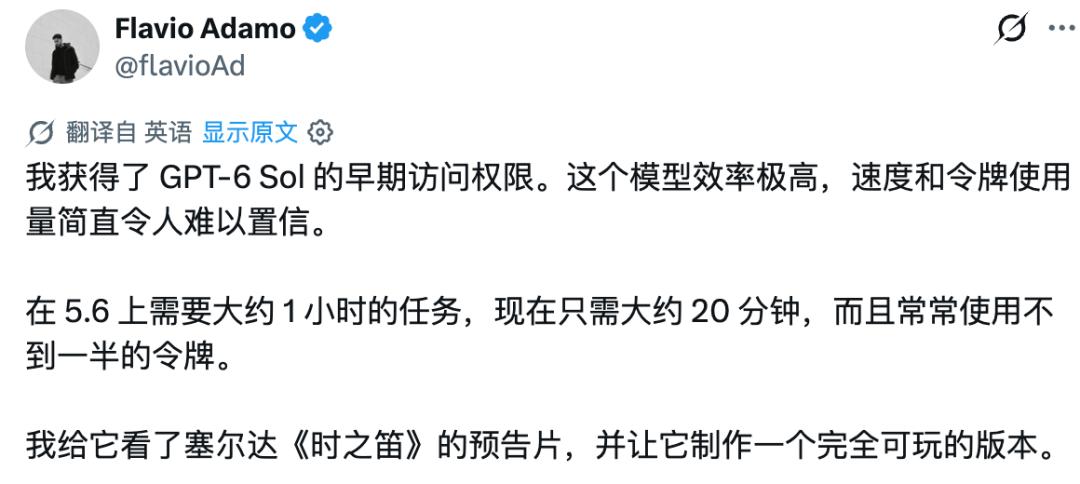
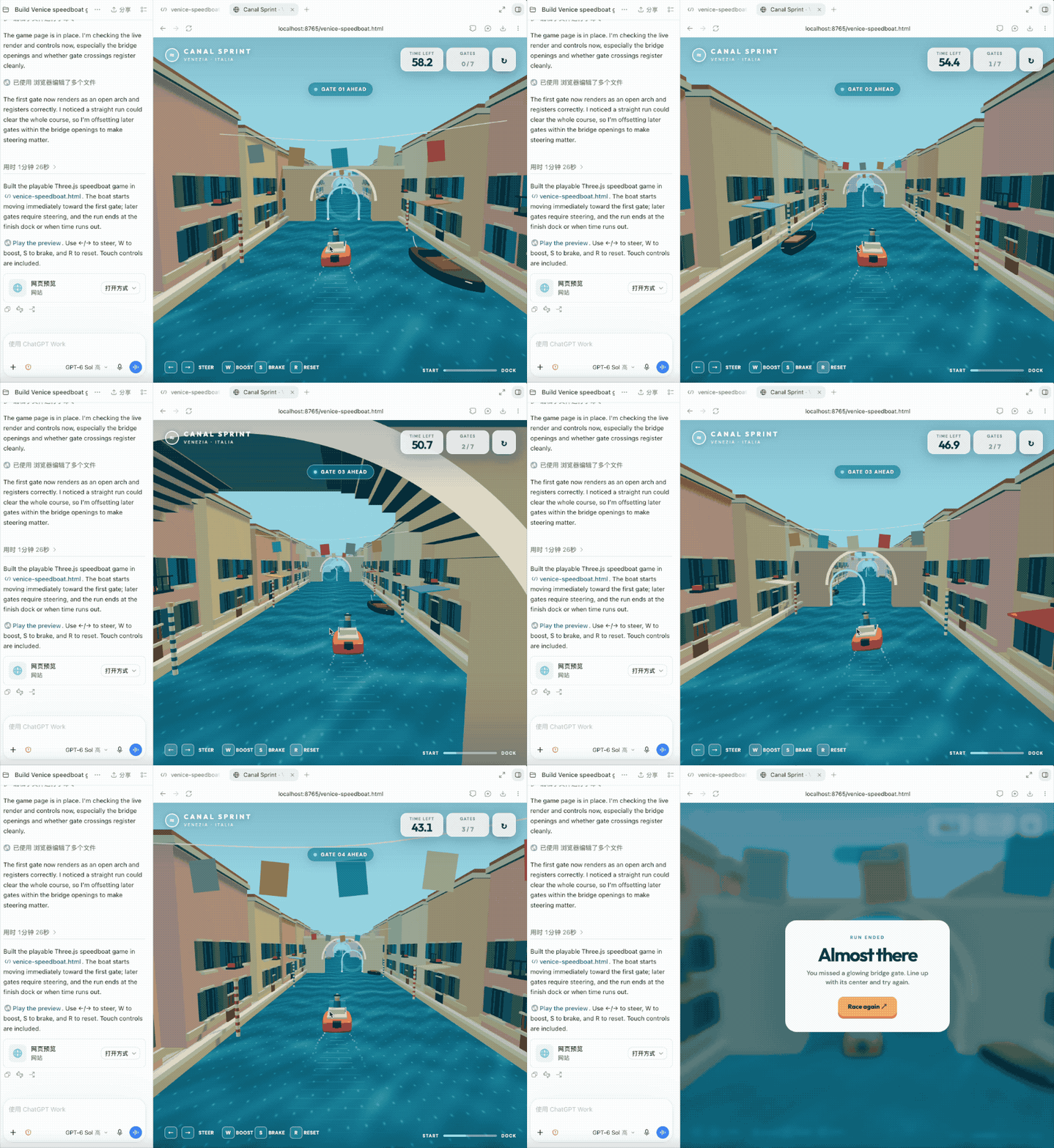
When we tested the Venice canal speedboat game with GPT-6 Sol, the model finally delivered a playable Three.js finished product, with core functions such as bridge hole clearance, countdown, wake trail, water surface reflection and chase camera all running normally, and the aesthetic is pretty good.
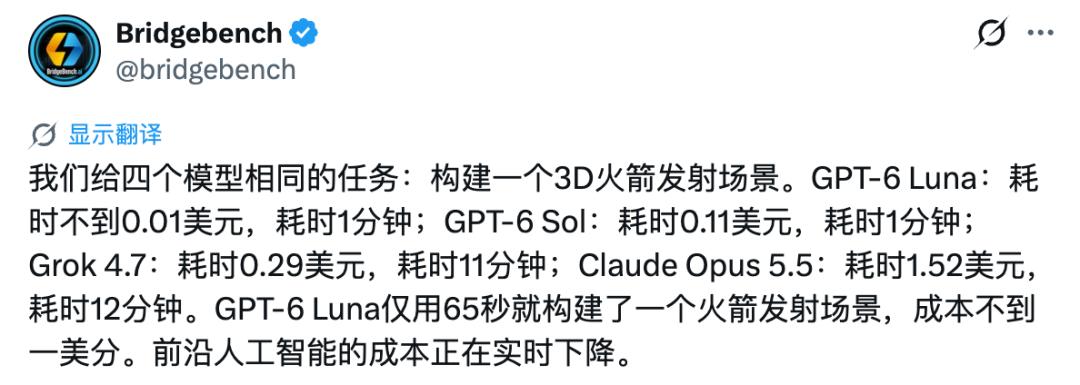
Bridgebench's 3D rocket launch test more directly demonstrates the price gap.
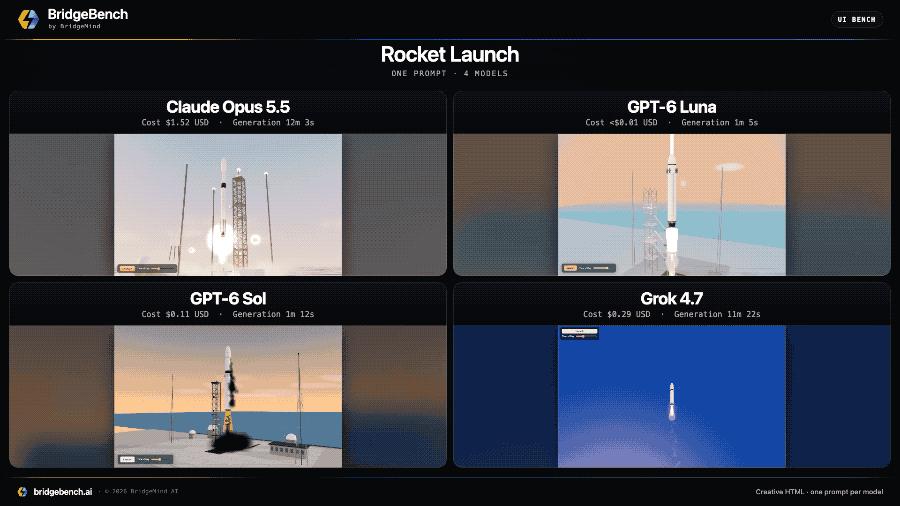
The conclusion on visual quality is not so optimistic.
aipulsedaily used the same prompt to let GPT-6 Sol and Claude Opus 5.5 build a Three.js scene of New York, believing that Opus 5.5 more completely presents streets, taxis, rooftops, Brooklyn Bridge and Central Park, and adds some extra details; Sol's result is closer to a static picture, lacking camera movement and continuous rendering loop.
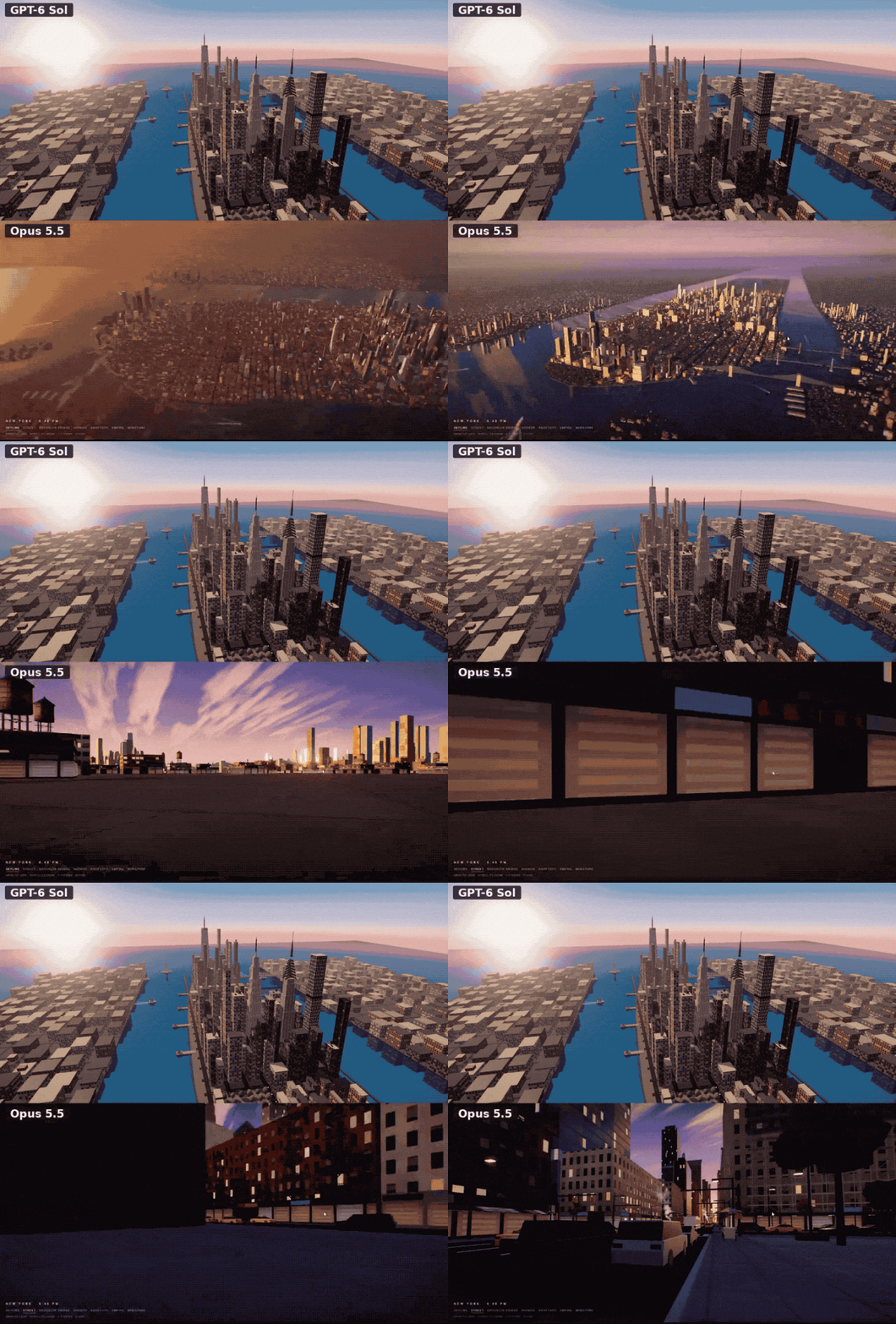
In another set of tests with the same prompt, Bridgebench also believes that Opus 5.5 has significantly higher visual taste and design completion.
<