Where did Zhu Xiaohu go wrong?
"This year is likely the last year for foundational large models, and we will need to tell new stories starting next year."
In a recent interview with *Deep Web* of Tencent News, Zhu Xiaohu once again talked about the prospects of foundational large models. He explained that from the perspective of the secondary market's novelty, the story will be almost fully told once Anthropic and these domestic large model companies all complete their IPOs.
Three years ago, during his debate with Fu Sheng, Zhu Xiaohu was already not optimistic about the entrepreneurial opportunities for domestic foundational large models, advocating that entrepreneurs focus on AI applications. Over the past few years, Zhu Xiaohu has continuously poured cold water on foundational large model entrepreneurship, with remarks such as "Come back and check in another year, how many of these companies will still be around?", "There will be no independent large model companies in 5 years", and "The best outcome for the AI Six Dragons is to be acquired by major tech groups".
Now, Zhipu and MiniMax have gone public, and early institutional investors who entered the market at the very beginning have reaped substantial book returns. However, Zhu Xiaohu and GSR Ventures missed out on this entire feast.
The final outcome of large model companies can still be debated, but the gap in investment returns has already emerged. Zhu Xiaohu does not shy away from talking about this miss, saying that his outcome-focused thinking kept him away from the bubble, but it also doomed him to miss certain opportunities. He frankly admitted, "It is unrealistic to expect to seize every single opportunity."
Having previously invested in Didi, Ele.me and Xiaohongshu, why did Zhu Xiaohu come up empty-handed this time? How did the experience that helped him win the mobile internet era cause him to miss out on AI?
1
In March 2023, the ChatGPT concept was booming. Zhu Xiaohu stated at an event that ChatGPT is too powerful, which is not conducive to startup companies. Later, this view was summarized by the media as "Zhu Xiaohu: ChatGPT is very unfriendly to startups, please give up the fantasy of financing in the next two or three years".
Three months later, Fu Sheng, CEO of Cheetah Mobile, reposted the relevant report and commented: "Half of the startups in Silicon Valley are already building around ChatGPT, yet our investors can still be so fearless out of ignorance." The two immediately launched a debate on WeChat Moments.
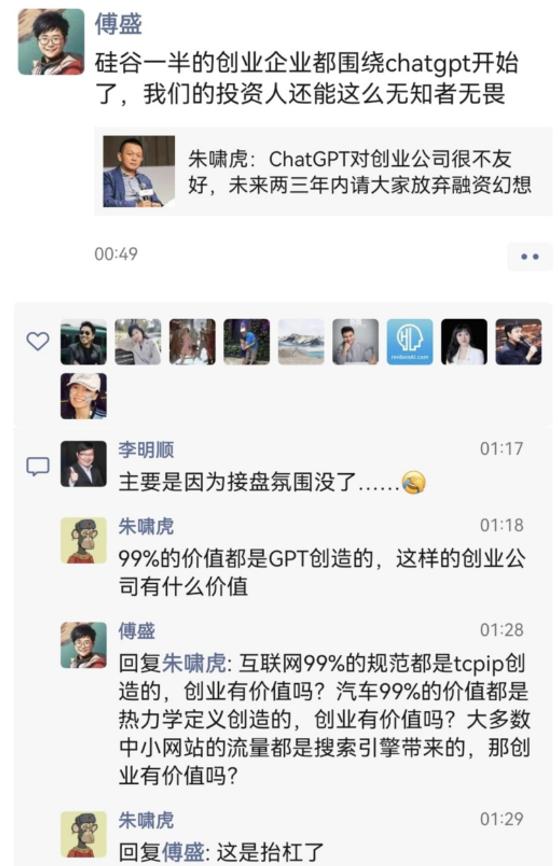
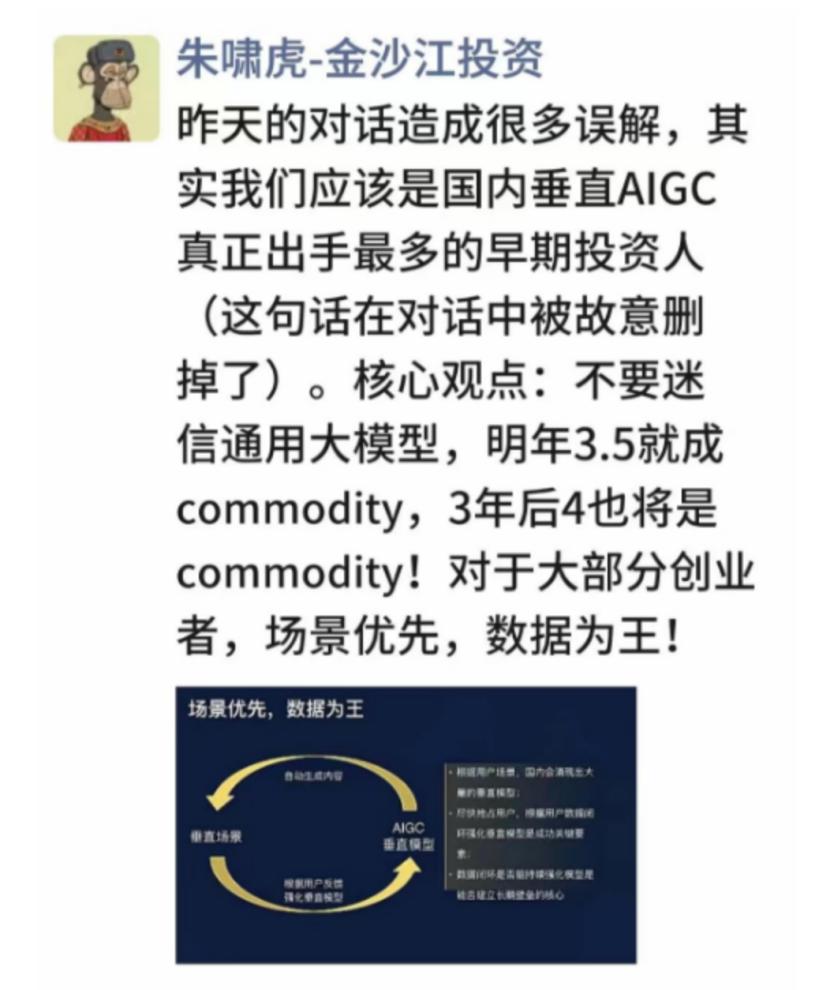
Zhu Xiaohu was not optimistic about startups building general large models, while Fu Sheng thought he underestimated the entrepreneurial opportunities of this round. After the incident, Zhu Xiaohu posted again on WeChat Moments, emphasizing that people should not blindly worship general large models, and claimed that he was the early-stage investor who had made the most investments in vertical AIGC projects in China.
While the two were debating across the air, Baichuan Intelligence, Stepfun, Moonshot AI, and 01.AI were established one after another, and Liang Wenfeng also founded DeepSeek in July of the same year. Zhu Xiaohu is no stranger to some of these entrepreneurs.
He once communicated with Wang Xiaochuan, but because he could not see the exit path for large models clearly, he was unwilling to look at large model projects and stopped talking to Wang Xiaochuan. He has known Wang Huiwen for many years, but he did not discuss investment in Light Years Away. GSR Ventures was also a shareholder of Recurrent.ai, the previous company of Yang Zhilin, but after Yang Zhilin founded Moonshot AI, Zhu Xiaohu did not follow up the investment.
In 2024, his judgment became more firm, and he even asserted that "There will be no independent large model companies in 5 years" and "The best outcome for the AI Six Dragons is to be acquired by major tech groups".
Until the beginning of 2025, the breakthrough of DeepSeek made him soften his stance: "DeepSeek is almost making me believe in AGI." In March of the same year, he said in an interview with Tencent News that if DeepSeek opens up financing, "I will definitely invest!" and even claimed that "I am willing to participate no matter the cost".
More than a year later, DeepSeek really opened up financing. In June 2026, DeepSeek completed its Series A financing, with a financing amount of 510 billion RMB and a post-investment valuation of 4000 billion RMB. The list of investors includes Tencent, CATL, JD.com, NetEase and others, but Zhu Xiaohu and GSR Ventures are not on it.
Recently, when Zhu Xiaohu talked about this matter, his explanation was: "This valuation has already exceeded our investment range, so it makes no sense for us."
From "no matter the cost" to "exceeding the investment range", technological breakthroughs changed his attitude, but the price stopped him in his tracks.
DeepSeek is just a microcosm. What Zhu Xiaohu missed is a group of foundational model companies that he had previously judged as "not worth looking at".
Such as Moonshot AI, which Zhu Xiaohu did not invest in. In July this year, Moonshot AI open-sourced the full-stack Kimi K3, which quickly detonated the global developer community, becoming the first open-source model that comprehensively surpasses closed-source flagship models such as GPT and Claude, topping the trending list on Hugging Face, and is also regarded by the industry as another landmark event that impacts the technical barriers of overseas manufacturers after DeepSeek 2.0.
Since the beginning of this year, Moonshot AI has completed four consecutive rounds of financing, from Series D to Series F+, with its valuation skyrocketing from 4.3 billion USD to 35 billion USD. Alibaba and Meituan's investment arms have continued to increase their positions, and Tencent has also participated in multiple follow-on investments. Recently, the market has repeatedly spread news that Moonshot AI is seeking an IPO.
Over the past two years, Chinese AI large model companies have been moving forward along the path of "technological breakthroughs, surging financing, valuation leap, and sprinting for IPO".
The industry that once made Zhu Xiaohu worried about "how to exit" now already has companies that have gone public independently. Zhipu and MiniMax have been listed, with the former having a market value of 3600 billion Hong Kong dollars and the latter 1000 billion Hong Kong dollars. Stepfun has also completed its Pre-IPO round of financing and is reportedly seeking an IPO.
For early shareholders, these changes can already be measured by return on investment. According to the calculation of *Mirror Studio* based on the closing price on September 4, 2026, the return on investment of Meituan's investment in Zhipu's Series B2 round reached 428%. The entrepreneurial opportunities that Zhu Xiaohu was bearish on have become the investment returns of others.
2
Zhu Xiaohu's investment criteria have always been very clear: whether the product can meet real demand, and whether customers are willing to pay for it.
In the mobile internet era, this set of methods brought him huge gains. He once recalled that when investing in Didi, Cheng Wei told him that the company would be profitable if it could achieve 20,000 orders per day, so he decided to invest. Didi later burned a lot of money because major tech groups joined the competition. When he invested in Ele.me and Xiaohongshu, he initially only put in 250,000 USD respectively.
Using a small amount of capital to verify demand before deciding whether to increase investment is his familiar strategy. When it came to the AI large model field, he still hoped to use 1 to 2 million RMB to verify whether a product has users and can achieve commercialization.
This also explains his doubts about foundational large model companies: "They have no scenarios, no data, what value do they have? And their valuations are so high right from the start."
The same criteria are also applied to embodied intelligence projects. Zhu Xiaohu invested in the angel round of Starsea Map in the early stage, acquiring 0.3% of the equity of Starsea Map with 600,000 RMB; when investing in Songyan Dynamics, he acquired 1.6207% of the equity with 3.2 million RMB.
But by March 2025, Zhu Xiaohu stated that GSR Ventures is gradually exiting some early-stage embodied intelligence projects, one of the reasons being that the commercialization path is not clear enough.
He asked the CEOs of several robotics companies where their potential customers are, and the answers he got did not convince him: "I feel that all the customers they talk about are imagined by themselves. Who would spend hundreds of thousands of yuan on a robot to do these jobs?"
This concern has a realistic basis. *Alphabet List* once analyzed in the article "Humanoid Robots: Trapped in Series A" that the commercialization dilemma makes it difficult for robotics startups to obtain large amounts of capital at one time, while R&D requires continuous investment, so the financing process is prolonged.
But the capital market's enthusiasm lasted longer than he expected. In the first half of this year alone, the total financing amount of domestic embodied intelligence exceeded 900 billion RMB, and there were as many as 22 companies with a valuation of over 10 billion RMB. According to incomplete statistics, 8 robotics companies have a valuation of over 20 billion RMB, and 40 robotics enterprises are queuing up for IPO intensively. Starsea Map, from which Zhu Xiaohu exited in the early stage, is now reportedly sprinting for its IPO.
Looking back at the original decision now, Zhu Xiaohu can hardly judge whether he is regretful. But he did sigh that he exited too early, and the bubble in this field is larger than he expected.
Even so, he is still unwilling to chase high valuations. In his view, if the entry valuation is reasonable, he is willing to take the risk. But all humanoid robot companies are too expensive this year. Under such expensive conditions, it is very hard to say whether they can get a reasonable return afterwards, or even whether they can get their principal back.
He prefers to invest in AI applications and robots with clear use cases. GSR Ventures has invested in logistics robot company Nimble Robotics, and also invested in underwater robot developer Seahub Intelligence. Compared with general humanoid robots, these projects have more specific customers and usage scenarios, which are closer to the type of business he is looking for.
3
Is Zhu Xiaohu wrong? As far as the return on investment of this round of foundational large model investment is concerned, he is indeed wrong.
The prophecy that "there will be no independent large model companies in five years" has not yet reached the point of verification. But the performance of investors does not need to be settled five years later. The enterprises have already brought substantial equity returns to early shareholders. Others have already invested in and held the shares, but he has always stayed outside the court, and this gap has already formed.
This miss is also due to the fact that the times are changing too fast. Zhu Xiaohu himself sighed that the AI era is three times faster than the mobile internet era. When he was repeatedly confirming the commercial path, technological breakthroughs, financing and valuation revaluation have occurred one after another, leaving less and less time for investors to verify calmly.
But his interrogation of commercialization cannot be simply answered with right or wrong. At present, the commercialization process of AI foundational large models and embodied intelligence is still very slow.
When it comes to embodied intelligence, the reason why Shao Tianlan, founder of Mech-Mind, recently lashed out at the embodied intelligence industry is essentially that the business model of this track has not been validated, and humanoid robots lack real commercial landing. For AI foundational large models, according to public reports, only Anthropic has achieved profitability. According to the *Financial Times*, Anthropic has achieved profitability for two consecutive quarters.
It is not wrong for investors to be oriented towards commercialization. Whether starting from business logic or considering being responsible to LPs, it cannot be said that Zhu Xiaohu is wrong.
It can only be said that Zhu Xiaohu's set of investment logic is not applicable to the current stage of AI and embodied intelligence.
In the mobile internet era, many projects can first use a small amount of capital to verify demand before scaling up. Foundational large models and humanoid robots require R&D investment first, crossing the technical threshold, before commercial demand can gradually become clear. The R&D cycle is very long, but the window for entering at a low valuation may be very short.
Zhu Xiaohu waited for DeepSeek, which convinced him, but also waited for a price that "exceeded his investment range". The same kind of miss has happened to other people before.
Lu Qi, who understands AI technology better than Zhu Xiaohu, has long been at the forefront of technology, explaining the opportunities of large models to entrepreneurs, but also missed the wave of domestic AI large models. According to the previous sorting out of *Alphabet List*, none of the early investors of the "AI Six Dragons" included Lu Qi or MiraclePlus.
Tencent also took a step slower. Tencent has created one "Tencent" after another through investment, but its investment returns in this wave of AI are also behind Alibaba.
Zhang Yiming founded ByteDance, and achieved great success in both product judgment and monetization. But in this round of foundational large model investment, Alibaba and Tencent have reaped substantial investment returns from projects such as Zhipu and MiniMax, while ByteDance did not catch up.
According to the calculation of *Mirror Studio* based on the closing price on September 4, among the semiconductor, AI and robotics projects listed this year counted by them, the total book floating profit of the Alibaba system is about 1687 billion RMB, that of the Tencent system is about 524 billion RMB, and that of the Meituan system is about 199 billion RMB.
Recently, ByteDance was reported to have hired Jiang Kai, former executive of Coatue, to lead its financial investment team based in Hong Kong, looking for investment opportunities in emerging technology companies.
It is already very difficult for an investor to bet on an entire era. The success of Didi, Ele.me and Xiaohongshu is enough to prove Zhu Xiaohu's vision back then. He missed this round in the AI era; but it is unrealistic to require him to keep winning in every era.
Reference Materials
*Dialogue with Zhu Xiaohu: This Year is the Last Year for the Story of Foundational Large Models*, Deep Web, Tencent News
*Zhu Xiaohu of GSR Ventures: There Will Be No Independent Large Model Companies in 5 Years*, Interface News
*Zhu Xiaohu of GSR Ventures: We Are Gradually Exiting Humanoid Robot Companies*, 36Kr China
*Zhu Xiaohu: "DeepSeek Is Almost Making Me Believe in AGI"*, Tencent News
*Zhu Xiaohu Tells a Chinese Realist AIGC Story*, Tencent Tech
*Exclusive Interview with Zhu Xiaohu: The Best Outcome of the AI "Six Little Dragons" Is to Be Acquired by Major Tech Groups*, InterfaceX
*The Hard Tech IPO Boom, Major Groups Are Counting Money Behind the Table*, Mirror Studio
*Jiang Kai Officially Joined ByteDance's Investment Department*, PEdaily