China's largest independent Token factory: raised 2.9 billion RMB
Pencil News learned that on September 20, "China's largest independent Token supplier" Silicon Flow announced that it has successively completed the second phase of B+ round and Series C financing. Together with the previous Series B financing, the company's total financing amount in 2026 has approached 2.9 billion yuan.
This year, Token has become the new "hard currency" of the AI industry. In March this year, China's Token consumption exceeded 140 trillion, with a growth of more than 1000 times in two years.
The business of Silicon Flow is to run models from different companies efficiently on GPUs and AI chips of different manufacturers, and then sell the finally produced Tokens to developers and enterprises.
China already has no shortage of platforms that can call large models. What Silicon Flow is proving is another thing: in a market surrounded by Internet giants and cloud vendors, an independent "Token factory" can still grow up.
How did it stand out from the competition?
Standing Out From The Giants
First, get a clear picture of the actual market map where Silicon Flow is located.
According to data from Frost & Sullivan, if we look at the entire market including large cloud vendors, Silicon Flow only accounts for about 1.5% of the market share. The top players are Volcano Engine (42.7%), Alibaba Cloud (32.5%), and Baidu Intelligent Cloud (11.8%), with the three accounting for about 87% in total.
Silicon Flow is "the No.1 outside cloud vendors" — based on the annual Token throughput in 2025, it is the largest independent ecological Token supplier in China, ranking among the top five among all Token suppliers.
Volcano Engine, Alibaba Cloud and Baidu Intelligent Cloud, which rank ahead of it, all have their own clouds, models and even huge application entrances. Volcano Engine can sell the Doubao model, ByteDance's applications and cloud computing in a bundle; Alibaba Cloud has Tongyi behind it, and Baidu has Wenxin.
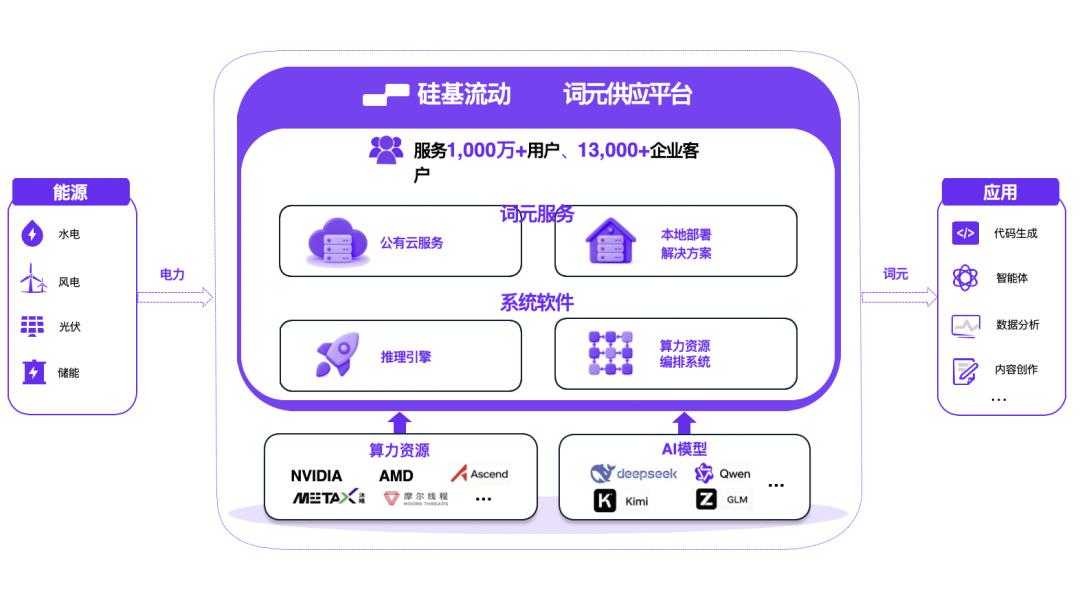
Silicon Flow does not have its own super App, nor does it bet on a single model. What it sells is the right of choice. It uses a unified interface to schedule more than ten chips from NVIDIA, Huawei Ascend, MetaX, Moore Threads and other manufacturers in a shared pool, allowing customers to call more than 170 mainstream models with one account.
Today customers can run DeepSeek, switch to Qwen tomorrow, and change to GLM next week; the underlying layer can also switch from NVIDIA to domestic GPUs. For enterprises that are unwilling to fully bind their AI business to a large manufacturer, this is exactly the reason for the existence of independent platforms.
As of June this year, Silicon Flow has served more than 13,000 enterprise customers, supports more than 170 mainstream AI models, and adapts to more than 10 chips from manufacturers such as NVIDIA, Huawei Ascend, MetaX, and Moore Threads.
Since Silicon Flow does not make profits by selling chips or collecting rents from its own computing power, it earns hard-earned money from the "system software layer" — inference engine optimization, heterogeneous computing power scheduling, model and chip adaptation, which features high technical content, great difficulty in scaling, and is almost doomed to lose money in the initial stage.
Why Raise Another Round Of Financing Now?
Participants in the second phase of B+ round and Series C financing include national-level funds such as China Internet Investment Fund, China New Era Fund, China Mobile Chain Leader Fund, and China Orient Asset International, together with a number of central and local state-owned assets, industrial capital and professional institutions. Old shareholders YT Capital, Shengyi Capital, and Guotai Venture Capital Group continued to make additional investments.
Since the beginning of this year, Token consumption has skyrocketed, and the AI business model has changed: inference requires more and more capital investment.
The more popular the models are, the more Token is like the "electricity" in the AI era.
This also explains why Silicon Flow's this round of financing has attracted capitals such as China Mobile Chain Leader Fund, Jingneng Fund, and Shanghai Inesa Intelligent Computing Fund. The resources behind them involve communication networks, energy, computing power centers and industrial infrastructure respectively.
In terms of time, this round of financing is less than three months after Silicon Flow submitted its listing application to the Hong Kong Stock Exchange (Chapter 18C) on June 30. Why invest such a large amount of capital at this point in time?
Because the inference era has just started, and Token is becoming a long-term, stable and predictable rigid demand. When Agents begin to split tasks, call tools and perform verification autonomously, the Token consumption of a single task may be 10 times or more higher than that of simple question and answer; when AI enters enterprise production processes from the dialog box, Token becomes a continuous consumable.
For Silicon Flow, the destination of the funds is also very clear: increase R&D investment in core technologies such as inference engine, heterogeneous computing power scheduling, model and chip adaptation, strengthen the construction of Token supply platform, and accelerate the expansion of overseas markets.
Every penny points to the same goal: while expanding the Token throughput, reduce the unit cost, so that the "factory" can move from scale to profitability.
It Is Still Too Early For Token Factories To Make Profits
The sharp increase in Token volume does not mean that selling Tokens can make profits immediately. Dreams are dreams, and accounts still need to be calculated clearly.
Public data shows that Silicon Flow's revenue in 2025 was 55.33 million yuan, a year-on-year increase of 653%, and the growth of commercialization is clearly visible.
However, its net loss in the same period was 345 million yuan, and the gross profit margin was -24%. Computing power is the largest cost — the cost of computing power resources in 2025 was about 59.63 million yuan, accounting for nearly 87% of the sales cost.
The problem mainly lies in the public cloud business, which is most like a "Token factory". In 2025, Silicon Flow's public cloud revenue was 29.26 million yuan, accounting for 52.9% of the company's total revenue, surpassing the on-premise deployment business for the first time; but the gross profit margin of this business reached -119% in that year.
The more the business expands, the greater the upfront investment. "Revenue growth without profit growth" is a required course that cannot be bypassed in this track.
There is an industry-wide paradox hidden in it: the unit price of Token is plummeting, while the total demand has skyrocketed by a thousand times. This is exactly the "Jevons Paradox" in economics — in the 19th century, the efficiency of steam engines improved, coal consumption was supposed to decrease, but instead it skyrocketed.
The Token market is repeating the same scenario, and the pace is even faster. Whether it can generate profits through massive scale while the unit price is declining is a life-and-death question for every Token supplier.
For Silicon Flow, there are three thresholds: first, reduce the unit cost to a sufficiently low level — this is the long-term practice of inference engine and scheduling capabilities;
Second, build customer stickiness — independent platforms do not have the support of giant ecosystems, so they have to rely on products and prices to retain customers;
Third, make overseas business the second growth curve — the domestic market needs to compete with cloud vendors, and going global is the way for it to escape the close hand-to-hand competition.
After entering 2026, the growth of Coding, Agent and enterprise production load is accelerating, and serverless Token, dedicated instances and on-premise deployment are all speeding up. Silicon Flow said that with the optimization of customer structure, the expansion of Token scale and the improvement of computing power utilization, the revenue structure and gross profit performance are improving.
Judging from the financing backtracking, on these three things, Silicon Flow has obtained the signal that its judgment direction is recognized. From the perspective of the whole industry, this financing of nearly 2.9 billion yuan means that besides "who controls the models" and "who controls the chips", "who efficiently produces Tokens" is becoming a new narrative officially accepted by capital.
China's daily 140 trillion Token consumption is still growing. After the model war, a war around "who can produce Tokens at a lower cost" has already begun.
This article does not constitute any investment advice.
This article is from the WeChat official account "Pencil News" (ID: pencilnews), author: Xi Wen, published with authorization from 36Kr.