The "Familization" of Domestic Chinese Beauty Brands: Things Unknown to Consumers
In February this year, the 2025 annual series of data on China's cosmetics industry released by the China Fragrance and Cosmetics Association shows that the total omni-channel transaction volume of the industry exceeded 1.1 trillion yuan, and domestic brands have firmly occupied the leading position in the market with a share of 57.37%.
Faced with an endless stream of domestic brands, many consumers who have difficulty making choices often have to go through reviews, watch evaluations, compare prices, and finally select the most satisfactory products to place orders. However, behind this carefully selected effort, the result may not be as expected.
Not long ago, a netizen posted on social media that he originally wanted to compare the nose patch products of RNW and AUOU, but accidentally found that the manufacturers of the two products were the same enterprise, and the two brands also belonged to the same company. This post also uncovered a little-known corner of domestic beauty brands: consumers think they are choosing between different brands, but in fact they may just pay for products from the same company.
Domestic Beauty Brands Begin "Grouped Operations"
It is not new in the beauty industry for a beauty group to operate multiple brands under its banner. Estée Lauder, La Mer, M·A·C, and Tom Ford all belong to The Estée Lauder Companies; behind Lancôme, Helena Rubinstein, Armani Beauty, and YSL Beauty is the L'Oréal Group. Consumers may not know all of them, but they have more or less heard of them.
When the same logic is applied to domestic beauty brands, consumers' perception will be weaker. In fact, the multi-brand matrix of domestic beauty groups has been quite common. For example, Proya owns Proya, Off&Relax, and Poxtra; CHANDO owns CHANDO, Maysu, and Spring & Summer; Marubi owns Love & Beauty and Chunji; Judydoll Group owns Judydoll and Joocyee; Shangmei owns Kans and One Leaf; Betametha owns Winona, and Aoykoh, etc.
No matter for international giants or domestic brands, the core logic of multi-brand layout is basically the same: use different brands to cover different categories, price ranges and crowds, and support larger revenue with broader market coverage. The formation of this multi-brand matrix usually goes through two ways: acquiring mature brands or independent incubation. But no matter which way it is, the underlying logic is mostly differentiation.
This differentiation is usually reflected in two levels. The first is to fill the gaps in product categories. For example, Judydoll Group originally focused on two makeup brands, Judydoll and Joocyee. Later, it acquired the Chinese business of French brand Rene Furterer to enter the scalp care track, and then acquired Bio-MESO to enter the scientific skin care field. The same is true for Yatsen Holding: it first expanded from the makeup brand Perfect Diary to skin care, and then successively acquired Gallinat, DR.WU (Chinese business), and EVE LOM.
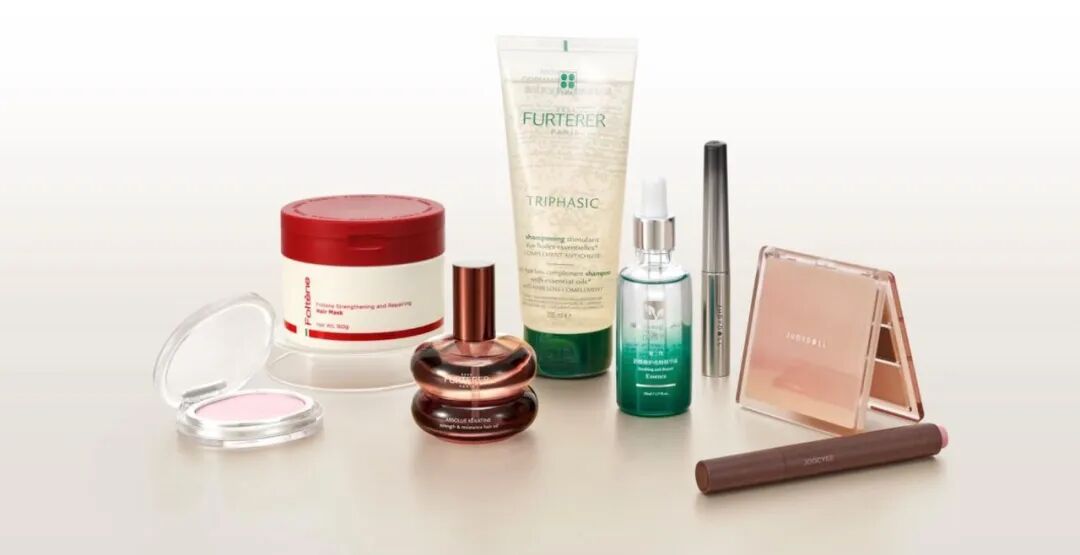
* Source: Official website of Judydoll Group
The second is the segmented positioning within the same category. For example, Poxtra under Proya, as well as the acquired TIMAGE and Flower Knows, all belong to the makeup category but have different positioning: TIMAGE focuses on Chinese aesthetics, Poxtra leans towards trend, and Flower Knows focuses on the two-dimensional girl style. For another example, Winona, a skin care brand under Betametha, focuses on sensitive skin, Aoykoh is positioned at high-end professional anti-aging, and BavinTin focuses on professional anti-acne.
Therefore, in the terminal market, due to the differences in positioning, price ranges and target crowds of various brands, consumers are not easy to realize that they all belong to the same company. But not all "grouped" brands follow this differentiation logic.
Take Peilai Group as an example. Although its brand matrix covers categories such as makeup, skin care, and personal care, there are many overlaps between the product lines of sub-brands, especially categories such as foundation, concealer, facial cleanser, facial mask, and nose patch, and the brand positioning is mainly mass market, with prices basically within 100 yuan.
It is worth noting that most groups have experienced a long cycle in the construction of their brand matrix. For example, Shangmei Group launched Kans in 2003, and did not launch One Leaf until 2014; Marubi launched Chunji in 2007, and did not add the makeup brand Love & Beauty until 2017; Betametha launched Winona in 2010, and launched Aoykoh until 2022.
In contrast, Peilai Group's new product launch rhythm is significantly faster. Qichacha shows that Peilai Group has more than 20 cosmetics companies under its banner, more than half of which can find corresponding brand products on shopping platforms (some are sold in small beauty stores, not official stores). The Jingzhe Research Institute reviewed public reports and found that in addition to UNNY CLUB and RNW which were launched earlier, Peilai Group launched a number of new brands intensively to the market in 2020 and 2021: UODO, DPU, TOCU, PIARA, JEJO, BESNEA, ONLY MAY, etc. all came into the market during this period.
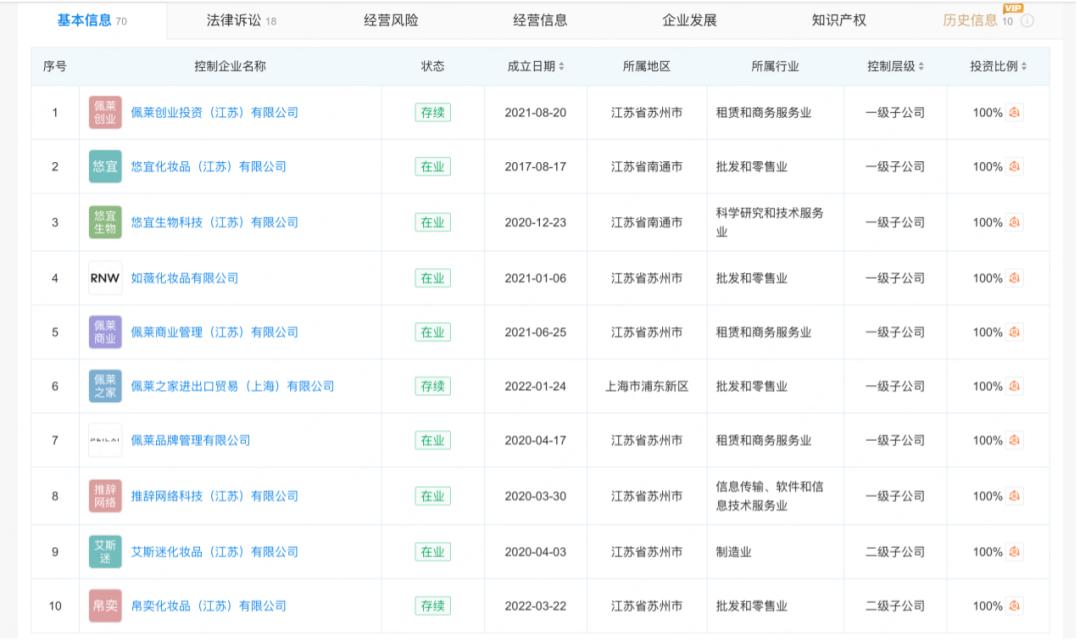
* Source: Screenshot of Qichacha
Overall, Peilai Group's multi-brand layout is closer to the strategy of intensively laying out brands and exchanging quantity for channel coverage. This means that although these brands operate independently in name, they may actually compete for the same group of consumers, forming a situation where "brother brands" compete with each other.
From "Multi-brand" to "Mass-producing Brands"?
At the product level, the competition situation of "brother brands" is more intuitive. Taking the nose patch products of Peilai Group as an example, its brands including RNW, EIIO, DPU, and AUOU all have similar products, with highly similar specifications and prices: the specification is unified as 5 sets, the price on Tmall is concentrated between 40 yuan and 50 yuan, and the price on platforms such as Pinduoduo drops to 25 yuan to 35 yuan.
With such close pricing, it is naturally difficult for consumers to perceive obvious differences when purchasing, so it is not strange that they want to buy two products for comparison. Behind this "similarity", it may be because they come from the same OEM system.
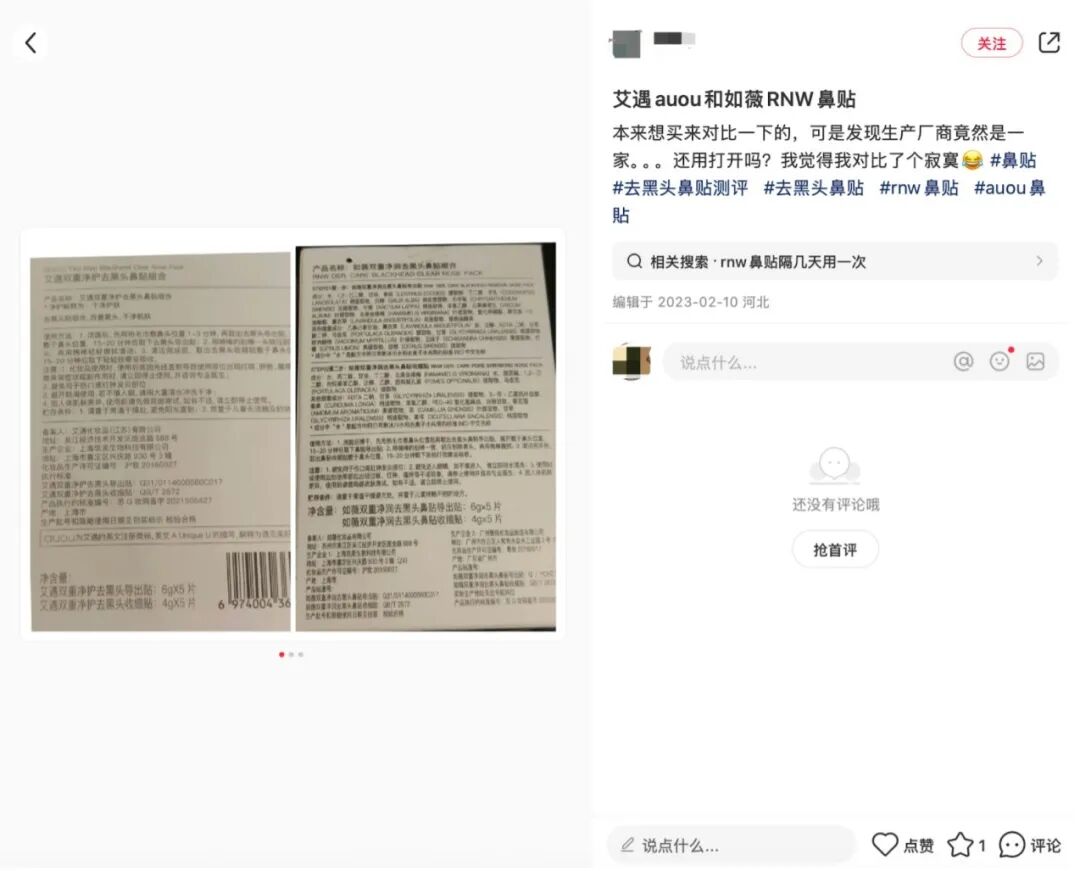
* Source: Screenshot of Xiaohongshu
The Jingzhe Research Institute checked the information on Qichacha and found that the manufacturers of the nose patches of the four brands RNW, EIIO, DPU and AUOU all point to Shanghai Zhumei Biotechnology Co., Ltd. or Guangzhou Yachun Cosmetics Manufacturing Co., Ltd., among which Zhumei Biology is a wholly-owned subsidiary of Guangzhou Yachun. In addition, Guangzhou Yachun has rich OEM experience. In addition to serving the brands under Peilai, it has also done OEM for enterprises such as Pechoin, Tongrentang, and Xiuzheng Pharmaceutical.
In addition to the "same origin" of OEM factories, the Jingzhe Research Institute also found when comparing the four nose patch products that the core ingredients mentioned in their promotional content are also highly overlapping. They generally use extracts from mushrooms, white willow bark, radix codonopsis, burdock root, witch hazel, lavender, etc. as the basis, and some add ingredients such as portulaca oleracea, chrysanthemum vestitum, and centella asiatica.
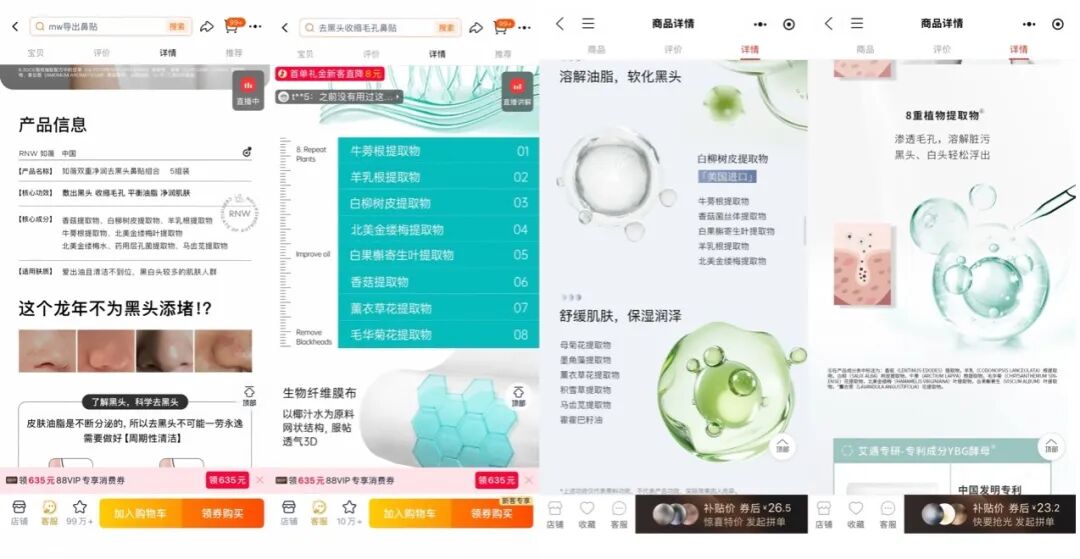
* Source: Screenshots of Tmall and Pinduoduo official flagship stores
Apart from products, the relationship between brand owners and producers is also unusual. For example, a concealer liquid of Peilai's brand UNNY shows that the manufacturer is Peilai Cosmetics (Shanghai) Co., Ltd. Qichacha shows that one of the shareholders of this company is COSMAX (China) Cosmetics Co., Ltd., which holds 80% of the shares, and the other shareholder is a wholly-owned subsidiary under Peilai Group.
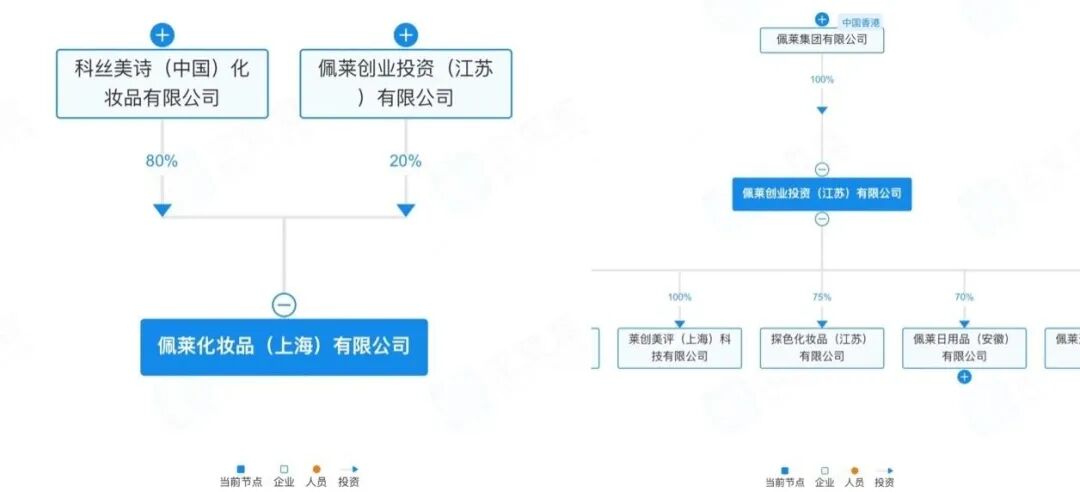
* Source: Screenshot of Qichacha
In other words, COSMAX, which has the identity of an OEM factory, has jointly established a new OEM factory with Peilai and has control over this OEM factory. From this point of view, Peilai's core focus seems to be not on products, but on brand operation. Therefore, the practice of multiple sub-brands operating the same type of product is essentially a strategy to confuse the market, whose purpose is to seize the market share of a single category through a multi-pronged approach.
According to the data from Tmall flagship stores, the sales performance of these nose patches varies significantly, with the daily sales ranging from more than 10,000 to more than 500,000. This means that even if a certain brand has poor sales or its reputation declines in the future, the group still has other brands to retain consumers.
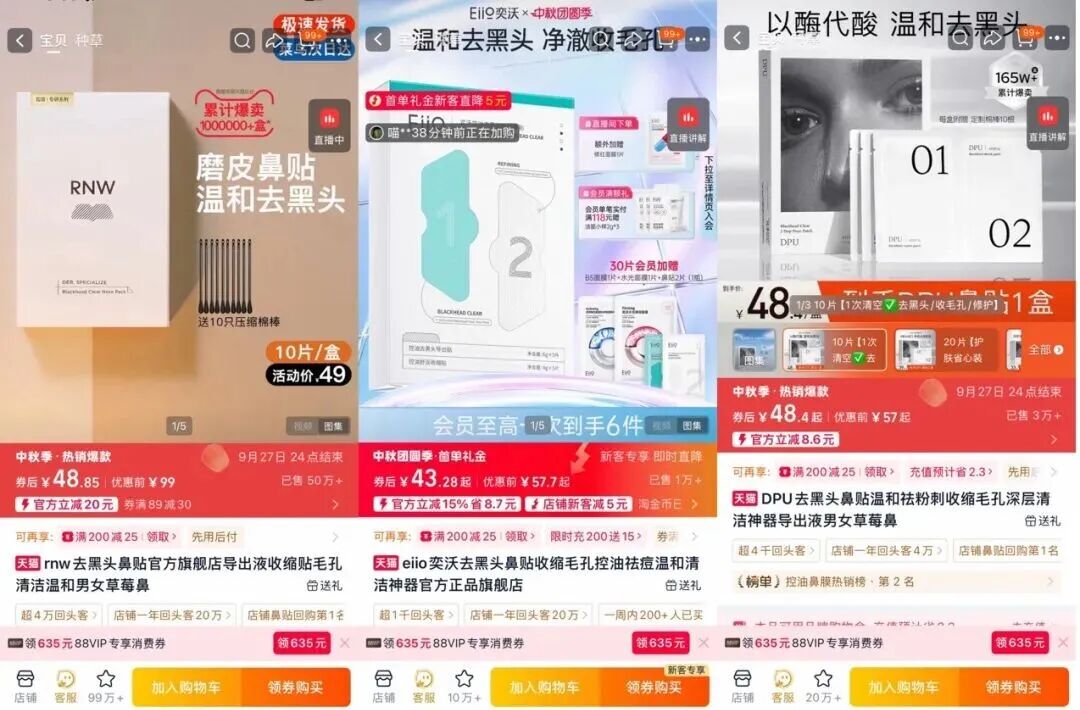
* Source: Screenshot of Tmall flagship store on September 17
But negative impacts also exist. When multiple brands squeeze into the same segmented market, it means that some brands are destined to become "cannon fodder", which is not conducive to the long-term accumulation of individual brand assets. From the overall development of domestic beauty brands, it is also far from beneficial.
Who Has Taken the Dividend of Domestic Beauty Brands?
In recent years, the rise of domestic beauty brands is obvious. Behind it is the reason of the expanded supply of domestic brands, but what really supports the increase of domestic brands' market share is the improvement of consumers' trust in domestic products.
This trust is particularly evident in the mass market. Student groups with limited budgets and people who have just entered the workplace tend to choose domestic beauty brands, and even are willing to try niche brands that they have hardly heard of. This trust is also being exploited.
Nowadays, the marketing method of some beauty brands is not hard advertisement, but seemingly more neutral KOC content planting. Evaluation copies often compare products with international big brands, in which international big brands are always rated well, then highlight that one or several domestic products have good effects, while making other domestic products at a disadvantage in the comparison. Faced with this seemingly "objective" evaluation, it is difficult for consumers to distinguish whether it is a real sharing or the content arranged in advance by the brand side.
Some brands also use videos to make tricks. For example, some makeup application videos claim to show "real" effects, no filter, and plain face, but actually use partial beauty retouching to make the makeup effect better than the real effect.
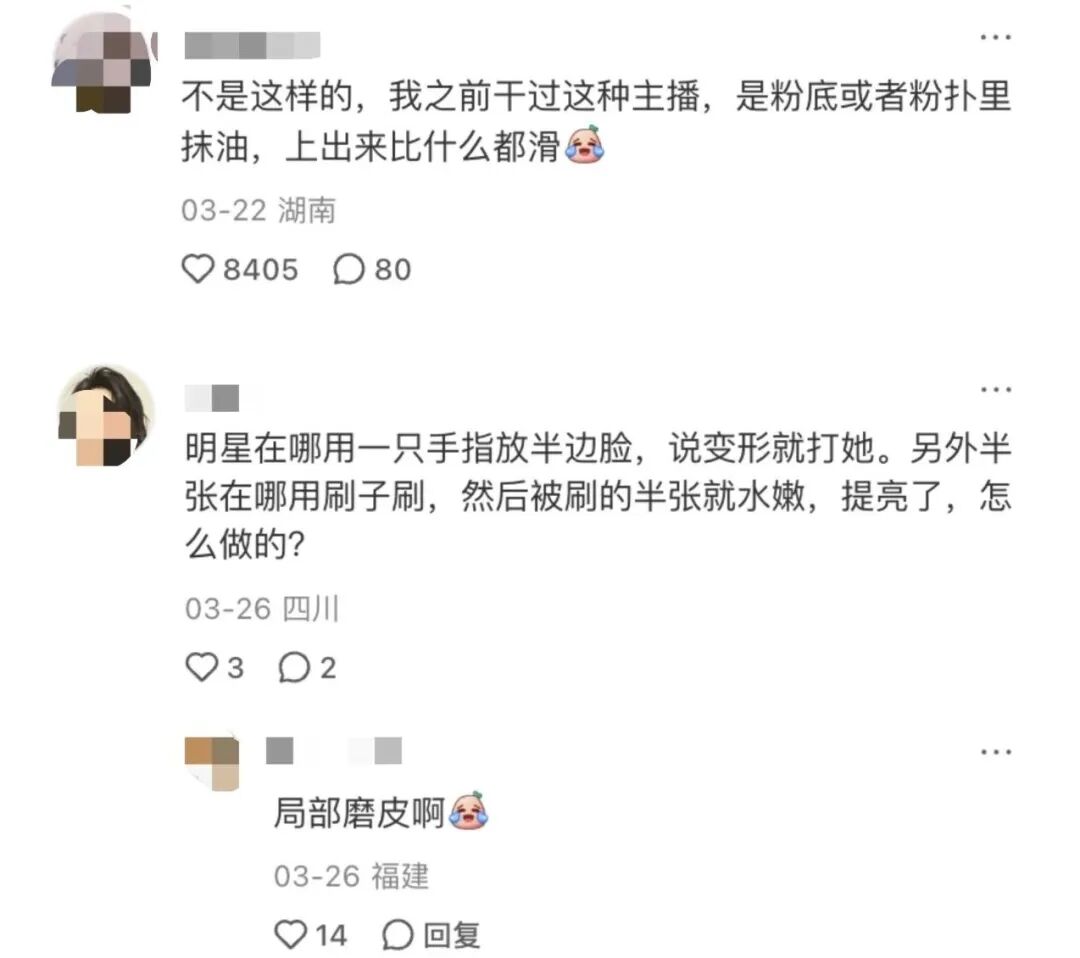
* The fake content planting methods shared by netizens (Source: Screenshot of Xiaohongshu)
This kind of strategy can easily open up the market. The reason is that the price of the product itself is not high, and the trial and error cost for consumers is relatively low. Even if the product is not easy to use or not suitable, consumers will not feel too bad. But the problem is that completing conversion through false propaganda has gone beyond the scope of normal marketing. This is no different from "eating the meal and smashing the pot", which damages the overall reputation of domestic beauty brands.
The market supervision department has had many penalty cases for false propaganda. For example, in January 2025, Peilai Group's brand JEJO was recognized as publishing false advertisements and given administrative penalties by the Market Supervision Administration of Wujiang District, Suzhou, because the recorded efficacy of products such as loose powder, eye and lip makeup remover, and isolation lotion did not match the promotional copies.
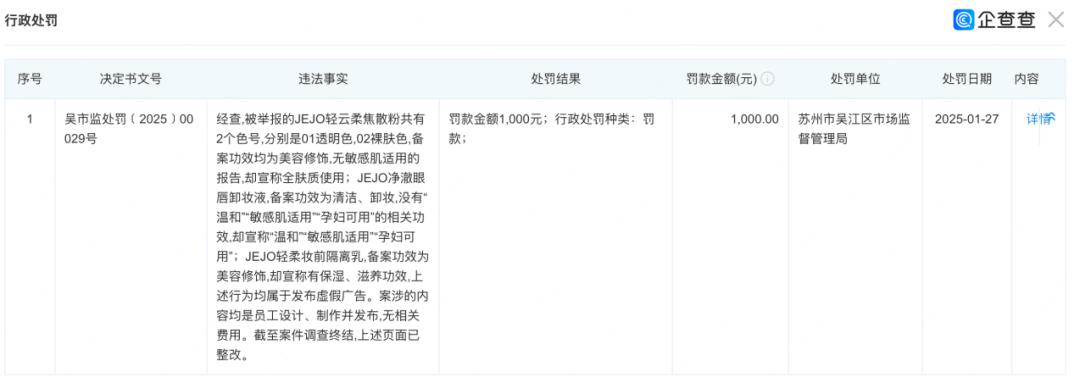
Source: Screenshot of Qichacha
It is worth mentioning that the products of Peilai Group's brand RNW, such as nose patches and hair removal mousse, have been repeatedly complained on the Black Cat Complaint Platform, mostly for problems such as allergies, acne, and redness, and their product introduction pages are also marked as suitable for sensitive skin.
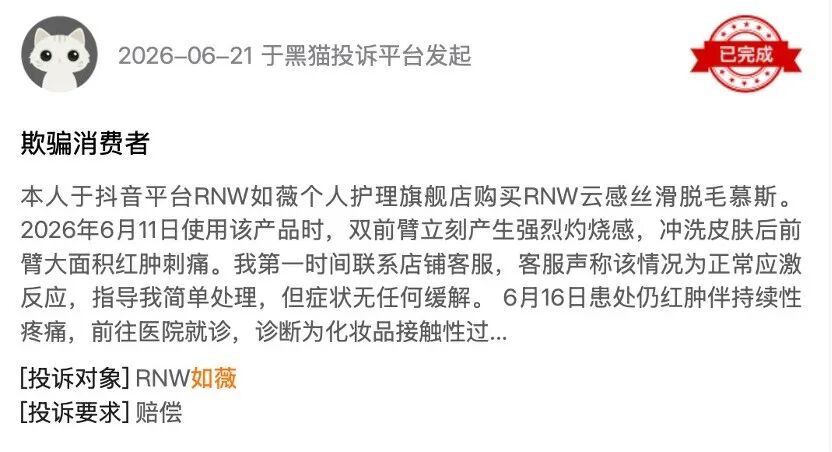
Source: Screenshot of Black Cat Complaint
From the perspective of the industrial chain, the problems not only appear on the brand side, but also exist in the production enterprises behind them. For example, in 2023, the Shanghai Medical Products Administration once notified that the nail polish produced by Jinhua Covis Daily Chemical Co., Ltd. detected the prohibited raw material 1,2-dichloroethane, involving brands such as UNNY and CHIOTURE. When the Jingzhe Research Institute inquired about this enterprise on the Cosmetics Supervision APP, it found that almost all the product publicity columns showed that they had been cancelled. However, the nail polish products