Three veteran tycoons of well-established real estate enterprises have been subjected to high-consumption restrictions.
In the past half month, three leading figures from established real estate enterprises have been successively subjected to high-consumption restrictions.
Their situations vary from one to another — some have been listed as untrustworthy debtors for "full non-performance" of their companies' debts, some have been named as the former legal representative even 8 months after their retirement, and others have been involved in disputes with the second shareholder of their own company.
On September 15, Sanya Wantong Health Development and Management Co., Ltd. (hereinafter referred to as "Sanya Wantong") was newly added to a consumption restriction order. The applicant of this case is Runhanhui (Haikou) Investment Co., Ltd. (hereinafter referred to as "Runhanhui Investment").
The consumption restriction order shows that the Meilan District People's Court of Haikou filed and executed the private lending dispute case applied by Runhanhui Investment against Sanya Wantong on April 10, 2026. Since Sanya Wantong failed to fulfill the payment obligation within the period specified in the execution notice, the court has taken consumption restriction measures against it, prohibiting the company and its legal representative Feng Lun from engaging in high-consumption and non-essential consumption behaviors unrelated to life and work.
It is worth noting that Runhanhui Investment, as the applicant, is exactly the second largest shareholder of Sanya Wantong, holding 30% of the shares. In other words, this is an enforcement case where "the second shareholder sues the company", and Feng Lun, as the legal representative, is also involved in it.
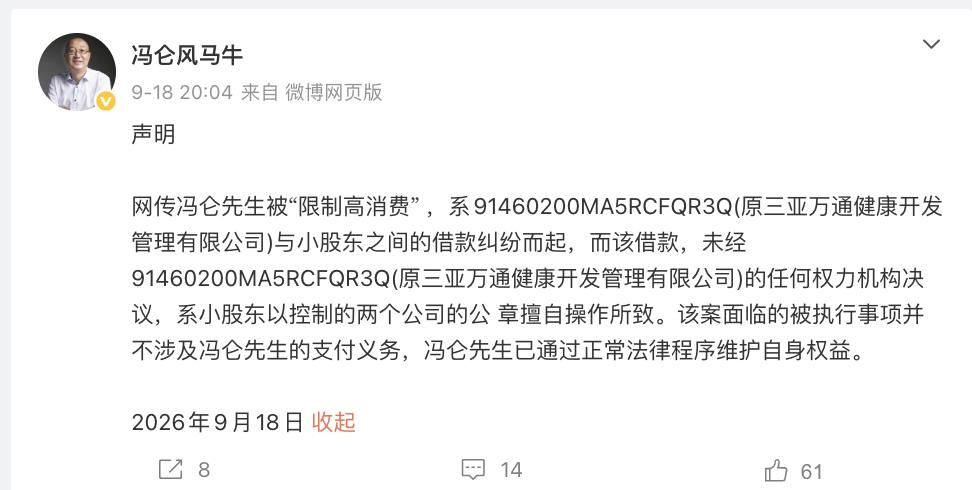
On the evening of September 18, Feng Lun responded to the high-consumption restriction on Weibo: This incident arose from the loan dispute between Sanya Wantong and a minority shareholder. The loan was not resolved through any resolution of Sanya Wantong's authority, and was arbitrarily operated by the minority shareholder using the official seals of two companies under its control. The enforcement matters involved in this case do not involve his own payment obligation, and he has safeguarded his legitimate rights and interests through normal legal procedures.
Prior to Feng Lun, Li Slian, Chairman of R&F Properties, had already been subjected to high-consumption restrictions.
On the evening of September 10, R&F Properties (02777.HK) disclosed through an announcement on the Hong Kong Stock Exchange that the company and its legal representative and chairman Li Slian have recently been newly added to the record of high-consumption restriction.
In the same case, R&F Properties, as the person subject to enforcement, is required to pay a total of about 429 million yuan in one lump sum, with the performance status of "full non-performance", and has thus been listed in the list of untrustworthy enforcers. The situation of being untrustworthy this time is "violation of the property reporting system".
This high-consumption restriction and untrustworthy record involve a financial loan contract dispute. The plaintiff is the Guangzhou Branch of Jiujiang Bank, and the defendants are four companies including R&F Properties and its subsidiaries, whose case was filed at the Tianhe District People's Court of Guangzhou in late June 2025.
This is already the second consumption restriction order Li Slian has received within a month. On September 8, the People's Court of Hengqin Guangdong-Macao Deep Cooperation Zone just took consumption restriction measures against Li Slian and R&F Properties, covering taking planes, taking G-series high-speed trains, staying in star hotels, etc.
In the same week as Li Slian, the consumption restriction order of Vanke also fell on Yu Liang. On September 13, the Intermediate People's Court of Changsha, Hunan Province, issued a consumption restriction order against Vanke Enterprise (02202.HK) and its former chairman of the board Yu Liang, with the involved subject amount of 4.988 million yuan in this case.
The consumption restriction order shows that the court filed and executed the relevant case on March 12, 2026. Since Vanke Enterprise failed to fulfill the payment obligation within the period specified in the execution notice, the court has taken consumption restriction measures in accordance with the law.
At this point, 8 months have passed since Yu Liang retired. On January 8 this year, due to retirement at the age limit, Yu Liang resigned from his positions as director and executive vice president of Vanke, and no longer held any position in the company. On August 14, the legal representative of Vanke Enterprise has been changed to Xu Enli. However, in the court document one month later, Yu Liang still appeared in the identity of "legal representative of Vanke Enterprise".
According to the interpretation of previous judicial precedents of the Supreme People's Court, if the legal representative of the company subject to enforcement has been changed, whether the former legal representative before the change can be subjected to high-consumption restriction needs to be analyzed in combination with the time node of the change and the situation of the case to confirm whether he is the actual controller or the direct responsible person affecting the performance of the debt.
The successive high-consumption restrictions on the three leading figures reflect the in-depth and continuous adjustment of the real estate industry.
On September 18, the State Council Information Office held a series of themed press conferences titled "Starting the 15th Five-Year Plan Period".
Chen Shaowang, Spokesperson and Vice Minister of the Ministry of Housing and Urban-Rural Development, said that the three major sectors in the "15th Five-Year Plan" period are all in a critical period of transformation and development, which can be summarized as "two shifts, two changes, and three transformations". The "two changes" refer to the housing and real estate sector: one is that major changes have taken place in the supply and demand relationship of the real estate market, and the other is that the real estate industry has entered the stock era.
In terms of figures, in the first eight months of this year, the transaction proportion of second-hand houses has reached 52%. According to the statement of the Ministry of Housing and Urban-Rural Development, exceeding 50% marks that the real estate industry has entered the stock era.
Zhang Xuetao, Director of the Real Estate Market Supervision Department of the Ministry of Housing and Urban-Rural Development, introduced that in terms of commercial housing sales, the spot housing sales system will be mainly implemented to solve the problem of "paying for the house and getting the house at the same time" in project sales, realize "what you see is what you get", and fundamentally prevent delivery risks. At present, spot housing sales have become an irresistible general trend.
With the transaction proportion of second-hand houses exceeding half and spot housing sales gradually becoming the mainstream, the real estate industry is accelerating its transition to the operation logic of the stock era. For real estate enterprises in this industry, how to stabilize the capital chain and restore credit under the new rules is still a test placed on their desks.
This article is from the WeChat official account "Leju Finance", written by Liu Zhiying, and published with authorization from 36Kr.