Revenue Sharing and Openness: Chinese Companies Are Reshaping the AI Value Chain
In the technology industry, mastering a leading core technology often means holding the power to distribute benefits.
In the era of PCs and mobile communications, this power was long held by overseas companies. Qualcomm, leveraging the patent advantages accumulated since the 2G era, has long shared the profits of downstream hardware manufacturers in the form of patent licensing fees. As long as a mobile phone uses the 3G and 4G standard essential patents held by Qualcomm, it is required to pay a certain percentage of the net wholesale price of the whole device, with the rate reaching up to 5% of the device price. In 2013, the average profit margin of Chinese mobile phone enterprises was less than 0.5%, while nearly half of Qualcomm's chip and patent licensing revenue came from China.
The "tribute" that China's technology industry has paid is far more than just the sum paid to Qualcomm. Paying licensing fees to Microsoft, Intel, and Oracle, as well as paying architecture licensing fees to ARM, is a common memory of almost every generation of Chinese hardware manufacturers. In the AI era, this order that has lasted for many years has shown signs of reversal for the first time.
On September 19, Amazon Web Services, the world's largest cloud vendor, announced that Kimi K3, launched by Moonshot AI, has been officially launched on Amazon Bedrock (overseas regions only), making Kimi one of the first batch of Chinese AI companies to reach a model revenue sharing agreement with US cloud vendors.
The main reason why AWS chose to cooperate with Moonshot AI lies in the performance of K3 after its launch: it not only reaches the first-tier level in the industry, but also is on par with leading closed-source models. In addition, the cooperation has another meaning: it breaks the bargaining system of closed-source models for cloud vendors, so that leading closed-source models can no longer unscrupulously devour the profits of all links in the AI industrial chain.
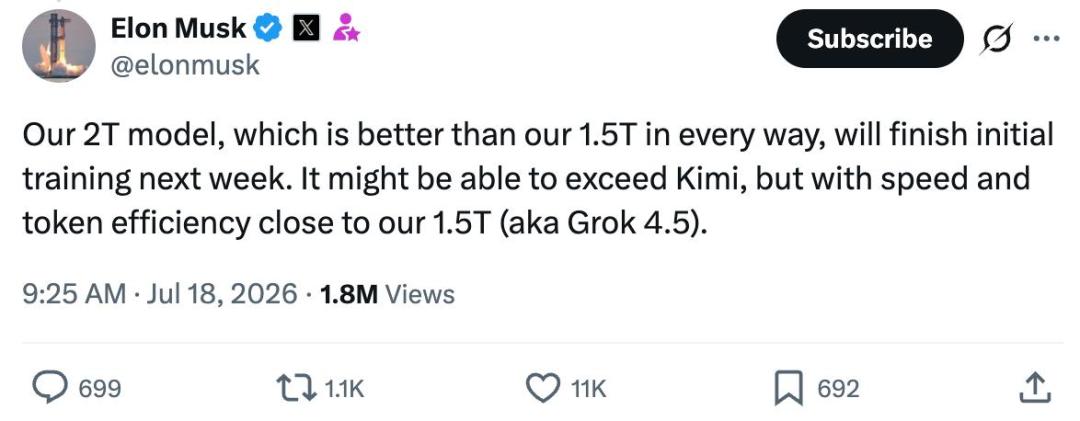
Elon Musk stated that he aims to surpass Kimi
On this basis, Moonshot AI will also pass the intelligent spark of AI to more participants in the industry. Recently, it officially launched its enterprise partner "Moon Landing Plan" to build an FDE team with several companies covering software information services, communications, computing power infrastructure, cloud computing and other fields, including Chinasoft International, AsiaInfo Technologies, Kingsoft Cloud, etc., to bring large models into the core business of enterprises.
Between the two-way adjustment, Kimi is rewriting the distribution method of the AI value chain: upward, making the world's largest cloud vendor pay and share revenue for the model; downward, opening the landing capability of cutting-edge intelligence to industry partners, while only staying at the model layer itself. When a Chinese AI company possesses model capabilities on the same level as OpenAI and Anthropic, instead of allowing such capabilities to devour profits across the AI industrial chain, it adopts a win-win mindset to ensure every link in the AI value chain of "Hardware - CSP - Large Model - Software Application - Enterprise" can benefit.
01. Why did the cloud giant bypass Silicon Valley and turn to Kimi?
To understand the significance of this cooperation, we first need to clarify how cutting-edge AI labs make money.
Their revenue generally consists of two parts: subscription services and API services, and APIs are divided into official channels and third-party channels, the latter mainly referring to cloud vendors. As cloud vendors have a larger base of enterprise users, both Microsoft's Azure AI Foundry and Amazon's AWS Bedrock have more than 100,000 paying enterprise users, and the revenue from this channel often accounts for a high proportion.
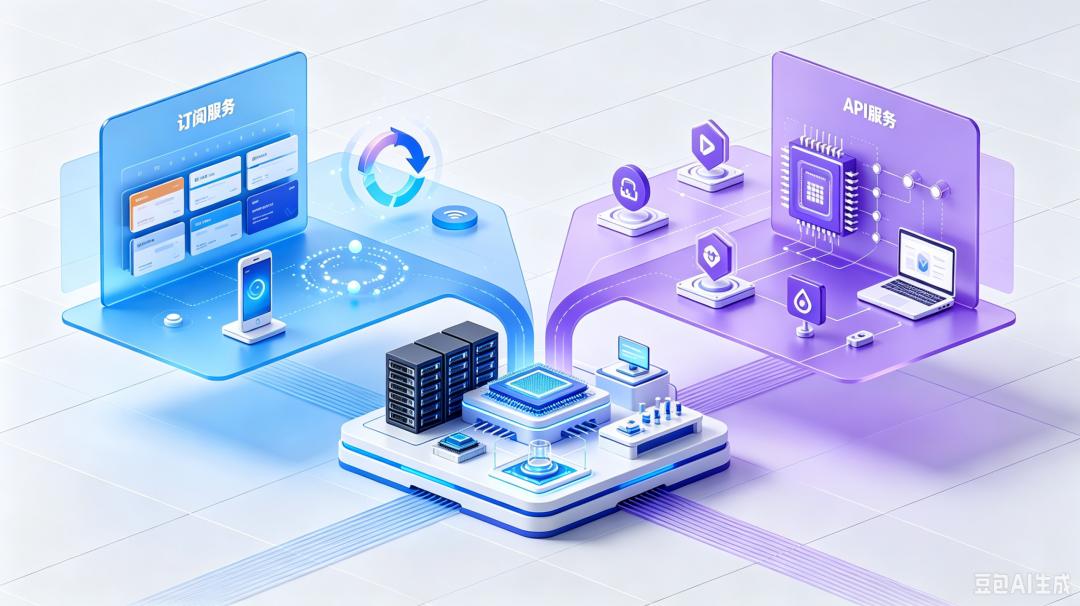
Generated by AI
Take Anthropic as an example. In 2025, the revenue generated from access via cloud platforms such as Google Vertex AI and AWS Bedrock accounted for about 60% to 75% of its total revenue. Whoever can secure a place on the cloud vendor's platform will hold the valve to reach global enterprise customers.
In the past, Chinese open-source model vendors allowed cloud vendors to freely deploy their own models and provide computing power services to users through loose licensing, and model vendors did not participate in revenue sharing. Only closed-source model vendors could get a share of the revenue from cloud vendors. Moreover, many enterprise users in China are also paying for overseas cloud vendors and closed-source model companies at the same time.
The emergence of Kimi K3 changed this accounting logic. In July this year, K3 was released and was listed in the global first tier in multiple independent evaluations such as the Artificial Analysis Intelligence Index, with capabilities comparable to leading closed-source models. More critically, for the open-source approach, Kimi adopts a mode of open-source weights plus vendor-customized agreements: if AWS wants to launch K3 on its own platform, it needs to share revenue with Moonshot AI. According to previous foreign media reports, the sharing ratio can reach up to 30%.
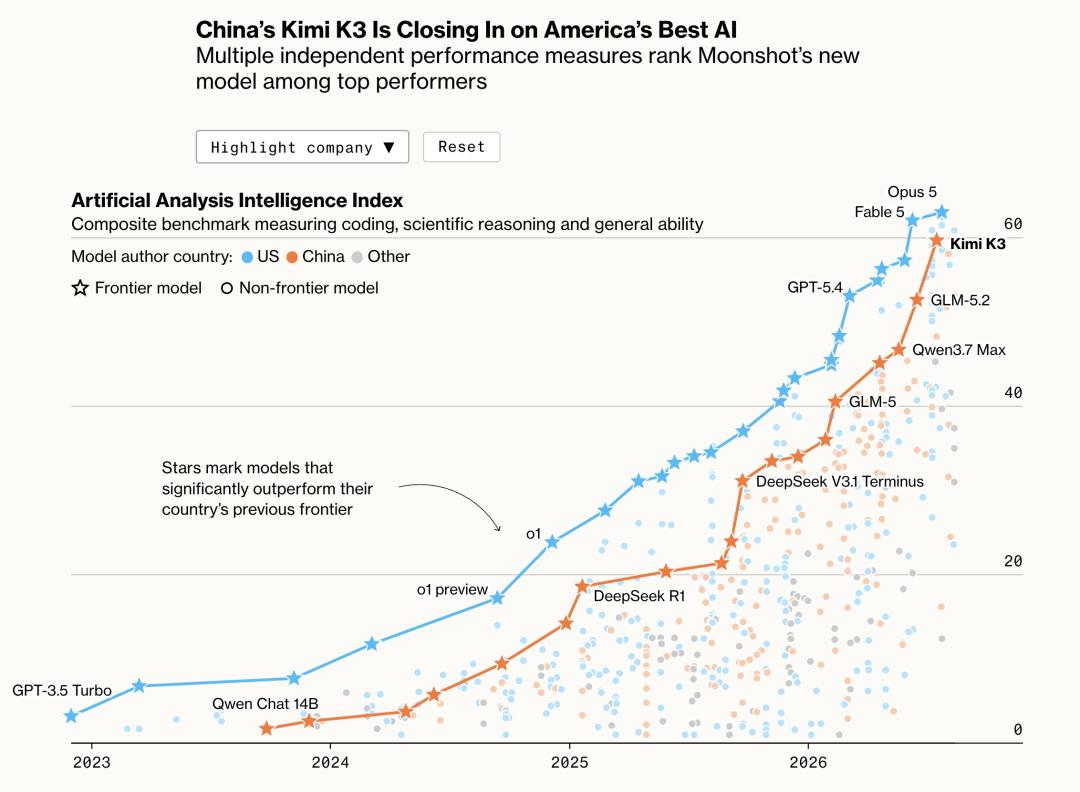
Multiple independent evaluations including the Artificial Analysis Intelligence Index have listed K3 in the global first tier
Behind the revenue sharing, the landscape of cloud services is being rewritten. In the first half of the year, Chinese companies were still paying for accessing overseas models; in the second half of the year, the world's largest cloud vendor began to share revenue for Chinese models. This role reversal is a direct result of the ebb and flow of model capabilities, and Chinese model companies' technical capabilities have for the first time gained the confidence to be clearly priced.
For Kimi, this is also a two-way choice. After the launch of K3, demand was so high that computing power supply was once tight, and new user subscriptions were even suspended. Accessing AWS's global infrastructure can alleviate the computing power bottleneck to a large extent, and also allow K3 to reach more overseas enterprise customers. This is another gain beyond the recognition of model capabilities.
For AWS, this is also a cost-effective arrangement. The introduction of K3 means that Bedrock's model shelf has an additional cutting-edge option, and global enterprise customers do not need to put all their chips on two or three closed-source labs.
The more practical aspect of this arrangement is reflected in value distribution. Leading closed-source labs are making profits with extremely high gross margins on inference, and then using the profits to integrate chips, power, cloud and software downstream. Take Anthropic as an example, according to foreign media reports, if channel sharing and model training costs are excluded, its gross profit margin may exceed 80%. Once there are only two or three oligopolies at the model layer, the computing power in the hands of cloud vendors will lose bargaining power and be reduced to the "rent collector" of large model companies. They urgently need a cutting-edge model that can compete with closed-source models to sell their computing power at a better price, and K3 is exactly the open-source option that can reach the cutting-edge of capabilities.
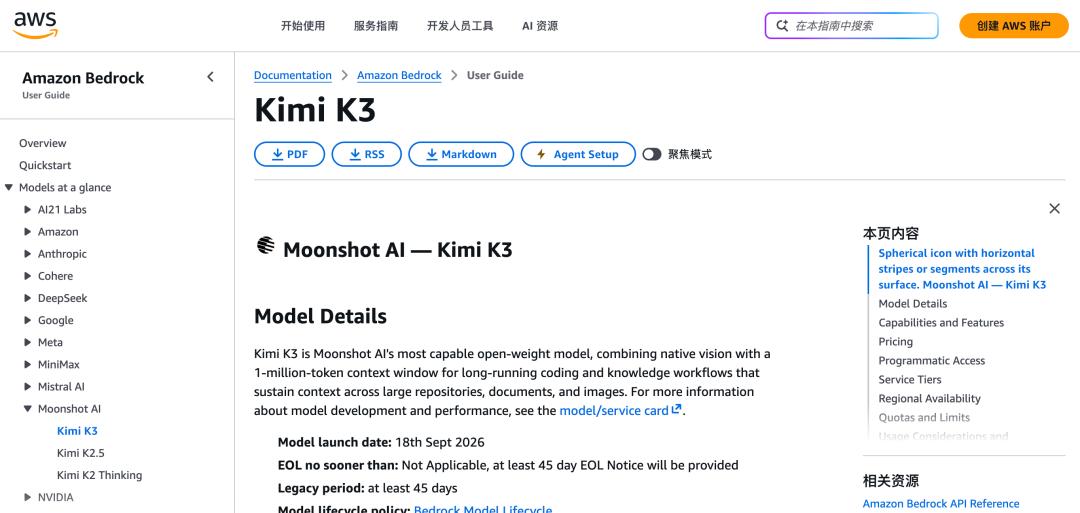
AWS has deployed Kimi
More than just AWS has voted for Kimi. Previously, Harvey, a legal AI company invested by OpenAI, trained its own model based on Kimi, and Microsoft Copilot also chose K3. In China, almost all mainstream large manufacturers have accessed and used Kimi.
When a Chinese company's model is selected by upstream and downstream of the global industrial chain at the same time, the significance of the sharing agreement is far more than a piece of contract, but a new position.
02. For the same FDE problem, Silicon Valley closes the door while Kimi opens it
The cooperation with AWS is only the first half of the story. While obtaining pricing power, Kimi is also doing another thing: distributing the spark of intelligence to more participants in AI applications.
At the beginning of September, Moonshot AI officially launched the Kimi enterprise partner "Moon Landing Plan", to build a Forward Deployed Engineer (FDE for short) team with system integrators in various industries, go deep into the customer site, and promote large models to enter the core business processes of enterprises.
Source / Moonshot AI Kimi WeChat Official Account
Moonshot AI stated that with the rapid improvement of capabilities of models such as Kimi K3, the key challenge of enterprise-level AI has shifted from the technology itself to large-scale implementation. The company will output model capabilities and engineering methodologies to partners in an open and cooperative manner.
The implementation of AI in enterprises is a seemingly promising thing but very difficult in actual operation. Unlike C-end users, enterprises have several orders of magnitude higher requirements for security, stability, localized deployment and industry know-how. No matter how powerful the model is, if it cannot be connected to the business process, it is only a demonstration product. The FDE model was first created by the American software service company Palantir. Its essence is to productize the service capabilities of consulting companies, station engineers at the customer's production site for several months, and help customers deploy the software into every link of the business.
It is with this strategy that Palantir has delivered its software to the core systems of governments, militaries and large enterprises, and FDE has thus become a key puzzle for enterprise AI implementation.
Representative closed-source companies in Silicon Valley have invested heavily in this path. OpenAI expands its FDE staff scale through external recruitment plus acquisition of mature teams, and invested 4 billion US dollars to establish OpenAI Deployment Company; Anthropic delivers at scale through its own FDE team plus partners, and jointly establishes an enterprise AI service company with Goldman Sachs, Blackstone and other institutions.
For FDE deploying closed-source models, the core is to understand customer business needs, and deliver a series of services including advanced prompt engineering, Agent and Skills, evaluation model framework and large-scale deployment. The two leading closed-source players choose to build their own teams, hold both intelligence and implementation capabilities in their hands, and try to swallow the entire enterprise AI cake into their own territory.
Facing the same cake, Kimi has chosen another path. The "Moon Landing Plan" is the first official FDE plan among Chinese model vendors, and it follows an open route of co-building with partners. The capabilities and methodologies at the model layer are output by Kimi, and the last-mile delivery is completed by partners. For partners, this is also a good business: cutting-edge model capabilities are scarce, and the industry know-how they have accumulated over years is also scarce. The combination of the two can bring real revenue from enterprise customers.
Why should the last mile be handed over to partners? Because the bottleneck of enterprise-level AI is no longer model capabilities, but large-scale implementation. Data shows that 95% of enterprise AI pilots have no measurable ROI, and it is expected that by the end of 2027, more than 40% of Agentic AI projects will be cancelled.
In addition, the industry know-how required for implementation is highly fragmented, including the integration of systems and permission systems, adaptation of business processes, and standards for security compliance. Only service providers that have been deeply rooted in various industries for a long time truly understand these. What is truly scarce in enterprise AI has long shifted from stronger model capabilities to the engineering capabilities to make use of the models. Letting professionals do professional work is the most simple logic of the "Moon Landing Plan", and it is also the fundamental difference between it and the Silicon Valley route.
The market's feedback is equally direct. The first batch of partners including Chinasoft International, AsiaInfo Technologies, Kingsoft Cloud, Yakon Ltd, and Tianjian Technology almost cover the business scenarios with the highest fit for AI implementation, such as finance, government and public affairs, energy, law, and communications. On the day the cooperation was announced, the share price of Chinasoft International rose by 23%, and AsiaInfo Technologies once rose by more than 25% during the trading session.
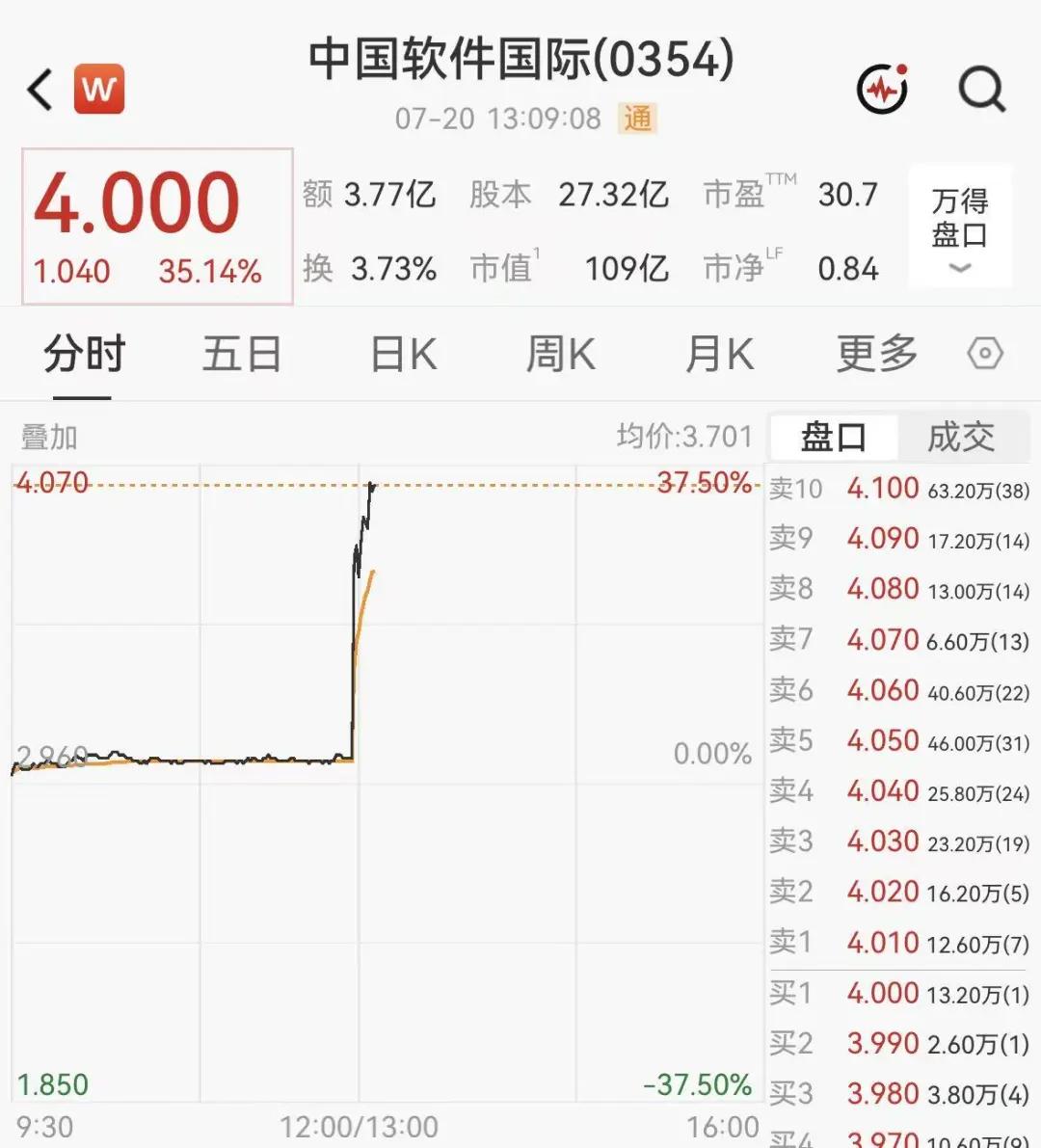
The share price of Chinasoft International rose sharply, and the company signed a "Moon Landing Plan" cooperation agreement with Moonshot AI
The capital market has illustrated the same truth with real money: when the first-tier model capabilities meet the deepest industry accumulation, the imagination space of enterprise AI has just opened.
03. Do not be Microsoft, do not be Palantir, Kimi only pursues AGI
Looking back, the cooperation with AWS and the "Moon Landing Plan" are actually the first half and the second half of the same main line: the first half answers how to price intelligence, and the second half answers how to distribute intelligence. Upward, what is obtained is pricing power; downward, what is released is distribution power.
Along this main line, what Kimi does can be summarized as "two-way openness". It achieves win-win revenue sharing with cloud vendors through open-source agreements, opens model capabilities to software service providers, does not earn money from services, and only earns money from the model layer.
The success of this strategy is based on the continuous realization of the commercial value of open-source models. According to the calculation of China International Capital Corporation Limited, with high cost performance and high intelligence level, open-source models are widely recognized by users at home and abroad, and the call volume is increasing trendily. It is expected that in 2026, the overseas open-source model revenue will reach the order of tens of billions of dollars; by 2027, the global open-source model call volume will account for 50% to 70% of the total Token volume, and the value will account for 12% to 30% of the large model market.
CICC believes that the accelerated penetration of open-source models may drive down the overall unit price of Token, but based on openness and inclusiveness, more usage scenarios will be unlocked, and the overall Token usage may increase significantly.
The unit price goes down and the total volume goes up, so the cake is getting bigger. This means that even without considering the substitution of closed-source models, open-source models themselves are enough to grow into a tens of billions of dollar business.
This also explains why Kimi dares to adopt "two-way openness": it is a bigger business. The essence of open-source models is to bring computing power hardware, cloud vendors, inference platforms, and aggregation platforms into the same co-development ecosystem. Cloud vendors sell computing power through revenue sharing, partners obtain revenue through FDE delivery, and the model layer obtains continuously growing inference calls. In this industrial chain running through upstream and downstream, every link can get relatively reasonable value, thus forming a positive cycle. The technological progress of open-source models will also be transmitted along this chain, driving the commercial realization of relevant participants.
