Why can't Pepsi beat Coca-Cola?
For every three carbonated drinks Chinese people consume, roughly two are from The Coca-Cola Company, and one from PepsiCo.
The two rivals have fought in the Chinese market for over 40 years, yet this gap has never been closed.
Data from Ma Shangying, an offline retail monitoring agency for FMCG, shows that in 2024, The Coca-Cola Company held a 61.11% share of China's carbonated beverage market, while PepsiCo accounted for 29.52%. A year earlier, the figures stood at 60.6% and 30.3% respectively.
In January 2025, the gap kept widening. The market shares of Coca-Cola and PepsiCo reached 59.88% and 27.2% respectively.
In the first half of 2026, Swire Coca-Cola recorded a revenue of HK$14.224 billion in mainland China, representing a year-on-year increase of about 9%, with its soda sales maintaining growth. COFCO Coca-Cola sold 810 million standard cases of beverages in the same period, up 9.6% year on year.
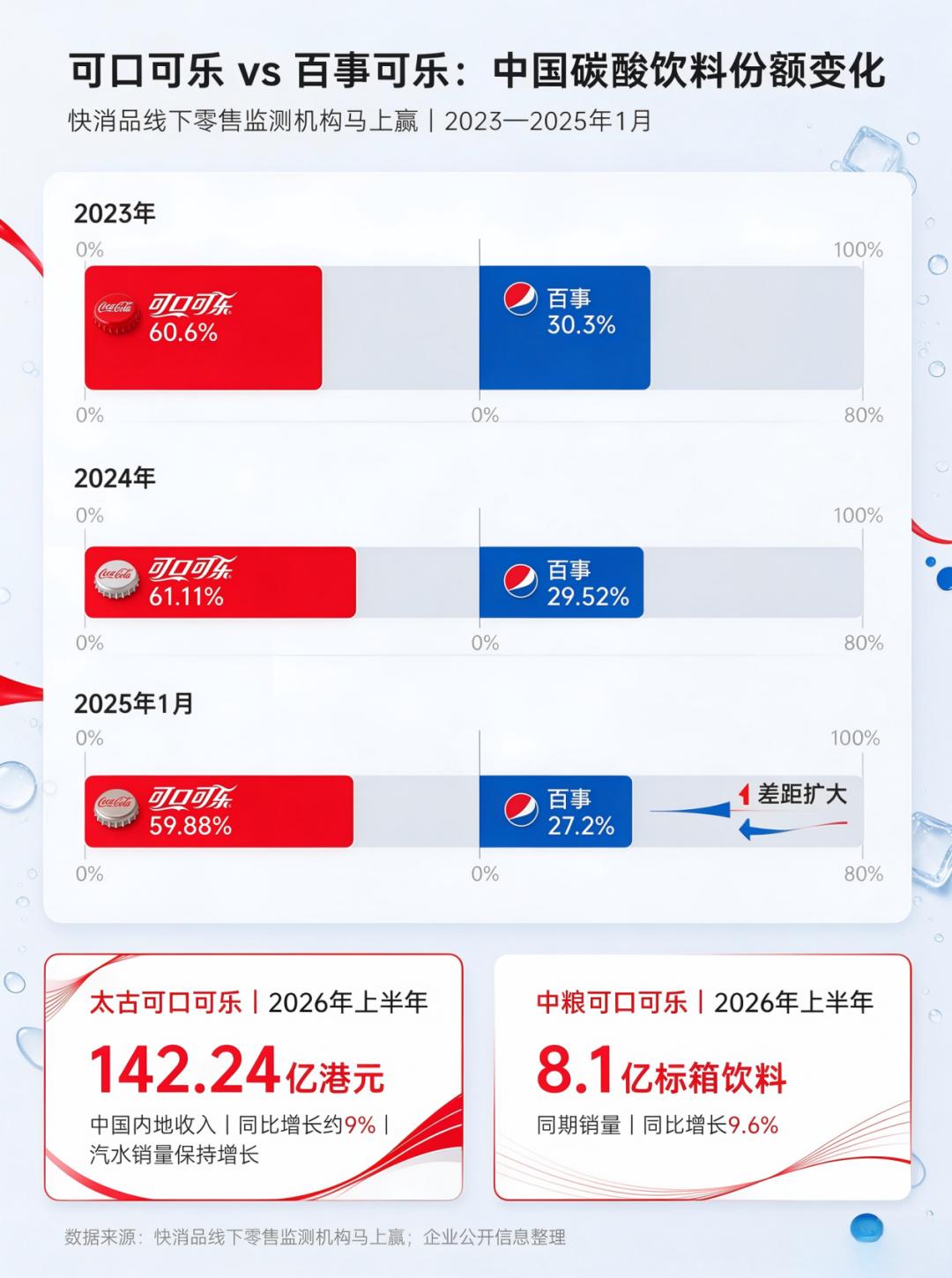
Figure | Source from the Internet
This is a somewhat counterintuitive outcome.
PepsiCo entered the Chinese market not late. In 1981, PepsiCo built a bottling plant in Shenzhen, only two years after Coca-Cola re-entered the Chinese mainland. Over the following 40-plus years, the two companies launched similar products, adopted similar packaging, and competed for the same group of consumers on TV, in convenience stores, restaurants and at sports events.
Nor is PepsiCo a weak brand.
In the 1970s and 1980s, it launched the famous "Pepsi Challenge" campaign in the United States. Consumers were blindfolded to taste two cups of cola without seeing the brand, and PepsiCo intended to prove through blind tests that more people preferred its flavor. Later, it signed Michael Jackson and turned the "Pepsi Generation" into a global marketing event.
In 1985, Coca-Cola even took an action that it regretted later: it modified the formula that had been used for nearly a hundred years and launched the "New Coke". The new product was boycotted by consumers, and the old formula was back on the market soon.
That was one of the moments when PepsiCo got closest to Coca-Cola.
But when this competition came to China, the final pattern that took shape turned out to be very stable.
01
The cola business is an industry where people tend to overestimate the differences between products.
Two 500ml bottles of cola are placed on the shelf, with similar prices, similar packaging, and no huge difference in taste that would make most consumers reject one of them.
But consumers do not stand in front of the two drinks to make a choice every time they drink cola.
Most of the time, they have no choice at all.
For example, when you walk into a restaurant, you drink whatever cola the owner sells; when you go to a small store, you buy whatever cola is in the freezer; the same is true for shops near cinemas, scenic spots, railway stations and schools.
Therefore, many beverage companies have long been fighting for a rather laborious and costly goal: to make their drinks closer to consumers.
Coca-Cola has been working on this in China for more than 40 years.
Nowadays, the production and sales of Coca-Cola in China are mainly completed by two major bottling groups: COFCO Coca-Cola and Swire Coca-Cola. The two companies divide the Chinese market by region, and produce, distribute and sell Coca-Cola's products in their respective regions.
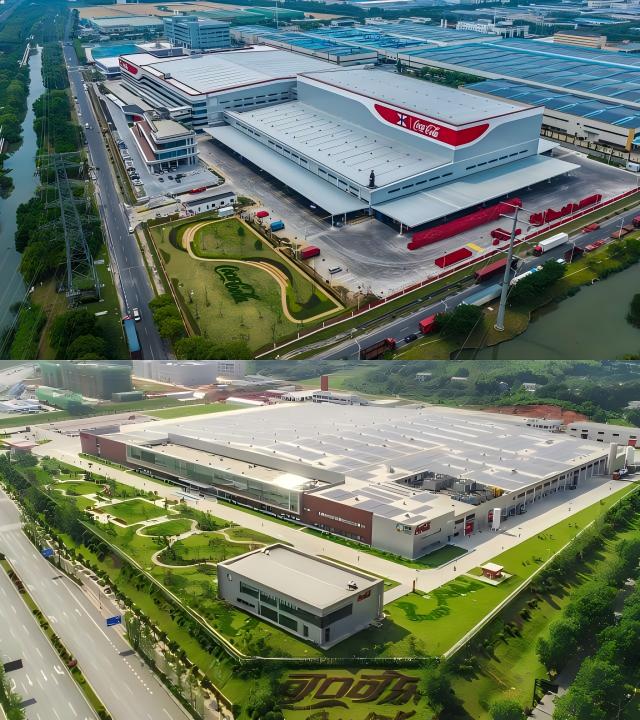
Figure | The upper picture shows Swire Coca-Cola's Kunshan factory, and the lower one shows COFCO Coca-Cola's Hunan factory
And the number of factories is still increasing.
In 2024, COFCO Coca-Cola invested 1 billion yuan to build a new plant in Shaanxi; Swire Coca-Cola launched a new production base in Guangzhou with an investment of 1.25 billion yuan, planning to build 11 production lines. After the latter is completed, the local production capacity is expected to increase by about 66%.
For locations closer to consumers, Coca-Cola is still continuing to invest in freezers.
At the end of 2024, Swire Coca-Cola alone had placed more than 1 million sales freezers and vending machines in mainland China.
These freezers are scattered in convenience stores, supermarkets, restaurants and small street-side shops.
For beverage companies, a freezer is far more than just a refrigeration device. In summer, when a consumer walks into a store, the first few bottles of drink they see and which drinks are cold often directly influence which brand they finally buy.
In 2024, China's beverage consumption was relatively weak, and Coca-Cola's sales in China declined in both the second and third quarters. By the fourth quarter, the company's sales in China resumed growth. James Quincey, CEO of Coca-Cola, specifically mentioned two points when talking about the Chinese market at the earnings call: increasing cold drink equipment, and increasing marketing investment in key channels.
More than 40 years later, Coca-Cola is still doing these heavy, labor-intensive tasks.
PepsiCo once had its own bottling system, but its subsequent infrastructure construction was surprisingly unreasonable.
02
In November 2011, PepsiCo and Master Kong announced the establishment of a strategic alliance.
This was the most important adjustment PepsiCo made in the Chinese market.
Prior to this, PepsiCo's Chinese beverage business was operated by 24 wholly-owned and joint-venture bottling enterprises. After the transaction was completed, PepsiCo transferred its equity interests in the bottling business to Master Kong, and the latter became PepsiCo's licensed bottler in China.
The division of labor between the two sides was very clear.
PepsiCo continued to own the brand and be responsible for marketing and promotion; Master Kong was responsible for the production, sales and distribution of PepsiCo's carbonated drinks, Gatorade and other products.
This transaction was fully justified at that time.
Master Kong already had a huge beverage sales network. In addition to instant noodles, it also sold tea drinks, bottled water and fruit juice. PepsiCo did not need to continue to invest a lot of capital to build its own bottling and distribution system, and could enter more terminals with the help of Master Kong's network.
When the two sides announced the transaction to the public at that time, they even took "expanding PepsiCo's national distribution network in China" as an important goal of the cooperation.
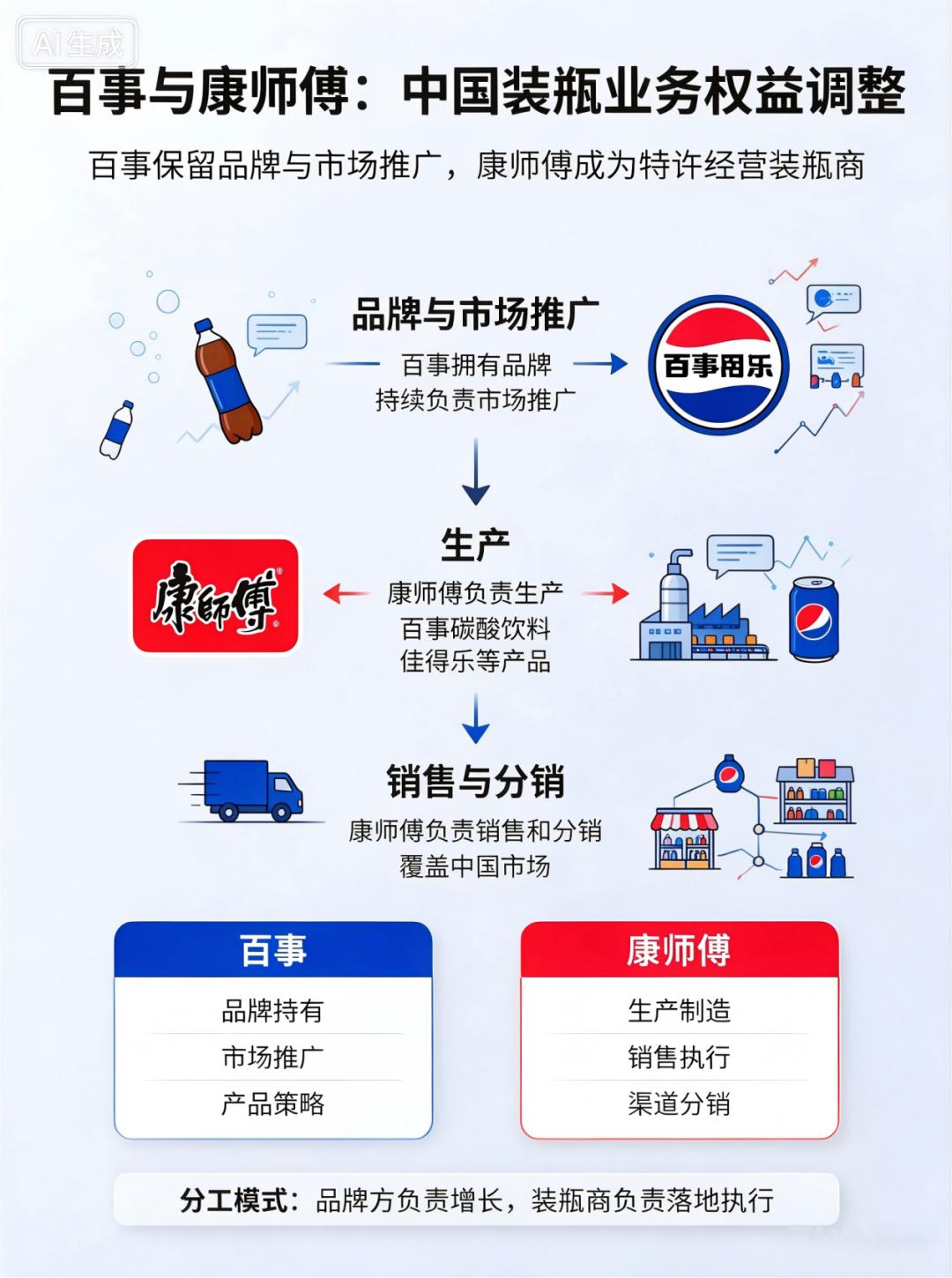
Figure | Source from the Internet
In 2024, the revenue of Master Kong's carbonated beverage business declined; PepsiCo also mentioned in its financial report that its beverage sales in China decreased slightly. In the same period, Coca-Cola's market share in China's carbonated beverage market rose from 60.6% to 61.11%, while PepsiCo's share dropped from 30.3% to 29.52%.
However, it cannot be concluded that "handing over the bottling business to Master Kong led to PepsiCo's loss". Master Kong itself is one of the largest food and beverage channel operators in China, and this system has also helped PepsiCo cover a large number of markets.
But the two companies embarked on different paths from then on.
PepsiCo transferred more production and distribution work to partners, and positioned itself more as a brand and product operator.
Coca-Cola also relies on bottlers, but it has always placed the bottling system at the core of the entire company. COFCO and Swire not only produce cola, but also are responsible for a large number of terminal sales work. A system that has operated for many years has taken shape between Coca-Cola, Chinese bottlers and terminals.
This difference is particularly important in the beverage industry.
A bottle of cola only costs a few yuan. Consumers rarely walk hundreds of meters to find another store specifically because Coca-Cola is out of stock, nor will they give up a gathering just because a restaurant only sells PepsiCo's products.
The one that enters the freezer first, the one that secures the restaurant, and the one whose sales staff can cover more small stores, reduces the chance for consumers to choose competitors.
In the final stage of the cola war, the competition is no longer only about which bottle tastes better.
03
This also explains another question: why Coca-Cola has more than just cola selling well in China.
When you walk into a convenience store today, The Coca-Cola Company usually occupies more than one position on the shelf.
There are also Sprite, Fanta, Minute Maid, as well as sugar-free versions and packages of different specifications beside it.
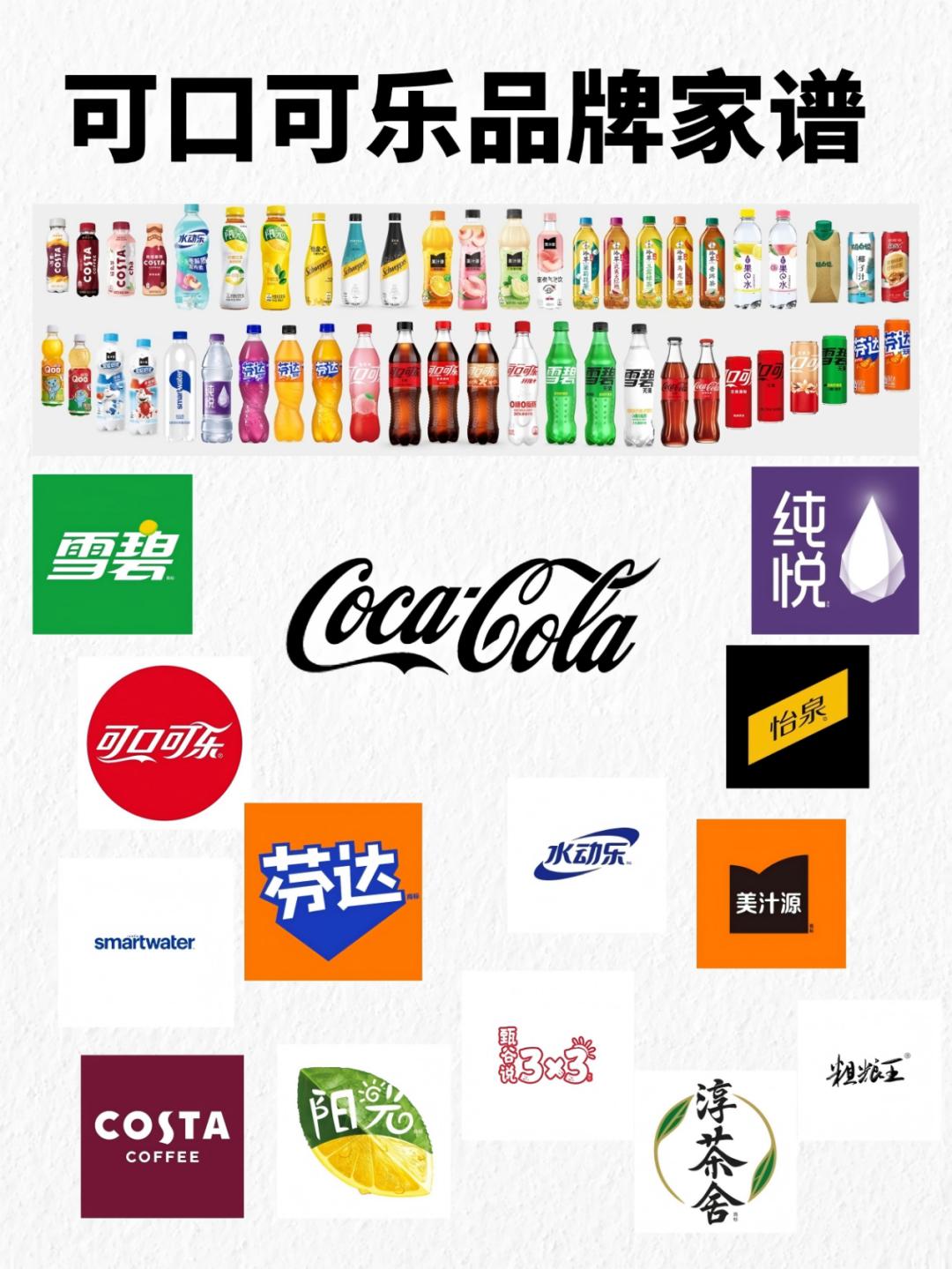
Figure | Source from the Internet
A well-laid network can continuously load new products into it.
A truck that delivers Coca-Cola to convenience stores can also deliver Sprite; a freezer that has been placed in a small store can hold multiple brands of The Coca-Cola Company; a distributor that has cooperated for many years does not need to build a new set of sales relationships for each new product.
This is also a part of the beverage industry that is easily overlooked.
What consumers see is the brand.
What distributors see is another set of logic: turnover speed, delivery frequency, promotion policies, freezers, account periods, and how many kinds of products a truck can sell in one trip.
Nongfu Spring also gained similar dividends when it developed tea drinks in recent years.
Oriental Leaf did not enter small shops and convenience stores across the country from scratch. A case of Oriental Leaf can enter any channel along the route that a case of Nongfu Spring has already taken.
The channel resources that Coca-Cola has accumulated in China for more than 40 years follow the same model.
PepsiCo certainly has a huge distribution network too. Master Kong itself sells iced black tea, green tea, mineral water and fruit juice. But there is a notable difference here: Master Kong has its own beverage business, and PepsiCo is only part of this system; the main task of COFCO Coca-Cola and Swire Coca-Cola is to sell The Coca-Cola Company's products.
Few public data can directly answer whether this will affect the efficiency of the two sides in terminal resource allocation, sales incentive and new product promotion.
But at least judging from the final market share, PepsiCo, with the help of Master Kong's channels, has not narrowed the gap with Coca-Cola.
Moreover, what they are facing now is not just each other.
The shelves for beverages in China are far more crowded than they were 20 years ago.
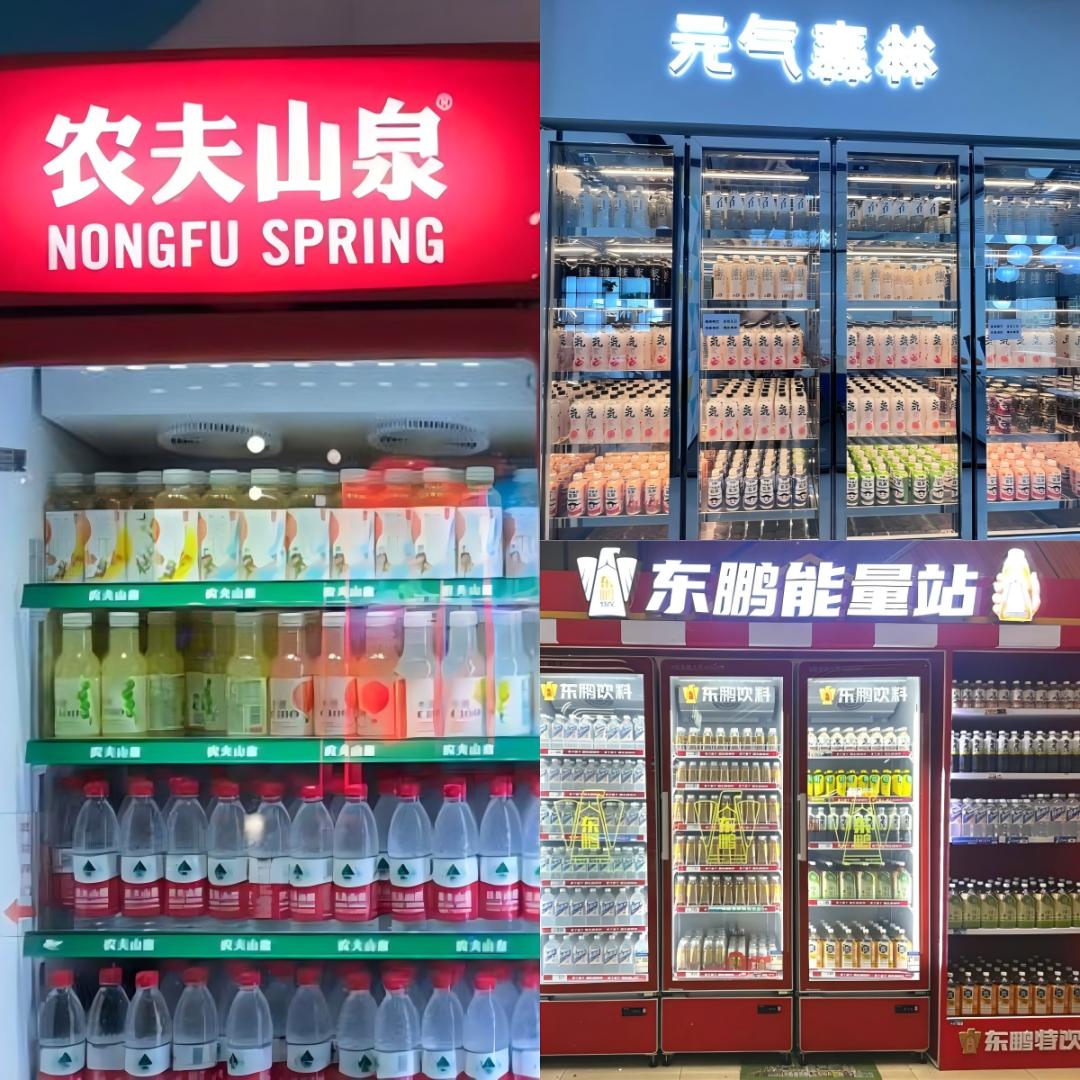
Figure | Source from the Internet
Nongfu Spring, Genki Forest and Dongpeng Beverage are all adding freezers to compete for positions in convenience stores and small shops. In 2022, Nongfu Spring already had about 650,000 freezers. Genki Forest is also continuing to increase its freezer placement.
In the past, Coca-Cola and PepsiCo fought for one freezer.
Now more Chinese beverage companies have joined this battle.
04
There is a bigger background behind PepsiCo's loss in the cola market in China.
Cola is no longer as important to PepsiCo as it used to be.
In 1998, PepsiCo acquired the juice company Tropicana; in 2001, it bought Quaker Oats, the parent company of Gatorade. Even earlier, it had entered the snack industry through a merger with Frito-Lay.
Today, PepsiCo owns brands such as Pepsi-Cola, Gatorade, Lay's, and Doritos. Potato chips, corn chips and other convenience foods are a very important part of its business.
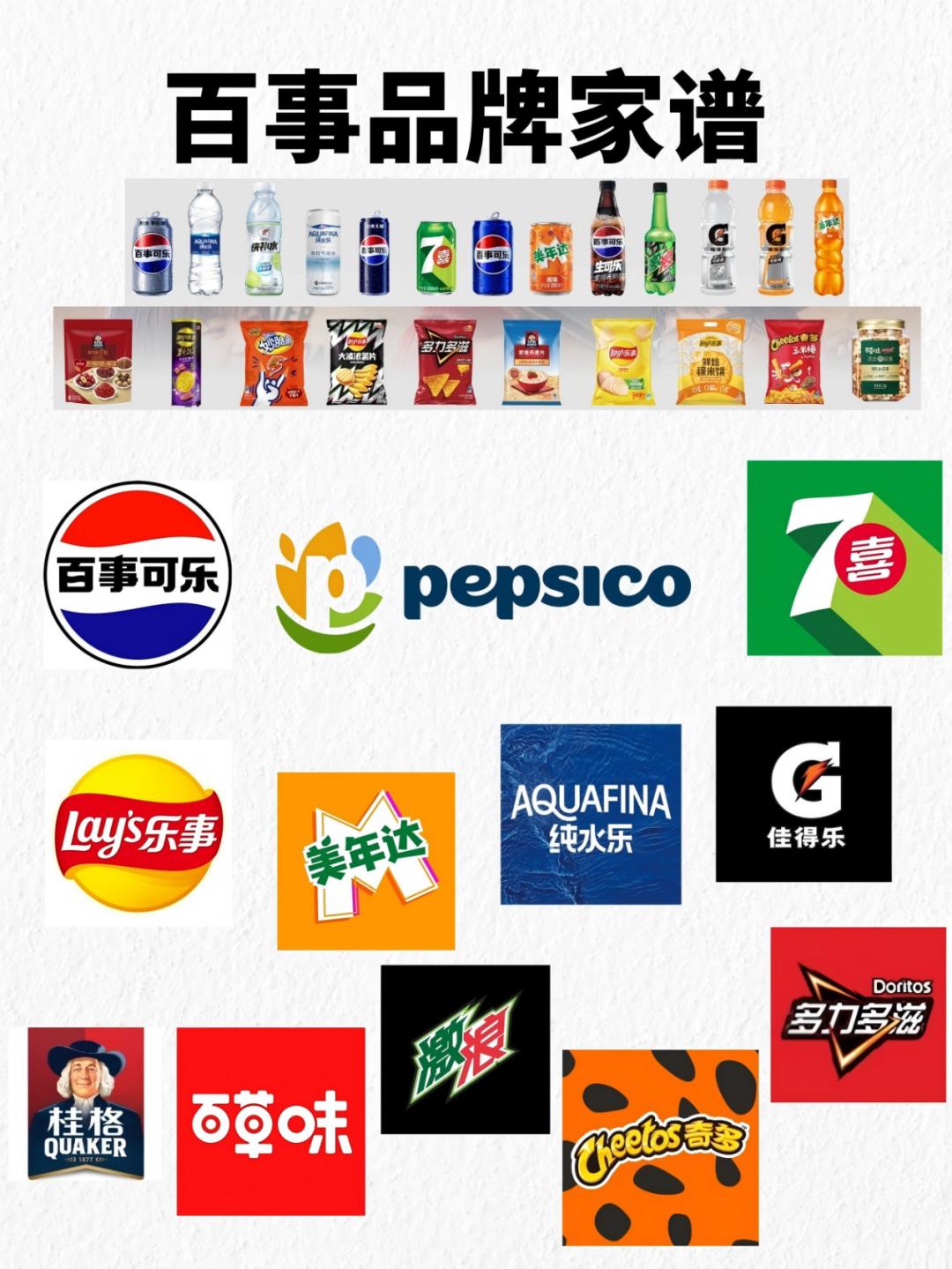
Figure | Source from the Internet
But Coca-Cola took a different path. It continuously sold off bottling business assets and concentrated capital on brands and beverages. In addition to Coca-Cola, Sprite and Fanta, it has also entered the fields of fruit juice, coffee, tea, sports drinks and water, but it has never gone beyond the beverage sector.
This is why, judging from the overall revenue of the company, PepsiCo is by no means a small company that has lost to Coca-Cola. But when we narrow the scope to the cola business, the result is very clear.
The Chinese market has maintained this gap for more than 40 years.
In 1979, Coca-Cola re-entered the Chinese mainland. Two years later, PepsiCo built its first bottling plant in Shenzhen.
Both companies later caught up with the fastest growth period of China's beverage market, and both spent a lot of money on advertising, inviting celebrities and sponsoring sports events.
The final gap that has been widened is hidden in places that consumers rarely notice.
Whose freezer is at the door of a small county store, which company a restaurant has signed a contract with, how many stores a distributor can deliver goods to in one day, and how far a factory is from the market.
Advertising can be renewed in a few months.
It takes many years to build all these facilities and networks.
Nowadays, China's beverage market has entered a new round of competition. Nongfu Spring, Dongpeng Beverage and Genki Forest are still placing freezers, expanding distributors, and seizing channels in restaurants and convenience stores. The problems they face are not completely different from those of Coca-Cola and PepsiCo 40 years ago.
PepsiCo once tried to challenge Coca-Cola with better taste, younger brands and bigger celebrities.
None of these efforts helped it catch up with