From supermarkets and hypermarkets to online platforms, why are all players moving towards self-operated operations in 2026?
In recent years, enterprises that seem completely different have been doing the exact same thing.
Hema, Yonghui and Wumart are ramping up efforts on private-label products, in-store operation and home delivery services respectively; JD, which entered the market earlier, continues to strengthen self-operated procurement and warehouse distribution; Hema has recently accelerated the pace of "converting stores into warehouses" and increased investment in front warehouses; Meituan, relying on its instant fulfillment capabilities, provides users with better-priced private-label products; vertical chain retailers such as Lingshi Henmang, Guoquan, Miniso and Jinlimen are strengthening their supply through headquarters-based product selection, centralized procurement and customized products.
These enterprises have different business formats and different starting points, but none of them are satisfied with just the "selling goods" link. Yilan Business believes that the focus of retail competition is shifting from "where to sell" back to "what to sell, how to organize the supply, and whether the delivery can be completed as promised".
Self-operation is not just a model but a capability. It is returning to the center of the retail stage and becoming the entry ticket for the second half of the retail industry.
01
Self-operation is not a new story
Looking back at the global retail history, self-operation is by no means a new product. Every reform of business format essentially deepens a certain link of self-operation capabilities:
Early department stores rose by relying on buyers, and retailers organized commodities on their own for the first time. At that time, self-operation only needed to "be good at selecting goods"; the chain revolution allowed retailers like A&P to achieve national scale through unified centralized procurement, and self-operation was upgraded to "being able to organize the supply chain"; in the era of supermarkets and informatization, Walmart used satellites and EDI to manage inventory turnover on a daily basis, and self-operation evolved into "the capability of data and systems".
As the scale expanded, Walmart, ALDI and Costco further participated in product definition through private labels, carefully selected SKUs and supplier collaboration, and self-operation extended from procurement and sales to "product development and supply chain organization".
This set of concepts entered China along with the expansion of global chain retail.
In the 1990s, enterprises such as Carrefour, Walmart and Metro successively opened stores in China, and business methods such as centralized procurement, chain management and private labels were gradually implemented. Local supermarkets such as Yonghui, Wumart and China Resources Vanguard also continued to explore in the fields of fresh food procurement, supplier management, logistics distribution and regional operation.
However, from around 1990 to 2010, China's retail market was still in a stage of rapid growth, and the number of stores and regional coverage could bring more direct growth.
As a result, "self-operation", which requires more time to build the supply chain, was temporarily put aside, and the focus of industry competition was mostly on opening new stores and expanding channel coverage.
At the same time, the development of e-commerce promoted the self-operation capability to shift to a new battlefield. JD continued the buyout procurement model, integrating its procurement, inventory and after-sales capabilities with its self-built warehouses and logistics — proving that the self-operation capability has not become outdated at all, and has even become more important online.
Many people have witnessed the subsequent development.
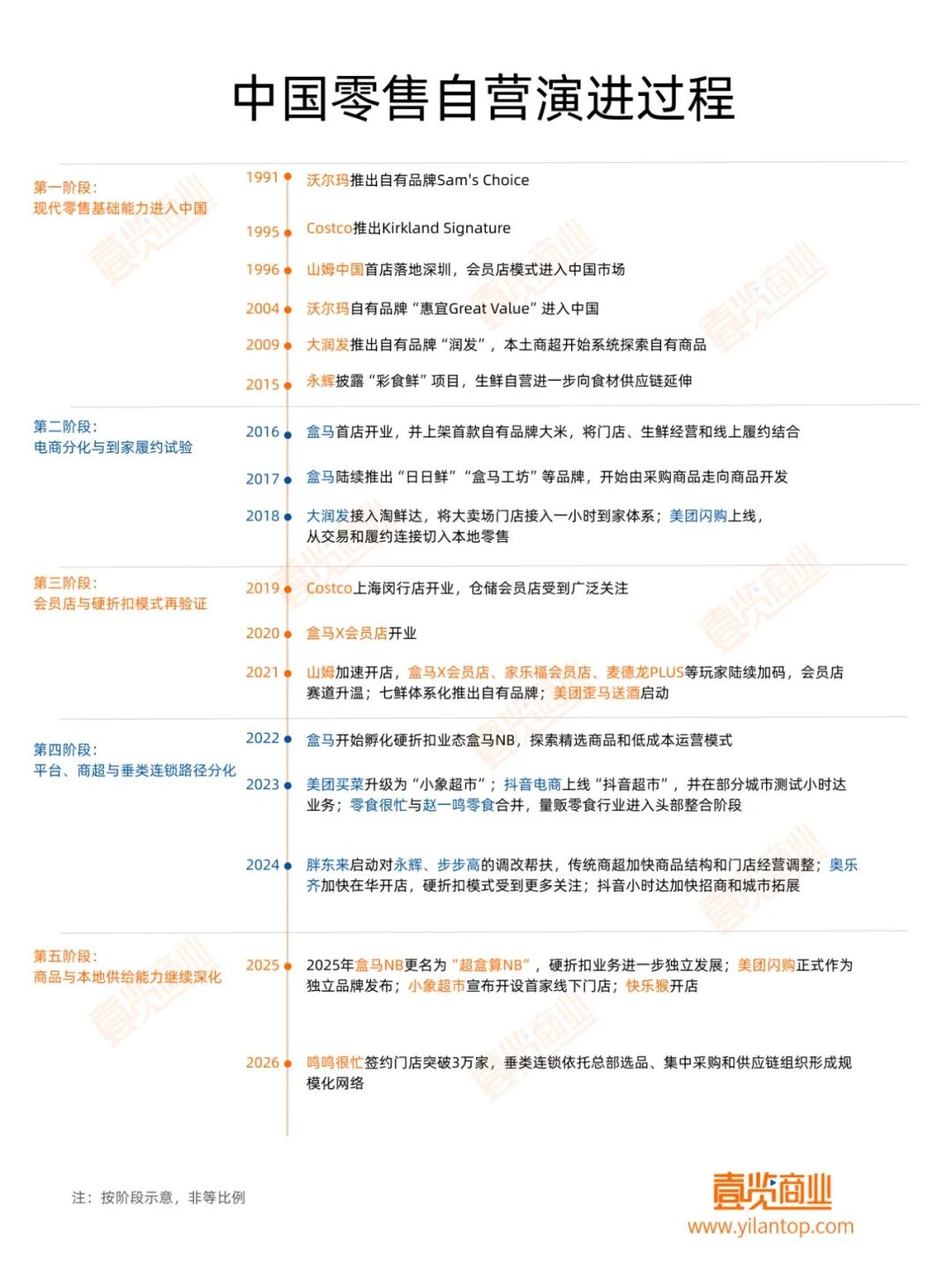
From 2016 to 2018, Hema entered the market with the integrated store-warehouse model, and RT-Mart connected its hypermarkets to the home delivery system; in 2018, Meituan Flash Shopping was launched, entering local retail through platform connection and instant fulfillment.
The opening of Costco's first store in Shanghai in 2019 attracted widespread attention. After that, Sam's Club accelerated its expansion, the membership store track heated up, hard discount stores, bulk snack stores and instant retail continued to expand, and competition further shifted to product structure, store efficiency and local fulfillment. By learning from Sam's Club and ALDI, new players such as Pangdonglai, Xiaoxiang Supermarket and Happy Monkey gradually emerged in the market.
These business formats seem to come one after another and have no connection with each other, but if you break them down, all players are practicing the same basic self-operation skills: the adjustment of Pangdonglai focuses on optimizing product structure; the expansion of bulk snack retailers relies on headquarters-based product selection and supply chain; the penetration of instant retail depends on local inventory and fulfillment capabilities.
It can be said that self-operation has never been a certain model, but a capability.
From the centralized procurement of traditional supermarkets, to online self-operated e-commerce, and then to membership stores, hard discount stores and instant retail, self-operation capability has always been permeating the evolution of the retail industry, just appearing in different forms in each era.
02
Redefine Self-operation
In the past, self-operation in the narrow sense usually referred to "selling goods produced by oneself" — enterprises purchase, hold and sell goods on their own, and take responsibility for inventory and after-sales services. But dividing self-operation only by whether an enterprise holds the ownership of goods is no longer enough to reflect the actual operation depth of the enterprise.
Therefore, instead of asking an enterprise "whether it is self-operated", it is better to ask: among the five links of product selection, procurement, inventory, product definition and fulfillment, which ones does it actually control? Because even if an enterprise does not hold goods, it can still influence the supply results through product selection, product standards, supplier management and fulfillment rules.
Therefore, the "self-operation" discussed in this article is self-operation in a broad sense, which observes which operational decision-making rights an enterprise has mastered and which operational responsibilities it undertakes. It is worth noting that private labels are a manifestation of enterprises' in-depth participation in product definition at present, and do not equal the full self-operation capability.
The increase of the self-operation rate of the whole industry is mainly driven by three reasons.
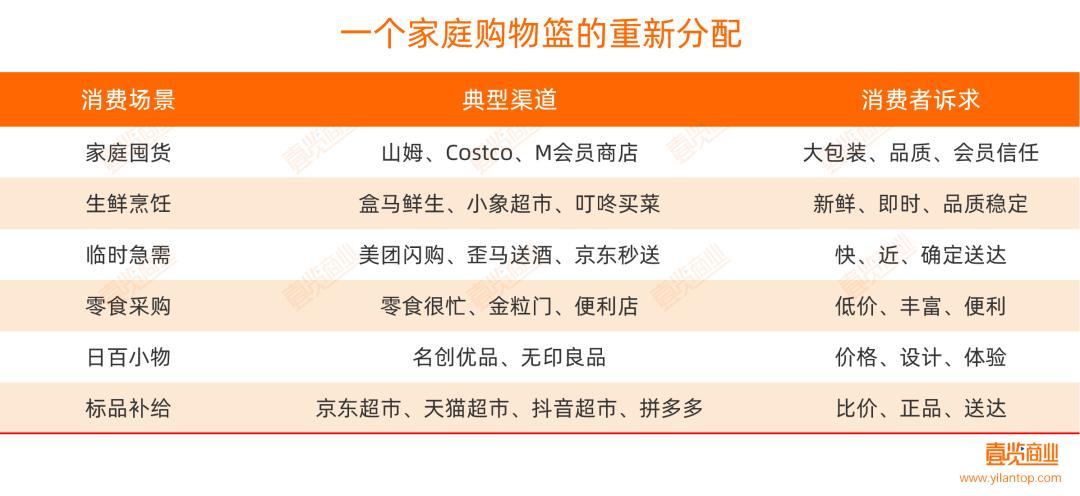
First, consumer demand is being re-split by different scenarios. In the past, a family's weekly purchases were basically all placed in the same store; now, this shopping basket is split into several parts: stockpiled goods go to Sam's Club and Costco, milk tea and beverages are provided by Mixue and Guming; fresh food comes from Hema and Xiaoxiang Supermarket, wine you want to drink in the middle of the night is delivered by Waima, snacks are bought at Lingshi Henmang, and daily necessities are picked up conveniently at Miniso. If retail enterprises want to take any part of this demand, they have to put in a lot of effort. Not developing self-operation means giving up more control over their own shelves.
Second, with the increase of entry points, the role of the "scenario" has also changed accordingly. Data shows that the market size of instant retail reached 5042.86 billion yuan in 2022, and the shelves have extended from physical stores to mobile phones. E-commerce, live-streaming e-commerce, instant retail, membership stores, discount stores, there are entry points everywhere, and consumers can be diverted at any time. Why would consumers choose to buy in your scenario? It increasingly depends on what you sell, the price, and how fast the goods can be delivered, all of which require the in-depth involvement of self-operation capabilities.
Third, the maturity of retail infrastructure has enabled enterprises to have the conditions for in-depth operation. Digital systems, warehousing and logistics, cold chain and instant delivery networks are constantly improving, lowering the infrastructure threshold for enterprises to enter the product and fulfillment links, making in-depth operation no longer "unimaginable" but "achievable".
However, the lower entry threshold does not mean that self-operation becomes easy. Enterprises usually choose the operational links they need to master according to product characteristics, business foundations and consumption scenarios, thus forming different self-operation paths.
03
From the Self-operation Panorama
See the Operation Differentiation of Retail Enterprises
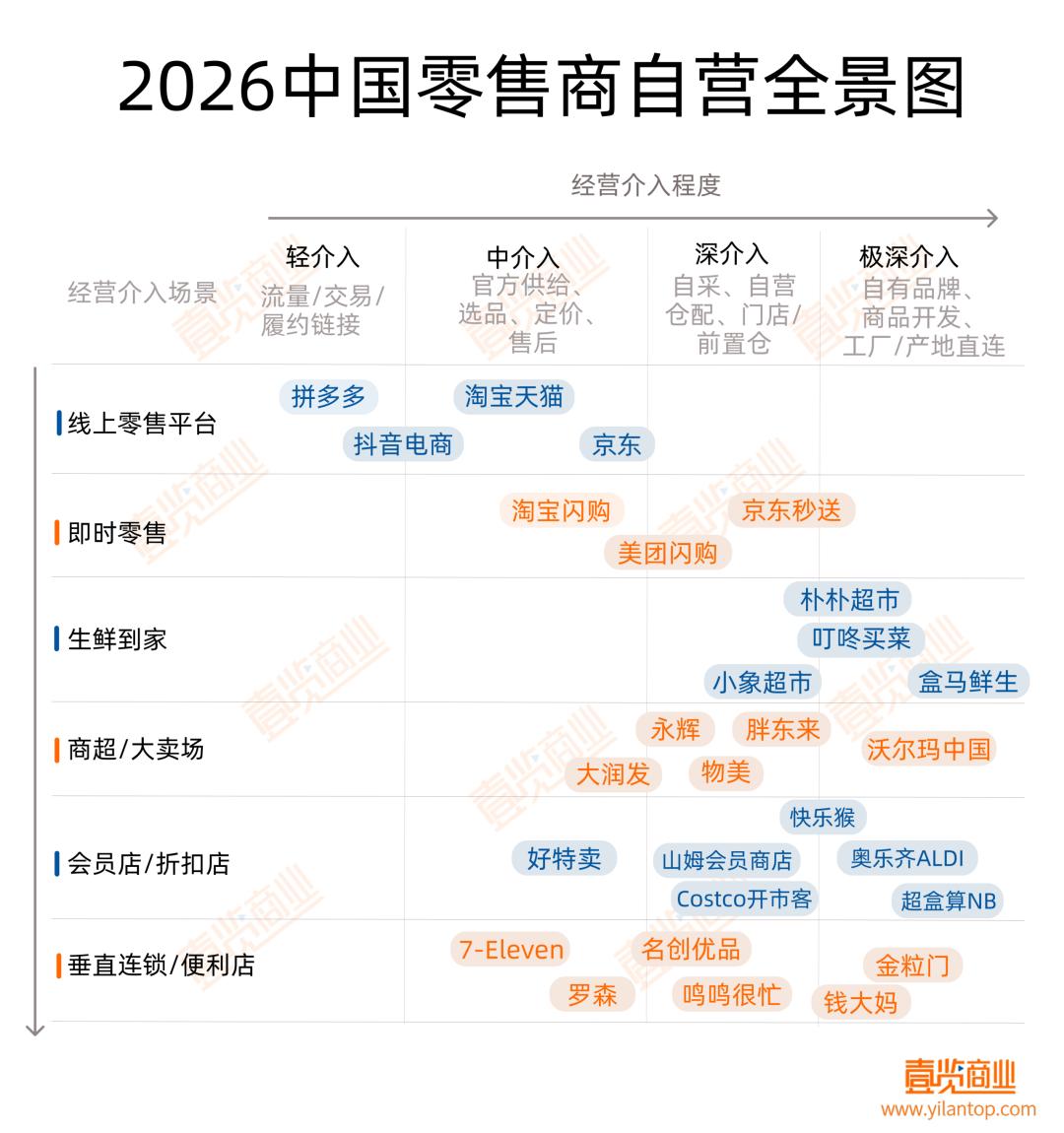
Based on the above framework, Yilan Business sorts out China's major retail enterprises and their specific businesses, and believes that according to the depth of self-operation capability's involvement in each link, they can be roughly divided into four levels:
1. Light involvement, mainly providing traffic, transaction and fulfillment connections;
2. Medium involvement, starting to unify product selection, price or service standards;
3. Deep involvement, directly participating in procurement, warehouse distribution and in-store operation;
4. Extremely deep involvement, further entering the fields of product definition, quality standards and collaborative development with upstream and downstream partners.
It is worth noting that these four levels are only used to describe the way and degree of business participation in retail operations, and are not a simple ranking of the quality of self-operation.
From the distribution of the panorama, three judgments can be drawn.
First, deepening operation has become a common trend, but the involvement paths of different business formats are not the same.
Traditional supermarkets such as Yonghui, Wumart and RT-Mart have already directly participated in procurement, inventory and in-store operation, and now they are mainly supplementing private-label product development and home delivery fulfillment capabilities; bulk snack retailers such as Lingshi Henmang separate casual snacks from supermarket shelves, and reorganize the supply through centralized procurement at the headquarters and customized specifications; platform enterprises such as JD and Meituan start from traffic, transaction and distribution capabilities, and gradually enter the fields of official supply, local inventory and product operation.
Second, procurement, inventory and fulfillment are becoming more common involvement directions, and product definition and upstream development are the main dividing lines that widen the depth of involvement.
Sam's Club participates in the specification, formula, quality standards and supplier collaboration of some products through Member's Mark, and Hema and Xiaoxiang Supermarket are also increasing the proportion of private-label products in multiple categories.
These retail brands have different business formats and fulfillment methods, but they have all moved from "purchasing existing products on the market" to the further link of "deciding what products should be".
In contrast, although many enterprises have gone deep into procurement and warehouse distribution, the products they sell are still mainly from the existing market supply, and their product development capabilities have not yet formed a scale. According to data from Euromonitor, Private Label Manufacturers Association (PLMA) and Nielsen IQ, China's private label penetration rate was about 8% in 2025, far lower than 26% in the United States, and also significantly lower than 55% in the Netherlands, 52% in Spain and Switzerland, and 44% in the United Kingdom and Germany.
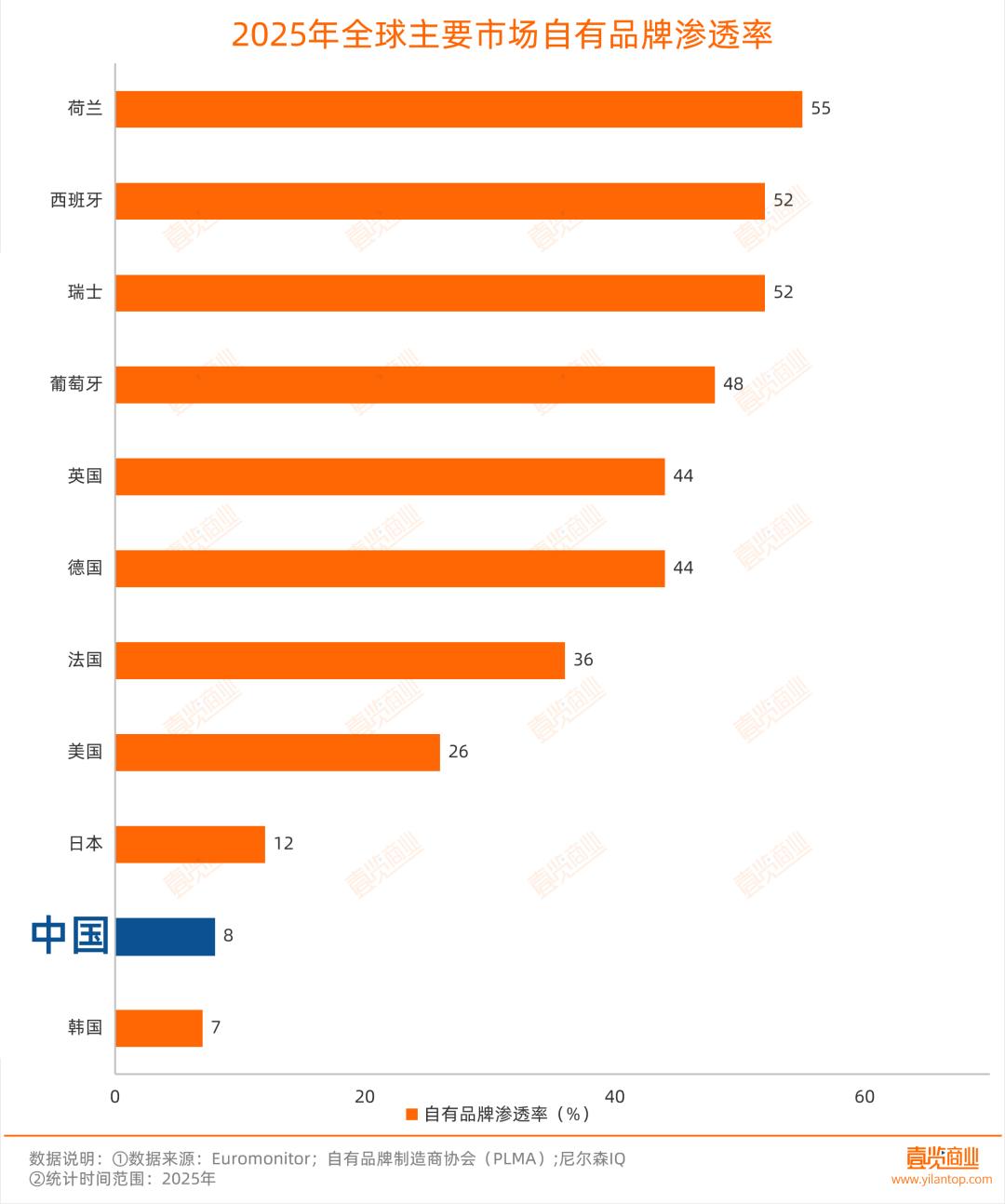
This shows that more and more domestic retail businesses have entered the procurement, inventory and fulfillment links, but the capability to convert consumer demand into product standards and form large-scale sales through private-label products has not been generally established, and there is still much room for improvement compared with developed countries in Europe and the United States.
Third, the same enterprise can adopt multiple operation methods at the same time.
Taking Meituan as an example, Meituan Delivery is mainly responsible for transaction and fulfillment connections, with relatively limited involvement in products and inventory; Waima Wine Delivery has deep involvement in procurement and supply chain of vertical categories; Xiaoxiang Supermarket participates in procurement, inventory and front warehouse fulfillment, and develops private-label products at the same time...
Similar combinations also appear in other enterprises. JD operates both platform business and self-operated retail at the same time. The Alibaba Group has platforms such as Taobao and Tmall, as well as Hema and SuperBox NB which are deeply involved in product, inventory and in-store operation. Up to now, the boundary between self-operation and platform has become more flexible.
04
What Kind of Self-operation Has Long-term Value
The "self-operation proportion" can only describe an operation state, and cannot directly judge whether this model has long-term value. To evaluate whether a self-operation model can last for a long time, three questions need to be answered in turn: where does the low price come from, who bears the operational risks, and what do consumers, suppliers and the industry get in the end.
First, low price itself is not an operational capability, and the long-term development of the industry does not encourage blind pursuit of low prices.
The old self-operation models often blindly pursue low prices. Low price is a double-edged sword. If it is built on product development, centralized procurement, or model improvement such as turnover efficiency, it can become a reusable operational capability; if it only relies on subsidies, leftover stock or one-sided price suppression, the price advantage is often difficult to sustain, and the cost will reappear due to subsequent quality fluctuations and unstable supply.
The express delivery price war, near-expiry discount stores and white-brand competition in live-streaming e-commerce have provided references: express delivery quotations lower than cost are difficult to maintain for a long time, unstable leftover stock supply cannot support continuous expansion, and excessive price suppression may also lead to quality decline and damage to consumer rights.
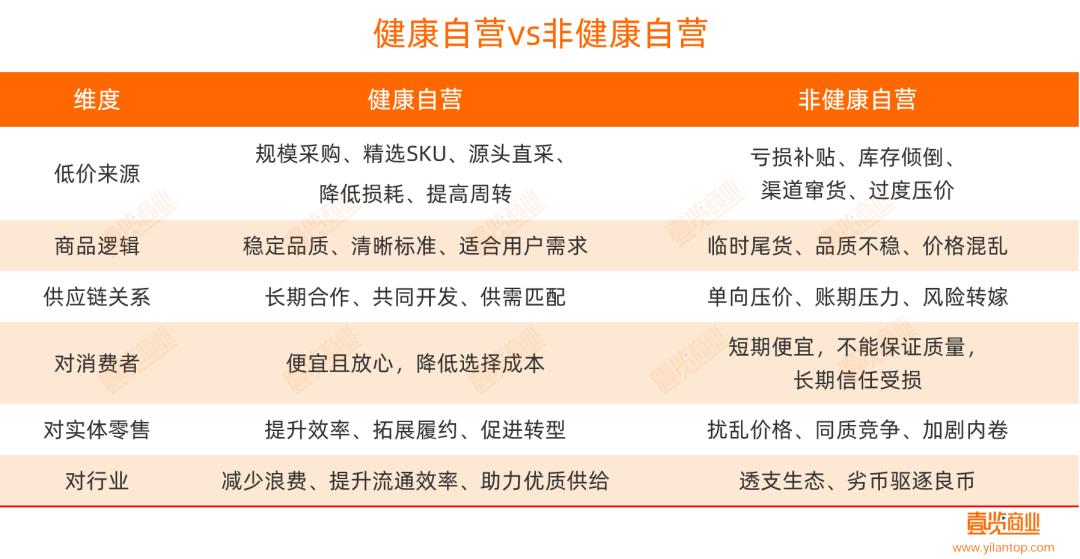
Second, self-operation means that enterprises obtain more operational decision-making rights, and also means that enterprises need to undertake more operational responsibilities.
If an enterprise holds the decision-making power, but leaves the pressure of unsalable products, loss, returns and cash flow mainly to suppliers or franchisees, the mistakes will hardly be reflected in its own accounts, and it will be more likely to lead to excessive price suppression and low-price dumping.
In the long run, in order to relieve the pressure, suppliers and franchisees may reduce quality, cut down investment in R&D and services, and enterprises will eventually face unstable supply and declining consumer trust.
Finally, to judge whether a self-operation model is healthy, we ultimately need to see what results it brings to different participants.
Fresh products have short harvest cycles and high loss rates. Once there is a deviation in procurement, post-harvest processing or cold chain transportation, the quality and price will be quickly affected, so it is easier to observe what value enterprises have created after going deep into the supply chain.
Smooth sales of agricultural products is an industrial value that cannot be ignored. In the plateau area of Shandan County, local broccoli was mainly sold to surrounding markets in the past, and the lowest price was only 60 cents per head. In 2024, Xiaoxiang Supermarket began to cooperate with local growers, screened varieties through order-based planting, and implemented requirements such as product weight, flower shape and root length into harvest standards.
After the order and product standards are clarified,