If you don't want to be left behind, do these three things immediately.
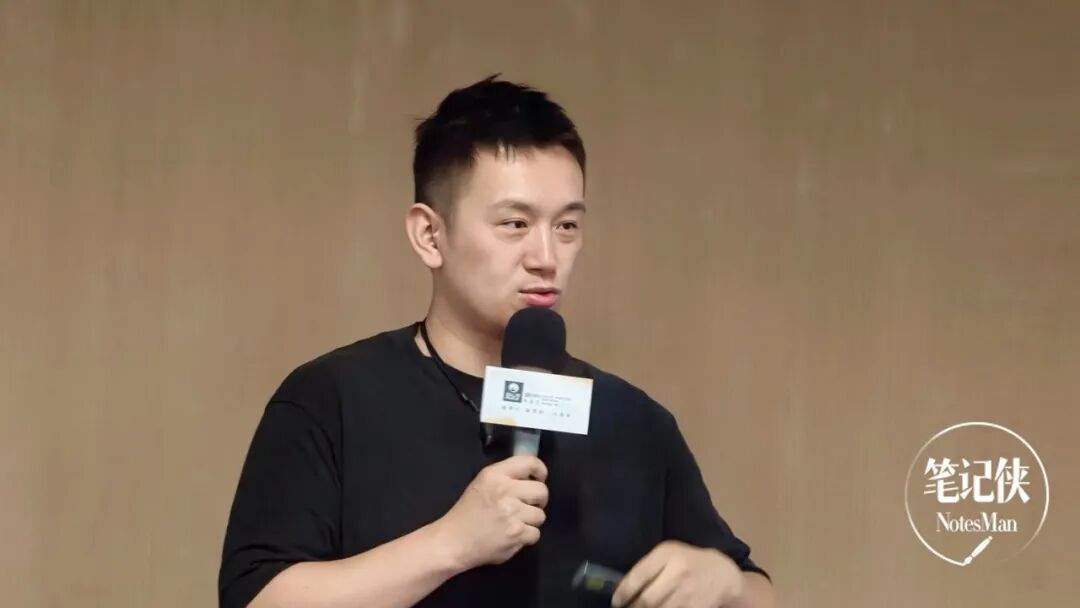
Content source: Sorted from the key sharing content of Zhao Fan (Jixin), Partner of Yingdao RPA, during the 02nd session of the 10x AI Growth Camp held by NoteX in Hangzhou from August 8 to 10, 2026.
The fast iteration speed of large models makes many enterprises anxious: Will the capabilities you finally build with great efforts today be completely wiped out by a version update tomorrow?
At the class of the 02nd session of NoteX AI Camp, Zhao Fan (Jixin), Partner of Yingdao RPA, gave their answer.
He divided the enterprise's AI adoption into three stages: from RPA (Robotic Process Automation) execution, to agents participating in decision-making, then to agents "taking up posts", and the final evolved form is called AI-native organization.
Around this judgment, they redefined the organizational capability and put forward the path from knowledge precipitation to AI implementation. The following is the sharing of Jixin.
I. Three Stages of Enterprise AI Adoption
What is an AI-native organization? Or what standards can prove that an organization is AI-native?
First, let's talk about our own division. We will divide the process into three stages according to the degree of AI adoption by enterprises.
1. Stage 1: Hand over the nodes originally completed by humans to robots
Some nodes in the process are transformed from being completed by humans in the past to being completed by RPA (Robotic Process Automation) now. In the early days, these links may all rely on humans to extract data, make judgments, process and execute. When RPA appears, as long as this series of nodes can be clearly defined, all of them can be automated.
Especially when the operation scale of this matter reaches the level of daily, weekly, monthly, or even the customer level, or your data volume is very large, the efficiency and accuracy will be higher. Therefore, the more such links, the easier it is to be automated.
For example, when we were running our own live streaming e-commerce business before, we asked our team members to connect with 100 influencers according to different categories. Note that these 100 influencers refer to those who can be actually reached and communicated with. You will find that you may spend a whole week sending messages to 2000 or 20000 influencers, and only about 1% of them will reply to you, so that you can actually establish contact with them.
Such work is essentially abstracted into step-by-step procedures, which can be completely regularized: category search, number of likes, number of comments, play volume, and then keywords. This series of judgment criteria can essentially be written into rules.
2. Stage 2: Add AI judgment into the process
In the second stage, more AI links will be involved. For example, the work that originally required manual judgment is now identified by AI.
We have cooperated with many catering enterprises. What catering enterprises fear or suffer most is the negative reviews on their online order traffic. Once negative reviews appear, the impact on O2O orders of local life services and customer reputation will be amplified, so they pay special attention to negative reviews.
If it is a chain enterprise, all stores across the country need to deal with negative reviews, and achieve timely intervention and correction. The cost of this matter alone is very high. So they now use AI to identify these problems.
In this way, the scenarios that can be covered are wider.
3. Stage 3: Agents take up formal posts
The last stage is called agents taking up posts: from executing processes to thinking and executing. It is equivalent to handing over the entire closed loop of a post to the agent to run, and multiple different agent posts may grow under this post.
When multiple agent posts appear at the same time, it will bring a series of new problems such as collaboration and iteration. Therefore, in the process of building and collaborating agent posts, the AI-native organization we mentioned will gradually grow.
From business processes to post agents, and then to the real native organization, this is a visible change path.
4. Trilogy of enterprise AI implementation
If an enterprise really wants to move in this direction, it is essentially following this trilogy:
The first part is to widely connect and run all the links with the highest ROI, clear execution paths and direct implementability first. For example, data collection, report generation, and order processing are all about reducing repetitive labor and establishing certainty. Because after these certainties are established, any additional functions added on top of them will bring more added value.
The second part is post enhancement. Enable every post to work faster and more accurately. It adds judgment on the basis of certainty, covers more scenarios, and the results can be output across systems, which in turn makes you clearer about which decisions can be handed over to it, and it can directly get the results after making decisions.
The third part is organization building. Let the whole team focus on a business goal, not only driven by humans, but better driven by agents.
Therefore, future organizations will add a new type of role under this judgment system and execution system, called AI employees. In addition to human employees, there are also AI employees. The combination of these three parts is the evolution path of future enterprises in our view.
II. AI-native Organization: Can the Company Still Operate Normally If AI Fails?
Before formally talking about agents, let's go back to a problem that all R&D staff and entrepreneurial founders will face: there are so many end-side agents on the market, and our capabilities are limited, so what should we do next? Which direction can help us break through?
1. Ask two questions first
We first raised a question for ourselves: What is the core capability of enterprise development in the AI era?
In this context, we put forward two questions for ourselves:
First, what are the real problems in the market?
The judgment standard is: this real problem is so important that we have to solve it.
Second, what solutions can I provide?
The judgment standard is: this solution, in our view, is a solution that delivers 10 times better results than the existing ones on the market.
Yingdao RPA was born under the guidance of these two ultimate questions. In short, we defined problems that no other RPA company on the market had defined, and adopted a set of solutions that no other RPA had defined. In this way, we formed the product design principles, business sales and service principles of Yingdao.
2. Three eras have different objects to be amplified
To answer these two questions, we must first see what changes have taken place in the era.
In the industrial era, the core is to manufacture tools. With the advent of steam engines, motors and other equipment, human physical strength was basically replaced in the industrial era. The difference in physical strength between people can almost be ignored in the factory, because the work is not done by humans, but by machines. Therefore, in that era, manufacturing tools was a very important entry point in the industrial era, which amplified human physical strength through tool manufacturing.
In the information age, to a certain extent, the core is to extend human brain. It provides people with more information, amplifies the efficiency of information flow, and makes it easier for enterprises to make decisions.
In the AI era, generally speaking, the core is to amplify human cognition and decision-making ability. This means that many human decisions do not need to be made by humans to some extent, because AI can make a large number of cognition and decisions for you.
3. In the past, humans drove the system; in the future, AI will drive the system
What is the essential difference between the past enterprise organization and the enterprise organization in the AI era?
In the past eras, including today, the core reason why all people come to a company around a common corporate goal is that an enterprise is essentially a human-driven system. Humans define the direction of the enterprise, and help these people move forward better through a series of methods such as software, processes, salary and incentives.
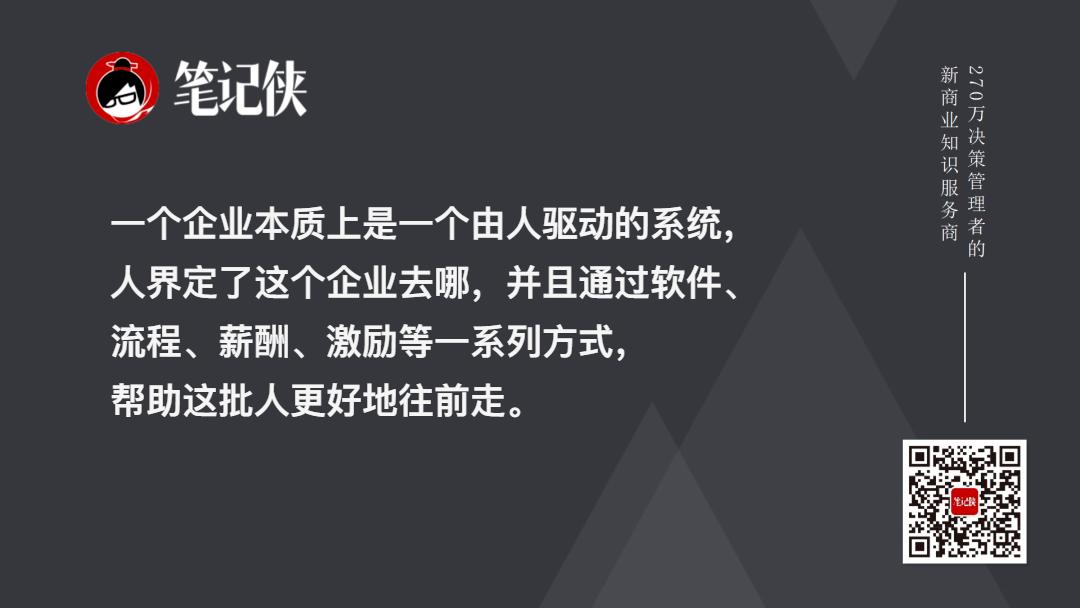
Therefore, the entire organization is completely human-centered. In this process, all decisions, experiences, and ways of moving forward, including what people often say "this task is too heavy, there is not enough manpower, it can't be completed, I need to recruit more people", essentially because in this organizational model, human is the ultimate carrier of all things, and also the core carrier of all experience, data and growth. In the past, the entire organization operated relying on the capabilities of individuals.
In the AI era, the core change is: the organization should operate around AI. Software, processes, incentives and people should all revolve around AI, and AI is the core of the organization itself.
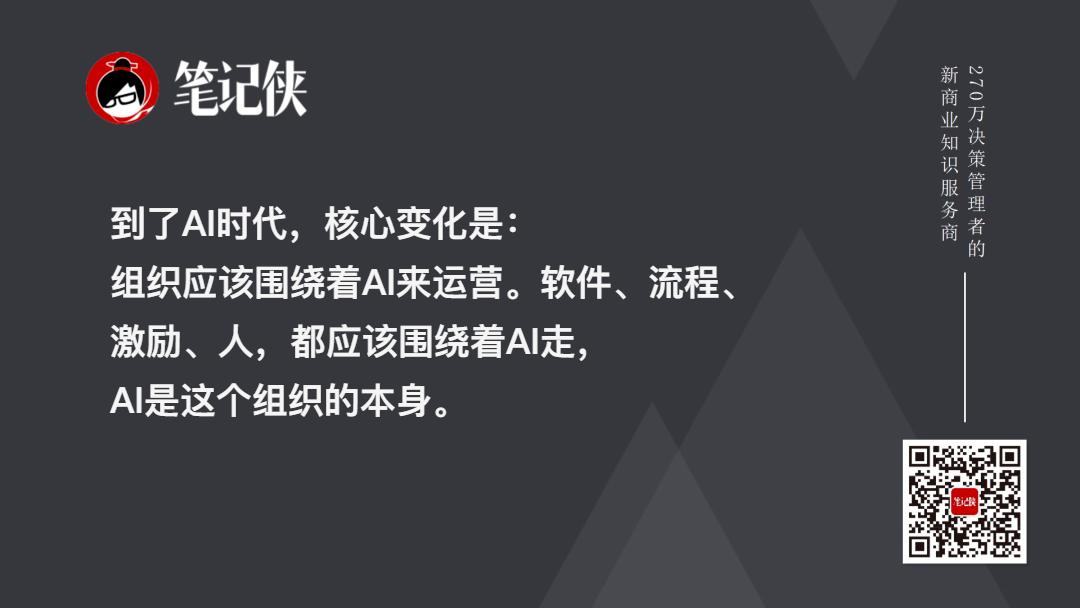
Because AI has the ability to make a series of decisions and cognitive judgments that humans have to some extent. Therefore, in this case, we believe that AI in the future is not just a tool, nor just an assistant for a post. AI is actually the operation hub of the entire organization.
Back to the original question: What is an AI-native organization?
We believe that such organizations already exist in the Chinese market now, such as Didi and Meituan that you are familiar with.
You can think about it: in the rider and driver system of Didi and Meituan, how many order deliveries are decided by humans? Almost none. These two organizations basically make judgments based on big data, algorithms and AI. If one day AI disappears from this system, these two organizations will basically cease to exist.
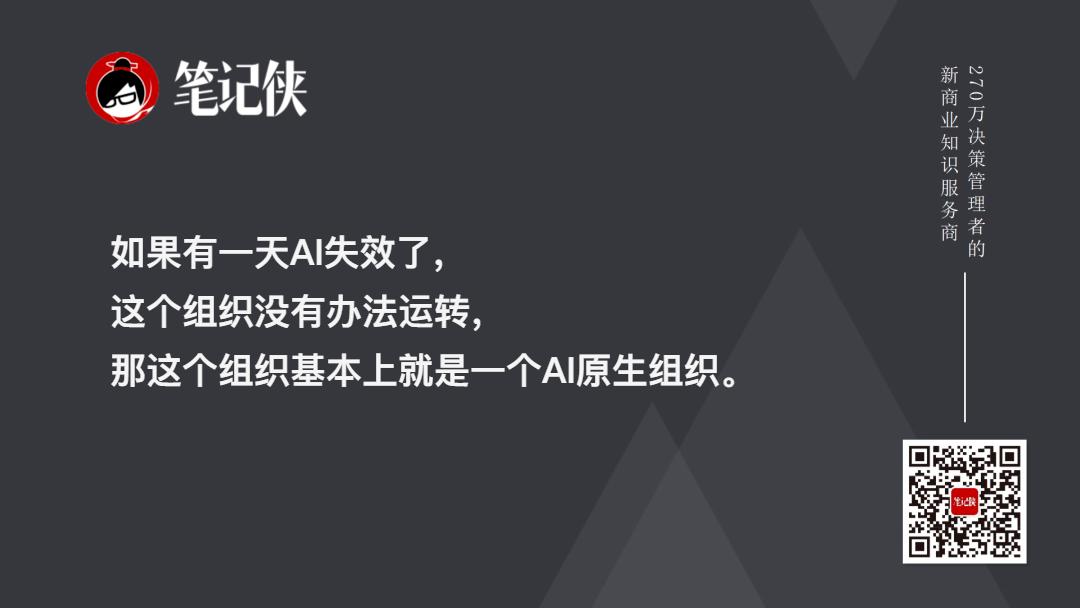
Therefore, if we use a most popular statement to define what an AI-native organization is: if one day AI fails and the organization cannot operate, then this organization is basically an AI-native organization.
Then what is the role of human in this process?
In this organization, human is the last value transmitter in the physical world. The real end-to-end delivery is still very unstructured and cannot be completely completed by the system: although there are deliveries by drones and self-driving vehicles, you still need humans to climb stairs, and you still need humans to complete urgent orders.
Human has become a link in the complete delivery process. At the same time, many high-value tasks still need to be completed by humans, including the design of the entire system. Therefore, people, processes, experience and incentives are all aimed at making the entire system operate better.
4. AI is not an auxiliary tool for the organization, AI is the organization itself
Because of this judgment, we will think that AI is not an auxiliary tool for the organization, AI is the organization itself.
Up to now, people are developing post-enhanced agents in products such as Project and OKR to help you better assist decision-making at that post. We believe this is definitely not the final state, and it may just be the beginning.
The final state is: to a large extent, you don't need to intervene at all, it can make decisions by itself, and only some links require you to step in for correction and design.
5. Build a tower or build a boat
Since the beginning of last year, there has been a globally popular argument that makes us very anxious: after the arrival of the AI era, all software companies will die.
We also judge that many vertical companies have developed certain capabilities, and once the large model iterates, the model manufacturers will also have these capabilities. So is it possible that a plug-in or a model release can completely replace all these capabilities of the enterprise? We were also a little anxious for a long time, but later found that this is not entirely the case.
Looking back: most enterprises in the past, including ourselves, their development and growth were essentially based on the logic of building towers. Every progress and development you make is built on the base layer stacked by processes, experience and personnel. One day you will become Mount Everest, higher than other mountains of the same type, so you will not be afraid of competition.
However, when a huge tsunami comes, it is possible that all these Mount Everest will be submerged. This situation will make people feel unsure, and they feel that they may be subverted one day.
Facing such technological progress, what kind of operation mode is really reliable?
We think the answer is to build a boat. It means that when the tsunami comes, no matter the sea level rises by 100 meters or 200 meters, my boat floats on the water, can sail against the wind, and can also drift with the wind.
Therefore, if a series of decisions of the entire enterprise can be built on every major iteration of the model, it will at least keep pace with the development of the entire era. The global capital, data, knowledge and other iterative resources should all become my cornerstone. There are so many resources available, why not make use of them?
In short: the entire mission, vision, values and all the capabilities behind the enterprise should be built on AI, so that every iteration of the large model and technological progress can push you to a higher level.
The definition of organizational capability is: every time AI is upgraded, the organization itself can also be upgraded accordingly.
III. Software is Rule-based, Agent is Probabilistic: The Upper Limit Is Determined by the "Thinking Framework"
With this judgment, the next question is: how to achieve this? As a product startup, what capabilities should we provide and what products should we build?
Let's first look at the core differences between the software era and the Agent era.
1. Traditional software is hard-coded, AI is a probabilistic system
In the traditional software era, you can recall the ERP and CRM you usually use. Basically, when you buy them, the boundary of the software has been clearly defined. This software is basically based on the best practices on the market, abstracting a set of rules and boundaries