Can fresh baking save mooncakes?
The bakery section in supermarkets is stealing the thunder from mooncake gift boxes.
This Mid-Autumn Festival, my friends and I got to eat mooncakes much earlier than usual.
Unlike previous years when brands only launched promotional campaigns around the Mid-Autumn Festival period, mooncakes this year appeared in supermarket bakery sections more than a month ahead of schedule.
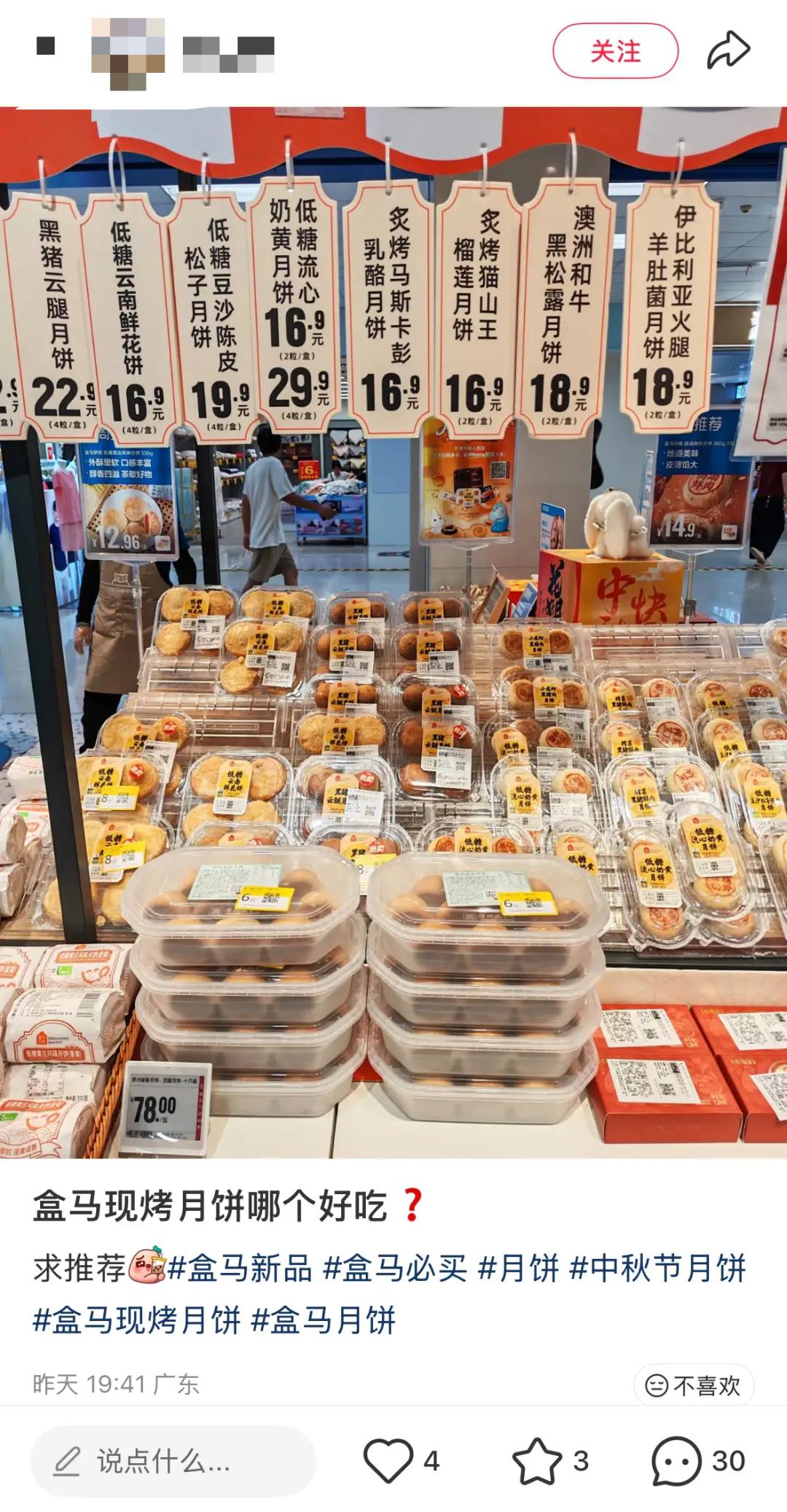
These products focused on fresh-baked are displayed alongside small breads, egg tarts and other pastries. Grabbing a box as a snack or for breakfast is nothing more than a casual, convenient move.
In the past, Mid-Autumn Festival was an annual node for maintaining interpersonal connections, and mooncakes became a hard currency for socializing. Now, the overall atmosphere of the festival is becoming far less formal and heavy. Previously, the festival was all about visiting relatives and friends, while now it is more about relaxing and unwinding.
Traditional festival-specific food that used to be tied to social occasions has also shifted from being a carrier of interpersonal favors back to being just "food to eat".
This trend was already very obvious last year. According to data from iiMedia Research, among the purposes for consumers to buy mooncakes in 2025, sharing with family accounted for 55.9%, eating by themselves accounted for 50.4%, and gifting accounted for 42.5%; for the first time, the proportion of people eating mooncakes in their daily lives exceeded that of gifting.
By this year, corporate group purchase orders for mooncakes have dropped by more than 30%, and individual customers buying mooncakes for their own consumption have become the absolute main force; affordable loose-packaged and fresh-baked mooncakes are the most popular.
Fresh supermarkets like Freshippo and 7FRESH have become the main beneficiaries of this wave of demand. They have turned fresh-baked mooncakes into limited-edition autumn pastries, which perfectly caters to consumers' casual, "a little taste is enough" mentality for seasonal consumption.
01
Why Are Mooncake Fillings Made of Literally Everything These Days?
The era of buying mooncakes for self-consumption has also ushered in a full expansion of the mooncake flavor competition arena. The saying "literally everything can be made into a mooncake filling" has turned from an online joke into a common industry practice.
A few days ago, the hot search topic #Mooncake Market Collapses, Consumers Become Smarter# went viral. The so-called "collapse" here refers to the fact that high-end mooncake gift boxes priced above 500 yuan have basically disappeared from the shelves of mainstream supermarkets, while sales of affordable, small-portioned products have risen significantly. In a stock market competition, flavor innovation has become the most commonly used breakthrough method for merchants to stimulate consumption and attract new customers.
Exotic fillings such as snail rice noodle, stinky tofu, and spicy chili oil have successively become hot topics on social platforms. Some people complain that they are dark cuisine, while others try them out out of curiosity to check in on social media. Novel and unusual flavors have become a proven traffic code that never fails.
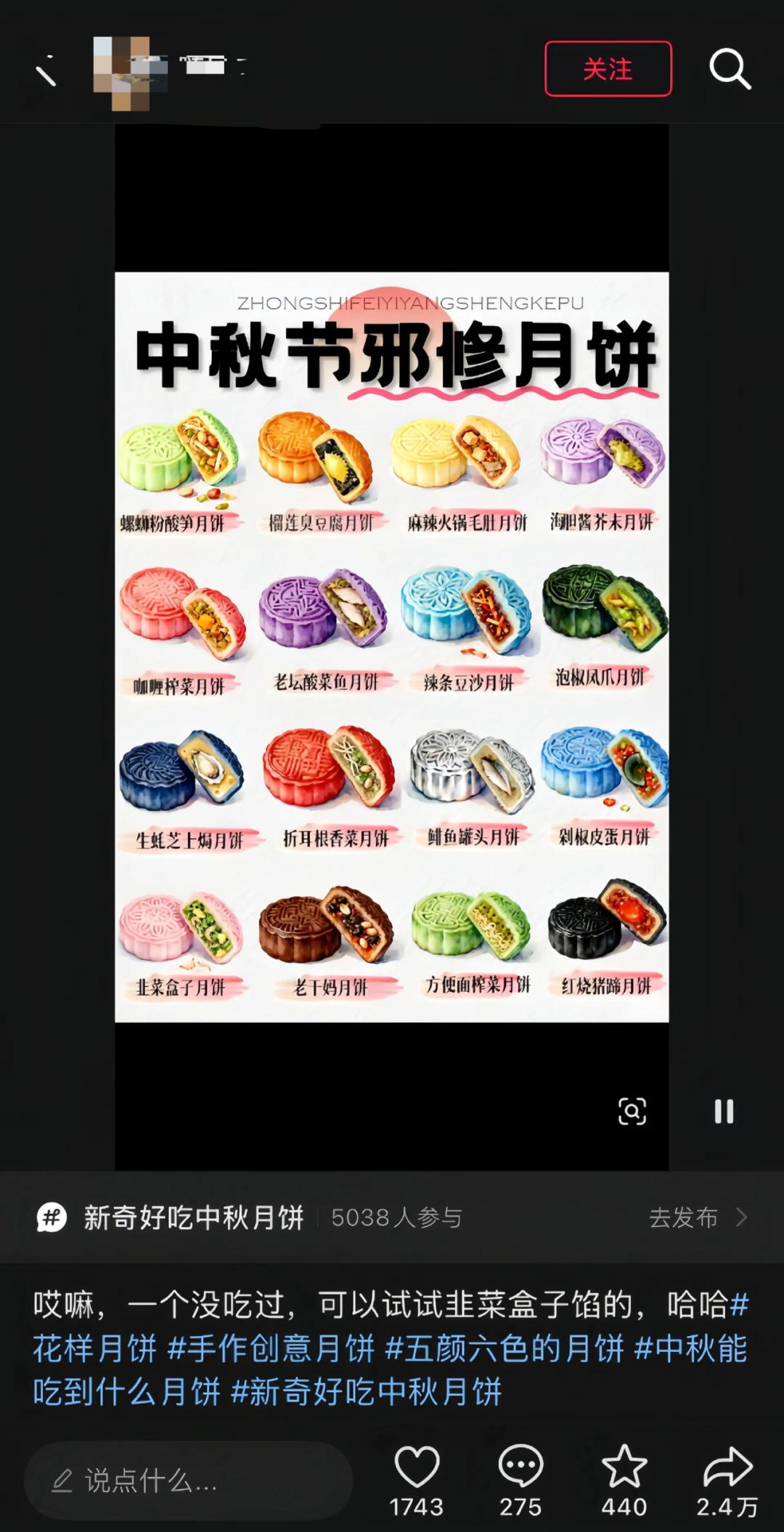
This perfectly matches the current habits of consumers who buy in small quantities and are easily influenced by social media content to try new products. However, those exotic fillings are all just traffic-driving products. Most people only buy them once to take photos and post on social media, which hardly generates stable repeat purchases. What always supports the basic sales volume are the classic flavors.
Judging from this year's mooncake market, savory mooncakes have staged a complete counterattack, and fresh pork mooncakes have become the top seller in the fresh-baked section. On this basis, niche flavors such as pickled mustard black pork, preserved vegetable fresh pork, and crayfish black pork have emerged in endlessly. Many people joke that "we finally don't have to be forced to eat sweet mooncakes anymore".
The long-standing north-south dispute over mooncake flavors can also be put on hold for now. Now every region has its own exclusive flavor, such as milk skin mooncakes from Inner Mongolia, shredded radish mooncakes from Shanghai, forming a vivid "mooncake flavor map".
Sugar reduction is also an irresistible general trend. Nowadays, when many people pick up a mooncake, their first reaction is no longer to check the packaging grade, but to flip to the ingredient list to check the sugar content. It is worth mentioning that sugar-reduced mooncakes are not only standard products in supermarkets, but also have been developed into independent product lines by traditional brands.
According to the R&D and procurement team of Freshippo Bakery, the current mooncake consumption trend has shown strong certainty: health benefits, genuine high-quality ingredients, and high cost-effectiveness.
The reason why supermarkets can become the main force of this round of flavor innovation essentially stems from the natural advantages of the fresh food model.
In the past two years, new retail formats centered on fresh food such as Freshippo and 7FRESH have been widely deployed, plus the fresh food transformation launched by traditional supermarkets across the country, which has jointly pushed supermarket bakery, once an inconspicuous supporting category, into a core offline track that drives consumption trends.
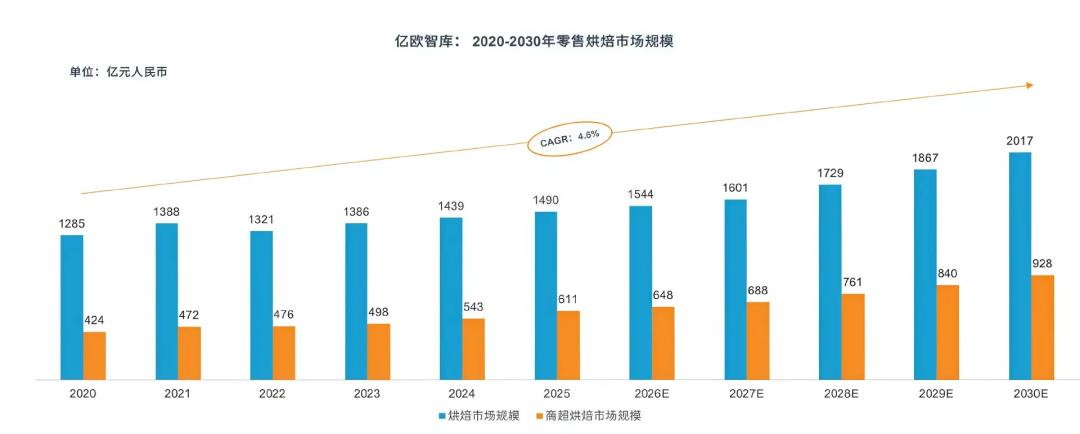
Data from Yiou Think Tank shows that the size of China's supermarket bakery market is expected to increase to 64.8 billion yuan in 2026, with its proportion rising from 33.0% in 2020 to 42.0%, and the proportion will further expand to 46.0% in 2030, officially becoming the largest core channel in the bakery industry.
For traditional mooncake factories, new flavors mean mass production risks starting from tens of thousands of boxes. Once the market response is poor, all inventory will become waste, leading to extremely high trial and error costs.
However, relying on the bakery system that has been polished for several years, supermarkets can produce in small batches and multiple runs. They can increase production capacity when sales are good, and switch flavors immediately when the public praise is not satisfactory.
At the same time, filling innovation can directly reuse the existing fresh food and bakery supply chain of supermarkets, so the marginal cost is not very high.
Supported by regional consumption data, supermarkets can quickly adjust products according to local taste preferences. This agility is hard for traditional national mooncake brands to match.
However, the inherent quality control differences of the fresh-baked model always exist. For mooncakes of the same brand, the product quality will vary in different stores. The taste of freshly baked crispy crust and the cooled one are completely different. This still tests the supermarket's supply chain management capability.
In fact, traditional mooncake brands have not stopped the pace of innovation, such as launching co-branded products and using fresh-baked products to attract traffic. But their core business is still gift boxes, which is completely different from the focus of supermarkets.
Essentially, supermarkets are not making mooncakes, but making bakery pastries that look like mooncakes, adding a seasonal limited product to their bakery section under the name of Mid-Autumn Festival.
02
All Traditional Seasonal Foods Are Worth Remaking With the Fresh Food Logic
The changes of mooncakes are not an isolated case. If we take a longer time perspective, almost all traditional seasonal foods are following the path of becoming daily first, then being transformed into fresh food products.
Green rice ball (Qing Tuan) is a typical example.
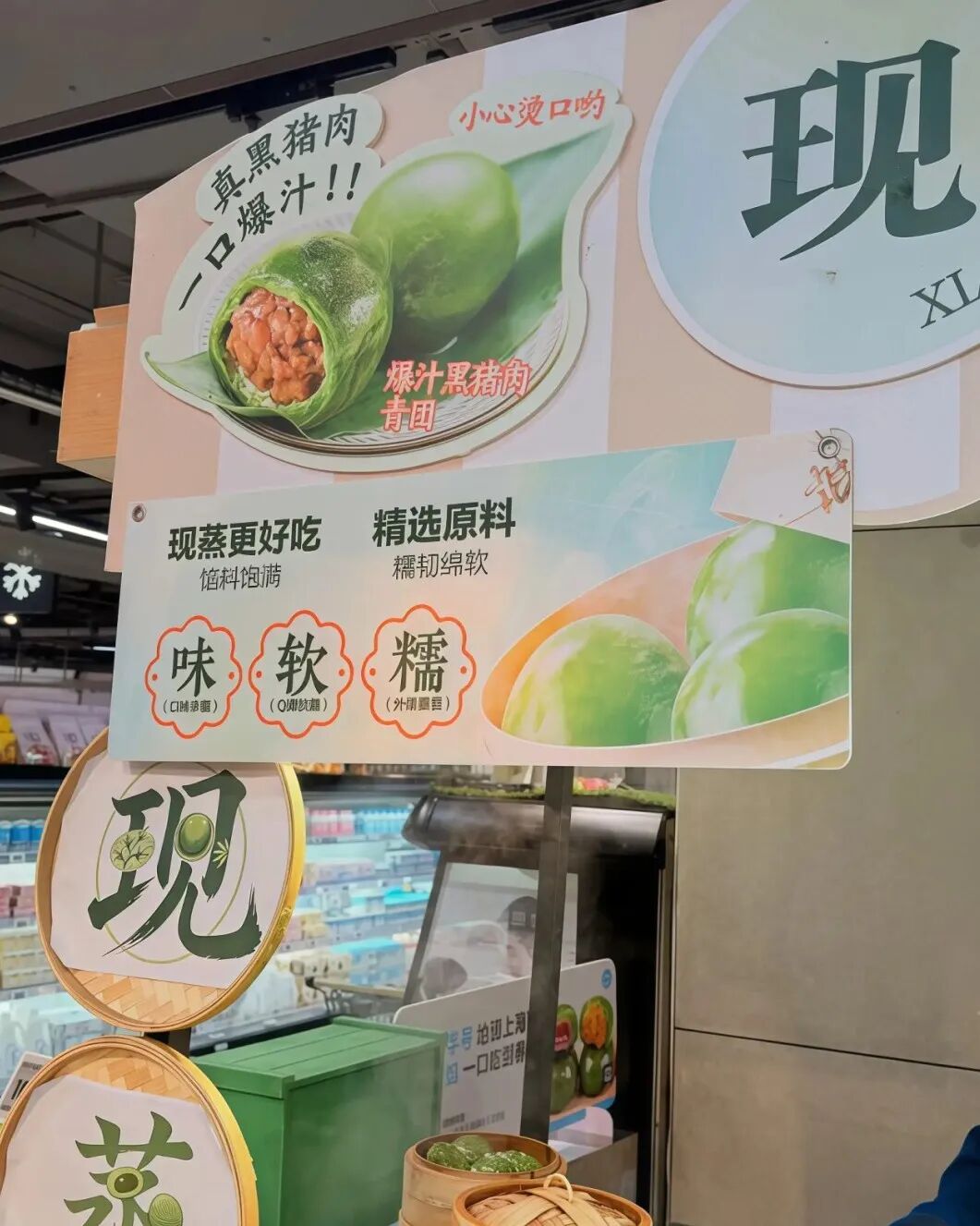
In the past, green rice balls only appeared on shelves around the Qingming Festival, but now they are permanently available on e-commerce platforms and supermarkets, with internet-famous flavors such as egg yolk with pork floss, taro paste with fresh milk emerging in endlessly. Many people buy them as afternoon tea snacks, and no one will bother about "whether it is allowed to eat green rice balls when it is not Qingming Festival".
The sales period of fresh steamed green rice balls has been extended from "only sold for 1 month around Qingming Festival" in the early years to about 2 months covering the whole spring now. Supermarkets are seizing consumers with higher quality requirements with fresher taste and simpler ingredients.
Rice dumplings (Zongzi) have gone through almost the exact same path: first, vacuum-packaged long-shelf-life products broke the time limit of Dragon Boat Festival, making them available all year round, and gradually penetrated into daily scenarios such as breakfast and extra meals; Dragon Boat Festival is just a relatively higher sales peak of zongzi throughout the year, as well as a period for supermarkets to attract customers and extend the sales cycle through fresh food transformation.
The underlying change of these categories is de-symbolization: they get rid of the heavy shell of "festival ritual voucher", and return to their original identity of "seasonal flavor snacks".
Behind this is the transformation of the whole society's logic of celebrating festivals, where the focus of festivals is returning to relaxation, comfort and small-scale gatherings.
Even the most grand traditional festival, the Spring Festival, is experiencing the same change. In recent years, New Year goods consumption has shifted from traditional centralized stockpiling and ceremonial gifting to focusing on personal interests and experience, pleasing both others and oneself.
Even New Year's Eve dinner is showing a trend of smaller tables. Meituan's 2026 New Year's Eve dinner data shows that the demand for small set meals for 1-4 people has surged, especially the growth rate of meals for 1-2 people is as high as 69%. "Small family reunion" and "celebrating the Spring Festival locally" have become the mainstream.
Festivals are no longer tasks that have to be completed, but just a reason to eat seasonal food, without any rigid rules. Seasonal foods have thus returned to their inherent value as food.
From the industrial perspective, the mutual maturity of demand and supply has made it possible for the fresh food transformation of seasonal foods to be implemented on a large scale.
As consumers' attention to health continues to grow, fresh, short-shelf-life, zero-additive products have changed from marketing buzzwords to real decision-making factors, and people are willing to pay a premium for better taste and healthier formulas.
On the other side, the model of "central factory standardized production + cold chain distribution + in-store fresh baking" of supermarkets has been fully verified, which balances the efficiency of industrial production and the taste of fresh-baked products. Coupled with the popularization of supermarket fresh food sections and instant retail, the last-mile delivery problem of short-shelf-life food has been solved, making "production on the same day, sale on the same day" a normal state for seasonal foods.
In the past seasonal food market, the core logic was gift premium: players competed on packaging, brand and channels, and drove annual sales by relying on the pulsed consumption during festivals.
The future market will be divided into two clear tracks: one is the high-end gift track, dominated by time-honored brands and traditional brands, serving gifting scenarios and earning brand premium profits; the other is the mass self-consumption track, dominated by supermarkets and fresh food brands, serving daily consumption and earning profits from large-scale sales. The two tracks do not interfere with each other, each with its own business logic.
In fact, all traditional seasonal foods with widespread public awareness are worth remaking with the fresh food logic of freshness, small portion and daily use. This is not only product innovation for a single category, but also extends the once-a-year festival business to year-round seasonal consumption, opening up broader growth space.
The ultimate meaning of seasonal food has never been about rituals, but about being delicious, and sharing it with people you like.
This article is from the WeChat Official Account "20She" (ID: quancaijing_20she), written by Zhang Ya, authorized for release by 36Kr.