As gold prices have soared sharply, why has Qianye Jewelry suddenly run into a major unexpected credit crisis?
A company with less than 400,000 yuan in cash on its books has 1.5 billion yuan worth of gold lying in its counters.
Gold prices have been rising for three years, surging from 400 yuan per gram to over 1,000 yuan. Logically, this company should have reaped huge profits effortlessly. However, its boss has lost contact, employees are demanding unpaid wages, and its stock price has plummeted by more than 60% in two days.
This is what happened to Qianye Jewelry in 2026.
After going through all its financial reports, one phrase kept lingering in my mind: position. The surge in gold prices is not the reason for Qianye's sudden collapse. It only exposed Qianye's already fragile business model to the public.
1
A business squeezed from both ends
First, let's clarify how the gold and jewelry industry is divided.
The upstream sector is the mines. When the gold price rises from 400 yuan to 800 yuan, the mining cost will not double, and all the extra revenue is profit. The ones who have made real big money in this market rally are those who own mines. Therefore, the companies that actually control the industrial chain are those that own a large number of gold mines, such as Zijin Mining.
The midstream sector consists of jewelry brands like Qianye, which purchase gold materials from mines, process them, produce branded products, and sell them to consumers.
This position has an inherent flaw: it has no say in negotiations with either end of the chain.
For the upstream, the gold price is determined by the market, leaving no room for bargaining. You have to pay for the gold no matter how much the price rises.
For the downstream, consumers regard gold as a product priced by weight. Gold from any brand is the same, and consumers can easily compare prices against the benchmark market gold price. If you raise the price, they will turn around and leave immediately.
With no bargaining power on either end, what profit can the midstream sector make? Only processing fees and circulation fees. Essentially, it is no different from running a factory that processes raw materials supplied by clients.
Shuibei in Shenzhen has laid bare this hidden truth completely. Outlets there sell products at the benchmark market gold price plus a few yuan of processing fees, with no branding or fancy stories, purely earning money from circulation. The existence of Shuibei is a sword hanging over all midstream brands: as long as consumers believe that "all gold is the same", your brand premium will drop to zero instantly.
This is not a problem unique to Qianye. It is the structural fate of the entire midstream jewelry industry.
The only difference is that some players have climbed up from this position, while others have failed to move up.
2
This is not a business strained by cash flow, but one that lives on turnover rate
Looking further into Qianye's financial data, you will find that its cash crisis did not suddenly erupt one day.
Gold and jewelry is a capital-intensive business. Every gram of gold in the counter is paid for with real money upfront.
Qianye has total assets of 1.589 billion yuan, of which inventory amounts to 1.535 billion yuan, accounting for 96.56%. This company barely has any non-inventory assets. All its wealth is the gold that needs to be sold little by little.
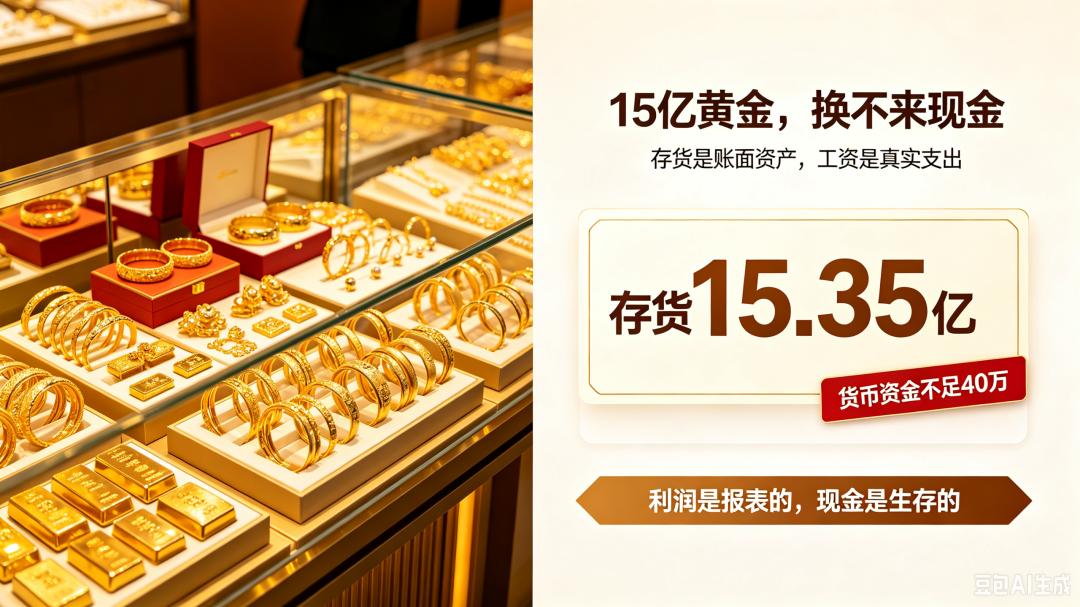
Its inventory turnover rate is almost the lowest in the industry. For jewelry brands of similar scale, Laofengxiang achieves more than 4 turnovers a year, Chow Tai Seng more than 1, while Qianye only achieves less than 1. The same batch of goods that other companies sell out in one year takes Qianye four years to clear.
Slow sales lead to slow capital return. With slow capital return, you have to keep pouring money into the business. Eventually, the listed company's liquidity is maintained by the boss's personal inter-bank borrowing. The semi-annual report clearly states: Other payables increased by 43.59%, due to "a significant increase in funds borrowed by the actual controller".
This would be a scandal in other industries. But in the capital-intensive midstream jewelry industry, it is just the norm after the tight cash flow is pushed to its limit.
What is even more distressing is that Qianye's financial statements still showed "profits" right before the boss lost contact.
Profit is an accounting concept. Cash is the very foundation of survival.
The 1.5 billion yuan of inventory recorded on the financial statements is called assets. But when payday comes, it is just a pile of metal that cannot be used to pay salaries. There are more than 60 employees in the rights protection group, some of whom have not been paid for as long as a year and a half. The disposable cash on the company's books is not even enough to cover one month's salaries.
3
Survival measures themselves accelerated the collapse
After the pandemic, foot traffic in shopping malls declined, and franchised stores suffered losses. Qianye chose the most cost-saving path: closing its self-operated stores.
It closed over 100 self-operated stores one after another until only one was left. The number of employees was cut from more than 300 to less than 100. Sales expenses plummeted by 40% — because all the cost-related matters such as rent, property management and personnel were transferred to franchisees.
The annual report refers to this as "shifting from physical self-operated retail to franchised wholesale". In plain terms: it degraded from a retail company to a wholesale company.
This is understandable. People with tight cash flow will first cut all departments that spend money.
But the cost is obvious. Under the franchise model, rent, salaries and daily operations are all borne by the franchisees. The only binding force that the "Qianye" brand has over its stores is a supply contract.
After the news of the lost contact broke out, many franchised stores in Beijing remained open as usual. The store clerks responded calmly: "We are franchised stores. At worst, we will switch to another gold brand later."
The same is true for e-commerce. In the past two years, nearly 70% of Qianye's revenue came from e-commerce, driven by low-price promotions and livestreaming by influencers. Later, when policies changed and the room for low prices was compressed, Qianye simply suspended its low-price business, and its e-commerce revenue immediately dropped by nearly 90%. A channel that once contributed nearly 70% of revenue vanished overnight.
Live streamers can switch to promoting other products. Traffic does not belong to the Qianye brand. Franchisees can replace their store signs.
After all the interfaces that reach consumers are outsourced, the only thing left in its hands is the goods.
By saving costs to survive, the company eventually turned a jewelry brand into a warehouse.
4
The surge in gold prices is not a lifesaver, but a death sentence
The question arises: cash flow has always been tight, why did this round of price surge crush it?
Because midstream brands were never included in the list of beneficiaries of this rally.
For mines, the rise in gold prices means multiplied profits.
For midstream players like Qianye, it means three simultaneous blows.
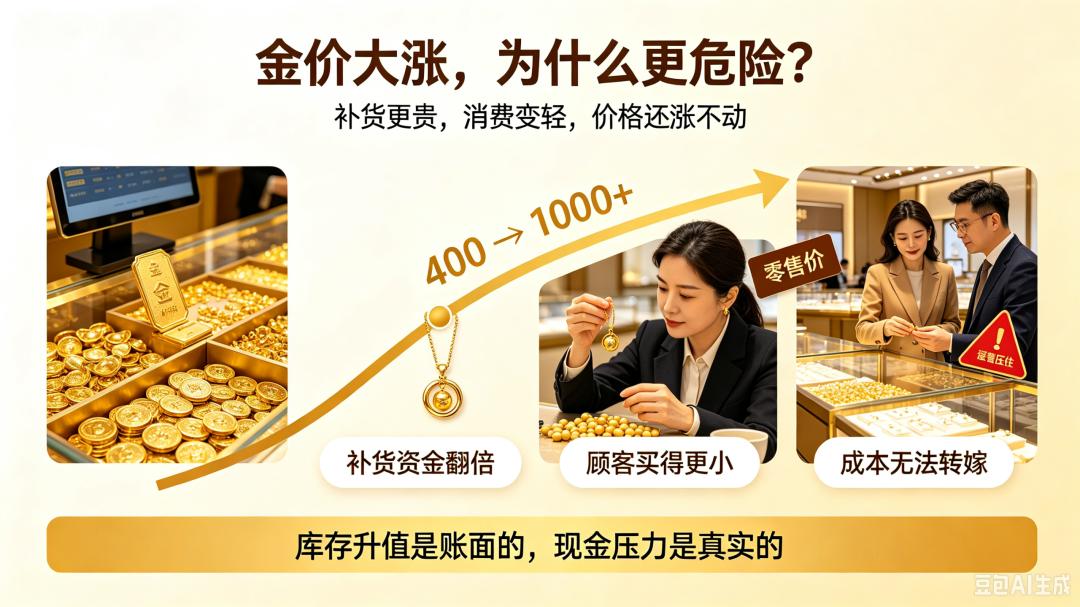
The first blow: the cost of restocking doubled. How much it cost to stock up when gold was 400 yuan per gram, it now costs almost twice as much when the price is 800 yuan. The goods are the same, but the cash they occupy is completely different.
The second blow: demand is suppressed by high prices. When gold prices are too high, consumers do not stop buying, but buy smaller quantities. Those who used to buy bracelets now buy pendants, and those who used to buy pendants now buy small gold beans. The proportion of trade-in for old products is getting higher and higher — consumers bring their old gold to exchange for new styles, only paying processing fees and the cost of the new added gold weight. As sales decline, the speed of inventory turnover becomes even slower.
The third and most fatal blow: it cannot pass the cost on to downstream consumers. As gold prices rise, the selling price of mines goes up, but Qianye's retail prices cannot rise. For undifferentiated products, raising prices will directly drive consumers away.
It has to bear all the losses in the middle. The cost side follows the market trend, while the revenue side is capped by demand. Even leading brands like Chow Tai Fook cannot hold on — same-store sales are rising, but same-store sales volume is falling. The total sales amount is supported by high gold prices, and the number of products sold is decreasing steadily.
Even the leading players are in this situation, Qianye has no cards to play.
Therefore, there is a counter-intuitive conclusion: the surge in gold prices is not a positive factor for midstream players hoarding gold, but a cost burden.
The inventory does "appreciate" in value, but that is only on paper. You have to restock at the new higher gold price, but you cannot get a proportionate return from selling to consumers. The market dividend flows to the mines, while the cost is trapped in the midstream inventory.
The more valuable the goods are, the more reluctant you are to clear them out. The less you clear out, the more stagnant your cash flow becomes.
5
There are only two ways out
With a clear view of this structure, there are only two ways out for jewelry brands.
The first way is to move upstream to gain access to resource attributes. Gold mines are scarce licensed resources, and it is impossible for brands to operate mines on their own. A realistic approach is to bind with resource providers — for example, China National Gold Group, which is backed by a mining group, has its channels directly connected to resources, so it will not suffer losses on the purchasing side when gold prices rise.
But this path is determined by background, not by efforts. Without that background, you cannot take this path.
The second way is to earn premium through design, breaking away from the logic of pricing by weight. Let consumers pay not for the weight of gold, but for the added value attached to that gram of gold.
Laofeng Gold has pushed this path to the extreme. For the same gram of pure gold, other brands sell it at the benchmark market gold price plus dozens of yuan of processing fees. Laofu sells products by piece, not by weight, integrating ancient craftsmanship, original design and brand narrative into the selling price. Converted to per gram price, it is nearly twice the benchmark market gold price, and there are still queues in its stores.
Why? Because it has turned gold into a luxury product logic. Gold is its cost, not its product. Its product is the brand.
When gold prices surge, Qianye which hoarded gold collapsed, while Laopu Gold is doing well. Because the former is the bearer of the resource market volatility, the latter is the beneficiary. Through branding, it has turned gold into its own unique asset.
In fact, Chow Tai Fook, CHJ Jewelry and other brands have been promoting fixed-price products, ancient gold craftsmanship and IP co-branding over the years, essentially moving in this direction — trying every means to make gold more than just gold. The entire industry is trying to escape the curse of "pricing by weight".
Looking back at Qianye, you will find that it already understood this path long ago.
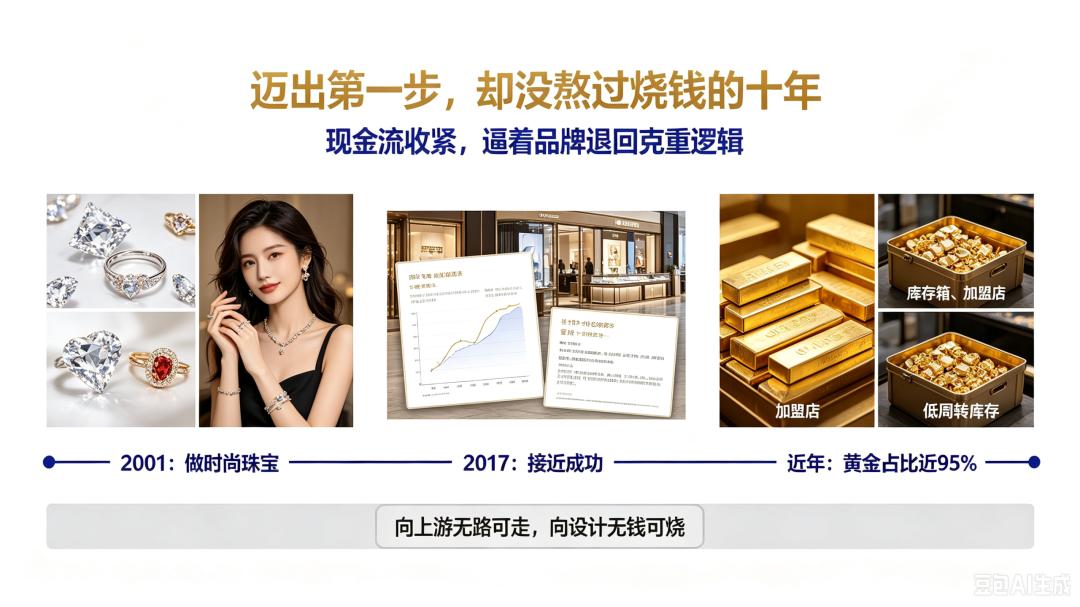
When it was founded in 2001, it did not focus on the traditional three pieces of gold jewelry for weddings, but on "fashion jewelry". It sold diamonds, colored gemstones and 18K gold, signed Anne Hathaway as its spokesperson, launched sub-brands targeting young women, and invited German design firms to build its visual system. It believed a decade earlier than the rest of the industry that young women buy jewelry not only for value preservation, but also for design and self-expression.
The story that the entire industry is talking about today is exactly what it wanted to tell back then. After the news of the boss's lost contact broke out, many people on social platforms are nostalgic for Qianye's old designs, saying that its products from many years ago "are still fashionable even today".
This is not empty compliment. It is the response from the market trend.
And it once came close to success. Around 2017, Qianye was a star jewelry stock on the New Third Board, with revenue of more than 1 billion yuan and profit of nearly 100 million yuan.
But it did not make it all the way.
The diamond consumption market slumped, and its non-gold jewelry revenue dropped significantly. Its capital chain tightened, it closed all its self-operated stores until only one was left, and livestream sales became its source of cash. Eventually, the revenue from gold jewelry accounted for nearly 95% of its total revenue.
It ended up becoming what it least wanted to be: an undifferentiated gold wholesale company.
It took the first step on the path of design premium, but failed to survive the most capital-intensive decade in the middle. It was the tight cash flow that forced it to retreat step by step back to the middle position of the industrial chain.
There is no way to move upstream, and no money to invest in design.
6
A few final thoughts
Back to the question at the beginning: why did Qianye Jewelry collapse when gold prices surged?
The accurate answer is: the surge in gold prices was the last straw that broke the camel's back. All the previous straws were piled up by itself — the capital-intensive business model, the asset structure with almost all inventory, the extremely slow turnover rate, the liquidity maintained by the boss's personal borrowing, and a failed differentiated attempt that it could not survive through.
What is worth remembering about this incident is not the tragedy, but the "position" in the industrial chain.
The midstream jewelry sector is a link that has no bargaining power with either the upstream or downstream. It only earns meager hard-earned money in good times, and it is the first to get hit when the resource market fluctuates.
High gold prices have never been its friend. They are a developer that shows its fragility. The hotter the market is, the clearer it shows who is swimming naked.
The way out has always been obvious: either you own the resources, or you own the brand premium. Brands stuck in the middle that make a living by hoarding other people's gold will die faster as gold prices rise.