Unlocking the Jev Black Box, In Dialogue With the World's First Batch of Reproducers: The 9B Small Model Successfully Achieves 79-Millisecond "Fast Decision-Making"
The Jevons Paradox in economics holds that the higher the efficiency of resource use and the lower the unit cost, the higher the total consumption of that resource tends to rise rather than fall. At present, the large model industry is fully illustrating this law — the cheaper and faster the model is, the more explosive the growth of its call volume will be.
The new species Jev that has recently swept Silicon Valley, a "large model" named after the Jevons Paradox, is pushing this trend to the extreme.
It refuses to write poems for you, refuses to discuss life with you, and even disdain to generate a single complete nonsense sentence. However, such a cold "mute" model has attracted more than 30 million enthusiastic views on X and drawn 25,000 developers to join the internal test in less than 48 hours after its release; 24 hours after it was launched on the large model hosting platform Vercel, nearly 13% of paid teams quickly accessed it — this penetration rate is twice that of GPT-4 in its early days.

In all martial arts, only speed can never be broken. Jev's killer feature is exactly this: extremely fast, and extremely low cost. As a former core researcher at OpenAI and co-inventor of RLHF technology, Diogo Almeida, founder of Jev, even made a bold statement: "The next era does not belong to auxiliary tools like Claude Code, Jev is the future! It is 200 times faster and 400 times cheaper than general-purpose models, with zero hallucinations. This will be the next big thing after RLHF."
From millisecond-response browser plugins, to high-frequency on-chain trading decision-making, to the speedrun cheat for *Doom* that makes 10 decisions per second and outperforms human players, the application cases built by developers around Jev are showing a blowout growth.
However, facing such a "black box" whose valuation has soared to 200 million US dollars overnight but whose training scheme and underlying weights have been kept strictly confidential so far, the industry's curiosity and doubts have also reached a climax: Is it a revolution in model architecture, or just a "Classifier" packaged by marketing?
Yesterday morning, the AI lab under APUS, a domestic artificial intelligence enterprise, publicly released the world's first batch of independent open-source reproduction results for Jev, and packaged it as an out-of-the-box Agent Skill named fast-browser-use. This project supports offline execution with a pure local model, runs across macOS, Linux and Windows desktop and server operating systems, and does not even require an independent GPU, so it can run locally on ordinary Mac and PC devices.
At present, the full code of this project has been opened to the community under the MIT license (https://github.com/APUS-AI-Lab/fast-browser-use).

Dr. ZHANG Xu, completed his undergraduate, master and doctoral studies at Tsinghua University, Doctor of Engineering, Chief Scientist of APUS AI
The author contacted Dr. ZHANG Xu, head of this project, as soon as possible. We had an in-depth discussion on topics including the underlying technical logic and route of Jev, the reproduction and transformation logic of APUS, the application potential of this kind of fast decision-making model, and the future "fast-sight division of labor" trend of Agent.
To be precise, ZHANG Xu's team did not obtain the model weights, complete architecture and training method of Jev; instead, they inferred its working mechanism through public materials and actual input and output, restored the most core workflow of Jev based on open source models such as Qwen3.5 series and Google Gemma series, and achieved comparable inference speed.
On the morning of the open source day (September 20), APUS announced the first round of results: in real browser tasks, Wikipedia search can be completed in about 18 seconds, and shorter tasks such as form filling and in-site jump can be completed in a few seconds, without calling the cloud model during the whole process; in the afternoon interview, ZHANG Xu's team migrated the test to RTX PRO 6000, the single decision-making time was compressed to 79 milliseconds, which successfully matched Jev's response time of 70 to 500 milliseconds.
He also revealed that their internally self-developed model can reproduce the performance of Jev with a smaller parameter scale of 9B and 4B, and will be open sourced in the near future. (As of press time, it has been open sourced at https://huggingface.co/apus-ailab/APUS-OpenJev-v1)
The following is the essence of the interview between the author and Dr. ZHANG Xu. For ease of reading, this article has refined and integrated the original dialogue.
Disassemble the underlying logic of Jev
AI Front: If we put aside the official conceptual rhetoric, can you explain in a more intuitive way what the difference between Jev and the common large models today is? What is its essence?
ZHANG Xu: The key to understanding this problem is to see through the two basic steps of large model operation. The first step is Prefill, that is, input processing; the second step is Decode, that is, autoregressive generation.
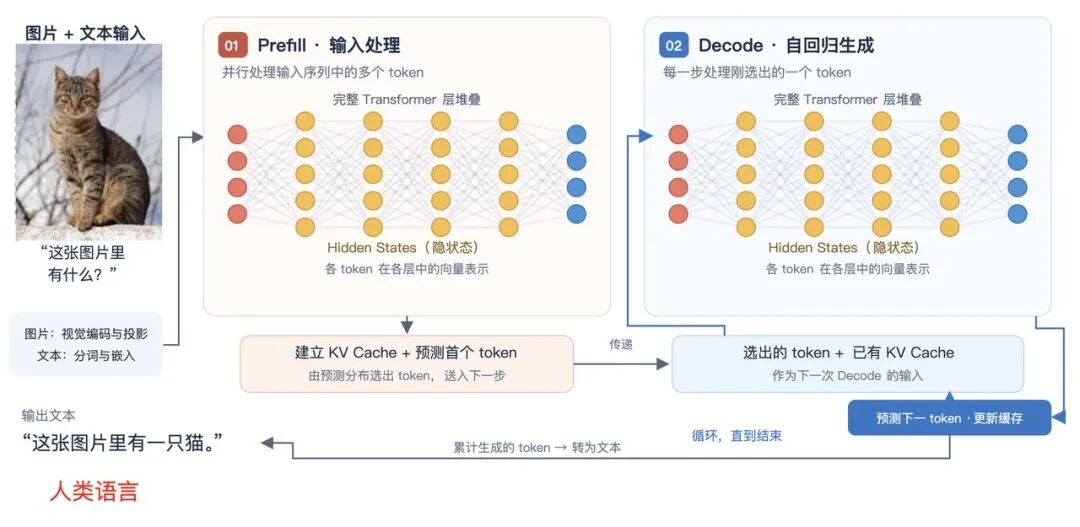
When the large model completes the first step of Prefill, the "Hidden States" inside its neural network has actually understood the details of the text and images you input.
The second step, Decode, is to spit out Token word by word, which is purely for the purpose of "translating for humans to read".
However, the bandwidth of human language is very narrow, leading to extremely high information loss. For example, for this picture containing cats, branch textures and complex light and shadow, no matter how you describe it in words, it is impossible to restore all details without omission to another person.
The core essence of Jev is that it cuts off the second step (Decode) and only retains the first step. It no longer generates text word by word to cater to humans, but directly calculates the result in the "Latent Space" after the model understands the information.
AI Front: So what does it output in the end? Is it just things like Choice, Score/Probability?
ZHANG Xu: Yes. Every time an ordinary large model generates a Token, it essentially calculates the full probability in the vocabulary of hundreds of thousands of words, and then selects one to output.
Jev then makes this process extremely convergent, turning it into probability measurement for limited options. For example, if you ask "Is this outline complete?", there are only two options: "Complete" and "Incomplete", and it only returns the probability scores (Score) of these two options.
This is also why it claims that it will not have hallucinations. It does not mean that it will not make wrong judgments, but that if you only give it A, B, C, it will not make up a D out of thin air.
But no hallucination is not the same as no error.
AI Front: Since it only gives the probability of fixed options, some people in the industry question that it is just a packaged "action classifier". What do you think about this? Where is its innovation on earth?
ZHANG Xu: That's not wrong. But I think we also need to see the larger research trend behind it.
For example, a picture contains very rich information, no matter how long the text you use to describe it, it is difficult to restore all the details. Language itself will cause information loss.
So there is a cutting-edge direction now: Since the model already has all this information internally, do we have to convert it into human language first, and then continue to process the language?
Jev can be regarded as a specific special case in this direction. It omits the subsequent language generation, and directly completes the judgment from the internal state of the model.
AI Front: So what is the specific larger direction you mentioned? Is it to further decouple "understanding" and "generation"?
ZHANG Xu: This is one of the aspects. The industry refers to the broader set of ideas as latent space computing.
For example, when two Agents communicate with each other, neither of them is a human. Why do we have to translate the information in the mind of the first Agent into human language, and then let the second Agent read it? Theoretically, processing can be done directly between the internal states of the model.
Model routing, communication between Agents, and internal thinking of models can all be developed along this direction. Jev just uses this idea to do a specific thing: probability judgment and decision-making for limited options.
AI Front: As a consensus in the industry, what is the current exploration progress of leading large manufacturers in this regard? What is the difference between Jev's approach and theirs?
ZHANG Xu: Yes, for example, the DeepSeek-v4.1 Flash version has been trying to decouple the capabilities of Prefill and Decode. A more typical representative is the latest GPT-6 (Astra), the Loop Transformer mechanism discussed in the industry, whose essence is to let the model's chain of thought and thinking process perform cyclic calculation inside the "latent space", instead of being converted into inefficient human text to output.
In comparison, Jev cleverly "productized" the achievements of latent space computing. It proves that directly using the intermediate results of the latent space is enough to subvert the current application form.
AI Front: The most obvious feature of Jev is speed. In addition to omitting long text generation, why can it be so much faster?
ZHANG Xu: Not generating text is the biggest reason, which is equivalent to "only outputting the first Token" and only making judgments. But besides that, there is also a downgrade of calculation dimension.
Second, the original open generation now only has a few or dozens of candidates for it, the calculation range is smaller.
Third, these candidates are independent of each other, which can enable more parallel judgments; while the traditional autoregressive generation has dependencies before and after, each Token has to wait for the previous one.
Our own implementation also uses processing similar to KV Cache broadcasting. So to sum up: less generation, smaller candidate range, and parallel processing.
AI Front: Then besides speed, what other essential performance advantages does it have?
ZHANG Xu: In other aspects, in our view, it is not essentially different from large models. It is actually a large model, but only uses half of it.
The final effect ultimately depends on how well the model itself is trained.
How to reproduce Jev
AI Front: Jev does not open source weights, complete architecture and training scheme. In this case, what exactly do you mean by "reproduction" in a strict sense?
ZHANG Xu: Strictly speaking, what we reproduce is its function.
I went through all their public materials, studied the founder's background, and actually called Jev to observe its input and output.
You can understand that I treat it as a black box. If we can achieve the same type of input and the same type of output, then we think we have basically reproduced its publicly available functions.
AI Front: So what specific changes did you make on Qwen?
ZHANG Xu: The original Qwen3.5 can work directly.
The model itself does not need to be modified, we only adjust the external working mode. The content open sourced this time is also part of our existing Agent Harness extracted from the company, and then simplified before release.
AI Front: So can any small model run it? Are there any requirements for the base model capability and parameter scale?
ZHANG Xu: There are requirements after actual tests.
I have seen some people in the open source community use a 600-million-parameter model to reproduce it, which can indeed run and "work a little", but you will find it very stupid and cannot be practically used.
So I tested Qwen from small models all the way up. Finally, 9B is basically the minimum available threshold, and it is difficult to be practical if the parameter is smaller; the effect of 35B will be better. We chose 9B also because we hope that ordinary users can run it on their own computers without very good equipment. In addition, we are also training our own model, which will be open sourced soon. Preliminary results show that its effect has surpassed Jev.
AI Front: Did this reproduction bring any results beyond your expectations? For example, you thought it was very difficult at first, but after finishing it, you found it was not so complicated?
ZHANG Xu: There is nothing particularly unexpected.
On the contrary, the reason why we can finish it so quickly is that we have accumulated a lot in this direction in the past, and we directly use the existing achievements.
AI Front: So conversely, the fact that you reproduced it so quickly shows that the publicly available part of Jev does not have a particularly high technical threshold, right?
ZHANG Xu: To be more objective, I don't know if there are other hidden technologies behind it.
But at least for the part it has shown, in our view, it is just a special case in this research field, there is nothing particularly mysterious.
Where can the "79 milliseconds" be applied
AI Front: Why did you make the reproduction into a Browser Agent as soon as possible?
ZHANG Xu: On the first day, we first looked at what people in the industry use Jev to do, and found that the most common usage is browser operation.
And we hope that the open sourced content is practically useful, not a technical Demo or toy, so we first developed the browser scenario.
In the past, many Agents operating browsers required the large model to generate operation code first, and then execute it. Now we first list the interactive elements on the web page, such as input boxes, links, page up and down, and then let the model make a direct choice: whether to input, which link to click, or turn the page now.
