Leadership Reshuffle on the Eve of Yunqi: Huawei's "Genius Youngster" Takes the Helm of Qwen, Who Will Carry the Flag in the Second Half of Qwen's Development?
The day before the opening of the Alibaba Cloud Apsara Conference, Alibaba pushed the new head of Qwen to the forefront of the stage.
On September 21, according to insider employees, Alibaba appointed senior AI researcher Liu Daheng as the head of the Qwen large language model project. On the guest list of the official website of the Alibaba Cloud Apsara Conference, his photo is placed right after Joe Tsai and Wu Yongming, in a very prominent position.
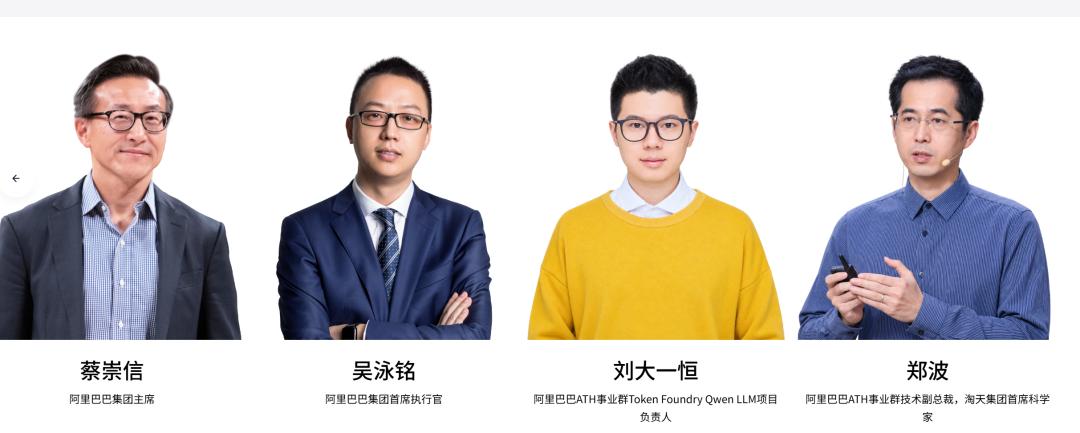
This arrangement itself sends a clear signal: Qwen, which has had a vacant leadership position for more than half a year, will make its official debut with its new head on Alibaba's most important annual stage.
On the eve of the opening of the Alibaba Cloud Apsara Conference, Alibaba appointed Liu Daheng to take charge of Qwen. This Sichuan University PhD, who was selected into Huawei's "Genius Young" program, took over a team that had seen successive departures of technical leads and senior executives in the past six months, as well as a global 7th-ranked model performance record.
What's the background of the new head
Let's first sort out the full profile of this new lead.
Liu Daheng completed both his bachelor's and doctoral degrees in computer science at Sichuan University. He was selected into Huawei's "Genius Young" program in 2020, and joined the Language Technology Lab of Alibaba Damo Academy in 2021. He has been a core member of Qwen since its early stage, and has long been in charge of pre-training work. In other words, he is not an airborne manager, but a technical talent who grew up internally from this product line.
Insiders told media that after multiple rounds of organizational restructuring, this appointment "clarified the management structure of the Qwen team". To put it plainly — this position has been vacant for a while, and now it is finally filled.
What about the status of the team he took over? Qwen 3.8 Max currently ranks 7th on the Artificial Analysis Intelligence Index, right behind the flagships of Anthropic and OpenAI, and Meta's latest Muse Spark 1.3. In the open source field, the Qwen series remains the representative of domestic large models.
Three changes in half a year: the timeline of Qwen's management
Why is the appointment of a project lead worth a dedicated report? Because in the past six months, the personnel turbulence of this team has been rather frequent.
In the early morning of March 4, technical lead Lin Junyang posted a farewell message on X: "bye my beloved qwen." According to LatePost, he had just written in the team's DingTalk group the day before that he "had no face to lead everyone anymore". Alibaba CEO Wu Yongming later confirmed the news in an internal email, and reassured employees at the same time: Zhou Jingren will continue to lead the Tongyi Lab, and the open source strategy will remain unchanged. Five months later, Lin Junyang returned to the public view as the founder of Pragmatik Labs, and has received investment from Tencent.
In June, Zhou Jingren, who was previously in charge of large model R&D, stepped down from his position and transferred to the role of Group Chief Scientist, focusing on long-term cutting-edge research — the frontline R&D management position has been vacant ever since.
Then on September 21, Liu Daheng took the position.
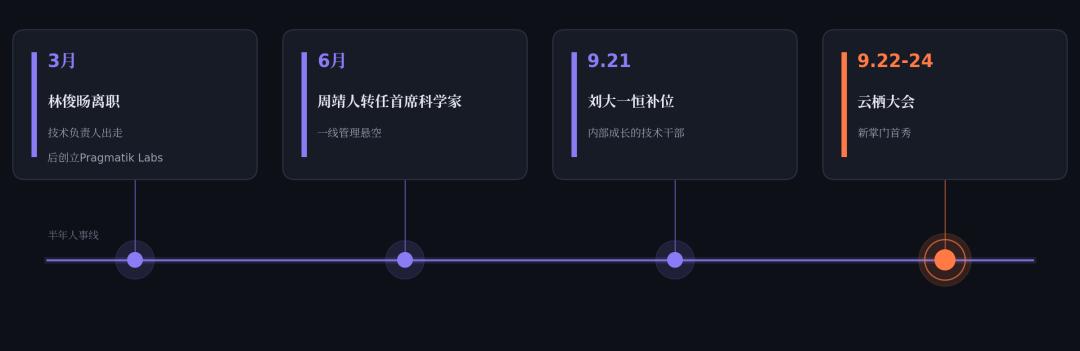
Connecting these three changes, we can see that Alibaba's talent utilization logic is shifting: from the star technical lead system to internal cultivation and echelon replacement. This path is more stable, but the star aura fades away, and the test for team cohesion is more direct.
Why it is arranged right on the eve of the Apsara Conference
This timing is not a coincidence, but a well-rehearsed debut.
The 2026 Alibaba Cloud Apsara Conference is held in Hangzhou from September 22 to 24, with the theme of "AI for Practical Use", and its core focus is Agentic AI — the full chain from chips, cloud infrastructure to models and Agent applications will all be demonstrated. Citi's pre-conference research report has raised expectations to a high level: the update of the Qwen v3.8 series, even new versions of v3.9 and v4.0, the upgrade of T-Head chips, and the enhanced version of enterprise Agent applications may all be released within these three days. The Hong Kong stock AI sector has already surged in advance today, with many concept stocks rising by more than 10%.
At this critical juncture, Qwen needs a top leader who can stand on the front stage and clearly explain the technical roadmap. The combination of the new head's debut and the new model release will reassure both developers and the capital market.
From a broader perspective, this appointment also comes at the peak of fierce competition among domestic open source models. Qwen is no longer in the comfort zone of "the top domestic open source model": DeepSeek's V4 series is advancing aggressively, Kimi K3 has pushed the parameter scale to 2.8 trillion, and Meta's Muse Spark has also surpassed Qwen on the ranking list. The battlefield of open source weights is far more crowded this year than in previous years.
A few words of caution
Apart from optimism, several issues need to be addressed.
Team morale and talent density are the first hurdles. When Lin Junyang left, many core members including Yu Bowen, the post-training lead, also changed positions. The impact of personnel turbulence in the technical team on the model iteration rhythm usually appears after one or two subsequent versions — the quality of the next new Qwen version will be the touchstone of this appointment.

The 7th-ranked position is by no means easy. The top spots are occupied by the flagships of Anthropic and OpenAI, while there are more and more pursuers behind. If the v3.9 or v4.0 expected by Citi is only a regular iteration, it will be difficult to meet the market's pricing for the "Apsara surprise".
There is one more point: all the appointment information comes from "insider employee disclosures" and the guest list on the official website, and Alibaba has not yet released an official public announcement. The details of the scope of duties and reporting lines are pending official confirmation.
Conclusion
The deepest implication of this appointment is a shift in Alibaba's AI organizational model.
The Qwen in the Lin Junyang era had a strong star technical lead characteristic; Liu Daheng's taking over confirms the "internal echelon" route — the person who came from the pre-training field and grew up with Qwen from day one takes the lead. Which model is more competitive will be proven in the subsequent model versions.
When the Apsara Conference kicks off tomorrow, Liu Daheng's first public appearance will be his first major test. Every word he says on the stage will be compared with the aura of "Genius Young", the 7th position on the ranking list, and the personnel turmoil of the past six months.
The second half of the competition for domestic open source models starts counting from this debut.
This article is from the WeChat official account "AI Contrarian", written by Bai Ke, and published with authorization from 36Kr.