A mass production-focused player has stood out in the track that NVIDIA has heavily bet on, OCS complete equipment manufacturer Xinxin Guang has closed a Pre-A financing round of tens of millions of RMB | 36Kr Exclusive
In 2026, following the storage chip sector, Wall Street has spotted the "light" in the optical communications track.
Among the top 10 S&P 500 constituents by year-to-date gain, three are optical communications companies; in early March, Nvidia invested $2 billion each in two optical firms Lumentum and Coherent, with additional multi-billion-dollar long-term procurement commitments attached.
Beneath the capital frenzy lies the structural shift of AI computing power architecture. As the computing power of a single cluster scales up to the 100,000-GPU level, massive volumes of data need to be exchanged at high speed between GPUs, and traditional electrical switching networks are approaching physical limits in terms of power consumption, bandwidth and scalability.
One of the solutions is to "replace electricity with light", so that signals no longer go through the "optical-electrical-optical" conversion, but complete path switching always in the form of optical paths. This is how Optical Circuit Switch (OCS for short) came into being.
36Kr learned that Wuhan Xinxin Optical Technology Co., Ltd. (hereinafter referred to as "Xinxin Optics"), an OCS complete machine manufacturer, has recently completed tens of millions of yuan in Pre-A round financing, led by Yida Capital, followed by Ushan Capital, Jianhua Investment, with Rixin Capital acting as the financial advisor. The proceeds from this round of financing will be mainly used for OCS product iteration, mass production system construction and team expansion.
Xinxin Optics was founded in Wuhan Optics Valley in September 2025. According to Wei Jun, founder and CEO, its core team members come from leading industry giants, have experience in mass-producing thousands of OCS complete machines, and have delivered products to multiple major domestic and overseas clients.
Considering the yield rate of finished complete machines and product cost performance, Xinxin Optics chose the MEMS micromirror route that has been verified for mass production by Google. This solution delivers better overall performance in dimensions such as port scale, insertion loss and reliability, which better meets the needs of large-scale deployment in data centers.
The team has also accumulated rich experience in the engineering implementation of technical routes. Core members have an average of more than 15 years of working experience, with full-chain expertise covering MEMS-OCS design, packaging, calibration and final testing. Facing the upgrading wave of computing power networks, they are applying this set of mass production know-how to the era of AI data centers.
Direct Optical Connection in Short Supply
To understand what Xinxin Optics is doing, we must first recognize the bottleneck of traditional electrical switching.
In traditional data center networks, signals transmitted between servers are optical, while signals processed inside switches are electrical. This "optical-electrical-optical" conversion can be likened to subway transfers: data is forced to get off midway, transfer, and then get on again, and each transfer consumes energy and time.
OCS is more like a non-stop overpass. Its working principle can be understood as follows: the entire switch is a "black box", with arrays of optical inlets and outlets arranged at both ends. Light enters from one end, hits the MEMS micromirror array inside the box, and the micromirrors change their deflection angle through electrostatic force, accurately reflecting the light beam to the corresponding output port.
This process only changes the propagation path of light, does not alter the optical signal itself, and naturally saves the latency and power consumption brought by the conversion link.
However, this does not mean that optical switching will replace electrical switching. As for the relationship between the two, Wei Jun judged that the entire AI cluster network is evolving towards an electro-optical hybrid architecture. At the current stage, OCS is more responsible for high-bandwidth direct connection paths with relatively stable communication modes, which is suitable for highly regular large-traffic scheduling in AI training; electrical switching continues to handle bursty and fragmented packet forwarding, and the two complement and coexist. To realize end-to-end all-optical switching, the entire industry chain still has a long way to go.
So why is the opportunity window opening right now? The answer points to the contradiction between supply and demand.
Google has disclosed that it needs about 15,000 300-port OCS switches in 2026, of which about 3,000 are planned to be purchased from external suppliers; Nvidia has included OCS in its AI factory network planning, and plans to introduce it in the new-generation architecture. Cignal AI predicts that the global OCS market will exceed $8 billion in 2030, with a compound annual growth rate of over 30% from 2026 to 2030.
But the supply side is clearly failing to keep up. Lumentum's management stated directly on the earnings call that even at full production capacity, the supply volume still lags behind demand, and the backlog of OCS orders has exceeded $400 million; Coherent also revealed that its order backlog has hit a record high.
With the acceleration of Google's cluster architecture upgrade and the onboarding of new customers, overseas manufacturers are unable to meet all the demand. This time gap between supply and demand leaves a window for new entrants.
Core Know-how Polished on Mass Production Lines
As a system-level product, the design and production of OCS involve a series of engineering issues such as optical path stability, device consistency, assembly accuracy, testing procedures and long-term reliability. These issues cannot be solved simply through principle verification, and require continuous optimization and adjustment in the actual mass production process to gradually form reusable solutions.
Having worked in various manufacturers, Wei Jun has been in the optical communications industry for 20 years. The core team members around him cover the fields of optics, mechanics, electronics, software, algorithms and other fields, and have more than 10 years of experience in OCS mass production.
This team has built up its own advantages in three links.
The first is self-developed core devices. One of the most difficult devices to manufacture in OCS complete machines is FAU (Fiber Array Unit), where hundreds of optical fibers need to be coupled and aligned with precision lens arrays with sub-micron-level tolerances — equivalent to achieving alignment at a scale of one hundredth of the diameter of a human hair. Xinxin Optics has developed 2D-FAU with more than 400 channels, and independently developed the corresponding process route. The same self-manufacturing capability also extends to MEMS driving, chip packaging and other links.
The second is calibration algorithms. Factory calibration is a key bottleneck restricting the mass production pace of high-port-count OCS. The number of optical path combinations inside an OCS is counted in hundreds of thousands, and each complete machine needs to be calibrated one by one before leaving the factory. For inexperienced manufacturers, calibration may take several months, but Xinxin Optics has reduced this time to 3 days through automated algorithms, greatly shortening the offline cycle of products.
The third is finished product yield. A high-port-count OCS complete machine involves thousands of parts and components and 70 to 80 processes. Ensuring that every device meets the same performance indicators is the biggest challenge in the mass production stage. According to reports, the current yield rate of Xinxin Optics during the production line running-in period has reached 90%, and core indicators such as latency, insertion loss and power consumption have also reached the mainstream level.
The above experience answers the question of "how to make the product", but facing the new market environment, how to define the product itself is another problem.
The constraints of AI data centers on OCS port density, power consumption and cost are completely different from those in the telecom era. The team's approach is to reverse-derive product design starting from mass production, function addition and subtraction, and cost control.
"What we are doing is not bringing back the S320 from ten years ago, but restructuring the product architecture and carrying out technical iteration based on current market demand," Wei Jun said. "For example, optical path simulation and algorithm optimization are all taken into consideration at the design stage."
At the recently concluded Optical Expo, Xinxin Optics made its debut with the NP-S200 Series OCS. It is reported that the NP-S200 supports 64/128/192 ports, adopts a pluggable design for easy redundant replacement. In case of port failure, there is no need to return the entire machine for repair or replace the software, and iterative functions can also be modularly embedded on the entire machine as needed.
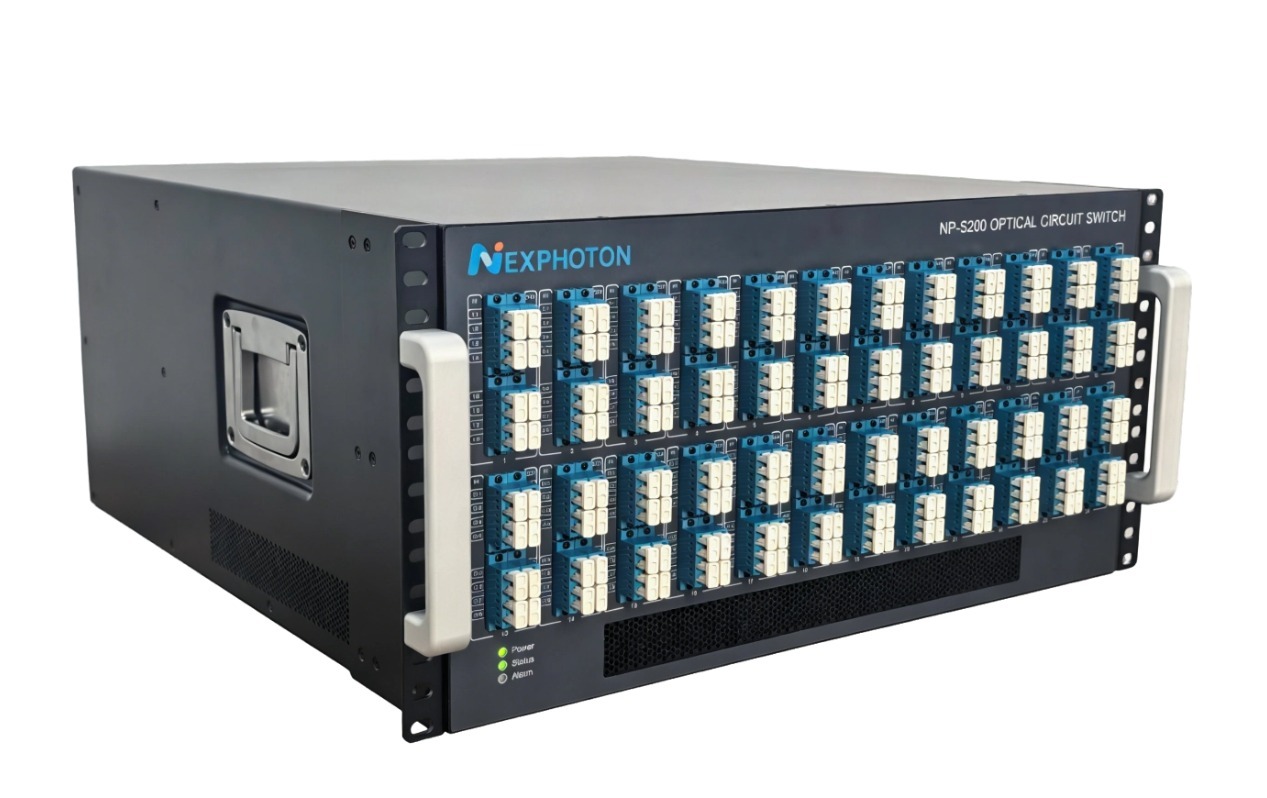
Schematic Diagram of NP-S200 Series OCS Product
In terms of product planning, Xinxin Optics will launch the H400/S400 series, covering 256/320/384 high-port-count products, among which the 320-port (Google's new-generation cluster specification) is the key direction, and mass-produced products are expected to be launched in 2027.
Do Not Chase Scale, Seize the Window First
Technical capabilities ultimately need to be tested by the market. Xinxin Optics has not bet all its resources on complete machines, but has simultaneously developed three cash flow businesses: active/passive optical devices, packaging and testing services, and subsystem OEM.
"Before the sales of self-branded complete machines pick up, we will first convert the production lines and manufacturing capabilities into tangible revenue." This strategy comes from Wei Jun's judgment on business rhythm.
In his view, technological leadership does not mean that an enterprise can survive to the end. There are many such cases in the industry: the scenario implementation fails to meet expectations, the cash flow comes under pressure first, and the team loses members; when the market erupts, the enterprise has lost the ability to iterate products and can only watch the opportunity window slip away. Therefore, it is necessary to keep up with the rhythm, but not to exhaust resources before the real demand arrives.
In terms of commercial progress, Xinxin Optics is currently contacting customers through overseas agency channels. The intended orders mainly come from overseas cloud vendors and testing institutions. It will appear at the North American OFC Exhibition next March to meet overseas customers face to face.
On the production capacity side, the 2,000-square-meter new plant will be put into use soon, with an annual production capacity of 1,000 units planned, and it is expected to have mass delivery capacity from the end of this year to the beginning of next year. A Southeast Asian production center is also under planning at the same time.
Facing the competitive landscape, Wei Jun holds an optimistic view: overseas giants have advantages in capital and production capacity, but in terms of OCS mass production and delivery, the gap between domestic manufacturers is not huge. For capable and experienced start-ups, there is a certain market opportunity left.
In the longer term, his positioning for the company goes beyond OCS complete machines: "We hope to become a solution provider for all-optical switching in AI data centers. Not only OCS, but also optical devices such as DCI, circulators, isolators and MPO. Wherever light is used in data centers, we provide full support."
From computing chips to optical devices, and then to today's network architecture, reviewing the industrial opportunities driven by AI infrastructure in the past two years, most of them present a feature: demand arrives first, and production capacity follows later.
With Google's ten years of R&D and deployment, and Nvidia's successive endorsements with a total of $4 billion investment, the technical direction of OCS no longer needs to be demonstrated. The real suspense at the moment lies in delivery: in the face of surging demand counted in tens of thousands of units, how to move from demonstration prototypes to stable mass production to bridge the gap between supply and demand.
For new entrants, an engineering test has just begun.