Three Years, Ledomanin: The Lessons a Snow Mountain Taught Us
Heading higher from the old Yulin Village of Kangding at the foot of Mount Gongga, the meadows gradually fade behind you, while glaciers, ice lakes and 6,000-meter-level snow peaks spread out above the snow line, and Leduomanin comes into view.
Several years ago, it rarely appeared in the travel lists of ordinary people. Today, Leduomanin has become a frequently mentioned snow mountain destination on social media. A mountain, growing from a niche site to a popular spot, has become one of the most intuitive epitomes of China's outdoor boom in recent years.
But mountaineering itself has always been a somewhat "counter-intuitive" thing: you spend time, money and physical strength, voluntarily expose yourself to altitude sickness, cold and exhaustion, and sometimes after walking a long way, you may not reach the original intended destination.
Over the past three years, Kailas has invited five photographers to complete a journey from their first visit, to returning to Leduomanin two years later, and to extending glacier observation to the farther Arctic this year. For those ancient and fascinating propositions, why do people keep walking into the mountains again and again? What does the flow of time bring to people and nature? What exactly does climbing give to people? Their three-year journey gives part of the answers to these questions.
The "life memory anchor point" that I will also recall when I am old
In the summer of 2023, photographer Wang Jingwei followed the mountaineering team to step into the glacial zone of Leduomanin for the first time, and saw the "Leduomanin Blue" that many people talked about with great relish.
It is a faint, light blue that glows from the glacier. Under the effect of sunlight, the deeper you go, the more obvious the color becomes. At that time, they had been walking on the glacier for more than an hour, and the huge ice body under their feet extended into the distance. Wang Jingwei squatted down occasionally and put his hand into the glacial meltwater. He recalled, "It's like touching history."
He raised his camera. The white ice wall in front of him approached from both sides of the frame, cutting out a long and narrow gap in the dark blue sky, and his partner in an orange jacket in the distance was climbing close to the ice wall. Different from the sharp and hard glacier that people usually imagine, the ice body in the lens is rounded and transparent under the light, "just like silk". Wang Jingwei quickly pressed the shutter to freeze the "key moment" in his memory.
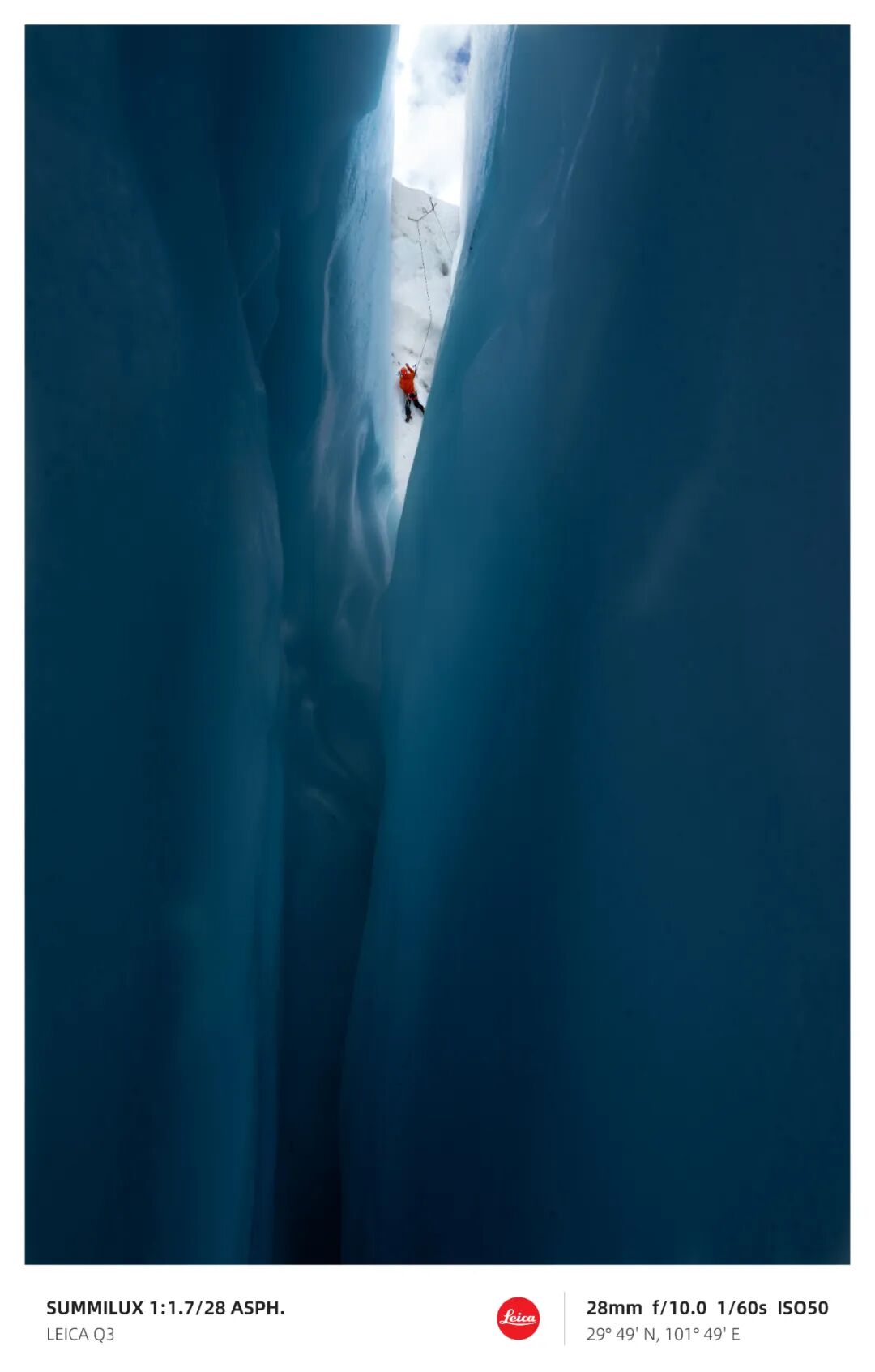
Photography by Wang Jingwei
Compared with ordinary snow peaks, the special feature of Leduomanin lies in its glaciers. It is located in the Mount Gongga area of western Sichuan, with its main peak at an altitude of 6112 meters. The abundant water vapor brought by the monsoon nurtures the maritime glaciers, where ice towers, cracks, blue ice and moraine lakes are scattered, and the lakes formed by meltwater reflect the surrounding snow peaks.
In 2023, it was not a familiar name to the public, carrying the romantic imagination of a few mountaineers for distant places.
But the outdoor scene in those years was another lively picture. Outdoor sports began to quickly enter the lives of ordinary people from the hobby of professional players. As a brand that has long been rooted in the mountaineering scene, Kailas has already felt this change.
Kailas found that at that time, on social media, more and more people wrote "climbing the first snow mountain in my life" into their life wish lists. But the problem is that most of the snow mountains they have seen only exist in other people's photos, videos and stories. "Many people have actually had the desire, but they just haven't taken the first step."
Therefore, Kailas decided to make "the first snow mountain in life" a project. The team invited Wang Jingwei, He Sheng, Wu Min, Yang Lu and Tang Ningxin — five people from different fields including automobile, fashion, humanities and men's wear, who have mature photography experience, but like most outdoor enthusiasts, have little experience with high-altitude snow mountains.
In July 2023, they carried their cameras, set off from the Gexi Grassland, walked along the Liangcha River and Upper Riuque to higher places, and the trek began.
After you really enter the high altitude, the rhythm of your body will change suddenly. You can't take big steps, you can only take "small quick steps" to keep your heart rate down. Breathe in, breathe out, breathe in, breathe out, every breath becomes clear.
The first time Wang Jingwei really felt the "real side" of the snow mountain was on the section of the road continuing from Liangcha River to Upper Riuque. The total climb that day was nearly 800 to 900 meters, and the exhaustion that had not dissipated in the previous few days surged together, making his legs as heavy as lead. The weather gave people no time to prepare, it was sunny just now, but the clouds and fog quickly pressed into the valley, and the wind and hail came without warning.
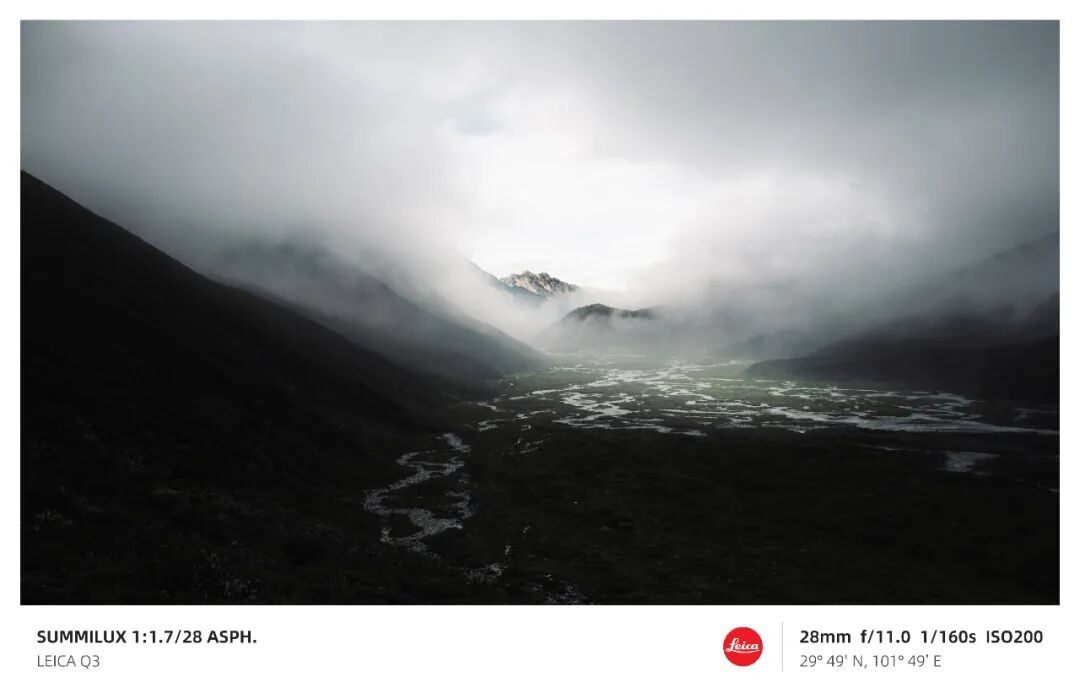
Photography by Wang Jingwei
The physical suffering and inner frustration tortured the people moving forward together. Wang Jingwei could only move forward step by step against the wind. So-called climbing, most of the time, is to repeat these small actions hundreds or thousands of times.
At three or four o'clock in the afternoon, the camp finally appeared not far ahead. Wang Jingwei stopped slowly, caught his breath, and unconsciously looked back at the road he had come from.
He suddenly found that at this moment, the clouds just split a gap, and a beam of light poured down from it, shining on the meadow and a few cattle and sheep. The surroundings were still gray clouds, only that small area was bright. He almost instinctively raised his camera and pressed the shutter. "At that moment, I felt like I was about to cry."
Later, Wang Jingwei called this photo his "life memory anchor point". "Maybe when I am in my seventies, eighties, or even nineties, lying in bed unable to move, this picture will still flash through my mind."
This is probably the interesting part of mountaineering. The scenery will not be delivered directly to you. Before you really see it, you first experience panting, bad weather, physical exhaustion, and even self-doubt. When you finally look back, those difficult roads you just walked have already become part of the scenery.
During the 5 days of in-depth exploration of Leduomanin, the five photographers each experienced their own first time. He Sheng suffered from severe altitude sickness, once descended to a lower place, and when his body recovered a little, he was unwilling and wanted to walk into the mountain again; Wu Min, Yang Lu and Tang Ningxin also pointed their cameras, which used to focus on cities, clothing and people, at snow peaks, glaciers and the people walking in them for a long time for the first time.
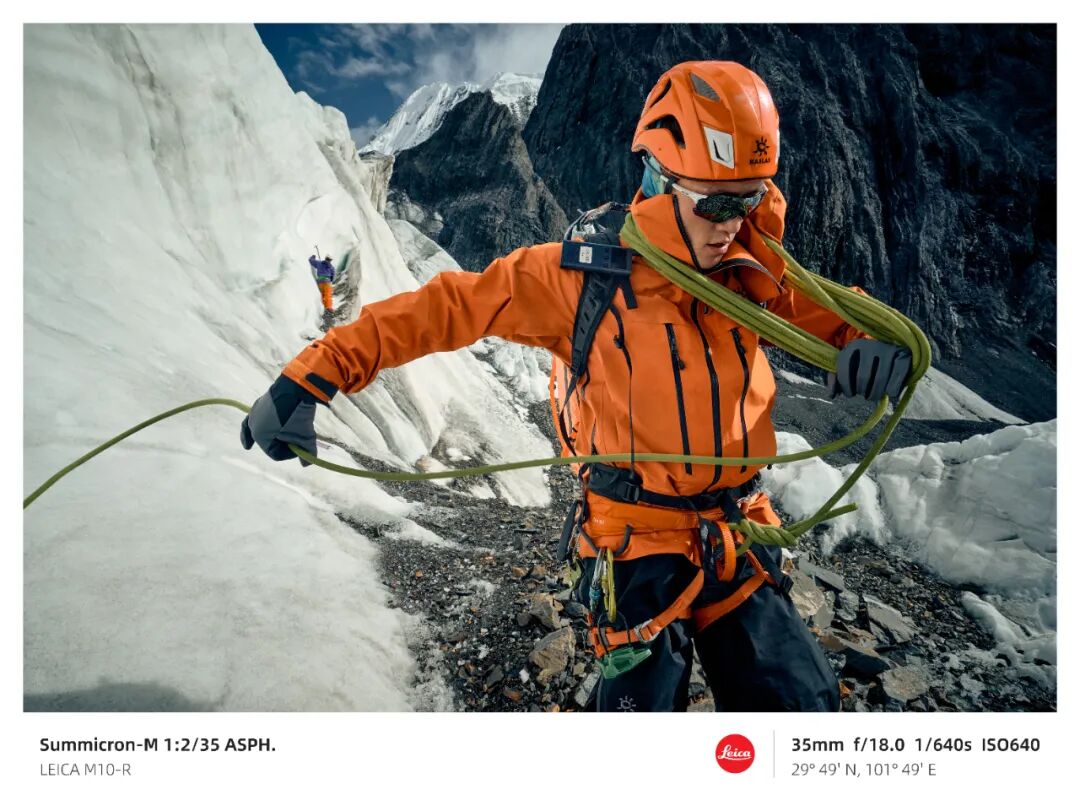
Photography by Yang Lu
After returning to Chengdu, these photos were included in the "First Snow Mountain in Life" photography exhibition. The panting, wind, snow and blue glaciers that several people experienced in the mountains became images on the wall, and unexpectedly gave a push to other people.
Photographer An Qing is one of them. She was already longing for snow mountains. Inspired by the exhibition, she and other people who later loved outdoor activities went hiking in Jiujiahai together, and had her own high-altitude memory. She said, "The photos you see are all from others. If you want to have your own, go get it by yourself."
Return to Leduomanin, take the snow mountain as a mirror
After 2023, China's outdoor boom continued to heat up, and Leduomanin quickly entered the public's vision from the once relatively niche destination.
In early 2025, Kailas returned to Leduomanin for research. Local people said that two years ago, even on the National Day holiday, there were only dozens of people entering the mountain, but by the National Day holiday in 2024, hundreds of people had poured into the valley in one day at the peak, and the business of homestays, horse gangs and hot springs all became hot accordingly.
It was this survey that made Kailas decide not to look for the next mountain, but to invite the five photographers from two years ago to come back and return to Leduomanin.
For the outdoor industry, "the next mountain" is always tempting. New altitude, new routes and new scenery are easier to create excitement. But the meaning of returning is the opposite: put the same people back in the same place, and see what exactly time has left behind.
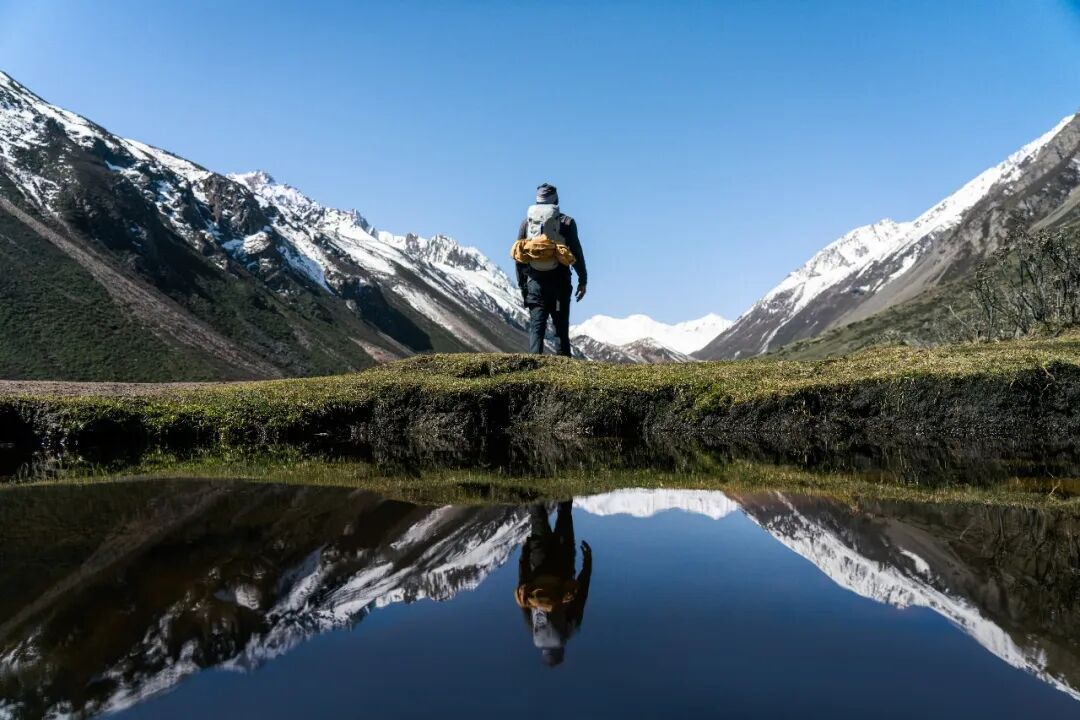
When Wang Jingwei received the invitation, his first reaction was "that's great".
This time, he specially prepared a fully manual 120 medium-format film camera. Compared with the unlimited shooting times of digital cameras, this time he decided to cherish every opportunity to press the shutter.
In May 2025, the original team re-entered the mountain along roughly the same route as two years ago. In May, snow fell frequently in the mountains, the meadows had not yet fully turned green, and the snow peaks and glaciers looked colder and closer. The weather in the Mount Gongga area is changeable, and clouds, sunshine, wind and snow constantly change the light on the glacier surface, "Leduomanin Blue" presents richer colors.
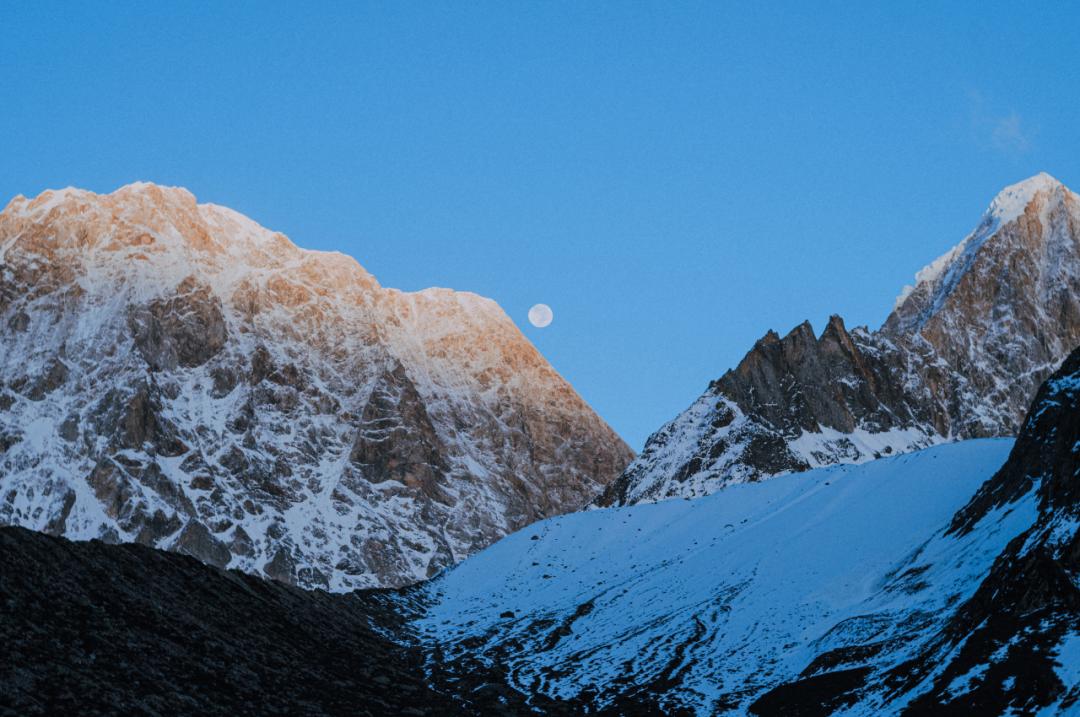
Photography by Tang Ningxin
People set off with expectations. This time, Wang Jingwei unexpectedly found that he was not as mentally exhausted as he was the first time.
When he entered the mountain in 2023, he had a strong sense of purpose all the time. He always thought about not falling behind, not slowing down others, and rushing to the next camp as soon as possible. Two years later, when he walked the same road again, his mentality changed: when he was tired, he would directly say "let's take a rest"; when his physical strength could not keep up, he no longer rushed to prove anything.
Only when people slow down can some things emerge. There is no signal in the mountain, no constantly popping up messages, and the surroundings are surprisingly quiet. As he walked, fragments of his past life flashed through his mind like a movie, with no one to disturb him, "You can completely re-examine your past."
When he was tired occasionally, he liked to chat with the guide. He described their relationship as "strange old friends" — even though they had known each other for a short time, they would talk about things that even friends who had known for more than ten years in the city might not have told.
He used that precious film camera to record the changes. Two years ago, he was once attracted by the grand snow mountain, this time, he is more willing to stop for the people in those extreme sceneries.
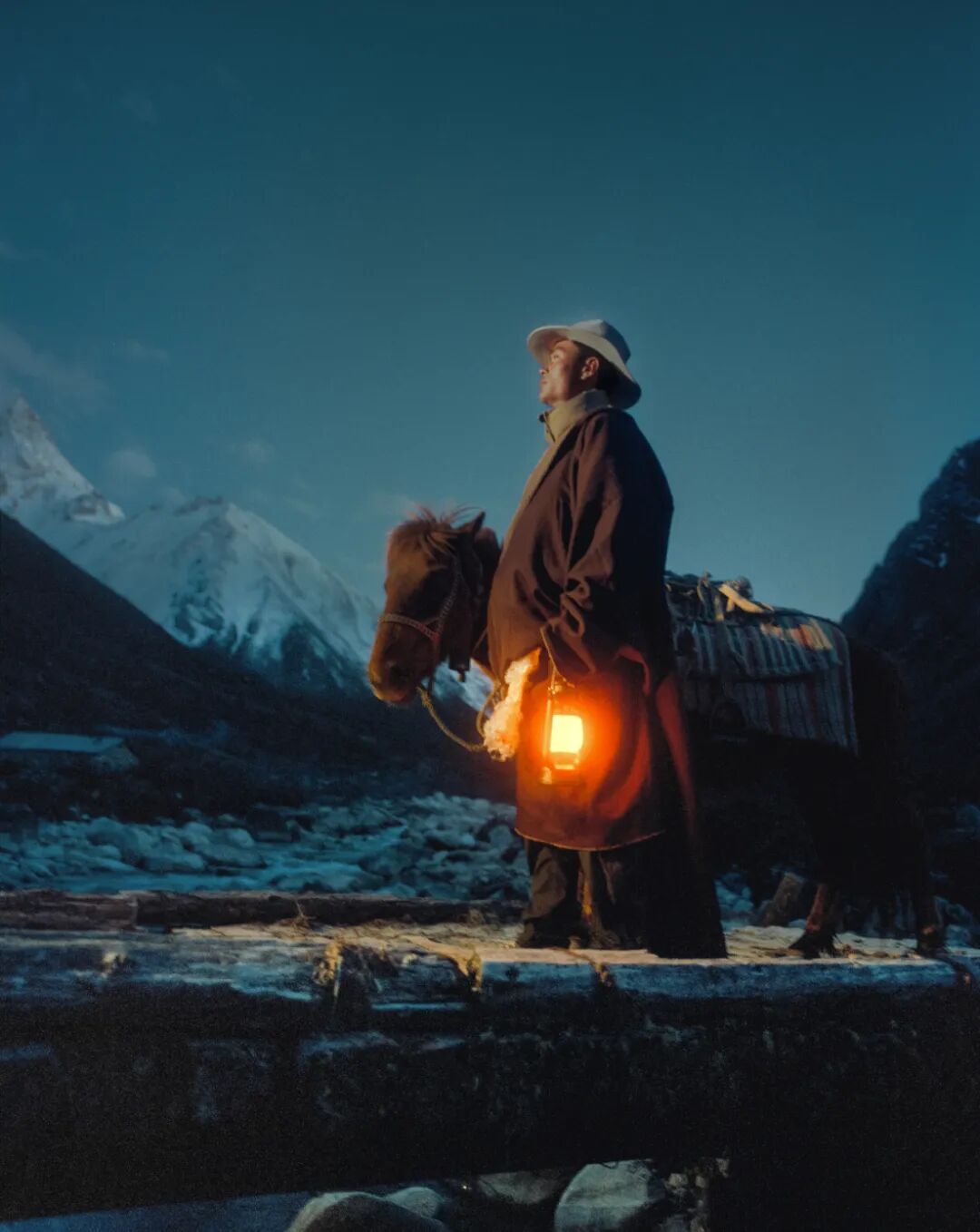
Photography by Wang Jingwei, "Light on the Way Home"
One evening, he was resting in the camp when he suddenly saw a Tibetan passing by the camp with a horse and a lantern. He picked up his camera and chased after him. It was already the blue hour of the day, the snow mountains in the distance only had faint cold light, and the lantern in front was warm. He stepped into the shallow water, lowered the camera position, and pressed the shutter with a slow shutter speed of 1/4 second. In the end, he named this moment "Light on the Way Home".
This time, everyone's lens is changing with time. Photographer Wu Min shifted his lens from the distant snow peaks to the water reflections, garbage and tiny lives; Tang Ningxin also began to shoot more horse gangs, herders and people living in the mountains. The mountain is still there, but the people who returned gradually began to see the people in the mountain, and also see themselves.
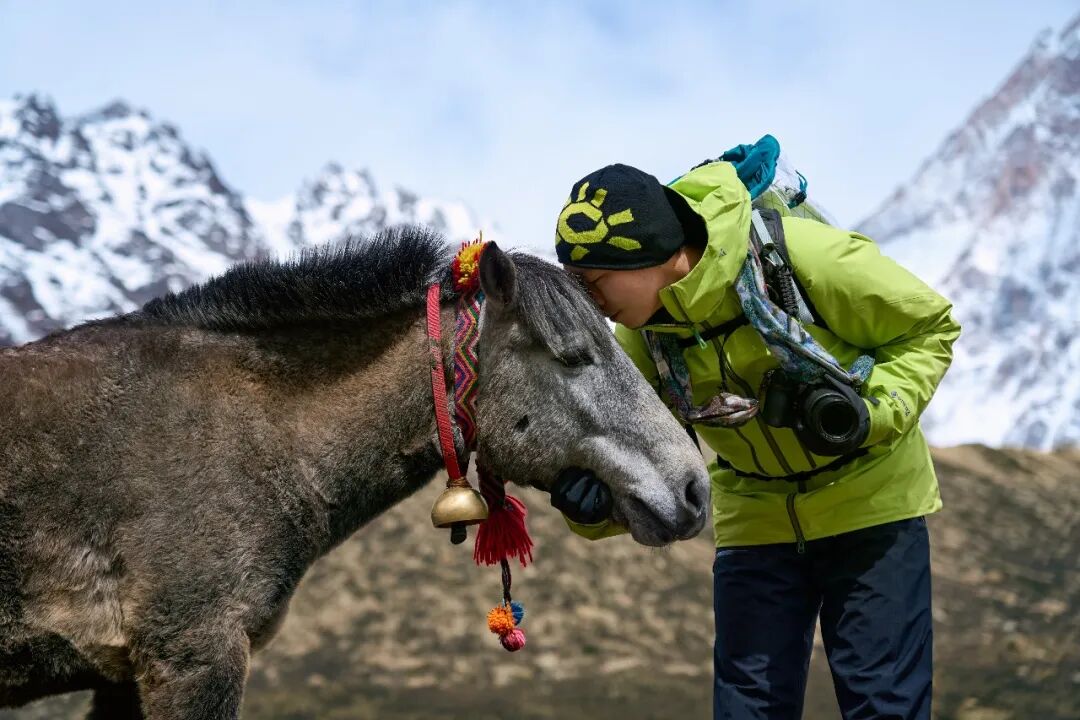
Group photo of Wu Min and local horses
In the second half of the trip, Wang Jingwei's leg was injured, and there was effusion in his knee. Two years ago, he planned to complete the climb of a small peak near the ice lake, but he descended in advance due to work; this time, the wish to "summit" a peak still did not come true.
But regret seems to have become part of the journey.
Wang Jingwei later described mountaineering as a kind of "practice": it is very similar to life, not every effort will bring a perfect result. What really matters is that after confirming that you have tried your best, you can also accept stopping. "Even if I didn't stand at the highest place in the end, I didn't miss any of the beautiful scenery along the way."
The poet T.S. Eliot said in Four Quartets, The end of our exploring will be to arrive where we started and know the place for the first time.
Returning to Leduomanin is like a mirror, allowing people to slowly see the truth of mountaineering in the two years after leaving the snow mountain — it is no longer about reaching the summit, but a process for a person to re-calibrate himself in front of nature.