Roundtable: From Export to Local Establishment: How Can Chinese Enterprises Achieve Overseas Localization? | 36Kr 2026 East Forward Global Expansion Summit
In 2026, Chinese enterprises' global expansion is shifting from "seeking incremental growth" to long-term global operation. On September 17, the 2nd 36Kr East Forward Global Expansion Summit 2026, themed "Riding the Tide, Reaching the Shore", was held in Shanghai. Global-oriented enterprises, investment institutions from the consumer, technology, manufacturing and other sectors, as well as globalization service providers gathered at the event, to discuss practical issues including localized operation, user insight, supply chain, compliance, channels and global organization. When "going global" is no longer a niche choice, enterprises have to face the real core problem: how to survive and take root in overseas markets, turn one-time market breakthrough into sustainable operation, and gradually build their own global competitiveness.
The following dialogue has been edited and organized by 36Kr:
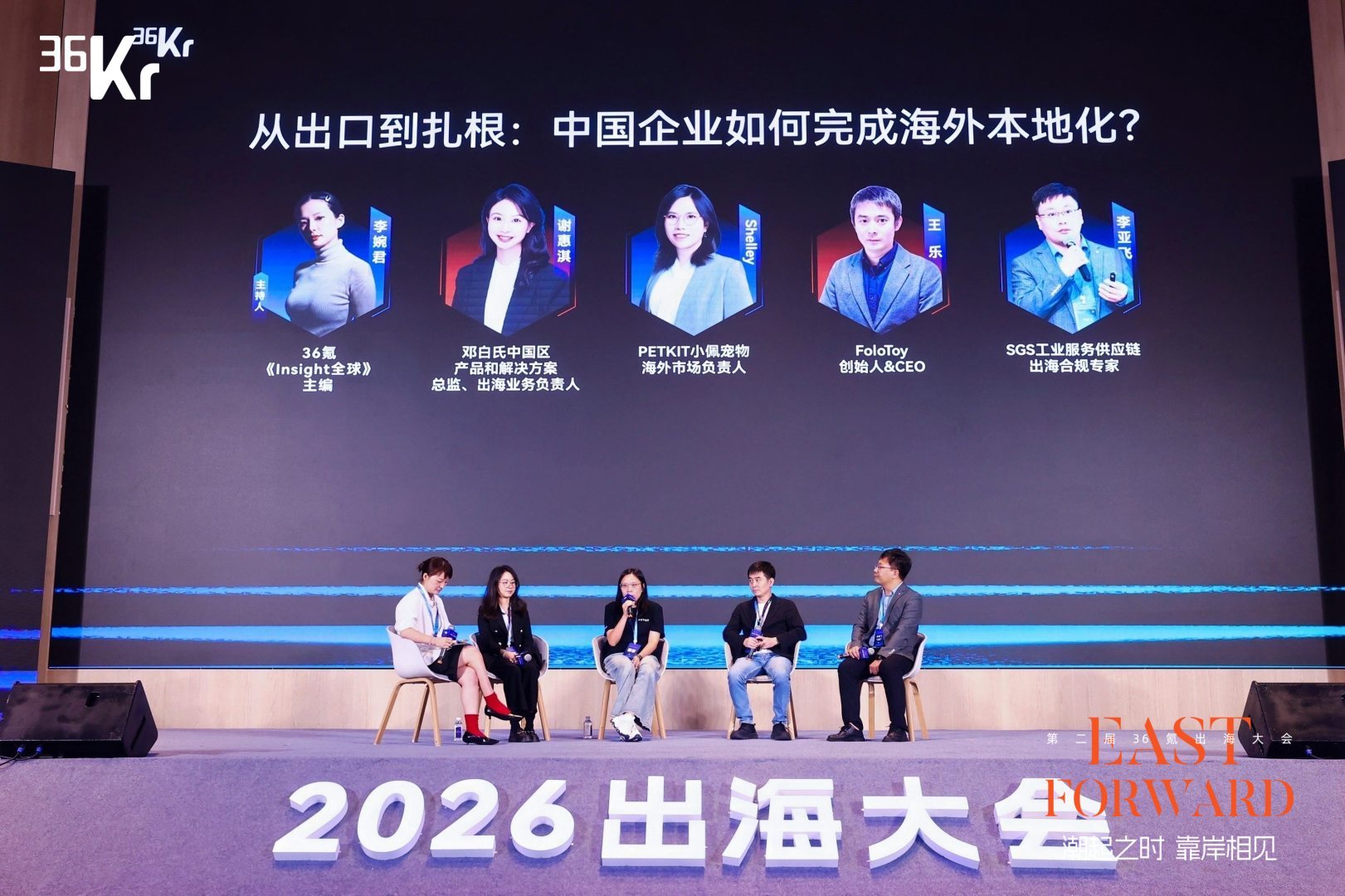
LI Wanjun | Chief Editor of 36Kr Insight Global (Host)
XIE Huiqi | Director of Product and Solutions, Head of Global Expansion Business, Dun & Bradstreet China
Shelley | Head of Overseas Market, PETKIT
WANG Le | Founder & CEO, FoloToy
LI Yafei | Supply Chain Global Expansion Compliance Expert, SGS Industrial Services
LI Wanjun (Host): Thank you, good morning everyone! I'm Wanjun from 36Kr. It's my great pleasure and honor to welcome all of you to the 2nd 36Kr Global Expansion Summit. As we hold this event for the second year, I'm very happy to have the opportunity to gather here with you today to talk about the new changes and new insights of global expansion in 2026.
The theme of today's roundtable is: From Export to Local Rooting: How Can Chinese Enterprises Achieve Overseas Localization? Localization is a topic that has been frequently discussed among practitioners in the global expansion field, yet it always brings new insights every time we talk about it. It is never a simple task, especially in the current context, localization has become quite complex.
Of course, we have many distinguished guests joining the discussion today, and we have a wide range of topics to cover, including product development, compliance, and partner cooperation, which I'm really looking forward to. First of all, let's invite the guests on stage to introduce themselves.
XIE Huiqi: Hello everyone! I'm Xie Huiqi from the Product and Solutions team of Dun & Bradstreet China, and I'm also the head of our global expansion business. Dun & Bradstreet is a professional commercial information service provider, we mainly help enterprises solve several types of problems:
First, how to select suitable overseas markets?
Second, how to acquire partners and customers?
Third, how to manage the global expansion risks of enterprises?
Fourth, after taking root in overseas markets, how to effectively operate, empower sales and manage payment collection terms to improve operational efficiency.
With the development of AI technology, we are gradually combining global commercial data with AI, so that more enterprises can access and use commercial information faster, integrate it into their agent workflow, and support enterprise decision-making. I'm very glad to be at the 36Kr Global Expansion Summit today to explore with everyone how enterprises can set sail and take root overseas under the new wave. Thank you!
Shelley: Hello everyone! I'm Shelley from PETKIT, I'm in charge of the company's global marketing team. PETKIT is a smart pet product brand founded in 2013, and so far we are the world's top 1 brand in the smart pet product sector. We entered the industry with capabilities in wearable devices and IoT, and with the development of the pet economy and the rise of global expansion wave, our global brand influence has achieved remarkable growth in the past decade.
Since the AI wave started sweeping the world from 2023, we have also embedded AI capabilities into our products, and created our exclusive AI-powered health-focused product form.
WANG Le: Good morning, distinguished guests! I'm Wang Le, the founder of FoloToy. FoloToy is a company focused on AI toys and AI hardware. We started operation in 2023. Right after the release of ChatGPT, we started thinking about how to combine large language models with hardware, and how to integrate them into family life scenarios, then we launched our product in the form of toys. Almost all products of our company are built around AI. Without AI, there would be no products of our company. An interesting point is that since we build our business around AI, and products like ChatGPT first emerged overseas, we naturally launched our products in overseas markets at the first step. With the development of models and technologies both at home and abroad, our products have been popularized in both domestic and overseas markets along with the popularization of the model market.
LI Yafei: Good morning everyone! I'm Li Yafei from SGS-CSTC Standards Technical Services Co., Ltd., which is widely known as SGS. I'm responsible for product certification in China, and I'm the technical lead for compliance of Chinese enterprises building factories overseas. SGS is headquartered in Switzerland, with around 100,000 employees globally and about 19,000 compliance experts in China, who help Chinese enterprises get their products to overseas markets. In the current booming global expansion trend, when new energy and lithium battery enterprises build lithium battery factories and new energy vehicle factories overseas, we provide them with local product compliance services. Thank you all!
LI Wanjun (Host): After the introductions just now, we have covered not only the traditional core sectors, but also the emerging new sectors, so we have a huge number of tracks and topics to discuss today. Since our roundtable only lasts 45 minutes, I will try to reserve as much time as possible for the guests on stage to share more insights.
The topic of enterprises "going global" no longer needs further discussion. What we want to discuss is what to do after going global? The proven successful experience of landing brands in overseas markets, the lessons learned from past pitfalls, and the issues we have been focusing on including compliance, factory construction, capital management, and partner selection, are all very critical points in the localization process.
Today we will discuss several core issues with the guests. From export to local rooting, what capability gaps do Chinese enterprises still have? How to fully understand overseas users, including what operational capabilities of enterprises can be reused, and what capabilities need to be rebuilt after entering overseas markets. We all say that running a company and developing products are essentially about resource allocation. At the end of the day, when the budget is limited, what should we prioritize doing first? I'm very much looking forward to hearing your thoughts.
The first question: Generally speaking, in your opinion, when enterprises try to take root in overseas markets this year, after going through the 1.0 and 2.0 stages of global expansion, we have now entered the 3.0 stage. Based on your own experience and the experience of the brands you have contacted, what are the most easily overlooked and underestimated difficulties? Please share your insights based on your respective experience and observations.
XIE Huiqi: In recent years, Dun & Bradstreet has been cooperating with many local governments. In addition to outputting our own global expansion solutions, we have also built comprehensive enterprise global expansion service platforms with local governments in Nanshan District of Shenzhen in Greater Bay Area, Shanghai, Jiangsu and many other regions. Through these platforms, we have contacted a large number of different global-oriented enterprises, ranging from start-ups, unicorns, mid-sized enterprises, to large leading core enterprises in the industrial chain.
We can see that Chinese enterprises' global expansion has entered the deep-water zone. For example, some 3D printing or laser engraving enterprises I got to know and contacted ten years ago, many of their products were initially built from 0 to 1 by individual makers, and sold to overseas markets through overseas crowdfunding. A dozen years later, some of them have successfully expanded to multiple national markets, and some have even gone public in the capital market.
In the process of continuous follow-up and service for these enterprises, they gave me very direct feedback: when they just started expanding overseas with a very small team, the boss and sales team had a very clear understanding of every customer and every market. But as the business scale continues to expand, they may gradually expand to more overseas markets, and even set up their own subsidiaries or offices in other countries. From the perspective of business leaders and decision-makers, the difficulty gradually becomes whether they can maintain continuously updated understanding of customers and local enterprises.
For example, the sales team of the enterprise may give feedback that local distributors in a certain market perform very well, and the orders are continuously increasing. From the financial perspective, they may find that a certain distributor's payment collection is slightly slower recently. From the after-sales perspective, they may find that there are still some unsolved problems and unmet scenarios for customers in a certain market. In the end, when it comes to enterprise decision-making, these information, data and feedback are scattered in the minds of different departments or individual business personnel, which leads to the strategic judgments and decisions made by enterprise decision-makers at a certain global expansion stage may mismatch the actual market situation they are facing. This is exactly the point that enterprises are easy to ignore or underestimate. The ability to maintain a clear understanding of current enterprises and markets while the business is continuously expanding highly depends on a unified data base among all departments, which can connect credible and real business data and break the "department silo".
Nowadays everyone is using AI, many enterprises have completed digital transformation in the last business cycle. Only by enabling all teams to quickly grasp the actual business operation information, can we better support enterprise decision-makers to make more appropriate and adaptive strategic decisions.
LI Wanjun (Host): That's a very great point, I totally agree with you. When I talked with some brands before, I also found these problems: the larger the enterprise and brand grows, the deeper this gap becomes. I may stay in the US all the time, but what about the Japanese market? What about the European market? Most of the time, I can only rely on the judgment of the managers or the staff assigned to those markets. At this time, people from different departments hold different opinions, and it is a huge problem for decision-makers to decide which opinion to follow.
Shelley: My point is quite similar to what Dun & Bradstreet shared. To some extent, many people think that selling products is the end point, but from our perspective, selling products is just the starting point. Every first unit of product sold in a market should serve as a window for you to collect information and promote your brand in that market. But many Chinese enterprises we have seen fail to realize this point. They may think that as long as they get the so-called insights from the platform, or find the so-called product-market fit, they can sell the products in the market at a low price, or launch products with exaggerated parameters, and finish the first step of selling goods.
But after selling the products, does it mean the start of success or the start of disaster? If you don't have enough market experience, it is a 50-50 situation. We have seen many platform sellers on Amazon in the US register a brand name that even local Americans can't pronounce, list the products for sale, push the products to bestseller, and disappear the next year. Such cases happen every day on every platform, in every country and every market.
On the contrary, what kind of companies can achieve long-term operation? We believe every product should carry the core value that connects the brand with consumers.
This point is very important, but it is not a high-efficiency task. Its success takes time, and its verification also takes time, which is very easy to be ignored.
LI Wanjun (Host): This experience is very real and very useful. Indeed, after the products are sold out, it sometimes becomes the start of disaster. The high overseas return rate can quickly pull down a brand in many cases. These are not so glamorous but very real experiences, thank you very much for sharing!
What's your observation, Mr. Wang? I know one of your products is very popular, it is now in pre-sale and sells very well. Your initial products also verified the overseas market and overseas users first. From 2023 to today, what is your own experience like?
WANG Le: Since we are a very early-stage startup, we did not find a mature category in the market to upgrade or innovate. Instead, we were thinking about what changes AI will bring to people's lives, and what the future form of hardware products, toys, and name badges should be based on these changes. We found many problems in this process:
When building a new category, we found that this category did not exist at all in overseas markets at that time. Even after two or three years, the growth rate is very fast now, the market size may multiply several times every year, but the total volume is still very small compared with existing categories, no matter it is the toy category or pet product category. This gives us a great opportunity to create a brand new category and form a brand new market from scratch, which is a huge opportunity for startups like us that start from zero.
Just now the previous guests shared the "new emerging three sectors", I can really feel that our products are launched first, and there may not even be relevant regulations in the local market. We not only have to face the problems of product iteration, model development and AI technology progress, but also have to face the problems of various regulations being established. For example, our products were first launched in the US in 2023, at that time there were no relevant regulations for AI toys, but up to now, there have been batches of regulations released in the US and Europe. I myself have participated in many parliamentary regulatory inquiry processes in the US and Europe, and participated in their legislation process. However, these legislations will restrict the unregulated wild growth of our toy products.
For example, Europe is gradually introducing regulations on how children can use toys safely. A series of regulations have been released in California of the US, which ban the sale of toys for children under a certain age.
For very emerging companies like us, the most important thing is that we confirm that the future market potential and capacity of this market is huge, but the challenges in the process are also huge. It is possible that your new hardware product was launched last month, and new regulations come out next month, so you can no longer sell this product.
From my experience, the update speed of overseas regulations is faster than that in China, they may ban your product very quickly. But in China, the technology iteration speed is faster, the regulation update speed is slightly slower, and the tolerance for new products is higher. Even though we are expanding overseas, we have a good opportunity to test our products in China first, then adjust our products according to the changes of overseas regulations.
There is another interesting point, I found that people all over the world, both in China and overseas, share a lot of common demands. People overseas are not totally different from us. Many basic human needs are similar, everyone pursues high-quality, cost-effective and high-standard products, this point will never change. So back to the essence, how a company defines its products and how to maintain its brand is the same everywhere.
LI Wanjun (Host): I can totally relate to that. Especially for new categories, as AI technology is changing with each passing day, the problems you face this month may be totally different from last month, the mentality is like riding a roller coaster. Starting a business is a process of continuously surging adrenaline, and the challenges are also huge, we can discuss this in detail later. Now let's invite Mr. Li to share, since you are more exposed to new energy projects and overseas factory construction, the business scale is larger, will the difficulties you face also be greater?
LI Yafei: From 2024 to last month, I spent most of my time overseas. With the SGS platform and the opportunity of Chinese enterprises' overseas investment, I have taken a "global trip", I have been to Africa, Asia, South America, and I just came back from Brazil, not to mention Europe.
From my personal experience and contact with Chinese enterprises expanding overseas, I think there is a very easily ignored problem for Chinese enterprises' global expansion now, that is compliance. In the past, when Chinese enterprises expanded overseas, they mainly focused on product export. At that time, they might pay attention to getting market access for their products sold to Europe and the US first, for example, getting CE certification, building local service capabilities and sales channels, and then setting up their sales model quickly.
But now, Chinese enterprises are facing a new situation of domestic production capacity transfer. They want to get closer to the target market. For example, there are new battery regulations now, many new energy battery enterprises are preparing to move their production lines and manufacturing supply chains overseas. Some Chinese enterprises started to do this as early as 2018, but they encountered many obstacles in the middle.
The most easily ignored part is compliance. Compliance is essentially certification and licensing. When you move your industrial chain and smart manufacturing factories overseas, it involves a very complex standard system. For example, you need to meet local environmental protection requirements. After the new prime minister of Hungary took office, the regulatory requirements are very strict now, the compliance requirements,