With the mass-produced Qiyuan robot priced under 20,000 yuan officially available for sale, what is the viable commercial path for household robots?
Official image provided
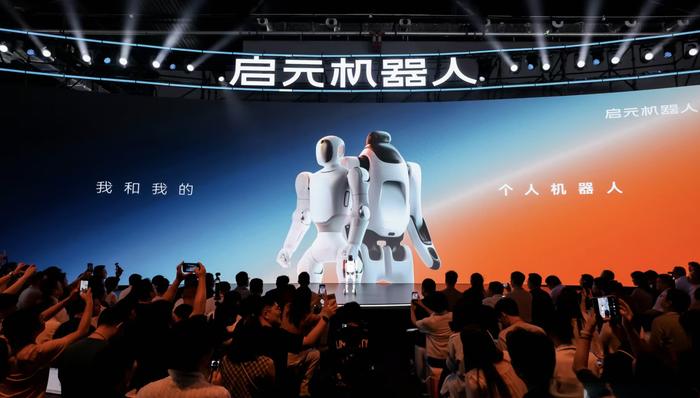
After three quarters of preparation and incubation, Qiyuan Robot under Sunway New Materials has finally been officially launched for sale.
On September 20, Qiyuan Robot launched two personal robots, Qiyuan Q1 and T1, in Shanghai. The long-speculated price was also announced simultaneously: the two basic versions are priced at 19,999 yuan each, with the Q1 Explorer version at 26,999 yuan and the T1 Pro at 29,999 yuan.
Since the debut of its first product on December 31 last year, Sunway New Materials has spent nine months launching mass-produced personal robots into the consumer market, with the price range comparable to the latest Apple foldable iPhone Duo.
However, after the price is finalized, the problems Qiyuan needs to face have only just begun. Why would consumers buy a robot to take home? What value can it provide for users? How can consumer embodied intelligence enterprises achieve commercial revenue?
On the day of the press conference, Tian Hua, CEO of Sunway New Materials, and Dong Hao, Chief Scientist of Qiyuan Research Institute, were interviewed by media including Jiemian News, giving systematic responses to issues such as why Qiyuan Robot targets the home scenario, the generalization challenge of embodied intelligence, as well as positioning, mass production and ecosystem.
When talking about the company's positioning, Tian Hua set Qiyuan's goal as "the Apple in the robotics industry". In addition to pursuing the high appearance and high quality of Apple products, he believes that personal robots have the opportunity to become the terminal interaction entrance in the AI era together with mobile phones.
Qiyuan Robot will have three sources of business revenue in the future: ontology sales, content (subscription and IP applications), and services (operation, maintenance and upkeep). Tian Hua believes that the real growth space lies in the latter two. "In fact, the ontology is only the entrance. The vast blue ocean for personal robots in the future lies in content, IP and experience."
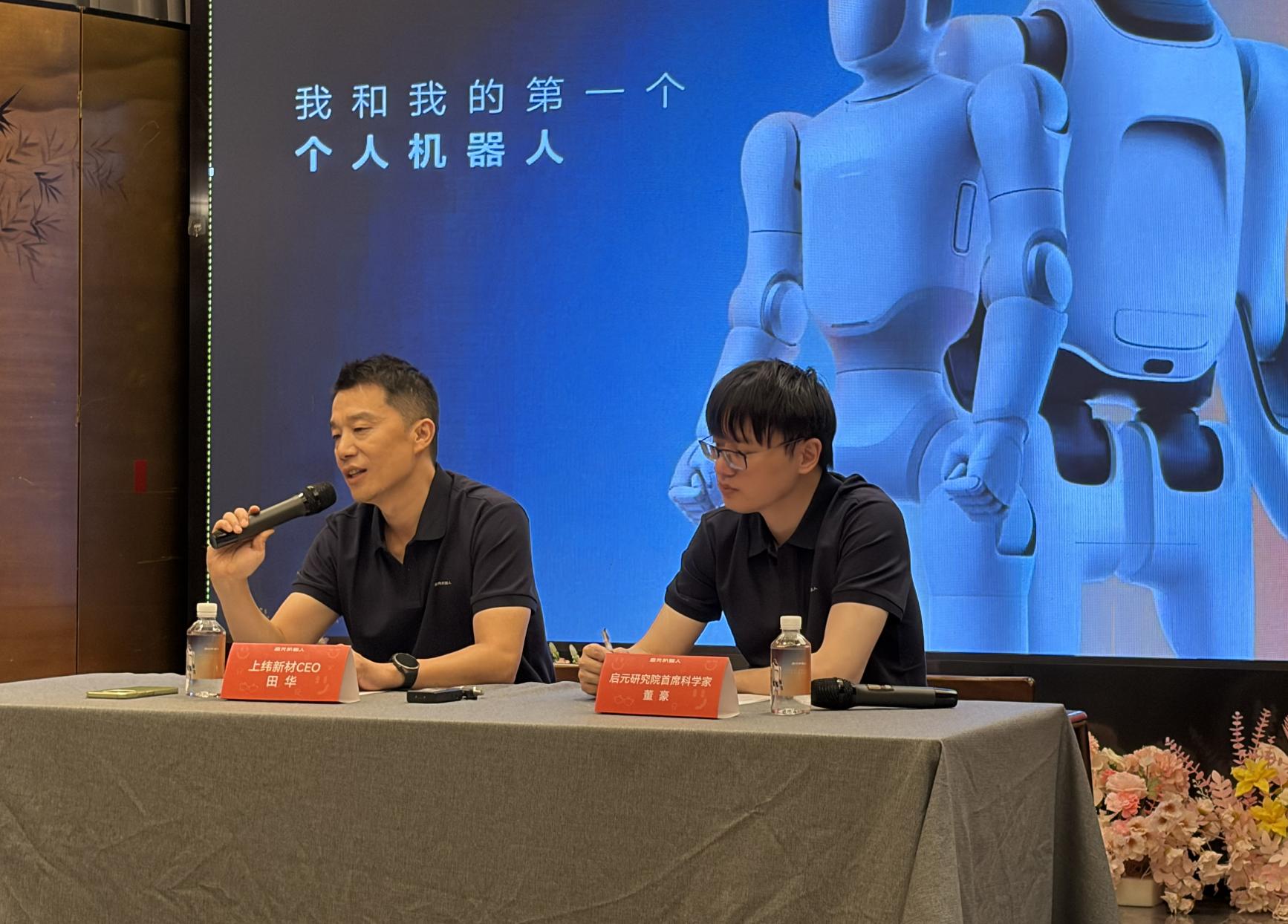
Tian Hua, CEO of Sunway New Materials, and Dong Hao, Chief Scientist of Qiyuan Research Institute. Photo by Jiemian News reporter
The core challenge of home robots lies in "generalization"
2026 is widely regarded by the industry as the first year of mass production for humanoid robots. According to TrendForce forecasts, the market size of humanoid robots in China will exceed 10 billion yuan this year.
However, from the exhibitions of more than 200 embodied intelligence enterprises at WAIC, most companies still choose the industrial scenario direction, and home robots remain a much harder route to verify.
Tian Hua mentioned to media including Jiemian News that there is currently an unwritten consensus in the industry: it is relatively easy to enter factories, but extremely difficult to enter households. Data in industrial scenarios is structured and the scenarios are simple; while households correspond to a highly complex unstructured environment. Therefore, Qiyuan Robot does not take complex housework as the core selling point in the first stage, but cuts in from education, companionship, entertainment and developer applications.
For example, Qiyuan Robot Q1 emphasizes children-oriented interaction, graphical programming and embodied intelligence enlightenment; T1 tries to integrate into family and outdoor life with capabilities such as switching between humanoid and quadruped forms, following, and carrying objects.
"Our original intention to enter the home scenario will not change just because it is difficult, it comes from our original aspiration." Tian Hua said that Qiyuan's goal is to become a leading enterprise in the field of consumer robots. In his view, product evolution has to go through three stages: the first stage is to be interesting, the second is to be useful, and the third is to be caring.
The actual operation capability is a problem that must be solved in the follow-up. Dong Hao, Chief Scientist of Sunway Qiyuan Research Institute, divided robot intelligence into interactive intelligence, motion intelligence and operation intelligence in the interview. The first two determine whether the robot can understand users and complete actions, while operation intelligence relates to whether the robot can truly undertake tasks.
Aiming at the generalization challenge of embodied intelligence, Dong Hao proposed the methodology of "Horizontal Scaling Law": instead of making ten tasks 70% done, it is better to make three tasks 100% done first, and then expand tasks horizontally on this basis.
Qiyuan's parent company, Sunway New Materials, is itself a listed company based on new material business. Tian Hua mentioned that the company currently adopts a two-wheel drive strategy: the new material business remains a stable source of main revenue, based on which it invests in the R&D of consumer-grade embodied intelligence.
Regarding investment, Tian Hua further gave the full-year expectation: "Our investment in the first half of the year has exceeded 160 million yuan, and it is expected to exceed about 500 million yuan this year." The expense will be mainly used to promote full-stack R&D in directions including robot ontology, motion control, multi-modal interaction and intelligent agents.
Where is the moat
When asked about the moat of consumer-grade robots, Tian Hua split robots into five categories: mechanism, electronics, software, operation and control, and further divided them into three dimensions: hardware, AI and ecosystem.
"It is a complex engineering project that cannot have any short board. It is easy for you to hand-make a prototype, and it is also easy to replicate a single unit, but it is extremely difficult to ensure batch consistency for 10,000 robots." Tian Hua said.
In the field of manufacturing and supply chain, China's consumer electronics industry has mature experience for reference. Qiyuan disclosed that its production process introduces the manufacturing rhythm and quality management methods of the automotive industry, with one robot off the assembly line every 2.5 minutes, and all product assembly data can be traced for a long time.
After crossing the thresholds of mass production and delivery, the second difficulty lies in user understanding: which point of the product can impress users, and why exactly users are willing to buy a robot. In the product experience officer session of this press conference, Qiyuan invited a number of celebrities including Huang Xiaoming, Hu Jun, Tian Liang & Ye Yixi, Tim and others, and spent a lot of time discussing the performance of safety, privacy, openness and playability.
In the past period of time, the consumer-grade robot market has warmed up significantly. Previously, Songyan Dynamics' "Xiaobumi" and UBTECH's U1 series for companion scenarios have all entered the competition.
However, Tian Hua summarized the current form of some robot products as still staying in the stage of eyeball economy of one-way display of stunts, lacking the support of ecosystem, gameplay and content, resulting in users only having a few minutes of enthusiasm and being difficult to form long-term stickiness. This is even a common problem in the whole industry.
The evaluation standard set up inside Qiyuan is whether the user usage duration can be extended to 30 minutes, one hour, two hours. In the future, the company will rely on monthly software version iterations to continuously improve the smoothness and playability of the product. Therefore, order cancellation rate, user retention and activity will be the tests after delivery.
Hardware entrance is not profitable, long-term commercialization lies in the ecosystem
Tian Hua believes that the long-term value of personal robots will not only stay on the hardware itself.
Taking iPhone as an example, it has more than 1 million applications. Tian Hua believes that if a robot does not have such an application ecosystem, content ecosystem and IP ecosystem, it is just a walking machine, and cannot be called an intelligent robot.
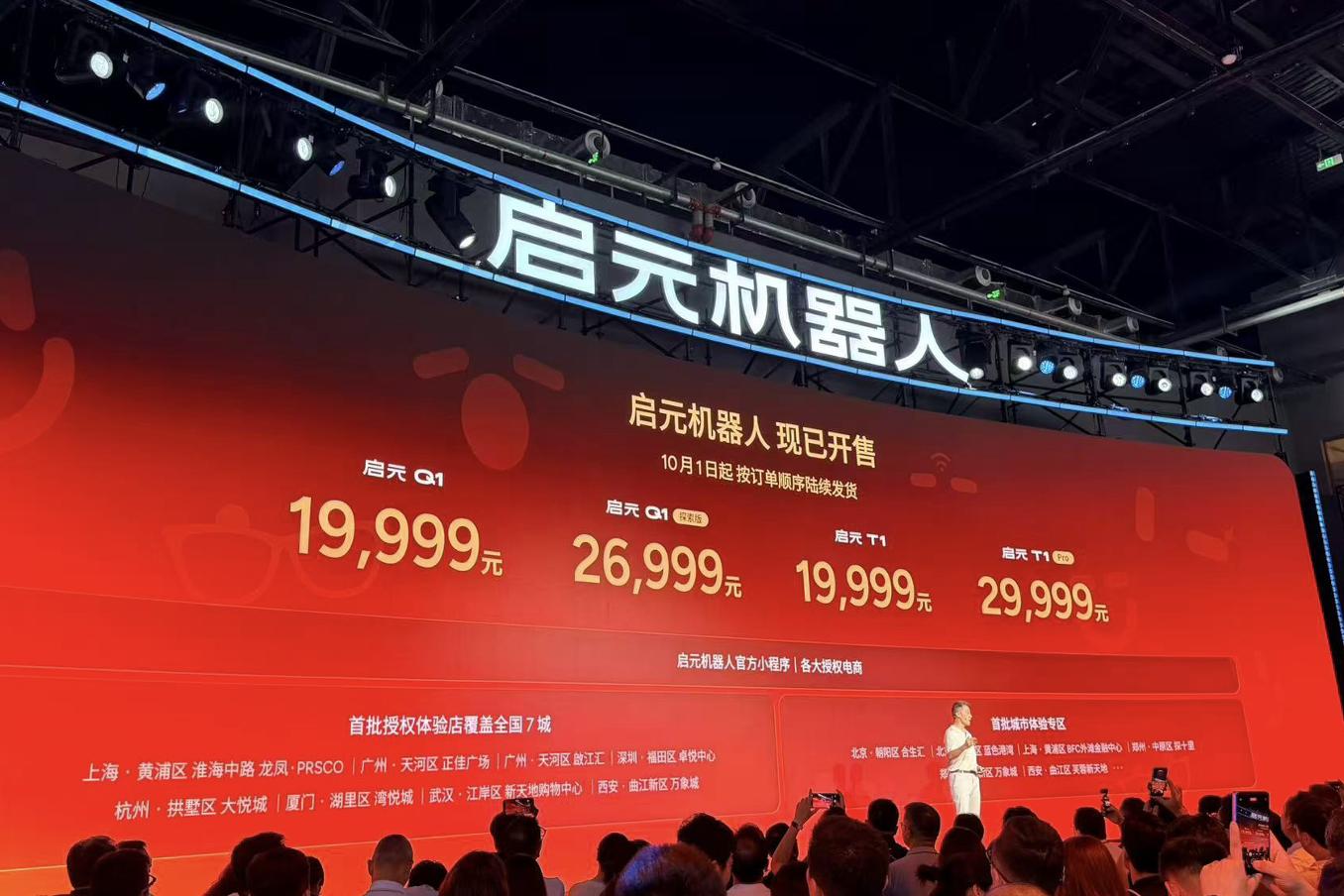
Qiyuan Robot is priced at less than 20,000 yuan, Tian Hua admitted that the hardware is not profitable. Official image provided
On the AI model side and the ecosystem side, Qiyuan Robot also announced core progress this time: PrimeMind is the base large model of Qiyuan Research Institute for home scenarios. The press conference simultaneously launched the Skill Store, Creator Workshop and Appearance Creation Platform, hoping to add new functions and gameplay for robots.
At present, more than 1000 developer partners have participated in co-creation, with more than 100 new Skills added every month. Partners include developer communities such as CSDN and Tencent WorkBuddy, and it has established cooperation with more than 20 universities including Peking University, Tsinghua University, Shanghai Jiao Tong University, Tongji University and East China Normal University. The Qiyuan Star Ecosystem Plan promises to invest 1 billion yuan in the next 5 years.
However, the successful experience of the mobile application ecosystem may not be directly replicated to the robotics industry. First of all, robot applications involve physical interaction, so the development cost and adaptation difficulty may be higher. Secondly, users' willingness to pay for the robot ecosystem still needs to be verified. Tian Hua revealed that in the internal test phase of previous products, the activity of the developer group has exceeded expectations.
At the channel level, Qiyuan will focus more on online and offline store sales. At present, the first batch of authorized brand experience stores have covered 7 cities including Shanghai, Guangzhou, Shenzhen, Hangzhou, Xiamen, Wuhan and Xi'an. The store expansion rhythm is to first complete the coverage of first-tier and second-tier cities, and then consider sinking to lower-tier markets.
In terms of going global, Tian Hua said that the layout will be completed this year, and next year will be the first year of overseas sales, expecting overseas revenue to account for about 30% of the revenue of the robot segment. For the impact of relevant US FCC bans, Qiyuan will deal with it through components and local partners.
As for when consumer-grade robots can truly become popular, the timetable may not be short. Tian Hua said he once asked Zhihuijun "how long it will take", and the answer he got was 3 to 5 years. "Instead of waiting for things to happen, we make them happen."
This article is from "Jiemian News", author: Cheng Lu, authorized for release by 36Kr.