Meta is targeting brands' "content budgets"
Meta has been ramping up its investment in creator marketing and live streaming at an increasingly intensive pace recently.
Recently, Meta officially launched the Creator Marketing Hub, integrating the previously relatively separate Creator Marketplace and Partnership Ads Hub into a single entry, enabling brands to complete the full workflow from finding creators and discovering content to content authorization and ad delivery in an environment that supports a far more complete operational chain.
At the same time, Meta also announced that it will expand Instagram Live Video Ads starting from September 29, allowing brands to directly add paid promotion for creators' Instagram live streams, bringing live content that originally relied mainly on organic traffic to a larger audience.
Overall, what Meta is scaling up are two increasingly important types of content supply — content produced by creators, and real-time live content generated by creators.
So why is Meta continuously increasing its investment in this business at this point in time? The answer lies in the changes in the advertising industry and the entire creator marketing market.
From "Finding Creators" to "Finding Content"
Let's first briefly introduce the Creator Marketplace and Partnership Ads Hub.
The Creator Marketplace can be understood as Meta's "creator discovery platform", which mainly solves the problem of "where brands can find creators". Brands can look for partners based on information such as creators' content and audience demographics, and advance cooperation through the platform. Meta previously disclosed that the Creator Marketplace already has more than 5 million Instagram creators.
The Partnership Ads Hub solves the problems after the cooperation is reached. After brands and creators complete content cooperation, they can obtain authorization from creators to convert the organic content originally posted on Instagram or Facebook into Partnership Ads, and then carry out paid promotion in the creator's identity and original content form.
The launch of the Creator Marketing Hub this time brings these two previously separate sets of capabilities into one platform. For brands, the operation path is also extended accordingly. In the past, the usual process was to first find creators, then negotiate cooperation, produce content, obtain authorization, and finally decide whether to run ads. Meta now further adds "content discovery" to this workflow.
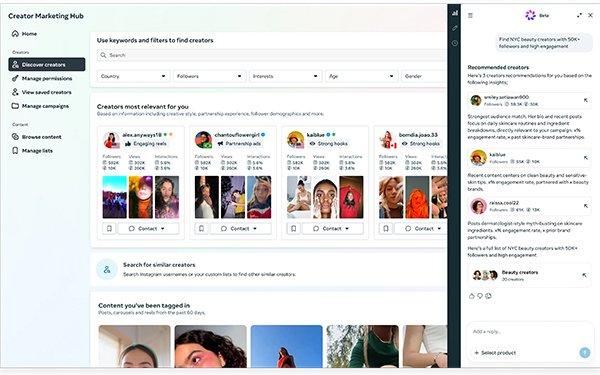
For example, if a brand has a specific product or marketing theme, it can directly search for relevant content that already exists on the platform. A piece of creator content may enter the brand's screening range because it is highly relevant to the product, or because of its outstanding interaction performance. Meta is also expanding the Content Discovery API, enabling brand partners to discover creator content through conditions such as keywords, content types, and performance, obtain recommendations for high-performing content, and further determine which UGC meets the requirements for direct ad delivery.
Here we can understand the two APIs in a simple way: the Creator Marketplace API is responsible for "finding people", and the Content Discovery API is responsible for "finding content".
Previously, the Creator Marketplace API was mainly oriented to Instagram creators. Now Meta plans to include Facebook creators as well, expanding the scope of creators that brands can search for. The Content Discovery API extends brands' focus from the creators themselves to the content that creators have already produced.
After finding suitable creators or content, Meta connects the subsequent cooperation links. The new Messaging API allows brands to directly contact creators to discuss potential cooperation; the content authorization scope and expiration time can also be viewed on the platform. After obtaining authorization, brands can directly create partnership ads. At the same time, Meta is also increasing the types of content that can be converted into partnership ads, making more organic content eligible to enter the paid delivery process.
Putting all these actions together, the focus of Meta's this round of adjustment is quite clear — the target that brands need to pay attention to is extending from a "creator list" to a larger "content pool".
A creator with millions of followers does not mean that every piece of their content is suitable for advertising; a creator with a limited number of followers may generate higher commercial value because a certain piece of their content precisely hits the product selling point, consumption scenario or user sentiment.
For brands, choosing a creator is only the starting point. They need to go deeper from "is this creator worth cooperating with" to "which piece of content produced by this creator is worth investing budget in".
Meta is also incorporating live streaming into this logic. For Live Video Ads, brands can use creators' live content as partnership ads for paid amplification. Live streaming itself has strong real-time nature, and content such as new product launches, product demonstrations, live commerce, and offline activities all rely on specific time windows. With the injection of paid traffic, the reach of a live stream will no longer be limited to the creator's original followers and organic traffic.
In summary, Meta is further connecting creator marketing and ad delivery, guiding brands to shift from "finding creators" to "finding and investing in content".
Why is Meta scaling up its efforts now?
To understand why Meta is suddenly pushing creator marketing forward, we first need to look at its own advertising business.
Meta is a company that highly relies on advertising revenue, and the advertising business remains its core business model. In the second quarter of 2026, Meta's advertising revenue increased by 27.5% year on year, higher than the 17% growth rate of Google's search ads in the same period. Market analysis even predicts that Meta is expected to become one of the world's largest digital advertising platforms in 2026.
This means that for Meta, any content form that can attract more advertising budget, improve delivery efficiency, and continuously provide fresh ad materials is worth continued investment.
Creator content exactly meets all these demands at the same time.
On the one hand, brands increasingly need creators to enter consumers' daily content scenarios. Reviews, experiences, recommendations, UGC and live streaming are not only playing the role of exposure, but also getting closer to the links where consumers get to know products, compare products, and even make purchase decisions.
A more direct change takes place at the "budget end". According to the *2025 Content Creator Economy Report* released by IAB, 45% of consumers' purchase behaviors are influenced by recommendations from content creators, and the advertising expenditure in the content creator economy continues to grow, with a growth rate four times that of the overall media expenditure.
This shows that creator marketing is gradually moving from a relatively independent marketing budget to the mainstream media budget. Brands are willing to continuously increase investment in creator content, and the platform naturally hopes to keep this part of the budget in its own advertising system.
Meta's Partnership Ads is a very direct example. According to the information made public in August this year, Partnership Ads has reached an annual revenue scale of about 10 billion US dollars, doubling within one year. This change means that creator content has had clear advertising value for Meta.
Another noteworthy change is that creator content is evolving from "one-time cooperation" to "continuous supply".
Traditional influencer marketing usually revolves around a single campaign: brands find several creators, complete content production and release, and then look for the next batch of partners after the project ends. What the platform hopes to promote is a more sustainable content production method — creators continuously generate content, brands select suitable content from it, and then amplify the high-performing content through advertising budget.
This also explains why Meta began to emphasize the Content Discovery API. A large amount of creator content is generated on the platform every day, and the real business problem has become: among so many pieces of content, which ones are worthy of brands' continued investment?
This is also the change taking place in the entire creator economy. In the past, brands were more likely to measure the value of a creator through indicators such as follower count and engagement rate. Now they increasingly need to evaluate the granularity down to specific content. Whether a piece of content can clearly introduce the product, whether a real experience can arouse discussions, and whether a live clip can drive conversions, may all become the basis for budget allocation.
Live streaming, on the other hand, provides another room for growth. Live streaming has become a very mature content form in the creator economy, which connects content consumption, real-time interaction and commercial transactions at the same time. TikTok is a typical case. According to The Wall Street Journal citing people familiar with the matter on September 16, ByteDance's revenue in the first half of 2026 exceeded 120 billion US dollars, with a year-on-year growth of more than 30%. International advertising, live streaming and e-commerce are all its main growth drivers.
Behind this figure, an increasingly clear platform business model is presented — content itself is becoming the entry point for commercial transactions. Short videos are responsible for discovery, creators are responsible for influence, live streaming is responsible for interaction and conversion, and advertising is responsible for further amplifying content. These links are being connected more and more closely.
What Meta is facing is exactly such an industry change. For it, creator marketing can hardly be regarded as a separate business anymore. Creators produce content, content captures users' attention, brands purchase traffic for content with commercial value, and the platform gains advertising revenue from it. The smoother the entire chain is, the more advertising budget creator content can support.
This article is from the WeChat official account "wj00816" (ID: Morketing), written by Alan Wang Jingxing, and authorized for release by 36Kr.