Jev has driven programmers all over the world crazy.
A plugin named HA-Jev has recently appeared in the smart home community Home Assistant.
Its logic is extremely simple: sensors read the power change of the washing machine and the status of the washing machine door, then throw a question to the model, "The washing machine has finished the cycle, are the clothes forgotten inside?" The model does not output any text analysis, only returns a probability value. When the confidence level exceeds 0.8, a reminder to take the clothes out pops up on the user's mobile phone.

HA-Jev is only used to remind users whether the washed clothes are still left in the washing machine | Image source: pitchhut
A single judgment takes tens of milliseconds and costs 0.000015 US dollars.
The plugin developer left a meaningful sentence on the forum: "I used to use large language models to answer questions that don't need them at all. Whether you have forgotten to take the clothes out is a judgment, not a stereotyped essay."
This sentence precisely hits the pain point of current generative AI. Over the past four years, the entire industry has poured almost all computing power, capital and engineering resources into "teaching models to speak more fluent human language". Everyone is accustomed to using huge models with tens of billions or even trillions of parameters to spit out a long sequence of thinking processes first, then package it into polite and considerate natural language, and finally let developers extract the required answers with complex regular expressions.
It was not until former OpenAI researcher Diogo Almeida appeared with his new model Jev. This model called "System One" has no "mouth", does not generate any text, and only outputs probability judgments.
Only a few days after its launch, developers around the world have launched nearly 500 open source projects around it. This is probably the next big trend after Openclaw
Everyone suddenly finds that once the desire of large models to express themselves is stripped away, the originally expensive and bloated AI applications suddenly become as light as a gust of wind.
01
The "Neurons" of Large Models
If we compare the past process of calling GPT-5 or Claude to hiring an omniscient philosopher to help you monitor the surveillance cameras, what developers are doing now with Jev is more like installing countless cheap and responsive neurons on the assembly line.
In the Agent infrastructure field that consumes the most computing power, this change is almost subversive.
In the past, the most commonly used method for developers to handle ultra-long contexts was to let large models generate summaries. Developer Tamara Tran came up with a different idea, and wrote a Jev plugin to compress the context of Claude Code. It does not make any induction or summary, but scores the relevance of each historical tool call one by one. As long as the score is lower than the threshold, the entire entry is directly eliminated.

Using Jev plugin to compress the context of Claude Code | Image source: X
The result is extremely remarkable: a bloated context close to 1 million tokens is reduced to 86,000 in 1 second, and the model does not generate a single character during the whole process. The insight here is very simple: summarization is an expensive generation behavior, but filtering is just a cold judgment.
Similar subversions have also taken place in mobile automation.

Using mobile-jev to operate mobile phones | Image source: jevfast.com
The Droidrun team created a mobile operation agent called mobile-jev. In a leaked demo, it controls a real Android phone to open Uber, enter the start point and end point, click precisely all the way to the payment interface, the whole process of 9 operation steps only takes 21 seconds.
No traditional text generation large model is called in the whole process. The text input is a plain text fragment directly extracted from the user's instruction, and where to click next on each interface, whether to swipe or confirm, all are handed over to Jev for extremely fast probability matching.
In addition to operating interfaces, developers even stuffed it into the oldest infrastructure.
pg-jev and duckdb-jev soon emerged on GitHub. Developers began to use natural language to directly perform real-time probability filtering and sorting on the row data of the database. In the Ruby community, some people directly encapsulate the judgment into native control flow syntax, and the written code looks like giving the program intuition.

Using Jev to play "StarCraft" has become a series of Github projects | Image source: Github
In the gaming field, some people let Jev control the simulator state to play Super Mario, some let it drive the guards in Doom, and even a team connected it to StarCraft to complete the first combat mission. What games need is operation decisions within tens of milliseconds. In the past, before the traditional large model could even sort out the idea for the first frame, the game character had already died.
Even in tedious work such as data cleaning, the gap is so huge that it is shocking.
A developer had 9081 pieces of product matching data accumulated for three months. As early as June, he used the mainstream large model to measure the cost, and the expensive API fee made him give up directly. After switching to Jev, he spent one night writing 150 lines of scripts, the whole task was completed in 13 minutes, and the total bill was only 32 cents.
When large models no longer pretend to be erudite humans, AI can truly be embedded into the capillaries of automated software.
02
The Jevons Paradox
The name Jevev comes from William Stanley Jevons, a 19th century British economist.
The famous "Jevons Paradox" in economics points out that when technological progress improves the utilization efficiency of a certain resource and leads to a significant drop in its use cost, the total consumption of this resource will not decrease, but will show explosive growth.
TypeSafe AI sets the price of Jev at only 0.042 US dollars per million input tokens, with free output. According to this tariff, 10,000 business decisions are made a day, and the monthly cost is about 120 US dollars. In the past, if a top reasoning large model with the same accuracy was used to complete this process, the monthly bill would go straight to 35,000 US dollars.
The plummeting cost instantly activates those edge scenarios that were previously judged to be "commercially worthless".
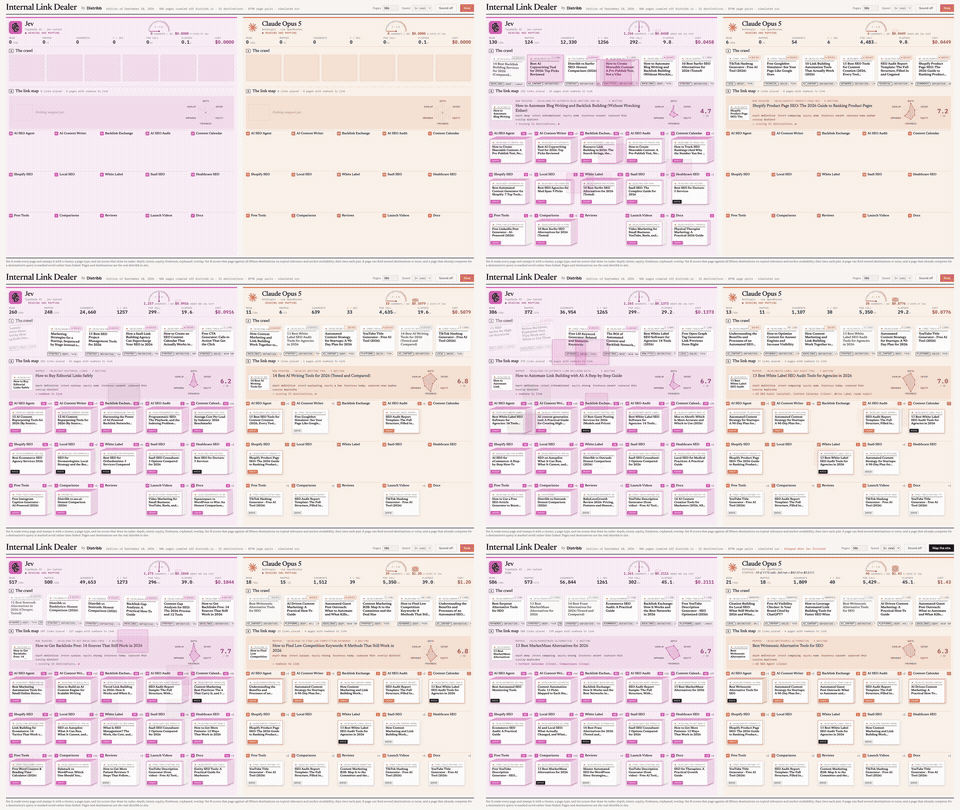
Using Jev for SEO is surprisingly fast | Image source: X
In the field of content analysis, the founder of Distribb used Jev to scan nearly 600 web pages, completed the reconstruction of the internal link map in 45 seconds, and set up more than 500 links, with a total cost of 21 cents. In the past, if a top large model was used to do this, it could not even read 20 pages in the same amount of time.
The founder's exclamation hits the essence: "This is not content creation, it's just 8790 decision-making questions of judging whether to link or not."
This also explains why founder Diogo Almeida left that exclamation when he left OpenAI: "We hold a flash of lightning in our hands, but it is not so easy to use."
As a core researcher who participated in the construction of ChatGPT and co-invented RLHF, Almeida's reflection carries the coldness of an insider in the industry. In his view, the entire industry has been trapped in the dead end of "optimizing human natural language" for too long.
Cooperation between computers does not need cadenced rhetoric. What machines need are clear instructions and probabilities. The language ability that the AI industry has spent trillions of dollars to train in the past four years is mostly an inefficient obstacle in the face of serious system engineering.
Armin Ronacher, CTO of the Pi framework, spoke bluntly about this phenomenon: "We should have realized this long ago. Just because the mainstream large models have been subsidized by venture capital to be extremely cheap before, everyone is used to squandering and no one is willing to do real creative thinking."
Once this cheap illusion is broken, the shift of architecture design will be irreversible.
Large models are returning to the position they should have been in.
It should not act as the central processing unit, it is more suitable to be the public relations spokesperson at the front end. In the future system architecture, massive millisecond-level judgments will be handed over to intuitive models that are as cheap as tap water. Only in very few scenarios where it is truly necessary to output paragraphs of text to human users, provide emotional value or draft complex long reports, will the expensive generative model be woken up.
03
The Separation of "Judgment" and "Generation"
Looking back at the AI narrative over the past three years, the main line has always been "large models are getting bigger, smarter and more versatile". One model can not only chat, but also write code, and can also process images and make tables, doing everything. The entire industry defaults that "intelligence" is a single whole that cannot be split.
The emergence of Jev tore apart this whole. It proves that some tasks require reasoning and expression, while others only require fast judgment. Binding the two together is a structural waste.

The popularity of Jev has ignited the enthusiasm of the open source community | Image source: Google DeepMind
Only one day after Jev went online, the open source community followed up. vLLM contributors quickly developed an open source version using Google's DiffusionGemma, and the preliminary test accuracy is close to the official version. This shows that "judgment model" as a product category has been established, not just a product innovation of one company.
What is more noteworthy is the downstream architecture change. In the new paradigm catalyzed by Jev, an AI system no longer has "one brain", but starts to have division of labor: massive millisecond-level judgments are handed over to intuitive models that are as cheap as tap water, and the expensive generative model is woken up only in a few scenarios where it is truly necessary to output paragraphs of text to humans and draft complex documents.
This is not cost reduction and efficiency improvement, this is the starting point for the AI infrastructure to move from "centralization" to "distributed division of labor".
When the cost of a judgment drops from a few cents to one ten-thousandth of a cent, developers do not just make the original 100 judgments cheaper. They begin to make 10,000 judgments that they would never have made before: add a semantic filter to each database record, add a security review to each tool call, and add a judgment of "did you forget to take the clothes out" to the washing machine.
These are not optimized versions of existing work, but brand new intelligent consumption scenarios.
So, what innovation will you use Jev to make?
This article is from WeChat Official Account "GeekPark" (ID: geekpark), written by Yuhang Yuan, edited by Jing Yu, published with authorization from 36Kr.