Salesforce drops a bombshell: partners with NVIDIA to fight back against Claude
At the recently concluded Dreamforce conference, Salesforce unveiled two seemingly contradictory new products:
The first is Claudeforce, a joint launch with Anthropic that allows customers to call Salesforce directly in Claude to complete tasks.
The second is Koa, a vertical model belonging to Salesforce itself jointly launched with NVIDIA. The mission of this model is to replace some closed-source models such as Claude and OpenAI for certain types of tasks.
The first product strengthens collaboration with Claude, while the second enhances the capability to substitute Claude.
First, a brief introduction to Koa: it is post-trained based on NVIDIA's open-weight model Nemotron.
According to Salesforce's evaluation data, on Salesforce CRM task processing (CRM Bench), including tasks such as updating opportunities and scheduling follow-ups, Koa's performance (weighted average score of 8.6) lags behind Claude Opus 4.8 (score 8.7) and OpenAI GPT-5.5 (score 9.0), but outperforms GPT-4.1 (score 8.1).
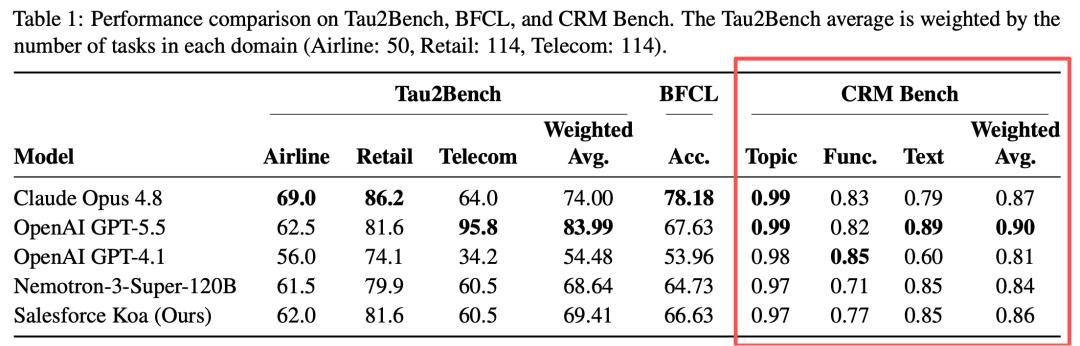
Source: Salesforce Koa
In other words, although there is still a gap compared to top-tier models, Koa already has strong usability for a set of well-defined, pre-defined CRM workflows.
In addition, as Koa's "zero-th customer", Salesforce states on its official product page that in terms of tool calling, Koa has improved accuracy by 11%; in terms of context recall, Koa's reliability has increased by 2.1 times; and in "long conversations", Koa's contextual memory capability has been enhanced by 15%.
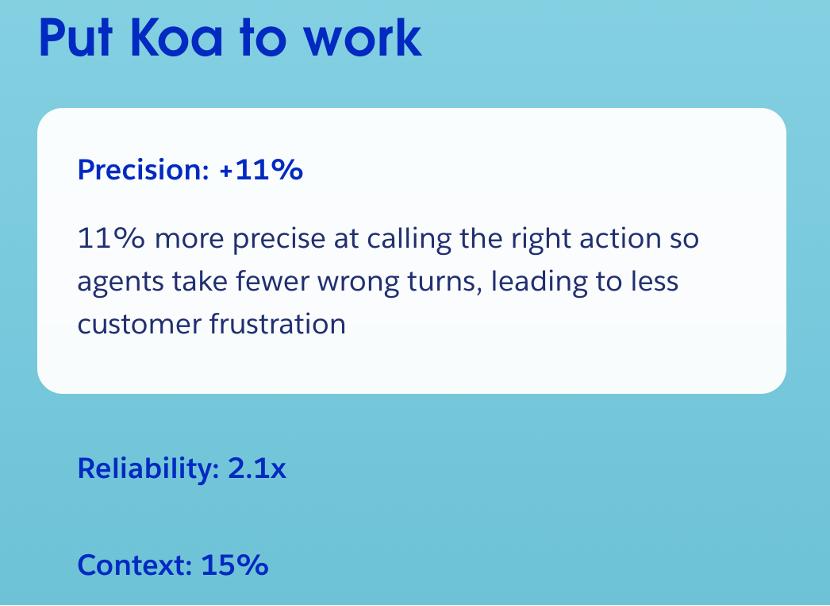
It is well known that the characteristics of enterprise AI include frequent tool calls, long context and multi-turn conversation processing. Salesforce's internal tests show that Koa is already ready to enter the pilot phase.
I. Why did Salesforce launch Koa?
So why did Salesforce launch Koa? There are three main reasons.
The first is the trust crisis of closed-source models.
Recently, Zhipu was exposed to secretly packaging users' workspace files in the background and uploading them. Zhipu later responded and apologized in the customer group, claiming that it was a system bug that has now been fixed. However, the aggrieved party, Taiyuan Chengming Technology Co., Ltd., is not buying it:

Source: Taiyuan Chengming Technology Co., Ltd.
Leaving aside whether it is a bug or not, I am afraid no one can guarantee that similar situations will not occur among large model vendors in the future.
By launching its own vertical large model, Salesforce ensures that part of customers' core data no longer needs to be additionally transmitted to third-party large model service providers, which naturally reduces the possibility of data leakage.
You may ask: will Salesforce use customers' data without permission?
The key point here is: the way Salesforce develops Koa is through post-training.
The pre-training of cutting-edge large models is equivalent to general capability training from primary school to doctorate, which requires trillions of levels of general corpora; while post-training is equivalent to on-the-job training after employees join the company, which requires high-quality, verifiable business data.
Therefore, Rohan Kumar, President of Platform and Engineering at Salesforce, made it clear when introducing Koa: "We did not use a single byte of customer data." The official statement of Salesforce also emphasizes that its training corpus is entirely composed of synthetic scenarios, simulating the reasoning, tool usage and decision-making processes of Agentforce in CRM workflows, without using any raw customer data.
At present, Salesforce's statement has been recognized by customers. For example, among Koa's first batch of trial users are highly data-sensitive customers such as Baxter Credit Union and UChicago Medicine.
The second reason why Salesforce launched Koa is to reduce its dependence on cutting-edge large models.
For a long time, SaaS companies have faced threats from large model vendors: every step forward made by large models forces SaaS companies to take a step back.
But Koa proves that SaaS companies also have the ability to build their own vertical large models. Considering that the capabilities of open-source large models are also advancing rapidly, the capabilities of open-source based vertical large models will become stronger and stronger.
In addition, cutting-edge large models are a high-gross-margin business. For example, Anthropic expects its gross margin to reach 50% in 2026, and even 77% by 2028.
With Koa, Salesforce has the opportunity to reduce its dependence on external models, leaving room for improving gross margin and giving benefits back to customers.
Apart from data security and reducing dependence on cutting-edge large models, I believe there is another strategic consideration for Salesforce to launch Koa: the AI transformation of SaaS companies themselves.
As the capabilities of large models become stronger and stronger, a fatal crisis is gradually emerging: clients may bypass software companies and directly use large models to build their own Agent software.
To cope with this trend, SaaS companies must ask themselves a question: how to become an indispensable part that clients cannot bypass when developing their own in-house solutions?
Transforming into a large model company in the vertical field, becoming the infrastructure for clients' in-house development, and helping clients develop their own solutions more efficiently and with higher quality, is probably the best choice.
II. The Driving Force Behind Koa
The most important driving force behind the launch of Koa is NVIDIA. NVIDIA not only provided the Nemotron open-weight model, but also provided the post-training toolchain, engineering collaboration and other support.
At this year's Salesforce Dreamforce conference, Jensen Huang, CEO of NVIDIA, even personally endorsed Koa, saying:
The adoption rate of open-source models has increased from 30% at the beginning of last year to around 70% now. On the one hand, people are adopting closed-source models at an exponential rate, and on the other hand, they are building their own custom artificial intelligence — because every software company is an AI company, and every enterprise will become an AI enterprise.
Jensen Huang
To put it bluntly, he is telling other SaaS companies: come and cooperate with me, and you can also have your own model just like Salesforce.
Has NVIDIA ever considered that doing so will offend big customers such as Anthropic?
This involves NVIDIA's long-term strategy: Enterprise Sovereign AI — that is, helping every enterprise become an AI company.
It should be noted that although Anthropic is a big customer of NVIDIA, the number of AI laboratories in the world is limited after all, which is negligible compared to the far larger enterprise market.
In addition, AI labs such as Anthropic are also actively "de-NVIDIA-izing". For example, Anthropic currently has more than 1 million AWS Trainium2 chips running the Claude model. In addition, in order to secure a $33 billion investment from Amazon, Anthropic has also promised to spend more than $100 billion on AWS (Graviton/Trainium) within ten years.
Therefore, there are no permanent friends or permanent enemies, only permanent interests.
Obviously, helping software companies like Salesforce post-train vertical large models is more in line with NVIDIA's long-term interests.
III. Will Koa Become an Industry Trend?
So, will post-trained vertical large models become an industry trend? Personally, I think the answer is yes.
In addition to enterprises' considerations in data security and cost, another very important reason is that open-source models are becoming more and more powerful.
Although open-source models cannot surpass top-tier closed-source models in the short term, combined with post-training and Harness engineering, they can already meet most of the needs of enterprises.
In this case, software companies and enterprises are highly motivated to adopt a "hybrid model strategy" — for highly professional, standardized, clear-context tasks such as CRM and HR, assign them to cheaper and safer vertical large models; while for open research, complex creation, cross-domain reasoning and other tasks, they will still call cutting-edge models such as Claude and GPT.
However, this does not mean that the era of "Enterprise Sovereign AI" mentioned by Jensen Huang will come soon. There are two very critical obstacles here.
The first is the talent barrier.
Most of the talents who can perform high-quality post-training are in top AI labs or large internet companies, and many software companies do not have such talents, let alone traditional enterprises.
The second is the cost-effectiveness issue.
The premise that Salesforce can post-train vertical large models is that it has the largest CRM system call volume in the world. It should be noted that the single-quarter revenue of Salesforce Agentforce + Data 360 has reached nearly $3.9 billion, and such a large revenue base can dilute the huge cost of post-training.
But obviously, most software companies do not have such a large AI revenue base.
Even so, in the long run, I still believe that post-trained vertical large models will become a trend.
Because no matter the talent problem or the training cost problem, with the continuous expansion of market demand, they will inevitably be gradually alleviated.
Take the mobile internet era as an example, when the iPhone was first released, Marc Benioff of Salesforce realized that a new era was coming. So he quickly set up a mobile SaaS R&D team, but the R&D was very difficult at the beginning, and the core reason was the lack of iOS developers.
However, a few years later, the number of iOS development talents exploded, and today, there is even a surplus of such talents.
To put it bluntly, as long as market demand remains strong, supply will naturally expand at an accelerated pace, and prices will naturally come down. Especially in China, what we have always worried about is never production capacity, but market demand.
Of course, even if vertical large models become widespread, cutting-edge large models such as Claude will not be completely replaced. After all, for some open, cross-domain complex tasks, cutting-edge large models will definitely perform better.
However, once vertical large models are widely adopted, the landscape of the enterprise software industry will be completely changed.
SaaS companies are already closer to customers. Once they master vertical large models and solve the bottleneck problems, AI will transform from a huge threat into a huge opportunity.
This article is from the WeChat public account "ToB Veteran", author: Wang Daiming, published with authorization from 36Kr.