As OPPO marks its 31st year of development, the moment has arrived for its long-adhered core principle of "Benfen" to be fully honored.
On September 17, OPPO celebrated its 31st anniversary of establishment. In an internal conversation, Chen Mingyong re-explained the concept of "benfen", summarizing it into nine characters: normal mindset, focusing on essence, and long-term oriented thinking.
These nine words once helped OPPO survive several rounds of iteration from feature phones, smartphones to the mobile Internet era. Today, the competitive foundation of the mobile phone industry is undergoing deeper changes.
According to IDC data, in the second quarter of 2026, China's smartphone shipments fell year-on-year by 4.3%, marking the fifth consecutive quarter of decline. Huawei and Apple saw growth of 19.4% and 24.4% respectively, while OPPO's shipments dropped by 9.7%. The rising prices of memory chips and other components have pushed up the cost of complete devices, and AI requires mobile phone manufacturers to re-invest in models, operating systems and end-side computing power. The old market is shrinking, and the bills for new technologies have already been delivered.
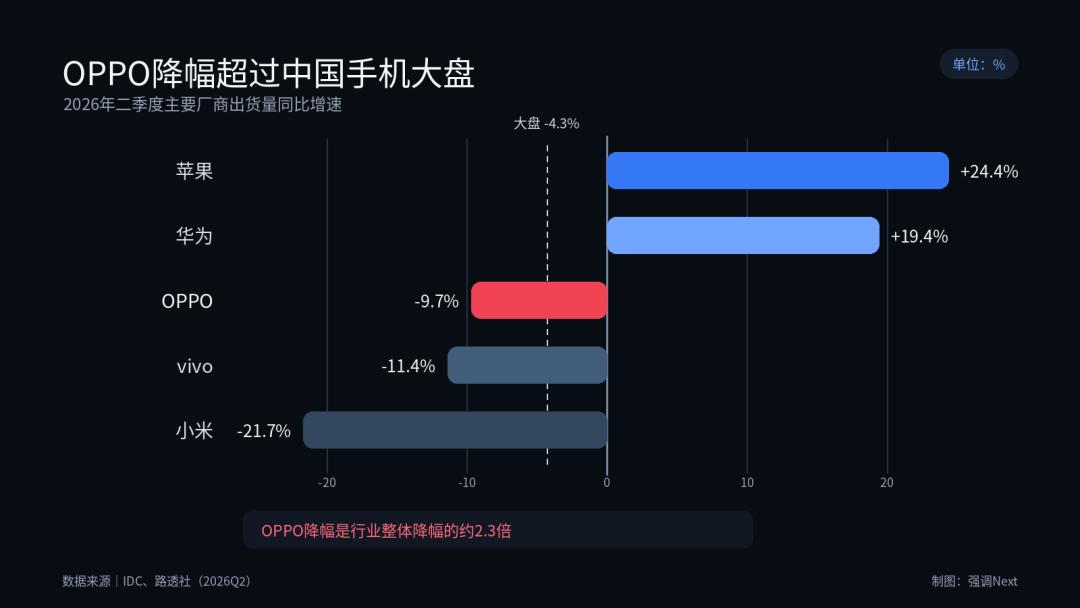
By reaffirming "benfen" at this moment, Chen Mingyong is more like setting the tone for OPPO's next round of choices. It has a longer decision-making cycle than publicly listed companies, and it is time to convert this time advantage into industrial position.
Maintaining the existing scale is no longer sufficient
OPPO's growth over the past two decades has been built on a mature consumer electronics methodology: accurately judging mainstream demands, quickly defining products, promoting products across the country relying on supply chain and offline channels, and then replicating this system to overseas markets.
This capability remains an important asset of OPPO to this day. Find, Reno, A/K and OnePlus cover different price bands, offline stores and distribution systems reach a large number of sinking markets, and its businesses have entered more than 90 countries and regions around the world. Few Android manufacturers have such a complete product echelon, supply chain scale and global operation capabilities at the same time.
The stock market has changed the value of these capabilities. After the mobile phone replacement cycle is extended, channels can improve the efficiency of user reach and capital turnover, but cannot create replacement demands out of thin air. The supply chain can quickly follow up with large-capacity batteries, telephoto lenses and new materials, but it will also make hardware selling points converge faster. The differences between flagship phones are increasingly dependent on long-term joint R&D, system scheduling and brand pricing power.
Profits are also concentrating at both ends of the industrial chain. Upstream advanced chips, storage and core components hold the cost discourse power, while Apple and Huawei take more high-end profits relying on their brand and system capabilities. Mainstream Android manufacturers are in the middle: they have to bear higher R&D and material costs, while maintaining scale in the price-sensitive market.
This explains the source of OPPO's current pressure.
The decline in market share is only the surface. The key lies in whether the scale advantage can continue to be converted into profits and technology investment. The speed of the Find series breaking through to the high-end market, and the ability of the Reno series to maintain its position in the mainstream market, determine whether OPPO can continue to support high-end R&D with mass public sales. Once the two are disconnected, the scale will change from an advantage to an expensive organizational burden.
"Normal mindset" can help OPPO avoid short-term overstocking and price wars, but cannot replace the continuous investment required by the high-end market. The more mature the market is, the clearer strategic direction is needed for patience to play its role.
What Zeku left behind is more than sunk costs
Zeku was OPPO's heaviest technology bet in the past decade.
At the end of 2019, Chen Mingyong announced that OPPO would invest a total R&D budget of 500 billion yuan in the next three years. In 2020, OPPO launched its self-developed chip project; in 2021, its first self-developed imaging chip MariSilicon X was released. In May 2023, OPPO terminated the Zeku business, and the team of thousands of people was disbanded accordingly.
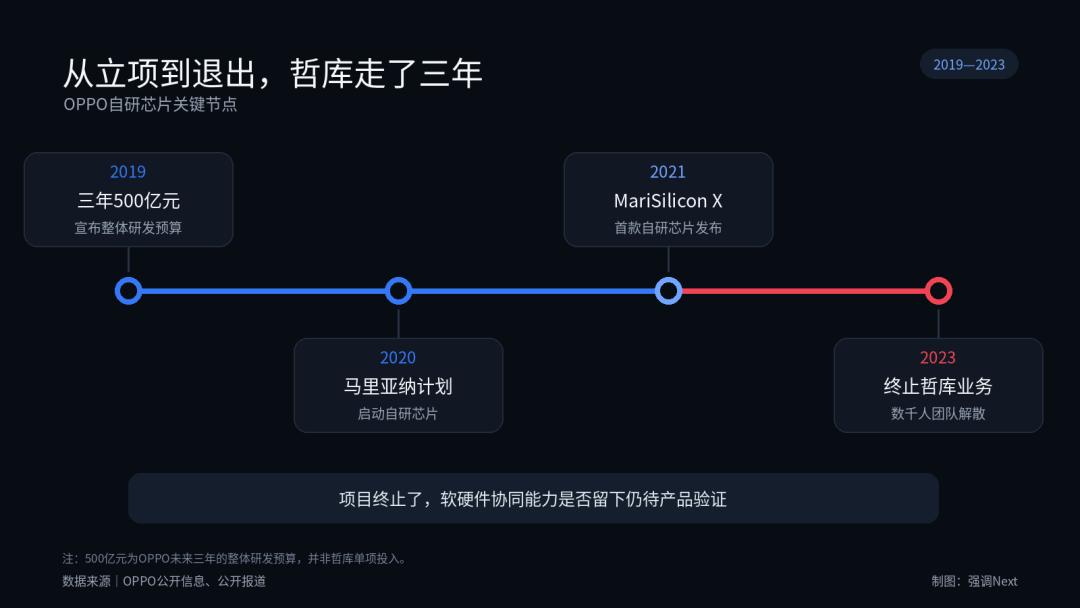
To move from a dedicated imaging chip to a flagship mobile phone SoC, it is necessary to make up for CPU, GPU, NPU, baseband, radio frequency, drivers and development tools, and bear the cost of advanced process tape-out and year-by-year iteration. The feasibility of chip investment depends on the return formed jointly by shipment scale, R&D efficiency and product premium. The shutdown of Zeku shows that OPPO judged that the cost of this path has exceeded the strategic benefits it could obtain at that time.
The exit also changed OPPO's technical boundary in the next round of competition.
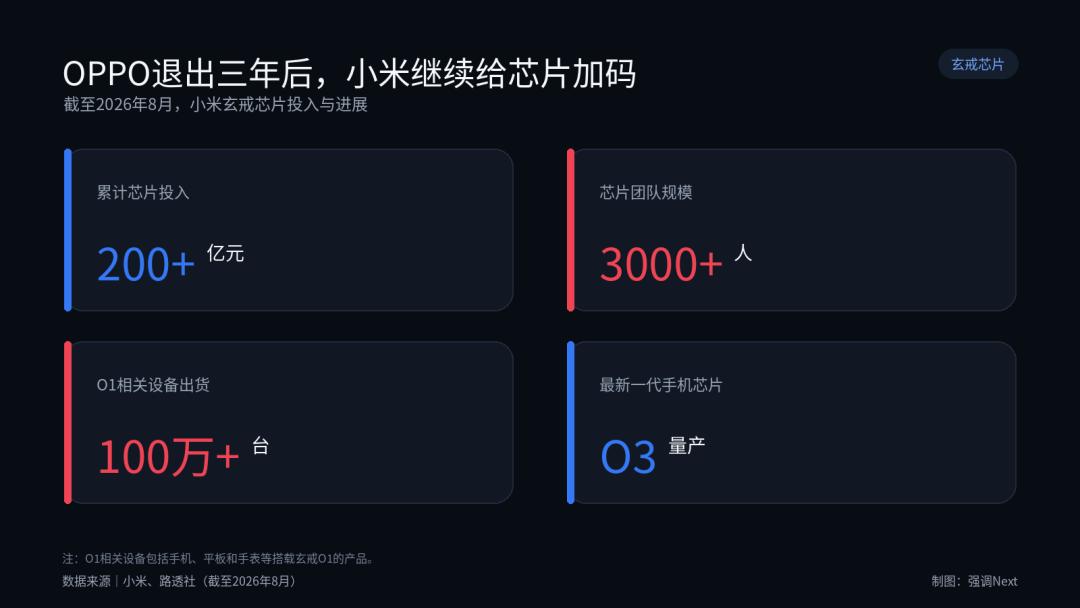
Apple forms vertical integration with self-developed chips and operating systems; Huawei continues to strengthen underlying autonomy under external restrictions; as of August 2026, Xiaomi has invested more than 20 billion yuan in chip R&D in total, with a team of more than 3,000 people. OPPO has chosen a more capital-light route: continue to purchase platforms from Qualcomm and MediaTek, and participate in underlying definition through systems, algorithms and joint tuning.
On September 15, OPPO announced that the Find X10 Pro Max will be among the first batch of products equipped with MediaTek's 2-nanometer flagship chip Dimensity 9600 Pro, and will adopt the underlying rendering and scheduling engine jointly developed by both parties. This kind of cooperation can reduce the capital risk of fully self-developed SoC, and also allow OPPO to write its requirements for imaging, power consumption and system fluency into the chip platform in advance.
The cost is equally clear.
AI mobile phones increasingly rely on the collaboration of NPU, memory, power consumption and operating system, and the general platform leaves limited differentiation space for terminal manufacturers. If the joint definition can span multiple product cycles, OPPO can still build software and hardware collaboration capabilities. If the cooperation only stays in single-generation tuning, the gap in underlying control with self-developed chip manufacturers will continue to widen.
Therefore, the value of Zeku cannot be simply summarized as "dare to stop loss". It is a capital discipline, and also a long-term trade-off. OPPO has saved the huge investment in continuing to develop chips, and it needs to prove afterwards that supplier cooperation can also generate unique and reusable technical capabilities.
AIOS turns mobile phone track into platform competition
OPPO has not entered the automotive sector, and concentrates its resources on mobile phones and adjacent personal smart devices. This focus reduces the dispersion of capital and organization, and also makes the core mobile phone business take greater growth responsibility.
AI further expands the boundary of the "core mobile phone business". In the past, operating systems mainly managed applications, files and hardware resources. AIOS needs to continuously understand users, store long-term memory, call different services, and allocate tasks between the end side and the cloud side. Mobile phone manufacturers thus enter the coordination layer of models, cloud computing, privacy infrastructure and application services.
In January this year, OPPO disclosed its overseas AIOS solution in cooperation with Google Cloud, focusing on user memory, cross-application search, active recommendation and private computing cloud. For OPPO, the strategic value of AIOS is higher than a single AI function. ColorOS, which masters system permissions and device entrances, can push model capabilities to large-scale products such as Find and Reno, and the global channels provide a practical path for AI services to reach users.
OPPO is also in the common constraints of the Android camp.
Basic models, cloud computing and core chips come from external partners, and cross-application services also depend on whether developers open accounts, payment and data permissions. Apple controls chips, systems, accounts and application distribution, while Huawei is building its own software and hardware system. OPPO needs to strive for an experience close to vertical integration in the cooperative ecosystem.
This makes AI the most specific test for OPPO's "long-term oriented thinking". The early functions of mobile AI are easy to be replicated, and system-level memory, end-cloud scheduling and service connection will form continuous differentiation. The strategic leap OPPO needs to complete is to extend the organizational capability of an excellent hardware company to platform operation and developer collaboration.
This step is more difficult than adding a new product line. It requires OPPO to maintain hardware scale at the same time, undertake long-term software investment, and be responsible for the final experience without fully mastering chips and models.
Patience will eventually translate into decision-making quality
OPPO is not listed, and does not need to explain investment returns to the secondary market on a quarterly basis. This governance structure allows the management to maintain a long product cycle, bear the situation that R&D projects do not make profits for many years, and also quickly terminate the Zeku business after changing its judgment.
This is exactly the basis why "benfen" can become a business principle.
Normal mindset reduces the interference of short-term rankings on decision-making, focusing on essence requires the company to identify the real return of technology investment, and long-term oriented thinking leaves accumulation time for systems, imaging and globalization.
But its boundary is also very clear. No stock price pressure does not mean no resource constraints. Without public financial reports and continuous disclosure, the outside world can hardly judge the investment efficiency of different businesses. OPPO's decision-making quality relies more on internal mechanisms, founder judgment and organizational consensus. After entering the cycle with heavier technology investment, one directional error will consume several years of time and a large number of talents.
The succession issue also belongs to this structure. OPPO's "benfen" has long been interpreted by Duan Yongping and Chen Mingyong. When the founders are present, corporate culture can act as a common language for resource allocation. After entering the generational transition, which businesses are worthy of long-term investment and under what circumstances should exit, need to be undertaken by a stable decision-making procedure. Otherwise, the culture will remain, but the judgment criteria may become blurred as the key figures leave.
The 31 years of history has proved that OPPO has strong survival and adjustment capabilities. It has grown from feature phones to smartphones, from China's offline market to the global market, and has accumulated its own technical experience in imaging, fast charging, foldable screens and system experience. These assets are enough for OPPO to stay in the game.
The new round of mobile phone competition has raised the cost of "staying in the game". Scale needs to be converted into high-end pricing power, supplier cooperation needs to be converted into underlying capabilities, and ColorOS needs to further undertake the user entrance in the AI era. OPPO has time and organizational stability, but the industry will not slow down the iteration speed of chips, systems and models for this reason.
"Benfen" has reached the moment when it most needs to be fulfilled. OPPO needs to use this patience to form key technologies and platform capabilities, so that the 31 years of accumulation can continue to determine its position in the next round of industrial competition.
Note: The data in this article comes from public sources and does not constitute investment advice.
This article is from the WeChat Official Account "Qiangdiao Next" (ID: leo89203898), the author is Hua Wen, and it is released with authorization from 36Kr.