AITO goes solo, Seres faces a major test
Seres, a star enterprise of China's electric vehicle industry, has made a decision that has held the entire automotive industry breathless.
On September 15, Harmony Intelligent Mobility Alliance released the Statement on the AITO Cooperation Model, announcing that Seres will take full charge of AITO's product definition, product design, brand marketing, channel retail, and service system, while Huawei Terminal will step back to play an enabling role.
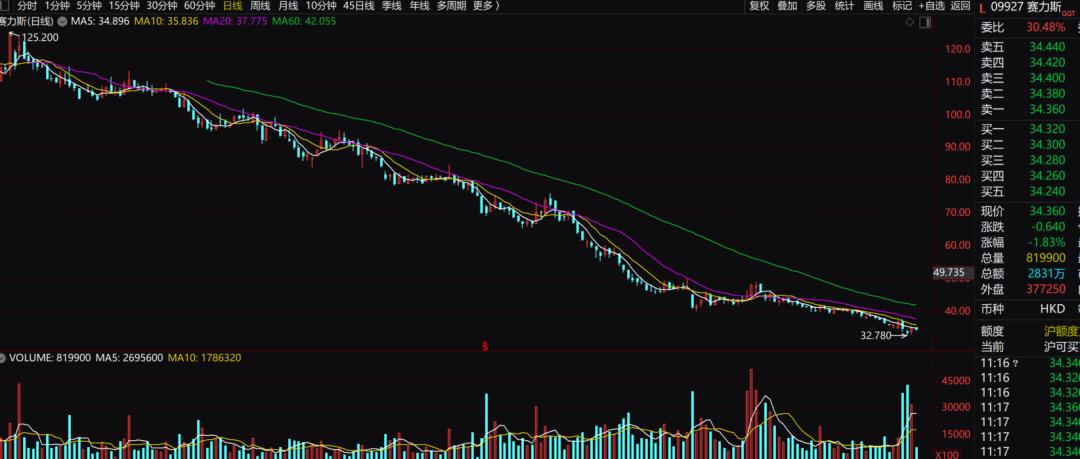
The sensitive capital market responded rapidly. On the day the news was released, Seres' A-share closed down 5.09%, and its H-share dropped by more than 6%; the next day, its stock price continued to dip during intraday trading, with the total market value falling back to below 80 billion yuan. Compared with its market value peak of nearly 300 billion yuan in 2025, Seres' market value has evaporated by more than 200 billion yuan in just one year, and the stock price has retreated by more than 70%. At present, the trend of Seres' H-share is still in a unilateral decline.
The trend of the stock price may be the market's collective interrogation of whether this symbiotic business model that has been maintained for many years can operate smoothly. Some netizens said on stock forums that as the first Xiaokang that embraced Huawei, Xiaokang will definitely not perform poorly; as the first Seres that separated from Huawei, Seres will definitely not perform well. Other netizens hold the view: "The separation is for the sake of export business. Don't over-interpret it. But it is certain that the stock price is extremely difficult to return to the previous level. In stock trading, without Huawei as the weathervane, it is not easy for the stock to be hyped up."
On September 17, another news broke out that multiple dealers had been notified by Huawei that starting from January 1 next year, AITO will officially withdraw from Harmony Intelligent Mobility Alliance and Huawei's exclusive stores. In response, Seres stated that the news is not true. The "exclusive operation" of AITO means that starting from January 1, 2027, Huawei's exclusive stores will be officially divided into two categories: one will sell AITO vehicles exclusively, and the other will sell vehicles of Zhijie, Xiangjie, Zunjie and Shangjie; the division will be officially completed on January 1.
What follows is an unavoidable question: At a time when sales continue to decline and profits have turned from positive to negative, how much room for adjustment does Seres have? After taking back the dominant position, where will its next step lead?
01
This cooperation adjustment, which is commonly interpreted by the outside world as "separation", is not a hasty break.
For Seres, the rigid cost pressure under the original cooperation model has become an unbearable burden. The fees Seres pays to the Huawei system are divided into three parts: hardware procurement fees for intelligent driving, cockpit, three electric systems and other components, technology licensing fees accrued at 2% of the total vehicle price, and channel marketing service fees accrued at 8% of the total vehicle price. Among them, the total of technology licensing fees and channel marketing service fees accounts for about 10% of the vehicle price, and the hardware procurement fees are settled separately according to the actual procurement amount.
Public data shows that from 2022 to 2025, the procurement amount Seres paid to Huawei reached 58.02 billion yuan, 72.48 billion yuan, 420.2 billion yuan and 560.54 billion yuan respectively, totaling more than 1.111 trillion yuan. Its proportion in the total procurement amount of the same period rose from 14.5% to 33.78%, and its proportion in the revenue of the same period rose from 17.04% to 34%. This means that by 2025, more than 1/3 of Seres' revenue has flowed into the Huawei system.
However, Seres actually continued to suffer losses from 2021 to 2023, with a cumulative loss of 81.06 billion yuan. Starting from 2024, Seres achieved a profit of 59.46 billion yuan, and 59.57 billion yuan in 2025. Its revenue increased from 1451.76 billion yuan in 2024 to 1650.54 billion yuan in 2025.
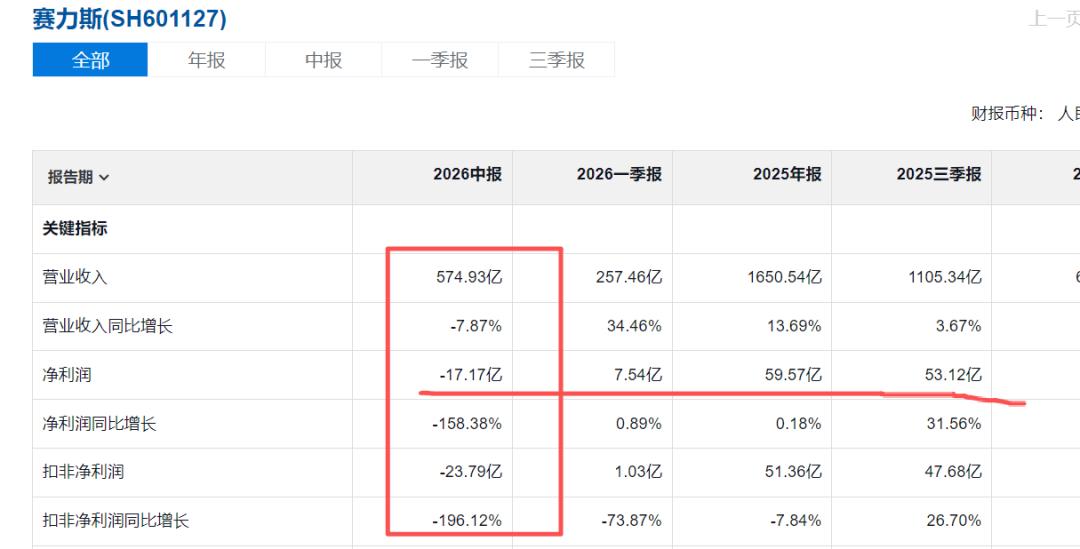
A simple comparison of the data makes it easy to find that despite the increase in revenue, the net profit has hardly grown. In other words, Seres may have hit a "ceiling".
Sure enough, in the first half of 2026, the pressure of this cost curve broke out intensively: Seres achieved a revenue of 574.93 billion yuan, down 7.87% year on year; its net profit turned to a loss of 17.17 billion yuan from a profit of 29.41 billion yuan in the same period of the previous year, plummeting 158.38% year on year; its non-net profit after deduction of non-recurring items suffered a loss of 23.79 billion yuan, with a comprehensive and sharp decline in performance. In August this year, Seres' vehicle sales volume was 20,652 units, down 49.68% year on year; the cumulative sales volume in the first eight months was 201,902 units, down 14.07% year on year.
Obviously, in the downward cycle of sales, the rigid expenditure accrued according to the proportion of the total vehicle price directly squeezes the profit space, which is the core motivation as well as an unavoidable move for Seres to take back the independent management right and control the cost structure independently.
For Huawei, this adjustment is an inevitable step in the strategic transformation of its automotive business. As of September 2026, Harmony Intelligent Mobility Alliance has gathered five brands: AITO, Zhijie, Xiangjie, Zunjie and Shangjie. If it continues to maintain the heavy asset model of full-link in-depth operation for each brand, not only will the management radius exceed the reasonable boundary, but also its R&D investment in the technology base will be diluted. Allowing AITO, which has achieved large-scale operation, to operate independently while Huawei returns to the light asset positioning of "technology supplier" not only conforms to its original aspiration of "not making cars, but helping car companies make good cars", but also enables Huawei to concentrate resources to accelerate the incubation of the other four brands.
In fact, Seres has been paving the way for this handover of dominant position for several years: in July 2024, it acquired all 919 trademarks and 44 design patents of AITO for 2.5 billion yuan, and all the brand intellectual property rights belong to Seres. In the same year, it signed an agreement to take a 10% stake in Zhiyin Intelligent for 11.5 billion yuan, and completed the payment of all consideration and obtained a board seat in September 2025. From the legal perspective, Seres already has the basic conditions to take over the full-link operation.
02
Looking back at the rise of Seres, the starting point of the story was a local car company that struggled on the edge of the automotive industry. Before the name change, the main entity of Seres was Xiaokang Co., Ltd., whose main business was the manufacturing of mini vehicles, low-end SUVs and auto parts. In the era of fuel vehicles, it long stuck to the sinking market, with its brand influence limited to the domestic regional market, and it had almost no say in the high-end passenger vehicle market.
With Huawei's technical endorsement and channel resources, AITO's deliveries in its first year of 2022 exceeded 75,000 units, and its delivery volume reached about 387,000 units in 2024, successfully turning losses into profits; in 2025, it took only 46 months to achieve the offline of 1 million vehicles.
However, there are two hidden dangers behind the high growth: the brand mind is attached to Huawei, and the pace of independent core technology is relatively slow. The commercial essence of Seres is more like a high-end manufacturing service provider within the Huawei system. In 2025, Seres' gross profit margin reached 29.14%, which is at a relatively high level among automotive companies, but its net profit margin was only 3.72%. The gap of more than 25 percentage points flowed to Huawei's channel service fees and technology licensing fees.
It is more necessary to emphasize that in-depth cooperation in the global business community often follows a law of life cycle: from deep binding to respective independence. This law has been staged repeatedly in the history of global commerce.
In the field of autonomous driving, the cooperation between Waymo under Google and the travel platform Uber was once regarded as a perfect combination of technology and traffic. In 2023, the two sides reached an agreement to access Waymo's self-driving taxis to the Uber application. But less than three years after the cooperation, Waymo has officially notified Uber that it plans to launch an independent application in Austin and Atlanta in January 2028, and seeks to fully withdraw from the cooperation in advance before the agreement expires. The reason looks very familiar: when the ability of one party to the cooperation is mature enough, the commercial value of independent operation will exceed the benefit of continuing to attach to the other party.
In the field of complete vehicle manufacturing, Apple Inc.'s "Titan Project" provides another reference. Apple once tried to cooperate with car companies such as Hyundai and Kia to make cars, but the South Korean giant refused to play the role of a "pure foundry", resulting in the cooperation never being implemented, and the project was finally terminated, with a large number of employees transferred or laid off. This case confirms from the opposite side that when the two parties to the cooperation cannot reach a consensus on the dominant position and benefit distribution, the deep binding model will eventually fall apart.
Even in China's automotive market, similar structural adjustments are taking place. For example, Audi and SAIC have cooperated to launch the new brand AUDI, the models jointly developed by Volkswagen and XPeng have rolled off the production line, and Mercedes-Benz has upgraded its Shanghai R&D center to a global innovation hub. Multinational car companies are shifting from "headquarters-led" to the localized cooperation model of "in China, for China". The logic behind this is probably the same as Huawei's decision to let go of AITO: in the deep water zone of industrial transformation, letting the party that knows the market best take the dominant position of operation is a practical choice to enhance the overall competitiveness.
So, can Seres really survive the independent operation of AITO?
Seres still holds several irreplaceable core resources, which constitute its confidence to move forward independently. The manufacturing end is its most solid hole card. Seres has deployed three smart factories in Chongqing, with more than 3,000 industrial robots deployed in its super factory, realizing 100% automation in key processes; the factory applies 9000-ton integrated die-casting technology, and its original "factory-in-factory" model directly embeds the production lines of core suppliers such as CATL and Yanfeng into the factory area, making its supply chain collaborative response efficiency rank in the first echelon of the industry.
Brand assets also have real value. In the "2026 Top 100 Global Automotive Brand Value List" released by Brand Finance, a global authoritative brand evaluation agency, AITO ranks first among Chinese luxury automotive brands with a brand value of 34.48 billion US dollars, and is also the only Chinese brand in the top ten global luxury brands. AITO M9 has won the sales champion of 500,000-yuan-level SUVs for 21 consecutive months, and the cumulative deliveries of all its models have exceeded 300,000 units.
In terms of capital, as of the end of June 2026, Seres' monetary funds stood at 51.93 billion yuan, with zero short-term loans and 1.054 billion yuan of non-current liabilities maturing within one year. Obviously, its cash flow is abundant enough to support transition expenses such as channel construction and R&D investment. In addition, its 10% equity in Zhiyin Intelligent and the board seat allow Seres to obtain institutional guarantees on the supply stability and bargaining power of Huawei's core technologies such as intelligent driving and cockpit.
However, while obtaining the dominant position of operation, Seres must also take corresponding risks.
The first to bear the brunt is the impact on brand cognition. Over the past seven years, AITO's brand premium has largely been built on the trust endorsement of the word "Huawei". When Huawei steps back from the "operator" to the "enabler", the weight of Huawei in the brand narrative will decline accordingly. Whether AITO's high-end positioning can be maintained has become the core test facing Seres. If consumers interpret this adjustment as "AITO is no longer that closely linked to Huawei", the brand premium may be directly eroded.
The impact on the channel end is more direct. According to industry statistics, a large part of Seres' AITO sales come from the stores of the Huawei system. Although some of the original Harmony Intelligent Mobility Alliance stores will be transferred to Seres to display and sell AITO vehicles exclusively, the core value of Huawei's stores lies in the inherent passenger flow and consumer trust of the Huawei brand. In the same physical space, the conversion rate of visitors may be vastly different between a store with the Huawei sign and an independent AITO sign.
The change in cost structure is by no means as simple as "saving 8% means profit". Stopping paying the 8% channel marketing service fee of the total vehicle price can indeed release part of the cost space, but Seres needs to bear all the expenses such as store operation, brand advertising, and marketing team building on its own. In 2025, Seres' sales expenses have reached 241.9 billion yuan, and in the first half of 2026, the figure was 84.71 billion yuan. After independent operation, the composition of this expense will change from "channel service fees paid to Huawei" to "operation costs of self-built channels". Against the background of shrinking revenue base, the sales expense ratio is likely to rise further.
Although there are various risks, from the law of enterprise development, the step Seres takes is worthy of applause. In the territory of the global automotive industry, few enterprises can actively choose the path of independent operation after being deeply attached to a strong technical partner for seven years. This requires courage, and even more strength. However, after the applause, a calm judgment is needed.
Seres needs to do four things well next. Consolidate the basic skills of channel and brand connection, strive to continue to share part of the passenger flow of Huawei's stores during the transition period, and improve the single-store operation efficiency of its own user centers. Stabilize the basic disk of the product matrix, ensure that the iteration rhythm of M9 is faster than that of competing products, straighten out the overlapping problem of the price bands of M6 and M7, and reduce the dependence on a single flagship model.
Take substantive steps in technology independence. In the short term, it will still rely heavily on Huawei's intelligent driving and cockpit technologies; in the medium term, it needs to accumulate technical experience outside the Huawei ecosystem; in the long term, it will build irreplaceable technical barriers in fields that Huawei is not involved in, such as chassis and range-extender systems.
The overseas business will focus on key regions such as the Middle East and Southeast Asia. In 2025, Seres' overseas revenue was only 2.379 billion yuan, accounting for about 1.4% of the total revenue. In the short term, the overseas market cannot become the core support for sales increment, so it should be taken as one of the key breakthrough dimensions.
From a more macro perspective, this model switch between Huawei and Seres also provides a new model for the cooperation between Chinese technology enterprises and manufacturing enterprises: deep binding can achieve explosive growth, but in the long run, any cooperation needs to complete the transformation from "helping the horse mount" to "accompanying for a journey" at the right time. Whether Seres can convert seven years of accumulated manufacturing capacity, brand assets and user base into core competitiveness for independent operation will determine whether this "coming-of-age ceremony" is ultimately the starting point of transformation or the beginning of recession.
One point that is easy to ignore is that this model switch between Seres and Huawei may significantly reduce the selling price of new energy vehicles. After all, if the cost can be controlled by itself, the price will naturally drop, and the products will be more competitive. Then, will price reduction become the trend of the new energy vehicle industry for a period