Two Different Development Paths of TCL and Hisense After Moving Beyond the Black Home Appliance Industry
From September 4 to 8, 2026, at the North Entrance of Messe Berlin for IFA 2026.
TCL designed its exhibition zone as a fully accessible home space. TVs, air conditioners, refrigerators and AR glasses are placed in the simulated living room and kitchen areas.
Not far away, Hisense's exhibition zone is more like a laboratory. A 116-inch RGB-Mini LED TV, 85-inch RGB field-sequential display, and 163-inch Micro LED giant screen are arranged in a line, next to the newly launched home AI operating system JUOS.
The two booths are only hundreds of meters apart, yet they are like strategic manifestos written by the "two leading consumer electronics giants" respectively: one says "come and experience my lifestyle", the other says "come and see my technology".
This seems to be the different answers given by the two companies to the proposition of "where to go after the TV industry reaches its peak". One pursues horizontal expansion and achieves growth through mergers and acquisitions, while the other focuses on in-depth vertical cultivation and maintains value through targeted investment.
01
Two Strategic Logics
In the first half of the year, the operating revenue of Hisense Visual Technology was lower than that of Hisense Home Appliances. Similarly, the total revenue of TCL Electronics was also lower than that of TCL Technology. Consumer electronics is not the entire business of TCL and Hisense, but it is the signature of the two giants.
The moves of this business reflect the strategic differences between the two giants. TCL Electronics has shown a very clear offensive posture, while Hisense Visual Technology has taken a distinct prudent and steady approach.
In the first half of 2026, TCL Electronics' R&D expenditure increased by 21.9% year-on-year to 12.95 billion yuan, while Hisense Visual Technology's R&D expenditure decreased by 2.34% year-on-year to 11.82 billion yuan. With one rising and the other falling, TCL's investment amount has surpassed that of Hisense.
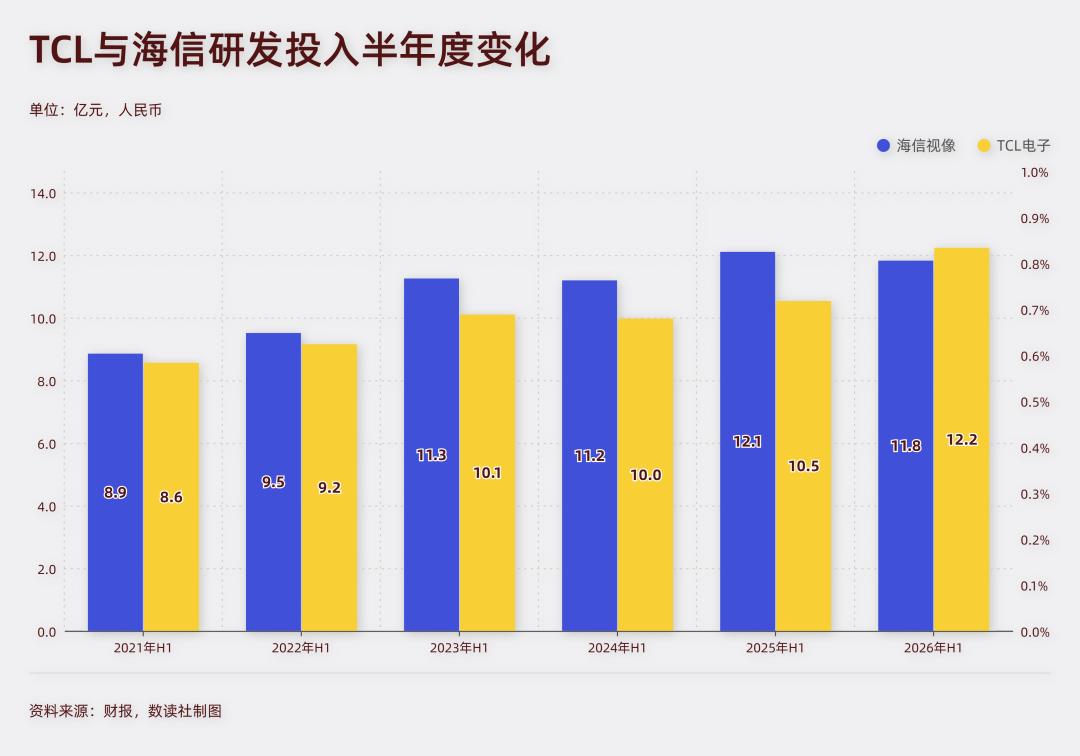
TCL Electronics' R&D investment is highly focused on three directions: AI intelligent interaction, new display technologies (SQD-Mini LED, printed OLED) and smart hardware.
The financial report states that AI applications have covered the entire value chain of R&D, manufacturing, supply and sales. This means that R&D investment is supporting a "platform-based" capability, where every achievement can be reused across multiple terminals such as TVs, mobile phones, tablets, and AR glasses.
The full-scenario smart lifestyle demonstrated in the "Inspired Habitat" themed exhibition zone at the IFA booth is exactly the visual presentation of this platform-based capability.
TCL Electronics' innovative business presents the feature of "advancing on multiple tracks": the revenue of photovoltaic business reached 104.77 billion yuan, up 2.3% year-on-year, the revenue of full-category marketing (air conditioners, refrigerators and washing machines) was 73.13 billion yuan, up 1.4% year-on-year, the revenue of smart connection and smart home was 9.53 billion yuan, up 15.5% year-on-year. The three sectors totaled 187.43 billion yuan, accounting for 32% of the total revenue.
Hisense Visual Technology's R&D investment decreased year-on-year, but this is more like a contraction and focus of the investment structure. While the total amount declined, resources are concentrated on core technologies.
Its focus is shifting to "deep cultivation". The exquisite 4-core true-color backlight technology of RGB-Mini LED, field-sequential display, and Micro LED are all developed around the core proposition of "display".
Hisense Visual Technology's "new display and new business" recorded an overall revenue of 4.1 billion yuan in the first half of 2026, up 20% year-on-year, accounting for 14.66% of the main business revenue.
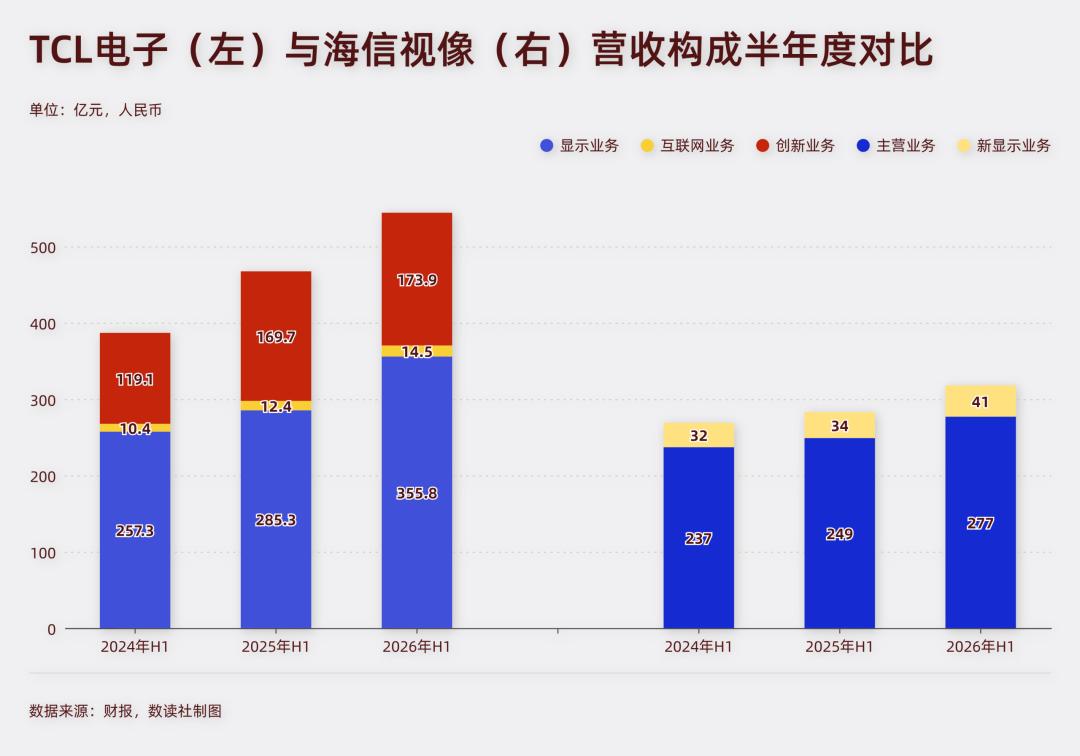
Among them, the revenue of commercial display business increased by 127% year-on-year, the global shipment of laser display increased by 17%, and the overseas business in particular increased significantly by 73%.
Further in-depth exploration of display technology naturally extends to the chip business.
Public information shows that in Hisense's chip business, the global market share of TV TCON chips is about 45%, and the global shipment share of laser TVs reaches 70.3%, ranking first in the world for seven consecutive years.
Hisense's focused investment in segmented tracks is forming a local monopoly advantage. These businesses have a considerable growth rate, but they are still limited to specific fields.
The different performance of the consumer electronics business is a microcosm. TCL and Hisense, the two giants, have derived many businesses in the long-term development process, but the main line is TCL's horizontal expansion and Hisense's vertical deep cultivation.
Hisense focuses on terminals with other industries as auxiliaries. The listed companies take consumer electronics (Hisense Visual Technology) and white goods (Hisense Home Appliances) as the core, and other derived businesses such as Kelin Electric and Nazhen Technology focus on smart grid distribution equipment and optical modules respectively, which are relatively independent and account for a small proportion.
TCL's business is more complex. Consumer electronics and white goods together form the TCL Industrial segment, in addition to which semiconductor display panels, photovoltaic and other silicon materials, and electronic product distribution together form the TCL Technology segment. The technology segment is more like the upper reaches of the industrial chain, while the industrial segment is dominated by terminal business.
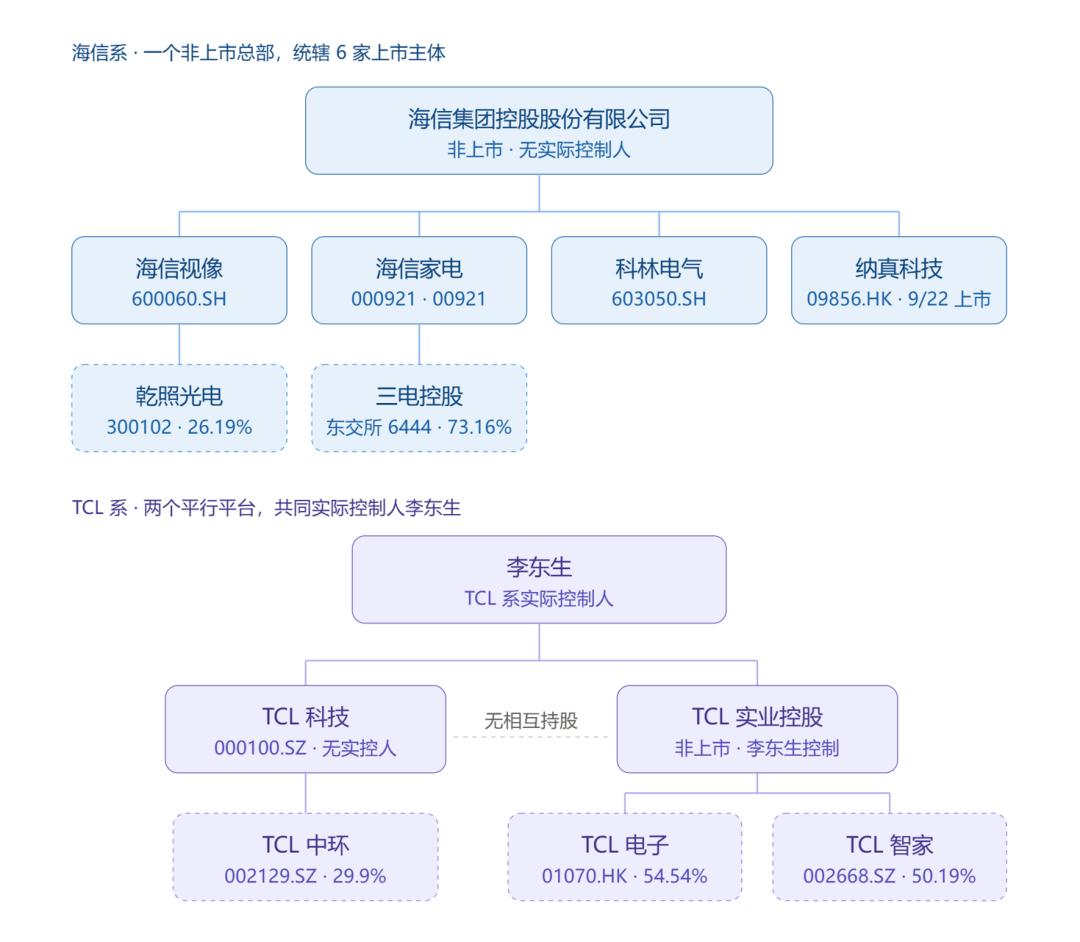
It is clearly visible that Hisense is more focused, while TCL's business is more extensive.
Among Hisense's two major listed companies, the business is very concentrated, clearly dominated by terminal business. In 2025, the revenue of smart display terminals accounted for 78% of Hisense Visual Technology's total revenue. The business of air conditioners, refrigerators and washing machines, small home appliances and other products accounted for 99% of Hisense Home Appliances' revenue.
TCL is completely different. The TCL Technology segment has little connection with home appliance terminals. Its revenue in the first half of the year was 88.7 billion yuan, accounting for 57.6% of TCL Group's total revenue.
For TCL Electronics, which is dominated by consumer electronics, the display business only accounted for 65% of its revenue in the first half of the year. The smart home business is relatively concentrated, with white goods accounting for 99%, but this business generated 9.9 billion yuan in revenue in the first half of the year, which is not a large proportion in the group.
Different strategic logics lead to different results.
Hisense's revenue and growth rate are both lower than TCL's.
In the first half of the year, TCL Electronics recorded a revenue of about 586.62 billion yuan, up 16.4% year-on-year. Hisense Visual Technology's revenue was 28.24 billion yuan, up 3.71% year-on-year. Looking only at the consumer electronics sector, TCL Electronics' display business generated about 35.588 billion yuan in revenue, which is not much different from Hisense's, but its growth rate is higher, reaching 24.7%.
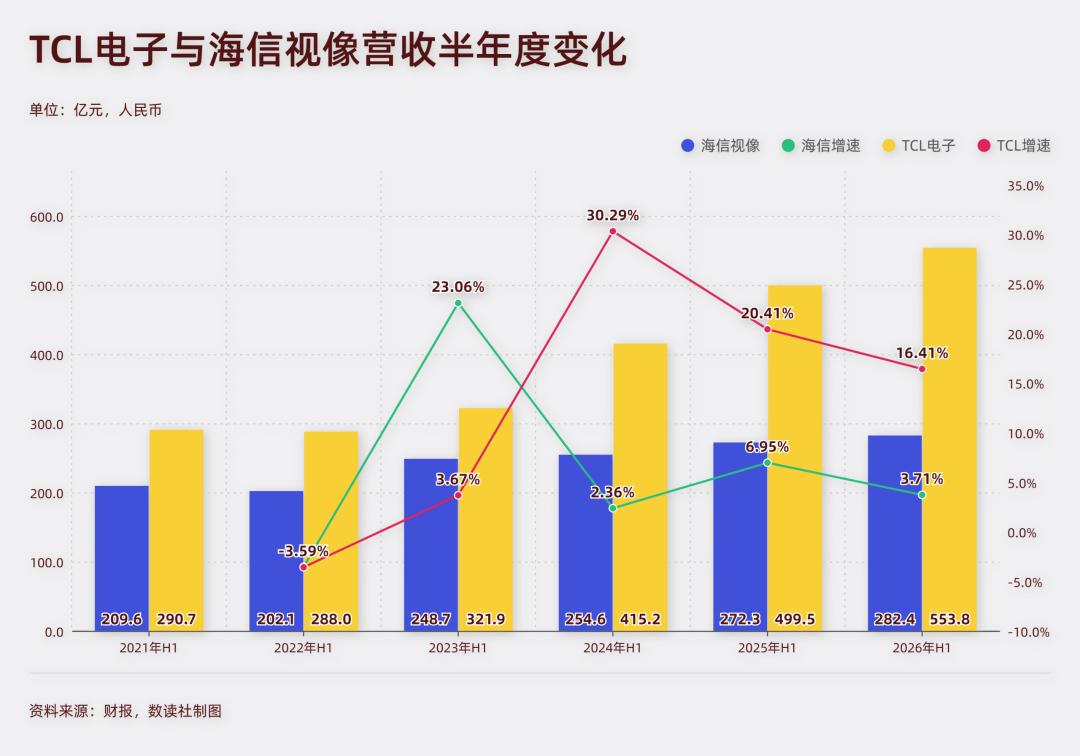
On a larger scale, TCL, which includes both the technology and industrial segments, posted a revenue of 154 billion yuan in the first half of the year, up 6% year-on-year. Hisense, which includes the visual technology and home appliance segments, recorded a revenue of 75 billion yuan in the first half of the year, down 2% year-on-year. The former's revenue is twice that of the latter, and its growth capability is even better.
But growth does not mean everything, and the more critical factor is long-term sustainable operation.
02
Profit Distribution and Capital Expenditure
The problem with vertical expansion is that the industry is relatively concentrated, and once the macro environment changes, the impact will be obvious. But its advantage lies in a solid basic business foundation. Although horizontal expansion leads to rapid scale growth, it poses greater challenges to business operation.
As of the end of the first half of the year, Hisense Visual Technology's asset-liability ratio was 42.11%, interest-bearing liabilities (short-term loans, long-term loans, bonds payable, non-current liabilities due within one year, lease liabilities, etc.) stood at 1.356 billion yuan, and the current ratio was 1.94. It has almost no cyclical financial rigidity, and its operation is relatively light. Hisense Home Appliances has a relatively high asset-liability ratio of 72.21%, but it is mainly operating liabilities, and its interest-bearing liabilities are relatively low.
Therefore, Hisense's operation is very light with low risks.
In the first half of the year, Hisense Visual Technology carried out large-scale dividend distribution. The 2025 annual dividend plan corresponds to an amount of 1.227 billion yuan, accounting for 50% of the attributable net profit of that year, and the company has maintained this dividend ratio for many consecutive years. This dividend formed a dividend payable of 1.227 billion yuan in the reporting period of the first half of 2026.
The management of Hisense Visual Technology is more inclined to return the free cash flow generated by mature businesses to shareholders. This does not mean that there is no growth opportunity in the existing business, but the company chooses to reflect shareholder returns through dividends while maintaining selective investment in new display businesses.
In sharp contrast to Hisense, TCL Electronics did not declare any dividend in the first half of 2026. Instead, it completed two transactions.
In March this year, TCL Electronics reached an agreement with Sony to take over Sony's home entertainment business. In July, TCL Electronics acquired 51% controlling stake in TCL Air Conditioner for HK$5.61 billion. After the delivery, the air conditioner business was officially incorporated into the listed company system.
This leads to a special phenomenon. TCL Electronics, which is dominated by consumer electronics business, will have part of the air conditioner business in the next stage. Moreover, the photovoltaic business is also part of TCL Electronics, plus the internet business, the company has experienced phased positioning confusion.
This is a microcosm of TCL's strategy. In the process of continuous horizontal expansion, the company expands rapidly, but the corresponding organizational management will fall into chaos for a period of time, which requires continuous digestion.
In August, TCL Electronics announced that it is considering promoting the spin-off and independent listing of the photovoltaic business segment through in-kind distribution. This is a move for business adjustment.
The motivation for the spin-off is that the photovoltaic business and the smart home appliance business have differences in capital allocation, cash flow cycle and risk structure. Photovoltaic involves power station development, financing, grid connection and long-term operation and maintenance, which has large capital demand and long payback period, and its operating logic is completely different from that of consumer electronic products such as TVs.
If this move is promoted, it will further confirm TCL's path feature of "expanding scale through mergers and acquisitions and capital operations, and then releasing value through spin-offs". This is an offensive strategy that uses capital operations to exchange for scale and category expansion. Its logic is: instead of distributing cash to shareholders, it is better to use cash to "buy growth".
If the integration is successful, TCL will have more growth points. But if it fails, shareholders will not only get no dividends, but also suffer the double blow of goodwill impairment and integration losses.
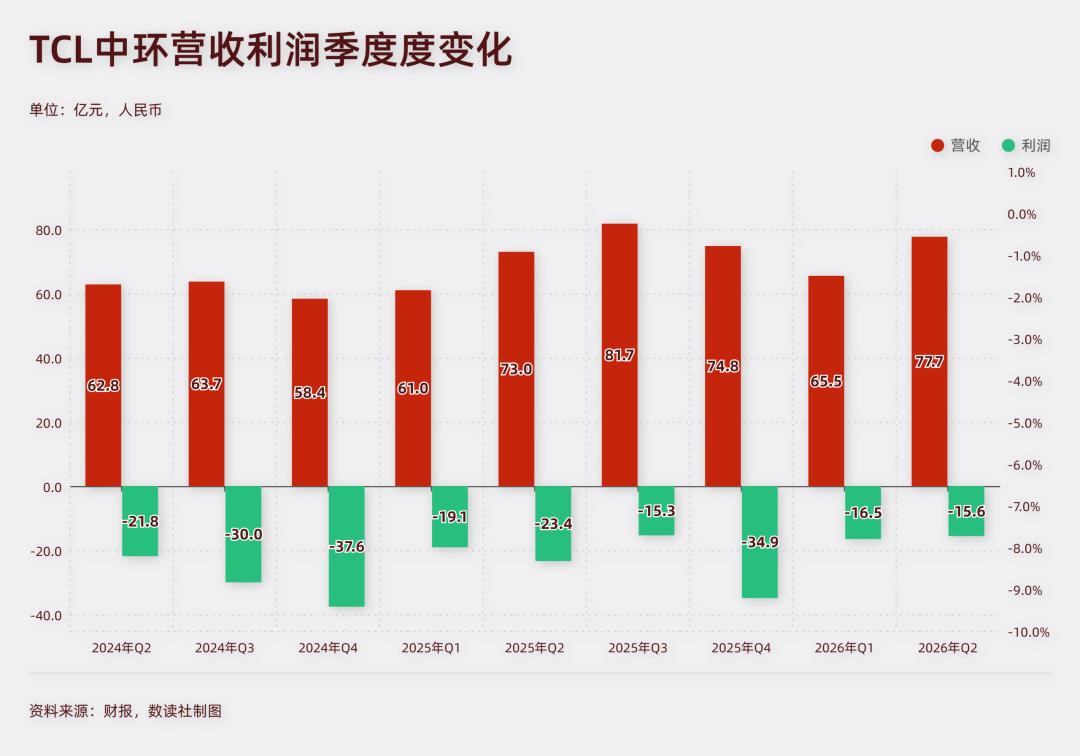
Take the photovoltaic business planned to be independent as an example. In 2020, Li Dongsheng invested 12.5 billion yuan to acquire 100% state-owned equity transferred by Tianjin Zhonghuan Electronics, which is the predecessor of TCL Zhonghuan. TCL entered the photovoltaic industry through this acquisition. However, with the continuous involution of the photovoltaic industry, TCL Zhonghuan has become a huge drag on TCL. In the past two years, it has lost nearly 10 billion yuan every year. In the first half of the year, TCL Zhonghuan, whose main business is photovoltaic semiconductor, lost 3.204 billion yuan. According to this trend, it will most likely suffer losses for three consecutive years.
There is no absolute right or wrong between profit distribution and capital expenditure, only different risk preferences.
03
Five TCLs and Two Industry Outlets
Different strategies are leading the two companies to different futures.
TCL is more successful in terms of scale, and it has already achieved considerable scale in the fields of semiconductor display, internet distribution, new energy photovoltaic and other fields. However, these businesses still need new market stimulation, the space for horizontal expansion is gradually shrinking, and the main work in the new stage is more inclined to digest existing businesses and deepen overseas markets.
At the IFA exhibition, TCL reiterated its goal of "rebuilding five TCLs overseas". Its founder Li Dongsheng made it clear that Europe will first grow into an entity that assumes operational responsibilities, with a complete industrial chain and supply chain.
At present, TCL has completed a dense localized network in Europe: taking Paris as its European headquarters, it has 17 branches with local employees accounting for more than 90%, and has built the largest TV manufacturing base of Chinese enterprises in Europe in Zyrardow, Poland, realizing a supply chain response speed that covers the entire EU within 3 to 4 days.
After a series of mergers and acquisitions, the areas that TCL can enter are decreasing, but the risk accumulation after continuous mergers and acquisitions and the challenges of industry cycle changes require larger markets to provide support.
TCL almost holds all its businesses tightly. Even Tongli Co., Ltd., which withdrew its listing application in August this year, was previously known as TCL Tongli Electronics. In Li Dongsheng's plan, TCL's consumer electronics, white goods, semiconductors, photovoltaics and other businesses are all part of a unified overall plan, and the ultimate goal is business synergy to grow together, eventually forming a home appliance empire that spans the upstream and downstream of the industrial