The Super Mystery of the Star ADC
The story of Trodelvy in NSCLC was supposed to come to an end with the failure of EVOKE-03, but it instead led to another mystery.
At the just-concluded WCLC conference, the Phase III EVOKE-03 clinical data of Trodelvy combined with Keytruda for first-line NSCLC treatment showed that among patients with PD-L1 TPS ≥50%, although Trodelvy plus Keytruda extended mPFS from 7.7 months to 11.8 months, the HR of 0.81 still did not reach statistical significance; the OS was even 21.5 months versus 22.8 months, with the combination therapy group even underperforming Keytruda monotherapy.
For this reason, after reviewing the final PFS analysis and interim OS analysis, the External Data Monitoring Committee gave the recommendation that "it is impossible to meet the endpoints", and Merck & Co. and Gilead Sciences announced the termination of the study on June 8.
The failure can now be deemed a settled conclusion. However, when the data was further broken down, a new finding came to light.
In EVOKE-03, the OS HR for Asian patients was 0.73, and that for Chinese patients even reached 0.65, indicating that Chinese patients benefit more from Trodelvy.
It is not yet clear whether this is due to differences in patient populations, or disparities caused by clinical settings and trial designs, but one issue has once again been pushed to the forefront:
How many of the results obtained from Chinese clinical practices can truly stand the verification of the global patient population?
01
Positive Signals Amid Failure
Trodelvy can basically be declared a total failure in the field of NSCLC indications.
Previously, Trodelvy had already suffered a setback in second-line NSCLC. The results of the EVOKE-01 study showed that in previously treated NSCLC patients, Trodelvy monotherapy did not achieve statistical significance in OS compared with docetaxel, nor did it show advantages in PFS and ORR.
The EVOKE-03 trial of first-line combination with Keytruda was originally Trodelvy's chance to turn the tide in lung cancer, but it ended in failure again.
The data released at this WCLC conference show that after treatment with Trodelvy combined with Keytruda, mPFS was extended from 7.7 months to 11.8 months, but still did not reach statistical significance. A more direct signal of failure came from OS: the mOS of the ADC+PD-1 treatment combination was 21.5 months, which was lower than the 22.8 months of Keytruda monotherapy.
Safety issues further amplified the failure signal. The incidence of grade ≥3 TRAEs in the Trodelvy plus Keytruda group reached 55.7%, compared with 16.5% in the Keytruda monotherapy group; the proportions of patients discontinuing treatment due to treatment-related adverse events were 30.9% and 20.1% respectively.
With second-line failure and no survival benefit from first-line combined immunotherapy, Trodelvy can be said to have basically bid farewell to NSCLC.
Amid the fiasco, other positive signals were amplified through in-depth data parsing. At this WCLC conference, the data of EVOKE-03 was further refined and split, and the results highlighted the disparity in benefit across different populations.
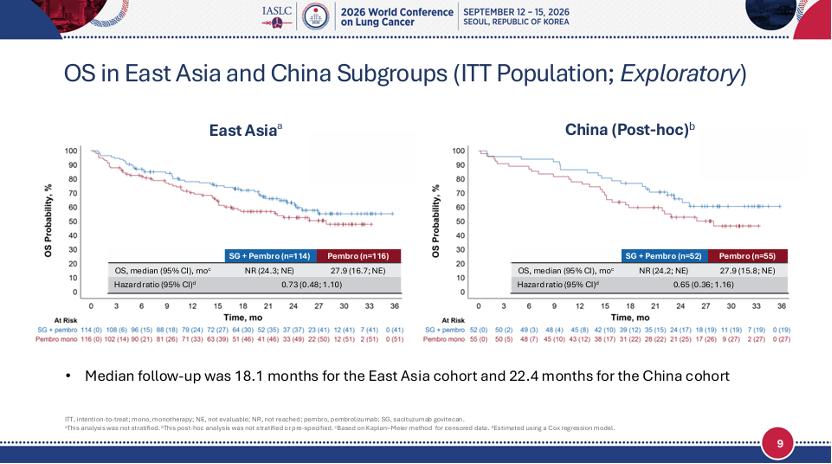
Specifically, there were 230 patients in the Asian subgroup, including 107 Chinese patients. The OS data for this subgroup has not yet been released, but given that the global OS HR is 1.07, the figure drops to 0.73 for Asian patients and further reaches 0.65 for Chinese patients, which already suggests that Asian patients derive more benefit from Trodelvy.
The same is true for PFS: the HR for the North American population is 1.2, while that for the Asian population is 0.68. It can be said that the entire PFS benefit of the EVOKE-03 trial is contributed by the Asian population.
The same drug, Trodelvy, shows a stark contrast between the benefit in Asian (Chinese) patients and the failure of global data, which has triggered more thinking.
02
"Advantage of Asian Population"
Whether the Asian population is more sensitive to TROP2 ADC, or the disparity in patient benefit from Trodelvy is caused by differences in subsequent treatment modalities, remains to be confirmed with the release of more statistical data.
However, some population-based statistical studies at this stage have already provided clues.
There are certain differences in disease spectrum between Asian NSCLC patients and European and American patients: the proportions of adenocarcinoma, female patients and never-smoker patients are higher, and driver gene alterations such as EGFR are also more common.
Among them, the impact of non-smoking on efficacy, such as reduced absorption, slowed metabolism and limited drug distribution, has been proven. And EGFR mutations can enhance the endocytosis of TROP2 ADC in tumor cells, which has also been clinically verified.
Although EVOKE-03 has excluded EGFR, ALK and ROS1 positive patients, baseline differences in tumor biology among patients from different regions still exist. For TROP2 ADC, factors such as TROP2 expression, tumor cell endocytosis and tumor microenvironment may all affect the final performance of the drug.
In fact, not only for lung cancer, the currently approved breast cancer indication of Trodelvy also suggests disparities in patient benefit. The ORR of the globally approved ASCENT study was 33.3%, with PFS of 5.5 months and OS of 13 months. In contrast, the Asian bridging EVER-132-001 study showed that ORR was 38.8%, mPFS was 5.55 months, and OS was 14.7 months, all higher than the global data.
This phenomenon also occurred in clinical trials of HER2 ADC. DESTINY-Lung05 is a Phase II single-arm bridging clinical trial conducted for Chinese HER2-mutant NSCLC patients. The results showed that in later-line treatment, T-DXd achieved an ORR of 56.9% and mPFS of 9.9 months. The corresponding global Phase II DESTINY-Lung01 study had ORR and mPFS of 55% and 8.2 months respectively, with the performance in China also higher than the global data.
Furthermore, the data advantage of the Asian population is not limited to ADC: immunotherapy drugs also show similar phenomena in the Asian population.
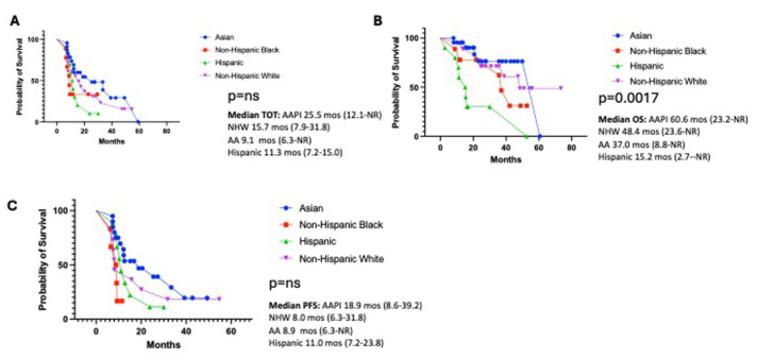
A recent article published in *Therapeutic Advances in Medical Oncology* analyzed the differences in responses to immune checkpoint inhibitors across different populations. Overall, the Asian population has a better response to immunotherapy, with longer overall survival or progression-free survival, and the 6-month survival rate in some studies is even twice that of European and American patients.
Similar signs can also be seen in the EVOKE-03 study: the mOS of the global Keytruda monotherapy group was 22.8 months, while that of Chinese patients reached 27.9 months.
In addition to differences in drug sensitivity among patients, disparities in treatment regimens across regions may also lead to differences in benefit. In particular, OS data will be affected by subsequent treatment, and differences in later-line drug treatment options and clinical practices in different regions may further widen the OS gap.
This means that the positive Asian signals in the EVOKE-03 study arise from multiple factors. And if we look beyond EVOKE-03, it is not hard to find that with the emergence of more and more global clinical data, the phenomenon of better clinical results in Asia seems to have become a widespread trend.
03
How Can Chinese Clinical Data Prove Its Value
As another TROP2 ADC, SKB264 from Kelun-Biotech has already shown superior survival benefit in first-line NSCLC patients. In the OptiTROP-Lung05 study, SKB264 combined with Keytruda reduced the risk of disease progression or death by 65%, with a PFS HR of 0.35, and ORR increased from 42.0% to 70.2%.
After the failure of EVOKE-03, SKB264 lost one more competitor. However, given the disparity in clinical data of Trodelvy between the global and Asian populations, the clinical performance of SKB264 will inevitably be questioned. After all, the key data currently released for OptiTROP-Lung05 come from Chinese patients.
In fact, controversies surrounding Chinese clinical data have always existed. In the early stage, domestic drugs did have cases where the clinical data in China was excellent but the global data was unsatisfactory.
A typical example is Claudin 18.2 ADC EO-3021, which performed well in the Phase I trial launched in China: among 17 evaluable gastric cancer patients, ORR was 47.1% and DCR was 64.7%. However, the results of the Phase I clinical trial conducted in the United States fell short of market expectations: among 36 evaluable gastric cancer patients, ORR was only 22.2% and DCR was 72.2%, so the drug was terminated for development by its partner Elevation Oncology.
In the face of such doubts in the past, domestic pharmaceutical companies were relatively passive. Chinese drugs including sintilimab and surufatinib all encountered regulatory obstacles during FDA applications because their key clinical data mainly came from China.
But now, from drug quality to clinical research design, from the regulatory system to clinical trial specifications, China has established an increasingly mature clinical R&D system for innovative drugs. More and more MNCs are introducing innovative assets from Chinese Biotechs, which also provides endorsement for the quality of Chinese innovative drugs and their clinical data.
After Merck & Co. took over SKB264, it launched 17 global Phase III clinical studies, among which TroFuse-005 has already released positive results first, achieving both the dual primary endpoints of PFS and OS in patients with advanced endometrial cancer who had previously received platinum-based chemotherapy and immunotherapy.
Although this set of global data cannot directly answer the questions raised by the NSCLC scenario, it at least proves that SKB264 has demonstrated efficacy in a larger population.
Facing the controversies over Chinese clinical data, some MNCs have also given positive responses before.
Özlem Türeci, co-founder of BioNTech, once said: "The non-reproducibility of data is not a problem unique to China. Data from China is as reliable as data from other regions and can be widely adopted."
Hesham Abdullah, head of oncology R&D at GSK, also said when talking about the company's cooperative development of B7-H4 ADC with Hansoh Pharmaceutical that the data from GSK's own R&D projects are consistent with the results in Chinese clinical trials. Pfizer even conducted on-site inspections and repeatedly verified domestic clinical data before reaching a cooperation with 3SBio, and confirmed the reliability of the data before finalizing the partnership.
Completing global clinical development with the help of MNCs has also become a way for innovative drugs to prove their value. A more proactive approach is to directly carry out clinical trials overseas.
For example, zanubrutinib from BeiGene obtained full FDA approval through a global MRCT-designed clinical trial; Hengrui Medicine has also set up R&D centers in multiple countries and regions, and is currently advancing 7 international multi-center Phase III studies.
Behind the advancement of these global clinical trials, MRCT, bridging study, and mutual recognition of data have also become important strategies for innovative drugs to apply for marketing overseas.
Of course, the foundation of all is the product itself. Only truly valuable innovative drugs can withstand the test of global clinical practice.
Today's Chinese innovative drug sector has reached a brand new stage of development. Speed is still our core competitiveness, but the closer we get to the global stage, the more we need to build a clinical system that can communicate with patients worldwide and present solid clinical evidence.
This is also the question that all innovative drugs going global must answer in the next phase of development.
This article is from the WeChat Official Account "Amino Insight" (ID: anjiguancha), written by Sha Xiaowei, and authorized for release by 36Kr.