The leading manufacturer of LiDAR for robotic vacuum cleaners has passed the listing hearing, how will Huanchuang Technology craft a compelling business narrative?
Recently, Shenzhen Huanchuang Technology Co., Ltd. (hereinafter referred to as "Huanchuang Technology") updated its post-hearing information document and officially passed the listing hearing on the Main Board of the Hong Kong Stock Exchange, with China International Capital Corporation and Guosen Securities (Hong Kong) serving as joint sponsors. This national-level "Little Giant" enterprise featuring specialization, refinement and innovation is just one step away from listing.
Let's first look at a set of core data. From 2023 to 2025, the operating revenue of Huanchuang Technology reached 332 million yuan, 433 million yuan and 614 million yuan respectively, with a three-year compound annual growth rate of 35.9%, and the annual growth rate hit 41.6% in 2025. However, the profit statement shows a different picture: the net profit for the same period was a loss of 883,000 yuan, a loss of 31 million yuan, and a profit of 2.201 million yuan respectively. With an annual revenue of more than 600 million yuan, the final net profit is only 2.2 million yuan, and the net profit margin is merely 0.4%.
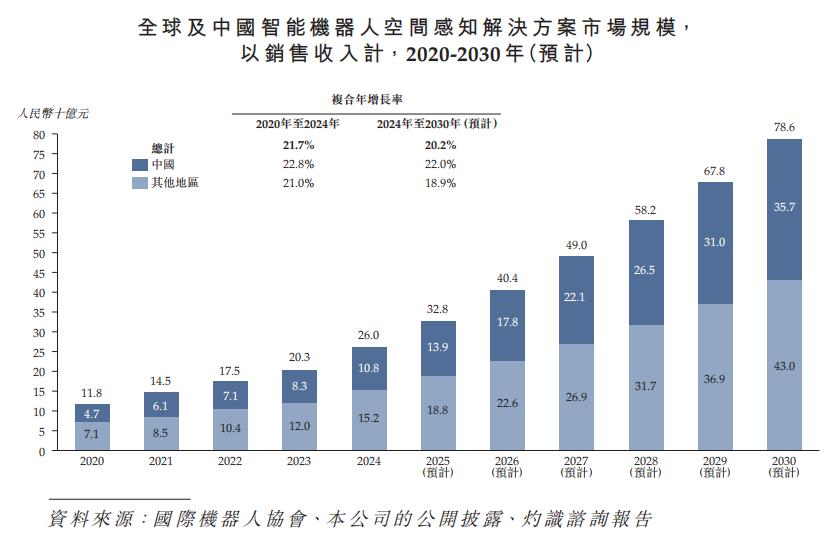
Huanchuang Technology is entering a market that is still expanding. According to data from CIC, the global market size of spatial perception solutions for intelligent robots increased from 118 billion yuan in 2020 to 260 billion yuan in 2024, and is expected to reach 786 billion yuan in 2030.
Robot vacuums are the most important application scenario among them. About 70% of the robot vacuums produced globally in 2024 are equipped with LiDAR. The industry prosperity remains at a high level. IDC data shows that in the second quarter of 2026, the global shipment of robot vacuums was about 7.885 million units, a year-on-year increase of 21.5%.
However, high industry prosperity does not mean high profitability. In August 2025, DJI entered the robot vacuum track across sectors with its DJI ROMO product line. The price war among leading complete machine manufacturers continues to spread to the supply chain, and the average price of products in the industry keeps declining. For Huanchuang Technology, an upstream component supplier, this is a typical market environment where "shipments are rising while prices are falling".
This also raises several questions worth exploring: as the world's largest spatial perception solution provider for robot vacuums by revenue, why is Huanchuang Technology finding it so hard to make profits? With a shipment market share of over 50%, why can't it obtain pricing power? The net outflow of operating cash flow for three consecutive years also reveals what structural weaknesses of this business? The answers can be found in the prospectus.
I. Making profits by installing "eyes" for robot vacuums, with an impressive list of customers and shareholders
The business model of Huanchuang Technology is not complicated: it independently develops AI spatial perception algorithms, dedicated ASIC chips and precision optical hardware, integrates the three into LiDAR and sensor products, and sells them to robot vacuum manufacturers to generate revenue from hardware sales.
The company was established at the end of 2013, entered the consumer-grade LiDAR market in 2017, and launched its first self-developed C1 ASIC chip in 2018. It is one of the few spatial perception solution providers in the industry with independent chip R&D capabilities. As of the latest practicable date, Huanchuang Technology holds 156 authorized patents, including 47 invention patents.
In terms of product lines, the company has three core offerings. Triangulation ranging LiDAR is its basic business, contributing revenue of 403 million yuan in 2025, accounting for 65.7% of the total revenue; dTOF LiDAR and line laser sensors are new products that started to see rapid volume growth in 2024, with revenue reaching 65 million yuan and 134 million yuan respectively in 2025, accounting for 10.6% and 21.8% of the total revenue. The two new products together now contribute 30% of the total revenue.
Meanwhile, this is also the most notable change in Huanchuang Technology's revenue structure in the past two years. It is worth noting that back in 2023, triangulation ranging LiDAR alone accounted for 98.3% of its total revenue, and now dTOF LiDAR and line laser sensors have gradually become new revenue contributors.
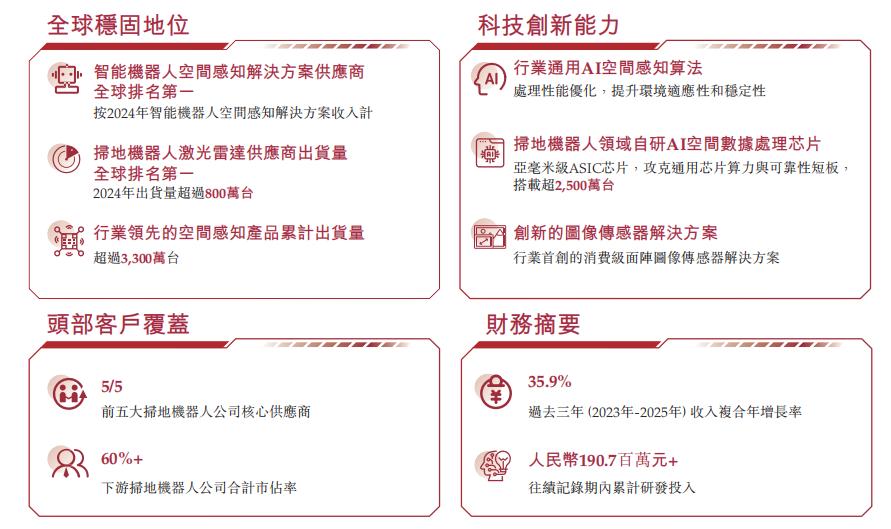
Market position is the most prominent part in Huanchuang Technology's prospectus. Calculated by 2024 revenue, the company ranks first in the global spatial perception solution market for robot vacuums; its shipment of LiDAR for robot vacuums is about 8 million units, with a shipment market share of over 50%.
In addition, the top five manufacturers in the global robot vacuum industry are all customers of Huanchuang Technology, and these customers together account for more than 60% of the global robot vacuum market share.
However, the high concentration of revenue structure is a separate issue. In 2025, the products of Huanchuang Technology applied to robot vacuums contributed 99.5% of the total revenue, while the revenue of the smart device business (XR controllers, etc.) that the company laid out in the early years shrank all the way from 4.295 million yuan in 2023 to 824,000 yuan in 2025, accounting for only 0.1%. The so-called business diversification is currently only reflected in the planning stated in the prospectus.
There is also a lot of information in the shareholder list. Founders Wang Jian and Zhou Kun co-founded Huanchuang Technology in 2013. Wang Jian graduated from the Major of Mechanical Manufacturing in Xi'an Jiaotong University, and used to be the general manager of the Shanghai Office of chip company Zoran; Zhou Kun obtained his bachelor's degree in Precision Instrument and master's degree in Automation from Tsinghua University, and used to engage in R&D at Bell Labs under Lucent in his early years.
The two, together with Liu Yi and three employee shareholding platforms, form a concert party, jointly controlling 31.19% of the voting rights of the company — this is the largest single shareholder group, but does not constitute the controlling shareholder, and the company's equity structure is highly dispersed.
Two details can well illustrate the "origin" and "circle" of Huanchuang Technology.
First, the three founding shareholders when Huanchuang Technology was established are Wang Jian (holding 47.4% of shares), Zhou Kun (40.1%) and Shenzhen Qvod Technology Co., Ltd. (12.5%). The founding team has a distinct background in the video chip and player technology circle.
Second, among institutional shareholders, Oriental Fortune Capital ranks first with a 13.59% shareholding, Qianhai funds hold a total of 7.73% of shares, followed by Seayou Capital, Kaisheng Capital, Lingrui Foundation, etc.; Goertek indirectly holds shares by holding about 45.52% of the partnership equity of Qingdao Tongge.
What is more subtle is Beijing Roborock Innovation Technology Co., Ltd. — it is a wholly-owned subsidiary of Sci-tech Innovation Board listed company Roborock, holding 1.83% of shares of Huanchuang Technology, and Roborock is exactly the largest customer of Huanchuang Technology. The overlapping identity of customer and shareholder not only acts as a "ballast stone" for order acquisition, but also makes the public pay more attention to the independence of their transactions.
In addition, Guosen Capital, a wholly-owned subsidiary of Guosen Securities, one of the joint sponsors, also holds 1.81% of shares, and the sponsor has made a special statement on independence in the prospectus.
II. Threefold Pressure on the Profit Statement: Price, Expense and Cash Flow
If you only look at the revenue curve, Huanchuang Technology is a standard high-growth company; but when you combine the profit statement, cash flow statement and balance sheet together, the pressure is clearly visible.
The first pressure comes from product pricing.
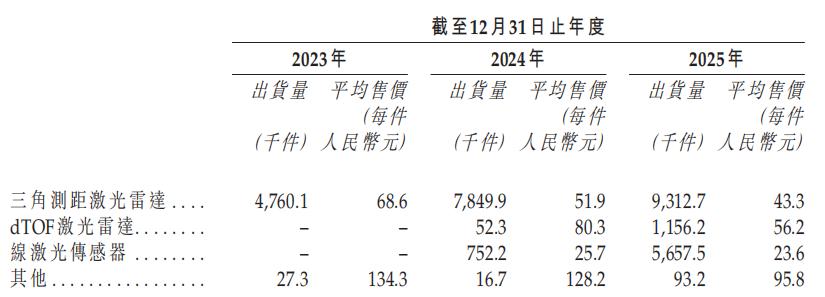
The average selling price of the company's core product, triangulation ranging LiDAR, dropped from 68.6 yuan per unit in 2023 to 51.9 yuan in 2024, and further fell to 43.3 yuan in 2025, with a cumulative decline of nearly 37% in three years.
The price reduction boosted sales: the company's shipment volume increased from 4.7601 million units to 9.3127 million units, but the revenue generated did not increase proportionally. In 2025, the shipment of this product increased by 18.6% year-on-year, but the revenue dropped slightly from 408 million yuan to 403 million yuan, marking the inflection point of rising volume but shrinking profit margin.
The price trend of new products is the same. The average selling price of dTOF LiDAR dropped from 80.3 yuan in 2024 to 56.2 yuan in 2025, and that of line laser sensors dropped from 25.7 yuan to 23.6 yuan. Exchanging price for volume is the common situation of the whole industry, and Huanchuang Technology is just the most typical sample.
The direct consequence of this is that the downward price trend directly compresses the profit space. The company's overall gross profit margin dropped from 21.5% in 2023 to a lower level, reaching only 16.3% and 16.5% in 2024 and 2025 respectively.
Specifically, the gross profit margin of triangulation ranging LiDAR dropped from 21.0% to 18.6%; the two new products were "operating at a loss to gain market share" in the early stage of volume growth: the gross profit margin of dTOF LiDAR was -32.8% and that of line laser sensors was -6.1% in 2024, which turned positive to 7.0% and 13.6% respectively in 2025, but still lower than the core product, thus diluting the overall gross profit margin.
The second pressure lies in the expense structure, which hides the real secret of turning losses into profits in 2025.
The direct reason why the company suffered a loss of 31 million yuan in 2024 was its aggressive R&D investment, with R&D costs reaching 77 million yuan that year, accounting for 17.7% of the revenue.
The reason why the company was able to turn its profit statement positive in 2025 is not the improvement of gross profit margin — the gross profit margin only rose by 0.2 percentage points — but the substantial contraction of R&D expenditure: the absolute amount of R&D costs decreased by 17 million yuan to 59 million yuan, and the R&D expense ratio plummeted by 8 percentage points to 9.7%. In other words, the 2.2 million yuan of net profit in 2025 was largely "saved" through cost reduction.
Taking a broader view: the government subsidies the company received in 2025 amounted to 4.765 million yuan, more than twice the net profit. If such non-operating income is excluded, the main business of Huanchuang Technology is actually still below the break-even line.
For a company that takes "technology leadership" as its core narrative and plans to invest most of its IPO raised funds in the next-generation CMOS image sensor chip and dTOF chip, there is an obvious contradiction between the sharp decline in R&D investment intensity and its strategic statement — whether this is a natural decline after R&D enters the harvest period, or a phased adjustment for the listing report, needs to be verified by subsequent financial statements.
The third pressure comes from cash flow, which is also the most alerting one.
From 2023 to 2025, the net cash flow from operating activities of the company was negative for three consecutive years, with net outflows of 35 million yuan, 40 million yuan and 9.038 million yuan respectively. By the end of 2025, its cash and cash equivalents on the book were only 12 million yuan, with another 124 million yuan of wealth management products.
For a company with an annual shipment of over 10 million units of equipment, the available liquid capital on the account is only more than 10 million yuan, which shows how tight its capital chain is.
So why does Huanchuang Technology's cash flow keep bleeding? The crux lies in the occupancy structure of working capital.
For downstream clients, Huanchuang Technology faces strong complete machine manufacturers such as Roborock and Ecovacs. Trade receivables and notes receivable expanded from 74 million yuan at the end of 2023 to 186 million yuan at the end of 2025, and the turnover days extended from 75 days to 95 days, with some large customers being offered a credit period of 90 days; by February 28, 2026, only 49.9% of the receivables at the end of 2025 had been recovered.
For upstream suppliers, the company's bargaining power is also limited. The turnover days of trade payables are 66 days, nearly 30 days less than that of receivables. Between payment collection and payment, the company has to advance more of its own funds into the industrial chain every year.
Inventory is also piling up at the same time. The inventory balance of Huanchuang Technology increased from 27 million yuan at the end of 2023 to 59 million yuan at the end of 2025, more than doubling. The inventory turnover days increased from 33 days to 39 days, and the impairment provision accumulated from 334,000 yuan to 1.572 million yuan. The company explained it as "strategic stockpiling to support business expansion", but the stockpiling also occupies cash.
In addition, there is an implicit constraint on the cost side: in the company's sales cost, the proportion of raw materials has long been between 74% and 78%, and the proportion of labor cost has risen from 15.3% to 18.0%.
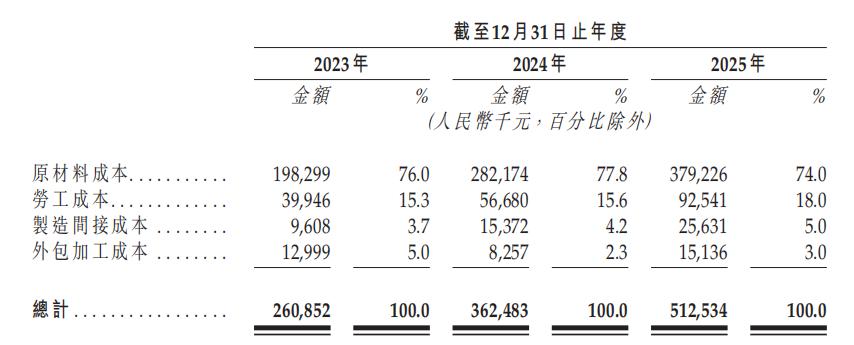
Under the dual squeeze of annual price decline and rigid proportion of raw materials, the profit margin of the manufacturing sector will only become thinner and thinner, which also explains why the company places high hopes on self-developed chips and large-scale production in its two bases in Huizhou and Pingshan to reduce costs.
The procurement side is relatively more proactive. The company's suppliers are mainly manufacturers of optical components, structural parts and electronic components. During the track record period, the procurement proportion of the top five suppliers was 29.7%, 32.3% and 25.7% respectively, and the proportion of the largest supplier was less than 10%. The concentration is significantly lower than that on the client side, and the risk of supply interruption is relatively controllable.
However, it should be noted that some core components still need to be purchased with advance payment. For example, the company's