Embodied intelligence component manufacturers are presented with multiple opportunities
Component manufacturers that have long stayed behind the scenes of embodied intelligence are now stepping onto the center stage.
For a long time, component manufacturers have existed in the embodied intelligence track in a nearly "invisible" state, with the spotlight of financing and public opinion mostly falling on complete machine factories and model companies. People care about who has built a humanoid robot that runs faster, and whose embodied large model can complete more complex tasks, but few people ask: who on earth provides the robot's joints, eyes, hands, and the communication and control capabilities that connect these systems?
In the Apple-style industrial system, supply chain enterprises often take on the heaviest work of manufacturing, R&D and delivery, but may not necessarily share the profits at the brand end. Similar problems also exist in the embodied intelligence industry. Complete machine factories put forward parameters, and component manufacturers are responsible for implementation; when the complete machine architecture changes, suppliers make new adaptations; when the product finally gains attention, brand value and valuation mostly remain at the complete machine end.
Today, these behind-the-scenes enterprises are beginning to emerge as a collective entity.
On September 2, the "China Embodied Intelligence Tier 1 Industry Alliance" was officially established, initiated jointly by Xingyuanzhi and Lingxin Qiaoshou, and composed of more than 20 core industrial chain enterprises including Orbbec, FA Robotics, Fly New Materials, Hesai Technology, Huawei Ke, Livox, Langyi Robotics, Linghou Robotics, Rokae, Meyervision, Nuwa Creation, Quan Zhibo, Senyun Intelligence, RoboSense, Tasha, Wuwian Zhike, iFLYTEK Robot Super Brain Platform, Xinjingcheng, Quectel, Zhixing Embodied, and Zongguanxian.
The members of this alliance cover links including embodied brain, dexterous hand, voice interaction, LiDAR, vision and tactile perception, robotic arm, chassis, wireless communication, and thermal management. Combining the products of these enterprises is enough to assemble a fairly complete robot.
However, when they gather together, they do not intend to build another robot brand. The three main lines proposed by the alliance are cross-hardware adaptation, cross-ontology deployment and scenario verification. It hopes to reduce the integration cost between different components through joint adaptation, collaborative tuning and test result sharing, and push the industrial chain from "competitive cooperation" to "symbiotic collaboration".
In other words, they are not satisfied with continuing to quote according to drawings, but participate in product definition at an earlier stage, turning individual parts into capability modules that can be reused across ontologies and verified by scenarios, so as to finally improve their participation and discourse power in the embodied intelligence wave.
What component manufacturers are waiting for may not only be the order growth brought by the volume production of robots. The productization, industrial division of labor and globalization of embodied intelligence are happening at the same time, and they are also striving for the standards, discourse power and profits of this industry.
Components Are No Longer "Fragmented"
In the early stage of the development of embodied intelligence, it is inevitable that complete machine factories adopt highly vertical integration.
At that time, the industry had no unified product architecture and no mature supply chain. Different robots vary greatly in size, load, degree of freedom, communication protocol and control frequency, and it is difficult to find ready-to-use products on the market. In order to build prototypes and run demonstrations as soon as possible, complete machine factories can only keep as many links as possible under their own control.
This development method promoted the rapid emergence of early products, but also kept the supply chain in a highly customized state for a long time. The same sensor needs to be recalibrated when installed on different robots; when the same dexterous hand is replaced with a different robotic arm, both software and hardware interfaces may need to be adjusted; after a joint module is adapted to a certain generation of ontology, if the parameters of the complete machine change slightly, all previous work will have to be restarted.
Component manufacturers seem to have many customers, but in fact they are faced with a group of isolated projects. A large amount of R&D resources are consumed in repeated adaptation, and engineering experience is difficult to precipitate into standard products, so the scale effect cannot be formed for a long time. They have undertaken a lot of hidden R&D work for complete machines, but their revenue is still calculated according to the number of parts and material prices.
This is also the reason why supply chain enterprises are prone to fall into low profits. The bargaining power of an enterprise does not necessarily depend on which link it is in, such as parts, complete machines or solution empowerment, but more on whether its products are easy to be replaced and whether it can participate in system definition. As we all know, in Apple's supply chain, enterprises that only provide processing and general parts have limited profits, but up to now, leading storage manufacturers have begun to have the right to "raise prices". This completely different position comes from their own irreplaceability.
The establishment of the embodied intelligence Tier 1 Industry Alliance may be a signal of this willingness to unite and promote industrial maturity.
The cross-hardware adaptation they emphasize means that components from different manufacturers can be combined at lower cost; cross-ontology deployment means that a certain capability is no longer bound to a specific complete machine factory; scenario verification allows component enterprises to prove what practical problems they have solved, rather than just what parameters they provide.
When adaptation methods, test results and scenario experience can be reused, what suppliers sell is no longer a sensor, a robotic arm or a dexterous hand, but a mature capability that can be directly integrated into the complete machine system. Complete machine factories do not need to study every link from scratch, and can invest more resources in products, models and scenarios.
This means that the industrial division of labor of embodied intelligence is gradually evolving from "complete machine factories put forward requirements and component manufacturers deliver" to the joint product definition by complete machines and Tier 1 suppliers.
Therefore, what component manufacturers really want to get rid of is not the behind-the-scenes position. Many global industrial giants also do not face ordinary consumers and rarely appear in the public view. Behind the identity of the "Tier 1 Alliance" is a larger commercial demand. What they want to get rid of is the role of only passively responding to parameters and relying on cost competition.
Another piece of news is also noteworthy: the asset transaction disclosed by RoboSense on September 10 just forms the other side of this "awakening". Its indirect wholly-owned subsidiary Shenzhen RoboSense plans to sell the rights and interests related to the R&D, manufacturing and sales business of embodied robot complete machines to Xiyuan Robot for 59.878 million yuan. As an important supplier of robot LiDAR, RoboSense did not continue to extend vertically from components to complete machines, but divested the complete machine business and refocused on more reusable perception capabilities.
This divestiture is more like a reconfirmation of the capability boundary. In the early stage of the industry, the boundaries between complete machines, components and solutions are blurred, and doing everything helps to seize the time window; when commercialization really starts, the heavy-asset complete machine business will not only disperse R&D and management resources, but also may make suppliers compete with downstream customers.
The alliance is a horizontal integration, while asset divestiture is a vertical contraction. Seemingly opposite, they both show that component manufacturers have begun to abandon the impulse of "taking all opportunities" and concentrate resources on advantageous links that can be reused across ontologies and form scale effects. Knowing how to focus, like daring to unite, is a sign that the industry is moving towards maturity.
Welcome the Spring Earlier
In the past, when people talked about opportunities for components, they often based on a simple premise: when the shipment volume of humanoid robots reaches millions, each robot requires dozens of joints, multiple sensors and a pair of dexterous hands, and the supply chain will naturally usher in an explosion.
But the opportunities for components do not necessarily have to wait for that moment.
Today's robots are still exploring among forms such as quadruped, biped, wheeled, humanoid and robotic arms, and the final configuration has not been determined. After years of debate, Sam Altman, CEO of OpenAI, still believes: "We will definitely make humanoid robots, and we will also develop robots of other forms." But fortunately, a large number of common demands have emerged at the bottom of different robots: all need to perceive the environment (visual sensing), control movement (joints), operate objects (dexterous hands), and handle communication, energy and heat dissipation issues.
A complete machine factory usually bets on a limited number of product forms, but a component enterprise that can realize cross-ontology reuse can enter dozens or even hundreds of complete machine factories at the same time. It can not only serve humanoid robots, but also enter collaborative robots, logistics AMRs, cleaning robots and other intelligent devices.
The more diverse the robot ontologies are, the easier it is for capabilities that can be reused across forms to achieve scale effects in advance.
Some changes have already appeared in financial and shipment data. Hesai Technology disclosed that the shipment volume of robot LiDAR in the second quarter of 2026 reached 142,371 units, a year-on-year increase of 193.4%. RoboSense delivered about 303,000 units in its robot business in 2025, and the company achieved single-quarter profitability for the first time. The growth momentum largely came from the robot business.
These figures do not mean that humanoid robots have been deployed on a large scale. A more accurate signal is that some underlying capabilities are crossing single robot categories and taking the lead in forming a large-scale market. Component manufacturers do not need to accurately predict which ontology will win in the future. As long as their products can be installed in enough robots, they can share the growth of the entire physical AI market.
This is also the value of the alliance's attempt to solve the cross-ontology deployment problem. When component enterprises face dozens of complete machine architectures separately, growth will bring more customized work; once the interface, testing and adaptation experience can be reused, growth can be transformed into scale effect.
There is a clear industrial chain behind it: the reduction of adaptation cost allows products to enter more ontologies; the increase in the number of customers leads to the expansion of shipment scale; the expansion of scale further promotes cost reduction and product maturity; when more and more complete machines take the initiative to be compatible with a certain set of interfaces, suppliers will gain stronger product definition rights.
Therefore, the spring for component manufacturers does not come quickly because of Musk's distant vision of "10 billion units, one for everyone" of robots. More importantly, the same capability can be sold to more robots. In other words, component manufacturers need to gradually form standards and have definition capabilities.
It is worth mentioning that mass production is indeed accelerating. With the acceleration of Musk's Optimus mass production, the good news of "1,000 units produced per week in September" and the "new order of about 5,000 units recently issued by Tesla to suppliers" from the supply chain, to a certain extent, whether it is the boost to the confidence of the entire technical route, or the real financial and stock market returns, have made the spring of T-chain component manufacturers come earlier than the grand technical narrative. Just two days ago, the production line of XPeng Robotics was officially put into use, which further strengthened this positive trend. For component manufacturers, all these constitute the rare certainty at the moment when the technology has not yet converged.
However, this spring will not come to every enterprise equally.
If the product is still highly customized, every new customer will bring a synchronous increase in R&D and service costs, and the larger the scale, the more tired the enterprise may be. Manufacturers that only rely on capacity expansion and low-price competition may even enter a fierce price war before humanoid robots are actually mass-produced, and the current downward trend of supply chain prices is already very obvious. At the same time, complete machine factories still have strong willingness to independently develop core links such as joints, controllers and dexterous hands, which is actually blurring the boundary.
The enterprises that can really obtain industrial dividends will be those that can realize cross-ontology reuse, upgrade from parts to modules, and master the know-how of interfaces, testing, certification and scenarios.
This is also the difference between a truly excellent Tier 1 supplier and an ordinary supplier. Ordinary suppliers complete production according to the specifications given by customers, while Tier 1 suppliers can tell complete machine factories how to combine to obtain better system performance. The former mainly shares manufacturing profits, while the latter begins to share technology and system value.
Another "Chinese Face"
Another opportunity for component manufacturers comes from the changing circulation mode of the global market.
New energy vehicles have provided a fairly mature overseas development route for Chinese manufacturing: Chinese enterprises complete R&D and production in China, and enter overseas markets with independent brands and complete products. However, complete vehicles integrate brands, software, hardware, data and supply chains, with very clear sources, so they are easy to become the target of special attention.
The overseas situation faced by embodied intelligence has similar characteristics. As Chinese embodied intelligence technology goes global, a different route from the automobile industry may be formed: it is not necessary to transport a complete humanoid robot to the whole world, and sensors, joints, dexterous hands and engineering capabilities can also be integrated into robots of different brands in different countries.
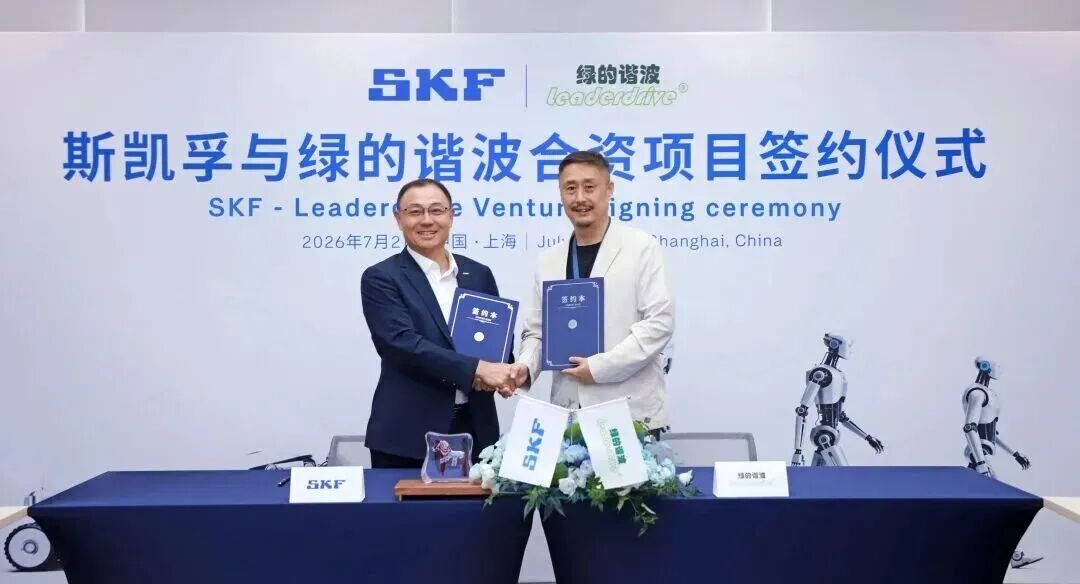
A series of actions by Green Harmony has shown this change. In July this year, Green Harmony signed an agreement with Swedish industrial giant SKF to establish a joint venture in China, focusing on high-precision transmission components required for robot joints: Green Harmony provides application know-how in the field of automation and humanoid robots, while SKF provides bearing technology, large-scale manufacturing and global supply chain capabilities. The joint venture plans to expand to Europe, Japan and the United States with the help of the latter's sales network.
However, "component-oriented development" is not a simple shortcut for overseas expansion. What component manufacturers need to do is to complete the transformation from "Chinese supplier" to "global Tier 1" through various methods.
The overseas expansion of new energy vehicles is to compete for consumer brands, while the overseas expansion of embodied intelligence components is to compete for industrial interfaces, technical standards and positions in the global supply chain. The latter penetrates deeper and is more difficult to be replaced.
This may be another way for the spring of component manufacturers to arrive.
But spring will not belong to all enterprises that produce parts. Simply relying on cost, production capacity and customized processing will still not escape price pressure and replacement. The companies that truly have the opportunity to gain industrial positions are those that have completed three upgrades: from parts to modules, from modules to system capabilities, and from local suppliers to global Tier 1 suppliers.
In the future, when Chinese embodied intelligence goes global, it is not all robots with Chinese characters printed on their chests. It may also be a sensor, a set of joint modules or a dexterous hand, integrated into robots of different brands in different countries.
At that time, Chinese enterprises may not manufacture the complete body of every robot, but they can determine how these robots see, move, and complete their work.
This article is from the WeChat official account "Embodied Research Society", author: Peng Kunfang, published with authorization from 36Kr.