Prices have surged tenfold in half a year, and the oil shipping market is skyrocketing wildly.
On September 17, the TCE of the crude oil shipping index TD3C route (Middle East Gulf to China, 270,000 DWT VLCC) of the Baltic Exchange was reported at USD 1.2125 million per day, up 40.64% week on week.
A month ago, this figure was still around USD 700,000.
If we go further back to before the official outbreak of the US-Iran conflict on February 13, the corresponding TCE of TD3C was about USD 117,400 per day.
In more than half a year, it has increased by almost 10 times.
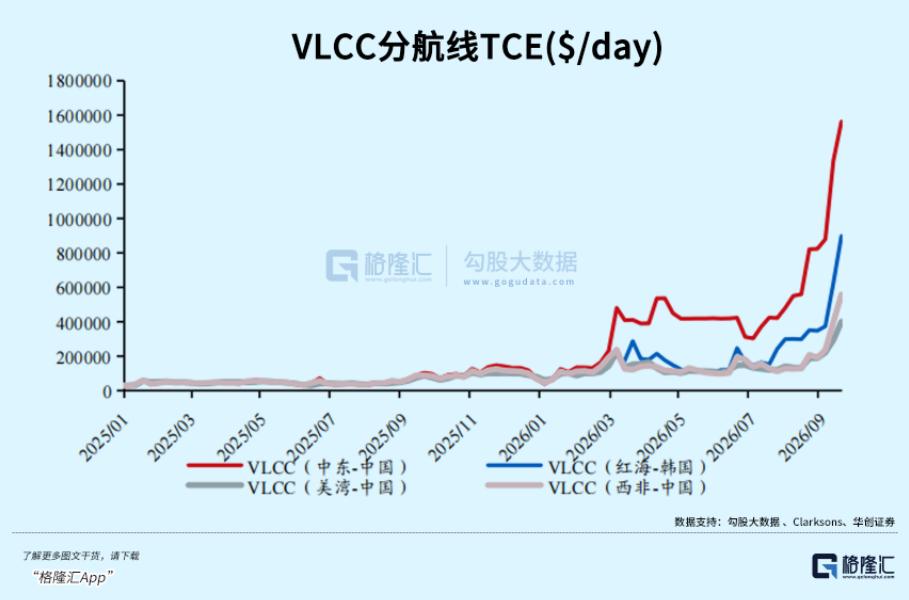
At the same time, the TCE of the TD15 West Africa to Far East route was reported at USD 524,500 per day, up 48.3%; the TCE of the TD22 US Gulf to Far East route was reported at USD 388,400 per day, up 51.1%.
On September 16, China's comprehensive crude oil import freight index CTFI reached 14,575 points, up about 83% from the beginning of September.
All major global crude oil shipping routes are strengthening simultaneously with a momentum that is so strong that it seems exaggerated.
So, who will benefit under such a prosperous cycle of the oil shipping industry?
Global VLCC Transport Capacity Is in Urgent Shortage
The root cause of the surge in the freight index lies in that after the Strait of Hormuz was blocked, the Middle East crude oil export mode has undergone tremendous structural changes, leading to the systematic and sharp consumption of the effective transport capacity of Very Large Crude Carriers (VLCC).
Part of the crude oil no longer follows the traditional direct sailing path of large oil tankers, but is transported through short-distance shuttle, ship-to-ship transshipment and other methods.
At the same time, a large number of exports from Yanbu Port on the west coast of Saudi Arabia are diverted to Ain Sokhna Port at the southern end of the Suez Canal, and then transported through the Sumed Pipeline to Sidi Kerir Port in the Mediterranean for shipment.
This route seems to take a big detour, but in fact, the Sumed Pipeline's daily transport capacity of 2.4 million to 2.8 million barrels is far lower than the potential 15 million barrels of Yanbu Port, so a large amount of crude oil still relies on oil tankers to detour around the Cape of Good Hope for transportation.
But the cost of detour will inevitably lead to a significant extension of voyage time. A conventional direct voyage from Yanbu to the Far East takes about 55 days, which is extended to 80 to 110 days after detouring around the Cape of Good Hope.
This means that for the same ship, the number of voyages it can complete in a year is directly reduced by more than one third.
Other analysis estimates that the blocked passage of the Strait of Hormuz has trapped nearly 10% of the VLCC fleet, and another 10% of the transport capacity is on standby and stranded. These ships have not disappeared from the fleet list, but they have disappeared from the schedulable effective transport capacity.
On the other hand, although global shipyards are building new ships overnight, the current production capacity can only mainly replace the old ships that are about to exit, and there are not many new increments that can be delivered immediately.
Relevant data shows that there are currently 262 global VLCCs under construction, equivalent to about 30% of the existing fleet. In the first half of 2026, new VLCC orders reached 139 vessels with 42.59 million DWT, and the proportion of hand-held orders in the active fleet soared from 5% at the beginning of 2024 to 35%.
Seeing these figures, the first reaction is that overcapacity is coming soon.
But when you break it down, it's a completely different story.
At present, the global VLCC fleet is just over 900 vessels. The economic service life of VLCC is 20 to 22 years, and at least 40 new vessels are delivered every year for normal replacement of old and new ones.
However, from 2024 to 2025, only 8 VLCCs were delivered in total globally. 39 VLCCs are expected to be delivered in 2026, 64 in 2027, and 102 in 2028. That is, the total of about 205 vessels from 2026 to 2028 just meets the basic replacement demand of the fleet.
More critically, old vessels are being forced out by regulations, not by freight rates.
At present, vessels over 15 years old account for as high as 41% of the global VLCC fleet. The IMO's CII carbon emission rating and the EU ETS carbon charge constitute hard compliance constraints, and it is very difficult for old vessels over 20 years old to meet the standards.
At present, about 150 to 160 old and obsolete VLCCs have gradually withdrawn from the market due to sanctions and safety risks.
According to the calculation of CITIC Securities, the proportion of VLCC capacity over 20 years old will increase by 4 percentage points to 23% by 2027. These vessels will not wait for freight rates to fall before being dismantled, and the compliance red line will force them to exit.
Ton-mile Demand Rises Structurally
While the transport capacity is shrinking, the changes on the demand side are also worthy of attention.
For example, the crude oil procurement structure of Japan and South Korea has been adjusted. Before the conflict, more than 90% of the crude oil procured by Japan and South Korea came from the Middle East. After the conflict, Japanese and South Korean refineries began to increase their procurement of crude oil from the US Gulf.
In early April, refineries in Japan, South Korea, Singapore and Thailand purchased at least 60 million barrels of crude oil from the US Gulf Coast for shipment next month.
However, the shipping distance from the US Gulf to Asia is 2.6 times that from the Middle East to Asia, and the ton-mile consumption per voyage will rise significantly, which is one of the core drivers of the current freight rate surge.
In China, after the export quota of refined oil products was restored, refineries can realize the high cracking profit of the international market by exporting refined oil products.
In September, the export of refined oil products reached 4.2 million tons. Back calculated according to the comprehensive conversion rate of 40% to 50% of refined oil products, at least an additional 8 million tons of crude oil need to be consumed, which is equivalent to the cargo volume of nearly 30 VLCCs.
This part of incremental demand is also directly superimposed on the transportation demand on the crude oil side.
China's own crude oil inventory is in the stage of destocking. At present, China's crude oil inventory is estimated to exceed 1.2 billion barrels. The overall net increase in the first half of the year was still about 530,000 barrels per day, but it has turned to release about 940,000 barrels per day in June.
Once China shifts from destocking to restocking, the magnitude of the released cargo orders will significantly change the balance between supply and demand.
FGENexantECA expects China to restart strategic restocking later this year, at a rate of up to 800,000 barrels per day.
If this expectation is fulfilled, superimposed on the crude oil processing demand brought by the continuous recovery of refined oil export quotas, the pull of Chinese cargo orders on VLCC freight rates will be structural.
Who Is Reaping the Dividend of This Prosperity Cycle?
The dividend distribution of this round of oil shipping prosperity is extremely uneven, which mainly depends on two dimensions: whether it has core VLCC transport capacity and the proportion of spot transport capacity.
The core advantage of China Merchants Energy Shipping is the high proportion of spot and short-term charter capacity, with the largest performance elasticity among domestic targets.
The company holds about 52 VLCC supertankers, which is a top-tier VLCC fleet in China, with business covering crude oil, dry bulk and LNG. At the stage when spot freight rates are soaring, fleets with a high proportion of short-term charter and spot capacity can fully capture the dividend of price increases at the first time.
In the first half of 2026, China Merchants Energy Shipping realized a net profit attributable to shareholders of RMB 6.96 billion, a year-on-year increase of 227.57%, of which the net profit of the tanker transportation sector was RMB 6.189 billion, a year-on-year surge of 378.62%, and the oil shipping business alone contributed 89% of the company's total net profit attributable to shareholders.
According to the calculation of Sinolink Securities, for every USD 10,000 increase in TCE per day, the after-tax profit of China Merchants Energy Shipping will increase by RMB 1.211 billion.
In the first half of the year, the average freight rates of the company's VLCC on the US Gulf and West Africa routes were USD 106,000 and USD 113,000 per day respectively, while the current TCE of TD15 and TD22 have reached USD 520,000 and USD 380,000 respectively. The performance elasticity of Q3 and Q4 is far greater than that of the first half of the year.
COSCO Shipping Energy Transportation is the company with the largest oil tanker fleet capacity in the world. It owns a fleet of 53 VLCCs, and at the same time deploys refined oil, LPG and LNG capacity, with no dry bulk business, making its track more pure.
The company adopts a combined model of long-term agreement and spot, with medium and long-term time charter contracts locking in stable profits, and stronger ability to resist cyclical fluctuations. But also because of the high proportion of long-term agreements, its performance elasticity in the stage of market boom outbreak is slightly lower than that of China Merchants Energy Shipping. Fortunately, the company's LNG and refined oil businesses have built a solid performance safety cushion, and the medium and long-term boom cycle will last longer.
In the first half of 2026, the net profit attributable to shareholders of COSCO Shipping Energy was about RMB 4.5 billion, a year-on-year increase of 141%, of which the gross profit of foreign trade oil transportation reached RMB 2.24 billion, a year-on-year surge of 317.6%.
The company's management clearly stated at the performance briefing that most of the sharply rising freight rates in September will be reflected in the fourth quarter performance. The company currently holds 6 VLCC orders, and another 6 bareboat chartered VLCCs will be delivered from 2027 to 2028.
The transmission in the refined oil transportation link is slightly slower, but the direction is clear.
China Merchants Nanyou is the only refined oil transportation target on A-share market. The company does not have any VLCC capacity, and its core assets are MR small and medium-sized refined oil tankers, whose main business covers the Far East-Middle East refined oil transportation routes.
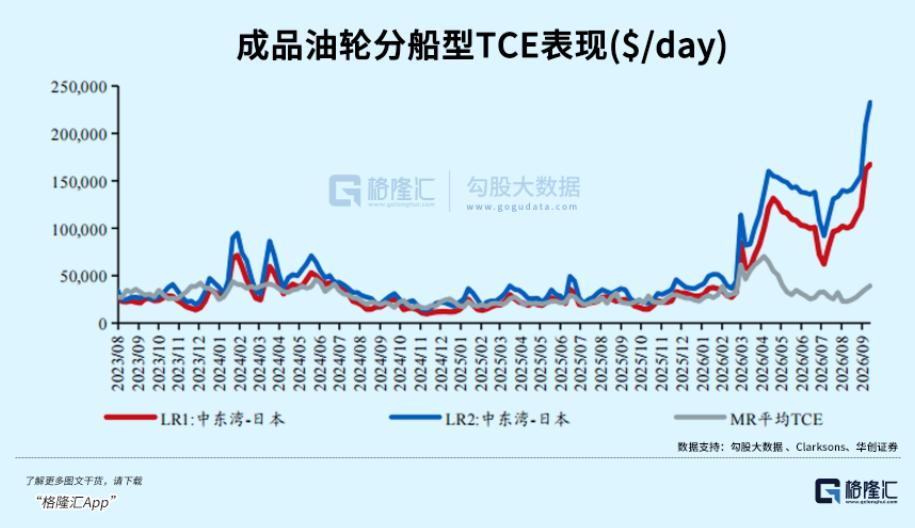
Refined oil marine transportation has an independent cargo order and pricing system. The surge in crude oil freight rates will not directly drive the price increase of refined oil tankers, and there is an obvious time lag in the market transmission. It can follow the recovery of energy marine transportation prosperity, but its performance elasticity is far less than the two major VLCC leaders, belonging to the second-tier benefited targets.
In the first half of 2026, the net profit attributable to shareholders of China Merchants Nanyou was RMB 812 million, a year-on-year increase of 42.41%. The daily revenue of MR refined oil tankers on the Atlantic route reached USD 50,300, doubling year on year, and the Asia-Pacific route exceeded USD 32,600, up 52.74%.
In the same period, the company disposed of 4 old MR refined oil vessels to optimize its capacity structure. When crude oil freight rates are high, shipowners will prioritize allocating capacity to the routes with the highest returns, and the supply of refined oil tankers will shrink accordingly.
Superimposed on the refinery eastward shift effect brought by the recovery of China's refined oil exports, the logic of supplementary rise in refined oil transportation is being realized.
As for the private dry bulk shipowners, they are basically irrelevant to this round of oil shipping boom.
For example, private shipping companies such as Sino-Ocean Marine Transportation and Haitong Development, whose core capacity is dry bulk carriers, are mainly engaged in the transportation of bulk cargoes such as Middle East sulfur, fertilizer and grain, which are two completely independent supply and demand cycles from crude oil VLCC marine transportation. The rising prosperity of Middle East crude oil shipping does not mean that the dry bulk market is strengthening. Such enterprises can only benefit slightly from the increment of Middle East dry bulk cargo orders, but are basically disconnected from this round of VLCC price increase market.
The transmission in the shipbuilding link is even later, but the order data has already reflected the market's hunger for capacity.
As of the end of June, China State Shipbuilding Corporation had a total of 729 civilian and offshore vessel orders in hand, with 93.89 million DWT and RMB 526.266 billion, of which oil tankers accounted for about 30%. The value of new orders received in the first half of the year was RMB 119.4 billion, a year-on-year increase of 93%.
However, the ship construction cycle is as long as 2-3 years, and the current surge in freight rates cannot be converted into the current performance of shipyards. It is a pure expectation speculation, and there is a long time lag for performance realization.
There are also some marine transportation targets that are just riding the trend and completely irrelevant.
COSCO SHIPPING Holdings focuses on container liner business, and COSCO SHIPPING Specialized Carriers focuses on special large cargo transportation. Their business tracks have nothing to do with crude oil oil transportation. This round of oil shipping market cannot produce any substantial benefits to their operations, and there is only sector sentiment linkage without fundamental support.
Conclusion
Objectively speaking, this round of oil shipping prosperity is the result of the resonance of three core logics: the ton-mile increment brought by the reconstruction of trade flows, the rigid contraction of effective capacity, and the compliance clearance of the industry, not a short-term geopolitical hype.
However, it should be noted that shipping is an extremely strong cyclical industry, and there is no permanent bull market. There are also several practical constraints in the current industry.
For example, the geopolitical situation is the biggest variable. If the Red Sea waterway is fully restored quickly, the long-distance trade flow detouring around the Cape of Good Hope will return to the short route, the effective market capacity will be released quickly, and the freight rate center will face downward pressure. In addition, the delivery volume of new VLCCs will rise sharply in 2028, and the long-term supply pressure will gradually dilute the current tight supply-demand balance.
In addition, the adjustment of the premium of oil-producing countries and the upper limit of refinery costs will also restrict the upward space of freight rates in reverse.
For investors, how to judge which position the industry is currently in in the cycle, and make matching strategic arrangements at different cycle nodes, is a thinking question that extremely tests investment capabilities. (The full text ends)
Gelonghui Statement: All views